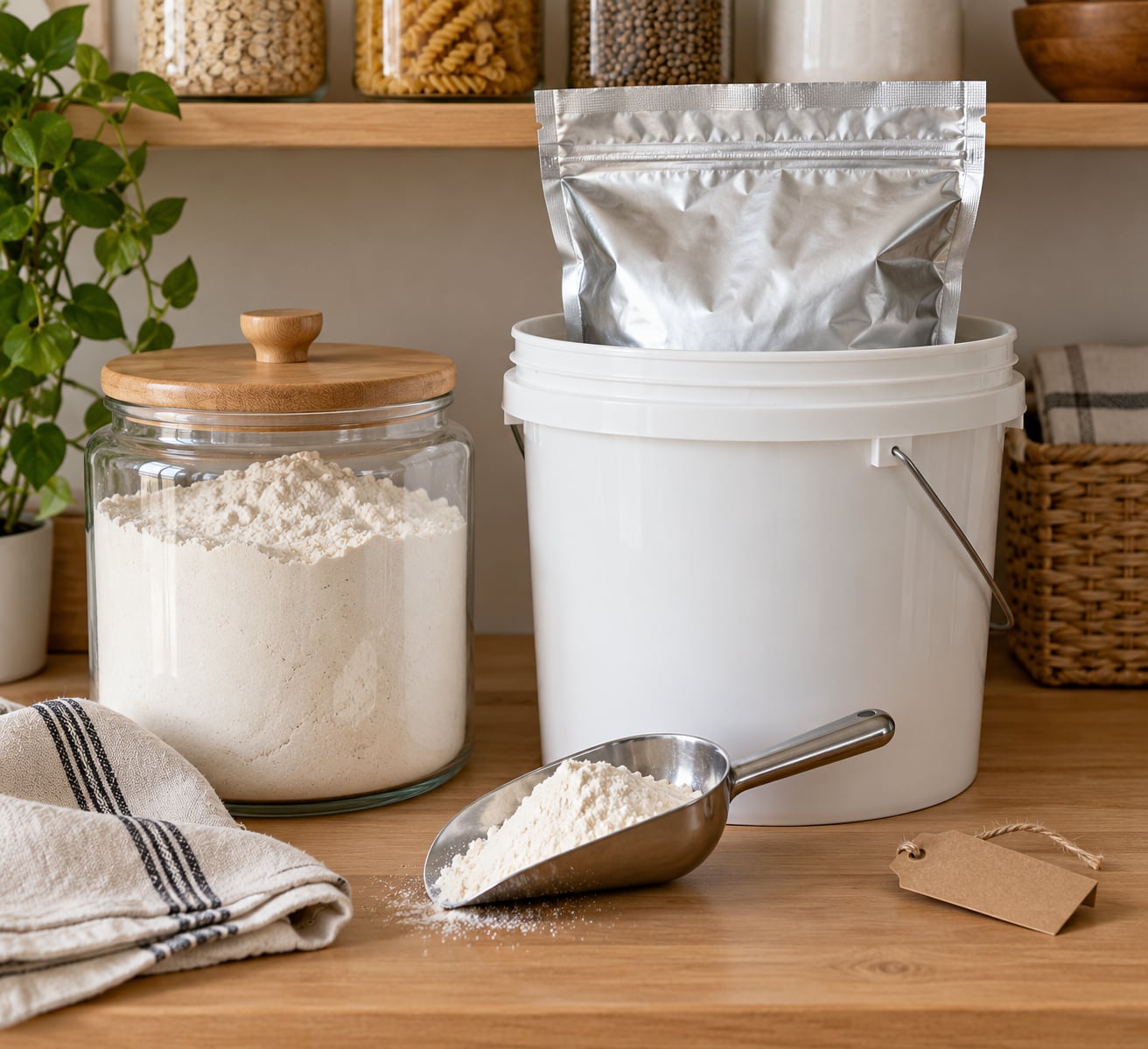
Store white flour for 5 to 10 years by sealing it in 7-mil Mylar bags with an oxygen absorber, then nesting those bags inside a rigid food-grade container kept in a cool, dry room below 75°F. Whole-grain and nut flours are a different story. They belong in the freezer, because their oils turn rancid long before the starch spoils.
Flour goes bad through three doors, and a good storage plan closes all three. Oxygen oxidizes the grain oils and creates rancid, off flavors. Moisture brings mold and hard clumps that never sift out. Insects ride in from the mill or the warehouse pallet. Cut off air, water and bugs, and a bag of refined flour will sit in a closet for a decade without complaint.
What changes between methods is the horizon. A few months for whole wheat on a pantry shelf, a year or two in the freezer, a decade in a properly sealed Mylar package. Here is how to hit each tier without overcomplicating it.
Table of Contents
- What You Need
- How to store flour long term in glass or plastic
- How long flour lasts by type
- Step-by-Step
- Breaking down a bulk 25-pound or 50-pound bag
- How to tell if flour has gone bad
- Store whole wheat berries instead
- Common Mistakes
- Frequently Asked Questions
- Do you need oxygen absorbers for flour?
- How long does flour last in a Mylar bag with an oxygen absorber?
- How do I store a 25 pound bag of flour?
- Is it better to store flour in plastic or glass?
- Can you still use flour that is 2 years out of date?
- Will freezing flour make it last longer?
- Conclusion
What You Need
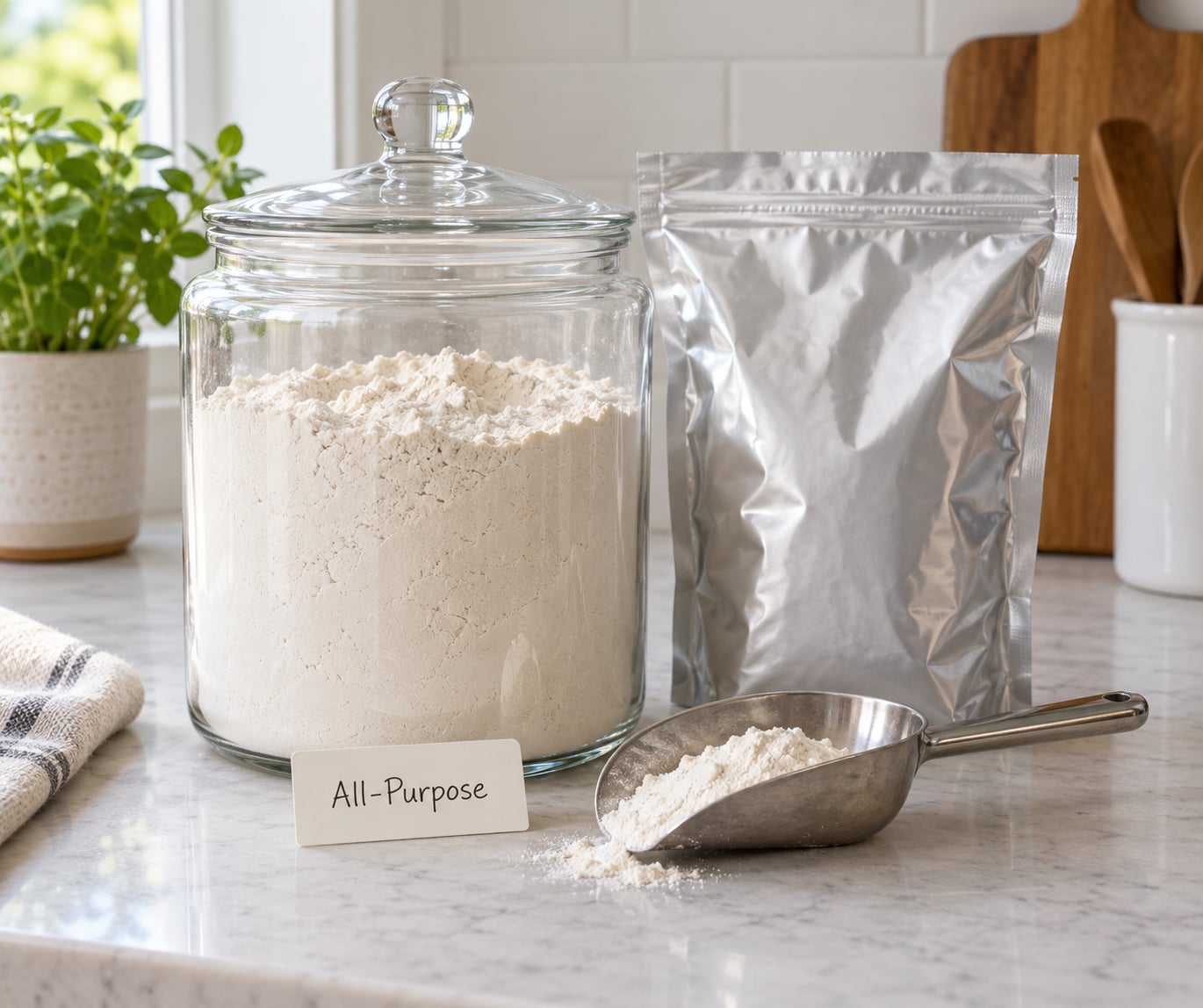
The supply list is short. A glass jar and a marker solve a year of ordinary baking. Mylar bags, absorbers and a bucket solve ten. Start with the tier you actually need rather than the biggest one you can buy.
- Airtight food-grade containers. Mason jars with two-piece lids for what you use every week, food-grade plastic buckets with a gasket or Gamma Seal lid for bulk, and heavy-duty freezer bags double-bagged for small portions.
- 7-mil Mylar bags, food grade. Cheap foil pouch gift bags are not Mylar. Look for the mil thickness on the packaging and for a food-storage label.
- Oxygen absorbers sized to the bag. About 300cc for a 1-gallon bag and 2000cc for a 5-gallon bag is the common pairing.
- A way to heat-seal. A clothes iron set to low, or a vacuum sealer with a heat-seal or moisture-only setting.
- A rigid secondary container. A food-grade bucket with a tight lid, or a clean crate inside a plastic liner.
- Labels and a marker. Flour type, the date you packed it, and where the container lives.
- Optional: a thermometer and freezer space. A cheap indoor thermometer tells you whether that closet or basement is actually staying under 75°F.
Volume math saves guessing. Flour packs at roughly 5 pounds per gallon-sized bag, so a 50-pound bag fills about ten of them. Working out the count before you buy Mylar keeps you from coming up short halfway through.
How to store flour long term in glass or plastic
Neither material wins outright, so pick by how much flour you move and how often. Glass jars are airtight, let you see the flour without lifting the lid, and never absorb smells from coffee or onions. The tradeoffs are weight and breakage, plus the fact that clear glass lets light through, which is only a real problem in a sunny pantry.
Plastic wins on bulk. Food-grade buckets move without breaking, nest cheaply, and take a vacuum sealer lid without fuss. The recurring disappointment people report online is thin or warped plastic bought from a marketplace, where the gasket never quite seals. Test any container before you trust it: fill it, close it, and press down. If air moves at the lid edge, it will not keep flour for years.
A practical split: glass for the flour you bake with weekly, plastic buckets with a proper gasket for anything you are putting away for a year or more, and Mylar inside whichever container you choose.
How long flour lasts by type
| Flour type | Airtight pantry | Freezer | Mylar with absorber | Freeze before packing |
|---|---|---|---|---|
| Refined white (all-purpose, bread, cake) | 1 to 2 years | 1 to 2 years | 5 to 10+ years | Optional, kills insects |
| Whole wheat and other whole-grain | 4 to 6 months | 1 to 2 years | 5 to 10+ years | Yes |
| Rye | 4 to 6 months | 1 to 2 years | 5 to 10+ years | Yes |
| Spelt | 4 to 6 months | 1 to 2 years | 5 to 10+ years | Recommended |
| Nut flours (almond, coconut) | 4 to 6 months | 6 to 12 months | 1 to 2 years | Yes |
| Gluten-free blends | 6 to 12 months | 1 to 2 years | 5 to 10 years | Recommended |
Step-by-Step
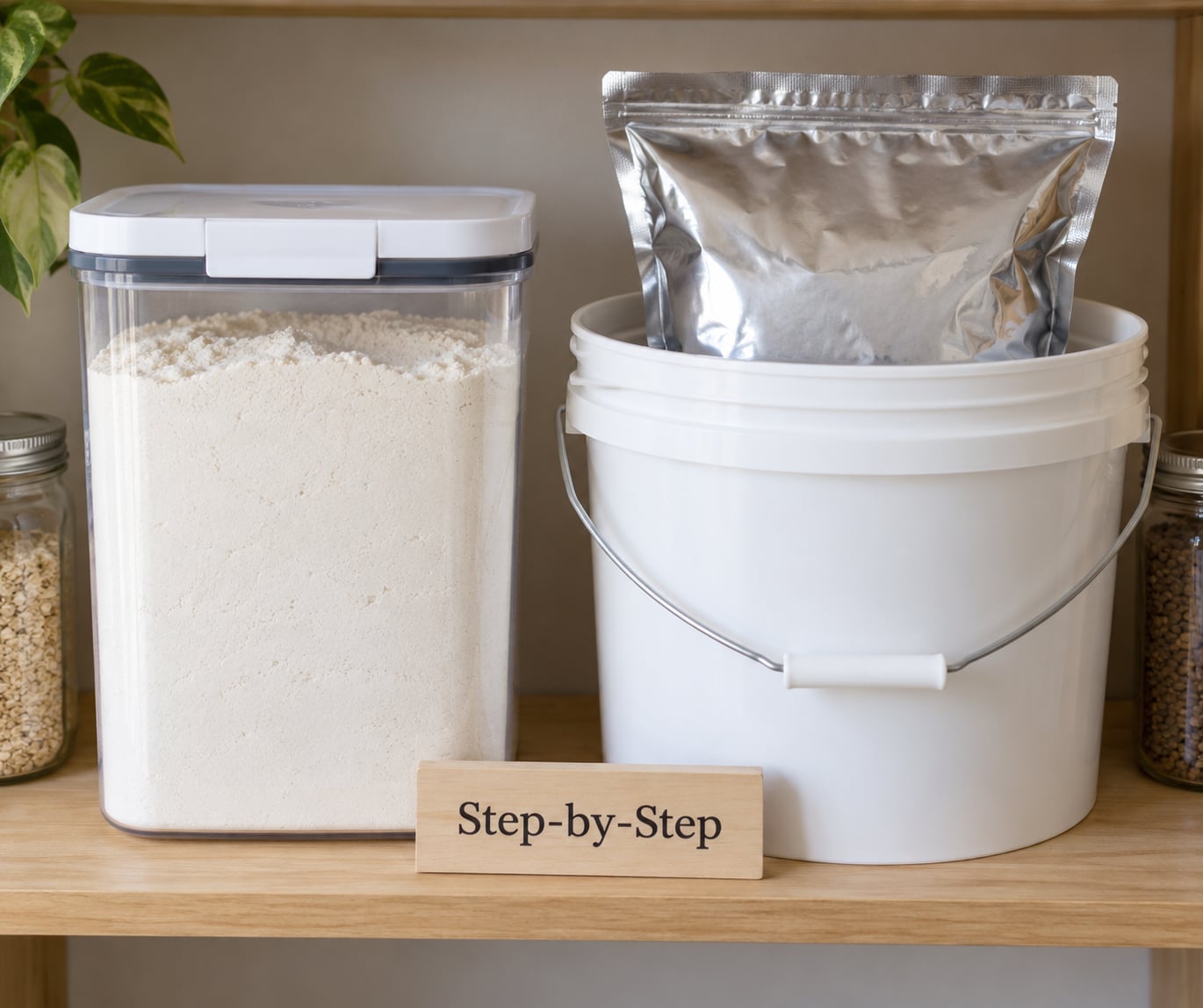
- Freeze it for 3 to 4 days first. Spread the flour in its original bag or divided into smaller bags and lay it flat in the freezer. The cold kills any weevils or insect eggs that arrived with the shipment, which matters more than most people expect. Pull it out afterward and let it return fully to room temperature before you pack it.
- Portion by what you actually bake. A household that makes a couple of loaves a week does better with 5-pound packages than with a 50-pound monolith, because you open only what you need. Fill bags over a table on the counter, not on the floor next to the open sack.
- Fill the Mylar bag. Leave 2 to 3 inches of headroom above the flour line so the absorbent and the seal have room.
- Add the oxygen absorber. One 300cc absorber for a 1-gallon bag, one 2000cc for a 5-gallon bag. Keep the packet where a child cannot reach it, and check the manufacturer’s list before using absorbers with very fine powders such as flour, since a punctured packet is not something you want in the air of your pantry.
- Heat-seal across the full width. Lay the bag flat and run a hot iron along the top seam, or use your sealer. Check the seal by looking for a continuous line across the bag, not a series of spots. A channel anywhere along that seam lets oxygen creep in and defeats the whole exercise.
- Nest the sealed bag in a secondary container. The Mylar keeps the air out, and the bucket protects it from punctures, pests and moisture if a shelf floods or a rodent chews through cardboard.
- Store it cool, dark and dry. Keep it below 75°F, off the floor, away from any window, and out of a garage that heats up in summer. Even with a perfect seal, temperature swings shorten the useful life.
One rule matters more than all the others: never open a container straight out of the freezer. Warm humid air hitting cold flour produces condensation on the flour itself, and dampened flour clumps and molds at the surface. Leave the container sealed at room temperature for at least four hours, and overnight for a full bucket.
Breaking down a bulk 25-pound or 50-pound bag
Bulk bags are where most people give up, usually because freezing the whole sack eats freezer space indefinitely. Portioning fixes that problem and the pest problem at the same time.
- Freeze the whole bag for 3 to 4 days before you open it, so any insects are dealt with once rather than spread through your pantry.
- Set it on a clean table and fill 5-pound bags from the top down, so the heaviest flour leaves the sack first and you are not lifting the bottom of a half-empty bag.
- Pack, seal and label each bag as if it were the last thing you will do all weekend. It will take longer than you expect.
- Fill the secondary buckets, seal them, and stack them off the floor rather than against an exterior wall.
How to tell if flour has gone bad
Check smell first, because it catches oxidation before anything else. Fresh flour smells faintly sweet and nutty. Whole-grain flour that smells like pencil shavings, old crayons or stale nuts has gone rancid, and no amount of freezing will fix it.
Look next. Clumps that will not break apart easily, gray specks, or a dull uneven color all point to moisture damage. Strands of silk webbing inside the bag mean insects are active in there, and flour with bugs or webbing should be discarded rather than sifted and saved.
Taste the last step, and only a small pinch. Bitter or completely flat flavor signals degraded flour. It is still fine in crackers, tortillas or flatbread, but I would not trust it for a loaf that rises on structure alone.
Store whole wheat berries instead
Home bakers who want the best of both worlds often buy whole hard red wheat berries, thousands of intact kernels to the pound, and grind only what they need for a bake. The germ and bran are still sealed inside the kernel, protected from oxidation, so the same Mylar method can carry whole berries for 20 years or more. The cost is a home grain mill and a couple of minutes per bake.
Common Mistakes
Almost every bad flour store makes the same handful of mistakes, and each one has a simple fix.
- Leaving flour in the original paper bag. Paper breathes, which means it welcomes insects and lets moisture in. Move it into a proper airtight container the day you buy it.
- Giving white flour and whole wheat the same shelf. Refined flour can sit for a couple of years. Whole wheat has a 4 to 6 month window before the germ oils turn. Freeze what you cannot use inside six months.
- Storing near heat or direct sun. Above the stove, in a sunny window or in a garage through summer, flour ages faster than any clock suggests. Pick the coolest dark spot you have, and check it with a thermometer rather than guessing.
- Using a damp basement in a humid climate. If the space reads above 75°F or feels damp to the hand, choose a conditioned closet inside the house or go back to the freezer.
- Not labeling or dating anything. Write the flour type and packing date on the container, then rotate: oldest in front, newest at the back, and the first bag you reach is the one you open.
- Opening frozen flour early. Condensation forms the moment cold flour meets warm air. Four hours sealed on the counter, or overnight, fixes it every time.
- Trusting a thin container with a weak gasket. Press the lid closed before it is filled with your decade of flour. Cheap plastic warps with heat and stops sealing.
Give the whole store a glance every couple of months. You are checking for webbing, small holes, a warped lid or a faint smell that was not there before. Ten minutes twice a year is cheap insurance on food you cannot replace quickly if the shelf is hit.
Frequently Asked Questions
Do you need oxygen absorbers for flour?
For the 5 to 10 year tier, yes. Absorbers pull the oxygen out of a sealed Mylar bag, and without them the remaining air slowly oxidizes the flour and the package loses its protective advantage. Skip them if you are storing flour in glass or plastic for a year or two, and match the size to the bag: about 300cc for one gallon, 2000cc for five gallons.
How long does flour last in a Mylar bag with an oxygen absorber?
Ten years is the honest floor for refined white flour, and 5 to 10 years is the range most long-term food stores plan around. Whole-grain and nut flours keep shorter even when sealed because their oils oxidize faster, which is why freezing them is the safer plan. Ten-plus year claims assume cool, dark, dry storage below 75 degrees and periodic inspection.
How do I store a 25 pound bag of flour?
Freeze the sealed bag for 3 to 4 days on arrival, then portion it into 5-pound bags, roughly one gallon each. Pack each portion into food-grade Mylar with a 300cc oxygen absorber, heat-seal across the full width, and place the sealed bags inside a lidded food-grade bucket. Keep the bucket off the floor in a dark space below 75 degrees.
Is it better to store flour in plastic or glass?
Use glass for flour you bake with often, because it seals well and shows you the contents without lifting the lid. Use food-grade plastic with a real gasket for bulk storage, since buckets are lighter and nest cheaply. Whichever you choose for multi-year storage, the flour goes inside a heat-sealed Mylar bag first. Plastic with a warped or thin lid will not hold.
Can you still use flour that is 2 years out of date?
Often yes. Smell it first: if it smells faintly sweet and nutty, it is usable. Bitter, flat or crayon-like odors mean the oils have gone rancid, and no baking will hide that. Flour with insects or silk webbing should be discarded rather than sifted. Very old flour also loses baking power, so expect flatter loaves.
Will freezing flour make it last longer?
Yes, and freezing is the best option for whole wheat, rye and nut flours that you will not use within a few months. The freezer holds flour for one to two years with quality intact. Never open the container while it is still cold, since condensation on the flour causes clumps and surface mold. Let it sit sealed at room temperature for four hours or overnight.
Conclusion
Do one thing this week: move every open bag of flour out of its paper sack into a clearly labeled airtight container, with the type and the packing date written on the front. Freeze the whole-grain and nut flour you will not use within six months, and freeze any new bag for 3 to 4 days before it goes into your long-term supply.
If you want the full decade, portion it into Mylar with an absorber, seal it, bucket it, and keep the whole thing below 75°F in the dark. Then smell a pinch before every bake. Ten seconds of checking beats discovering the problem halfway through a loaf.