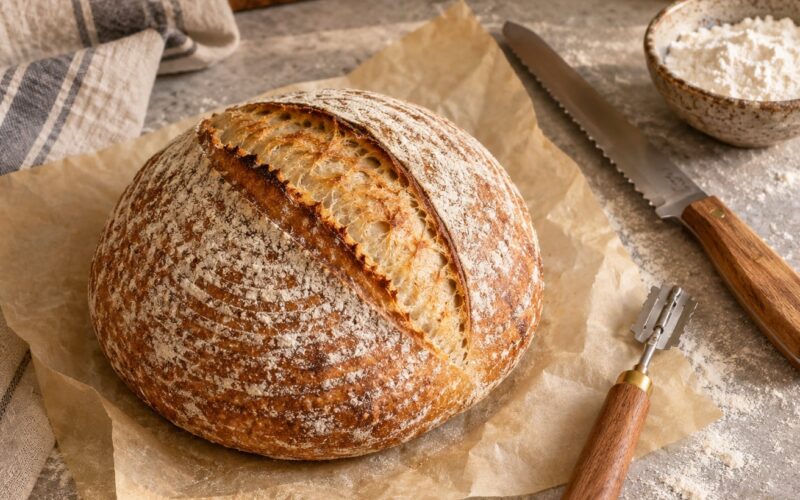
How to get a crispy crust on homemade bread comes down to three things working together: a very hot oven, steam for the first 15 to 20 minutes, and a dough low in sugar and fat. Bake at 450 to 500°F, keep the surface damp while the loaf expands, then finish in dry heat until the crust is deep golden and crackling. The whole bake takes 35 to 45 minutes, and almost all of it is hands-off.
I have baked a lot of bread that looked like a bakery loaf and ate like a cushion, mostly because I rushed the preheat and skipped steam. Once I started treating the first twenty minutes as a wet phase and the rest as a drying phase, the same dough came out with a shell you can hear when you tap it.
This guide works for no-knead loaves, sourdough, baguettes, ciabatta and rolls, and it tells you which parts to skip if your bread is enriched. It also covers what to do when your crust is soft, gummy underneath or rock-hard, because those three failures come from opposite mistakes.
Table of Contents
- What You Need
- Step-by-Step: How to Get a Crispy Crust on Homemade Bread
- Choose a Dough That Can Make a Crisp Crust
- Preheat the Oven and Baking Surface Thoroughly
- Shape the Loaf for Maximum Surface Contact
- Create Steam During the First Part of Baking
- Bake Until the Loaf Is Deeply Golden
- Dry and Cool the Crust Properly
- Common Mistakes That Make Bread Crust Soft or Burnt
- Frequently Asked Questions
- Why is my homemade bread crust soft?
- How can I make bread crust crisp without making it burn?
- Should I use steam when baking homemade bread?
- Do I need a baking stone or steel for a crispy crust?
- How long should bread cool before cutting it?
- What type of flour gives the crispest crust?
- Start With the First Bake
What You Need
You do not need a bread oven or a pile of gear. You need an oven that reaches 450°F honestly, something for the loaf to sit on that holds heat, and dough with a lean enough formula to brown before it burns.
This is the part most guides gloss over, and it is also where the crust is really decided. Steam keeps the dough surface cool and pliable past the crust setting point of about 140°F (60°C), so the loaf expands fully in the first ten to fifteen minutes. Once the steam is gone, that thin gelatinized layer dries out, browns through the Maillard reaction, and hardens into a thin crisp shell.
| Tool | What it actually does | Budget substitute |
|---|---|---|
| Oven thermometer | Tells you whether the oven is really at temperature | None. This is the one thing worth buying first. |
| Baking steel | Stores the most heat and gives the sharpest bottom crust | Baking stone, or a heavy upside-down rimmed baking sheet |
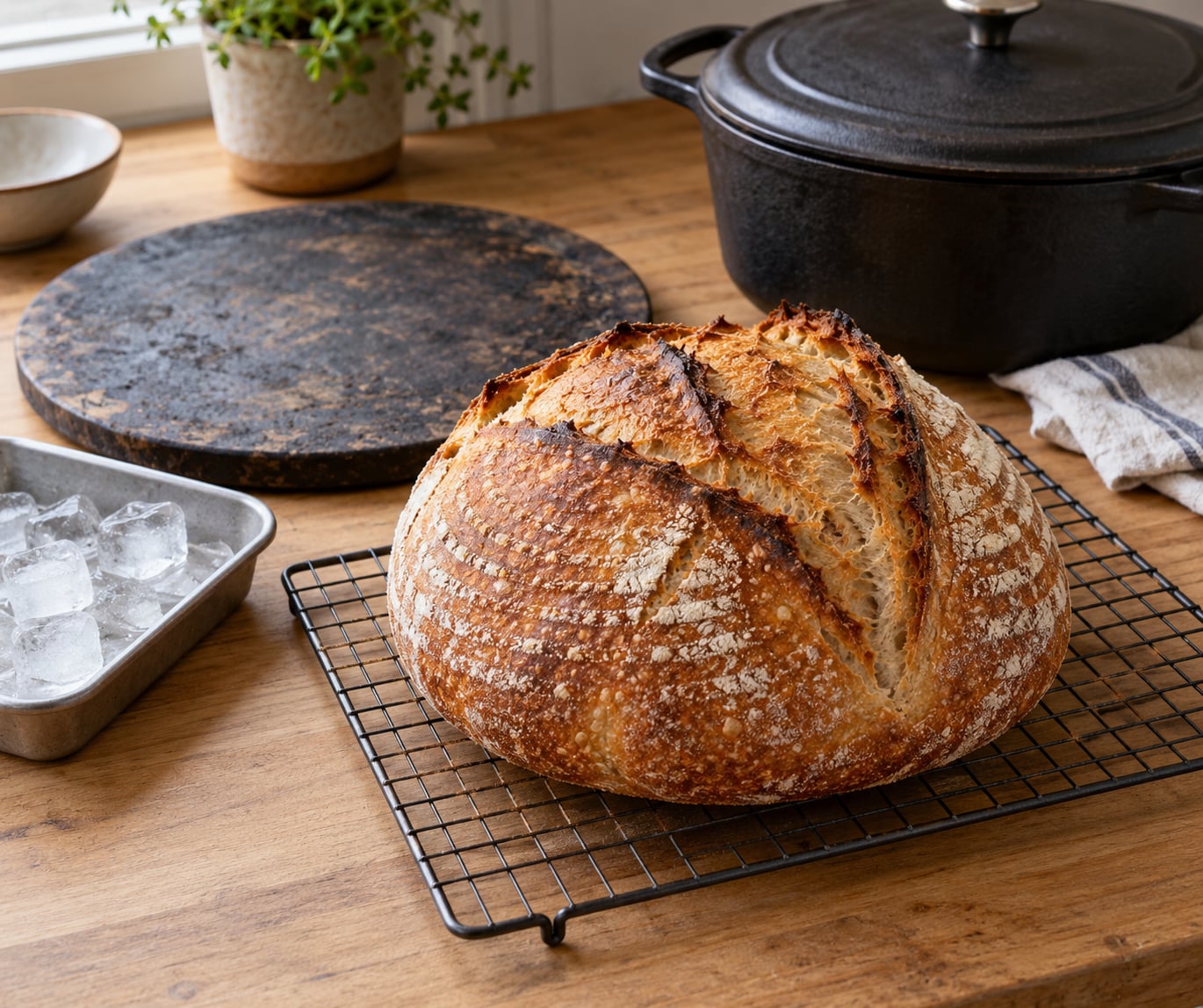
| Dutch oven or cloche | Traps the loaf’s own steam, so the crust can expand freely | Any oven-safe pot with a lid, or a large stainless bowl |
| Rimmed baking sheet | Holds a pan of boiling water or ice for steam | An old broiler pan or a metal loaf pan |
| Baker’s lame or razor | Makes a clean cut that opens into an ear | A very sharp knife or a razor blade in a handle |
| Pizza peel or parchment | Lets you slide the loaf onto a hot surface without dropping it | Parchment paper, or a stiff cardboard cut to fit |
| Wire cooling rack | Lets steam escape from underneath so the base dries | A cooling rack, or two chopsticks between plates |
Skip the lame and the peel and you can still get a good crust. Skip the thermometer and you are guessing, and most soft-crust complaints trace back to an oven running 25 to 50°F cold.
Your dough matters just as much as your equipment. Rich doughs brown fast and stay soft. Learn the difference before you bake.
Step-by-Step: How to Get a Crispy Crust on Homemade Bread
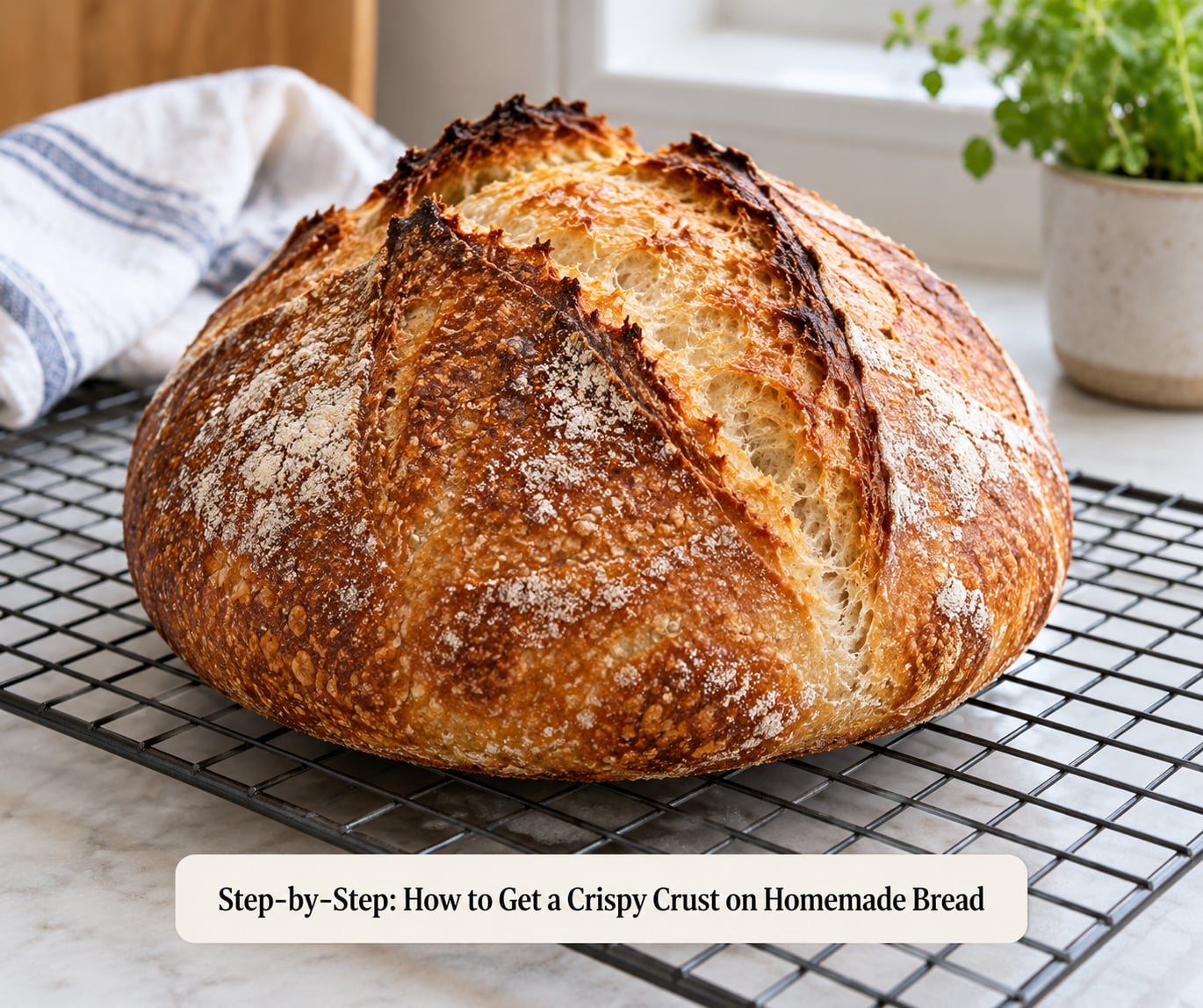
Choose a Dough That Can Make a Crisp Crust
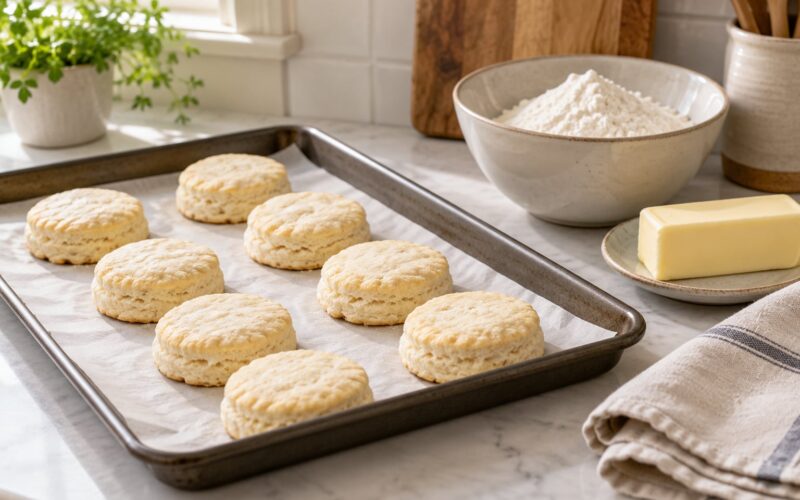
A lean dough makes a crisp crust. Sugar, butter, milk and egg are what make a loaf soft and tender, and they are the same things that turn a thin crackling shell into a thick chewy one. If you want that bakery snap, keep sugar near 2 to 4% of flour weight and skip added fat in the dough. Brioche and challah will never give you a shattering crust, and that is fine, they are meant to taste like butter.
Flour builds structure. Bread flour has more protein than all-purpose, which holds shape through the hot early phase, and whole wheat or rye speeds up browning because their bran and sugars brown faster. Bleached all-purpose works, just expect a slightly flatter loaf. A thin coating of semolina or rice flour on the peel or pan adds grip and gives the base a grittier texture without changing the dough.
Hydration decides the thickness of the shell. Wetter doughs spread and bake thin-crusted, and drier doughs hold a heavier, tougher crust. For a middle ground in a home oven, start around 68 to 72% water by weight.
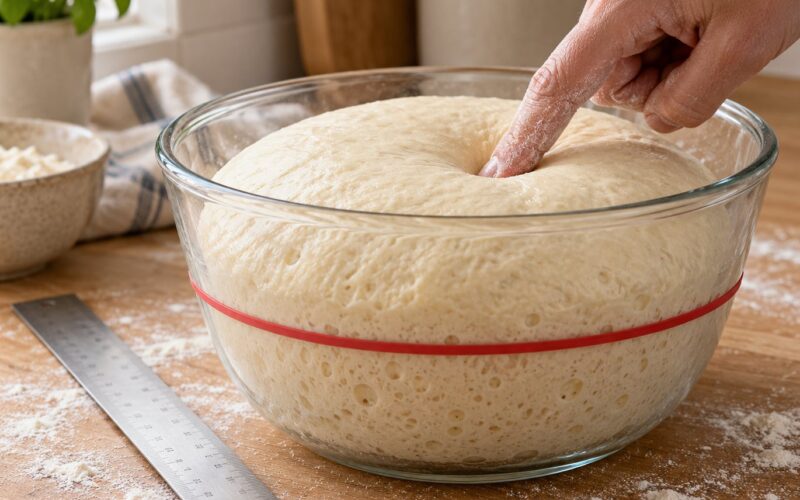
Fermentation changes flavor more than texture, but underproofed dough tears at the score and bakes dense, while overproofed dough spreads flat and picks up a pale, thin skin. Proof until the loaf feels full and springs back slowly when you poke it.
Preheat the Oven and Baking Surface Thoroughly
Give the oven 30 to 45 minutes at full temperature, with the surface inside already preheated for the last 20. Steady stored heat is what drives oven spring, the rapid rise in the first minutes of the bake. A loaf that hits a lukewarm oven starts setting its crust before it has expanded at all.
Put a steel or stone in with the oven, or set an upside-down heavy rimmed baking sheet on a rack in the lower third of the oven. Both heat the dough’s underside faster than bare metal, which is what kills the pale, gummy bottom people complain about most.
Watch out for a visible bottom heating element. There is no room for a stone, so bake directly on the rack and pull the loaf’s bake down a few minutes if the base darkens early.
Shape the Loaf for Maximum Surface Contact
Tension decides whether the loaf keeps its shape in the oven. Tighten the surface before the loaf hits the heat, and you get a rounded loaf with a uniform shell. Slack dough spreads, and a spread loaf has a thin, pale, sad crust.
Score after the loaf is fully proofed, right before it goes in. Cut about a quarter inch deep, at a shallow angle, and use one decisive motion. A lame, a razor or a sharp knife all work. A deep straight cut gives a clean ear, a shallow one gives a modest crack.
Dust the peel or inverted sheet pan with flour or semolina and slide the loaf on in one move. Flour the dough itself lightly if it sticks, and put the loaf in the oven within a couple of minutes, because steam is already escaping from the oven.
Create Steam During the First Part of Baking
Steam is the single biggest lever for a crisp crust. It delays the crust setting point so the loaf expands fully before the shell hardens. Load the loaf first, then add steam as fast as you can, close the door immediately, and give the oven 20 minutes before you open it again.
| Method | Equipment | Steam phase | Effort | Best for |
|---|---|---|---|---|
| Covered Dutch oven | Cast iron pot or any lidded oven-safe pot | 20 minutes covered, then 15 to 25 uncovered | Lowest, the loaf makes its own steam | Round country loaves and sourdough |
| Ice cubes into a hot pan | Preheated sheet pan, 5 to 6 cubes | Last 5 minutes of preheat, 20 minutes of baking | Very low | Baguettes, rolls and any open bake |
| Boiling water tray | Rimmed sheet pan, 1 to 2 cups boiling water | Bottom rack for the full 20 minute wet phase | Low, but you must pour fast | Lean loaves and baguettes |
| Spray bottle | Any mister | Mist the oven walls and the loaf every few minutes | Highest, needs several trips | Last resort when nothing else is available |
| Skin-on roast method | A loaf with the skin left on | Whole bake until the crust browns | Low once you get used to it | Crispy rolls and rustic batards |
| Steam oven setting | Oven with a steam function | Program it for 20 minutes | Lowest of all | Repeatable results every bake |
Burst steam is genuinely dangerous when it hits a hot pan, so pour with the oven door open and stand to the side, not in front of it. Dry oven mitts, a face away from the gap, and an empty oven is the safe way to do it.
Bake Until the Loaf Is Deeply Golden
Color is your best doneness signal. Pale tan means underbaked, and a pale crust is a soft crust because it never dried all the way. Deep golden to chestnut brown, with a slightly deeper edge where the score opened, is the target. Pull the loaf before it looks done, because carryover heat keeps darkening it.
Listen for a hollow sound when you knock the bottom, smell for a toasted rather than burnt edge, and use a thermometer when you want certainty. Most loaves land between 195°F and 205°F inside.
| Oven setting | Covered phase | Uncovered phase | Total time | Crust result |
|---|---|---|---|---|
| 450°F | 20 minutes | 20 to 25 minutes | 40 to 45 minutes | Medium brown, gentle flavor |
| 475°F | 20 minutes | 18 to 22 minutes | 38 to 42 minutes | Deep golden, the all-rounder |
| 500°F | 15 to 20 minutes | 12 to 18 minutes | 30 to 38 minutes | Dark and blistered, faster and riskier |
| Convection, 20°F lower | 20 minutes | About 20 minutes less | Shorten by 20 minutes | Even browning, dries the base faster |
If the top darkens while the bottom stays pale, drape loosely with foil for the last few minutes. If the whole loaf bakes pale, extend the uncovered phase by five minutes before you raise the temperature, since more heat alone is what scorches the outside while the crumb finishes.
Dry and Cool the Crust Properly
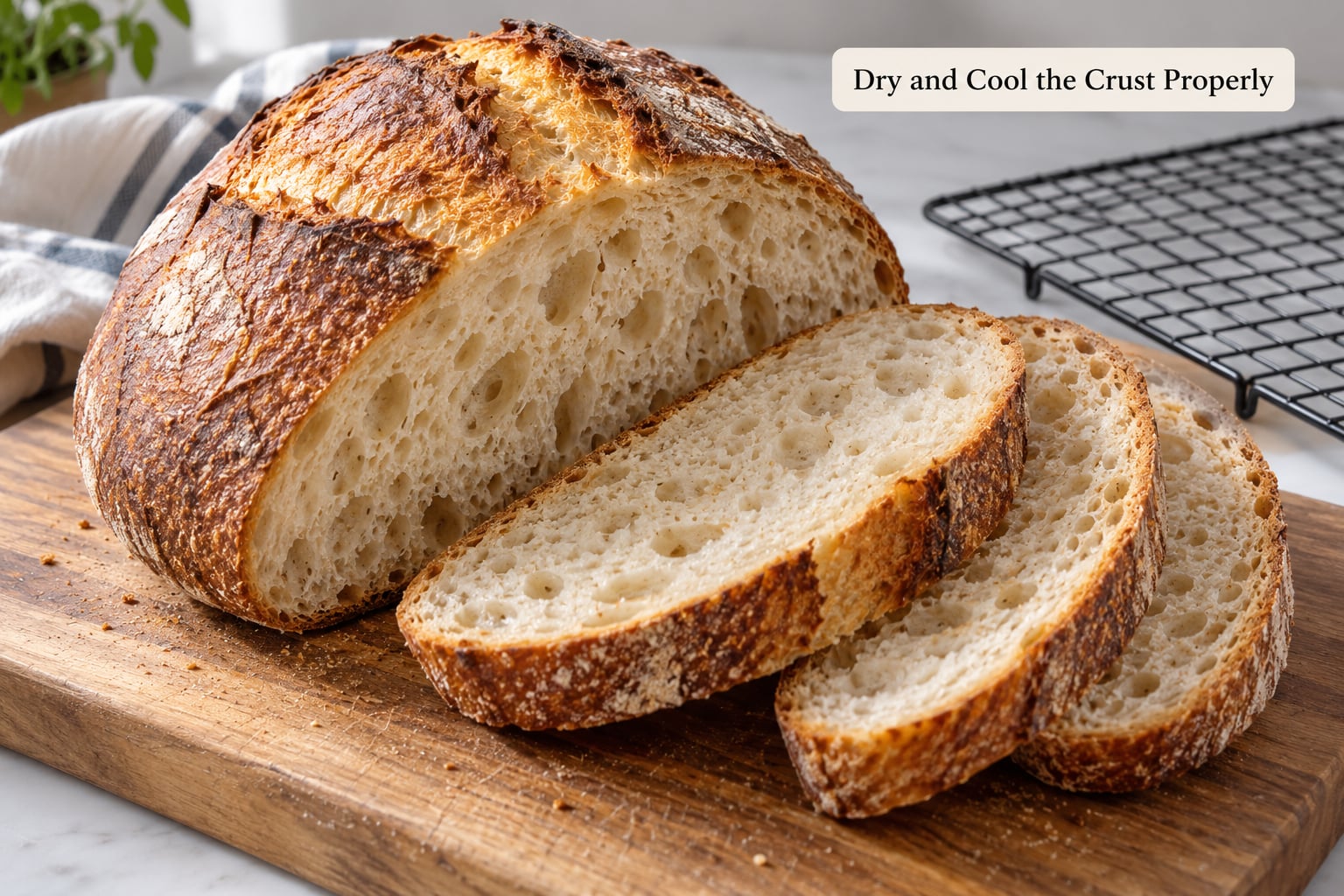
Cooling is the step that turns a soft crust into a crisp one, and it is where most people give up early. Steam trapped inside the loaf keeps the crust pliable, so a slice cut hot is gummy no matter how well the loaf baked.
Cool on a wire rack for two hours for a standard loaf, one hour for a roll or baguette, and do not put it on a cutting board or plate where the underside steams itself soft. Store the loaf cut-side down on a board, never in the refrigerator, which stales bread within a day. A plastic bag softens the crust, paper or a cloth bag keeps it.
When a loaf goes soft anyway, spritz the crust lightly with water and put it back in a 375 to 425°F oven for 8 to 10 minutes. The surface re-dries and re-crisps, and freezing the loaf and refreshing it the same way works well for weeks-old bread.
Common Mistakes That Make Bread Crust Soft or Burnt
Every crust problem shows up as a symptom you can match. Find your row, fix the cause, and the same dough usually behaves differently on the next bake.
| Symptom | Cause | Fix |
|---|---|---|
| Crust soft and chewy as the loaf cools | Sliced warm, or stored in plastic or the refrigerator | Cool two hours on a rack, store cut-side down in paper or cloth |
| Gummy, pale bottom | Baked on cold or thin metal with no stored heat | Preheat a stone, steel or inverted heavy sheet for 20 to 30 minutes |
| Dark top, pale bottom | No steam, so the loaf rises flat and the base sits in cool metal | Add steam for the first 20 minutes, check with an oven thermometer |
| Crust rock-hard and thick | Overbaked, or an enriched dough with sugar and fat | Pull the loaf 5 minutes earlier, cut sugar to 2 to 4% of flour weight |
| Blistering or scorched spots | Steam hit one spot, or the loaf sat too close to a heating element | Rotate the loaf, use a mid rack, lower to 450°F for larger loaves |
| Loaf spreads flat with a thin crust | Dough was overproofed or too wet for the flour | Proof less, reduce hydration by a few points, build more surface tension |
A few shorter habits that pay off. Feed the dough a stiff flour rather than bleached all-purpose. Use semolina on the peel for grip and grit. Score in one clean cut rather than sawing. And pull the loaf from a loaf pan for the last ten minutes if you bake sandwich bread, which crisps the sides and base too.
Frequently Asked Questions
Why is my homemade bread crust soft?
Usually one of three things: the oven was not hot enough, steam ran out too early, or you cut the loaf while it was still warm. Check your oven with a thermometer, hold the lid or steam pan on for the full 20 minutes, and cool the loaf two hours on a wire rack. A dough high in sugar, butter, milk or egg also browns before it dries, which leaves a soft shell.
How can I make bread crust crisp without making it burn?
Add steam first and dry heat second rather than raising the heat. Bake at 475u0026deg;F with steam for 20 minutes, then uncover and let dry for 18 to 22 minutes. If the crust darkens faster than the crumb, drape the loaf loosely with foil for the last few minutes instead of turning the oven down. Pull the loaf while the crust still looks a shade light, since carryover heat keeps darkening it.
Should I use steam when baking homemade bread?
Yes, for lean yeasted bread. Steam keeps the surface pliable past the crust setting point of roughly 140u0026deg;F (60u0026deg;C), which lets the loaf expand fully before the shell hardens. Enriched doughs with plenty of butter and sugar brown on their own and need little or no steam. Whichever method you use, the water or ice goes into a very hot pan and the door closes immediately afterward.
Do I need a baking stone or steel for a crispy crust?
No, but a hot surface is what stops the bottom from going pale and gummy. A stone, a steel or an upside-down heavy rimmed baking sheet all work, preheated for 20 to 30 minutes. If your oven has a visible bottom heating element there is no room for any of them, so bake on the rack and shorten the bake by a few minutes if the base colors early.
How long should bread cool before cutting it?
Two hours for a standard loaf on a wire rack, about one hour for a baguette or roll. Cutting earlier releases the moisture still inside the loaf as steam, which softens the crust as it escapes and gives you a gummy slice. Store the cooled loaf cut-side down on a board, in paper or a cloth bag, and keep it out of the refrigerator, which stales bread in about a day.
What type of flour gives the crispest crust?
Bread flour, or unbleached all-purpose, both give a crisp thin crust. Bread flour has more protein and holds shape during the hot early phase, so the loaf spreads less and the shell stays even. Whole wheat and rye brown faster and add a heavier, more rustic crunch. Enriched flours are not the issue, but sugar, butter, milk and eggs in the dough are what turn a crisp crust soft.
Start With the First Bake
To get a crispy crust on homemade bread, change one thing on your next bake and change nothing else. Preheat the oven with a stone or inverted sheet pan for a full 30 minutes, hold the loaf covered or steamy for 20 minutes at 475°F, then bake it uncovered until the crust is deep golden. Cool it two hours before you cut it.
Once that bake works, tune the dough next, not the equipment. Lower the sugar, or bake a little longer in the uncovered phase, and you will get closer to that thin crackling shell every time.