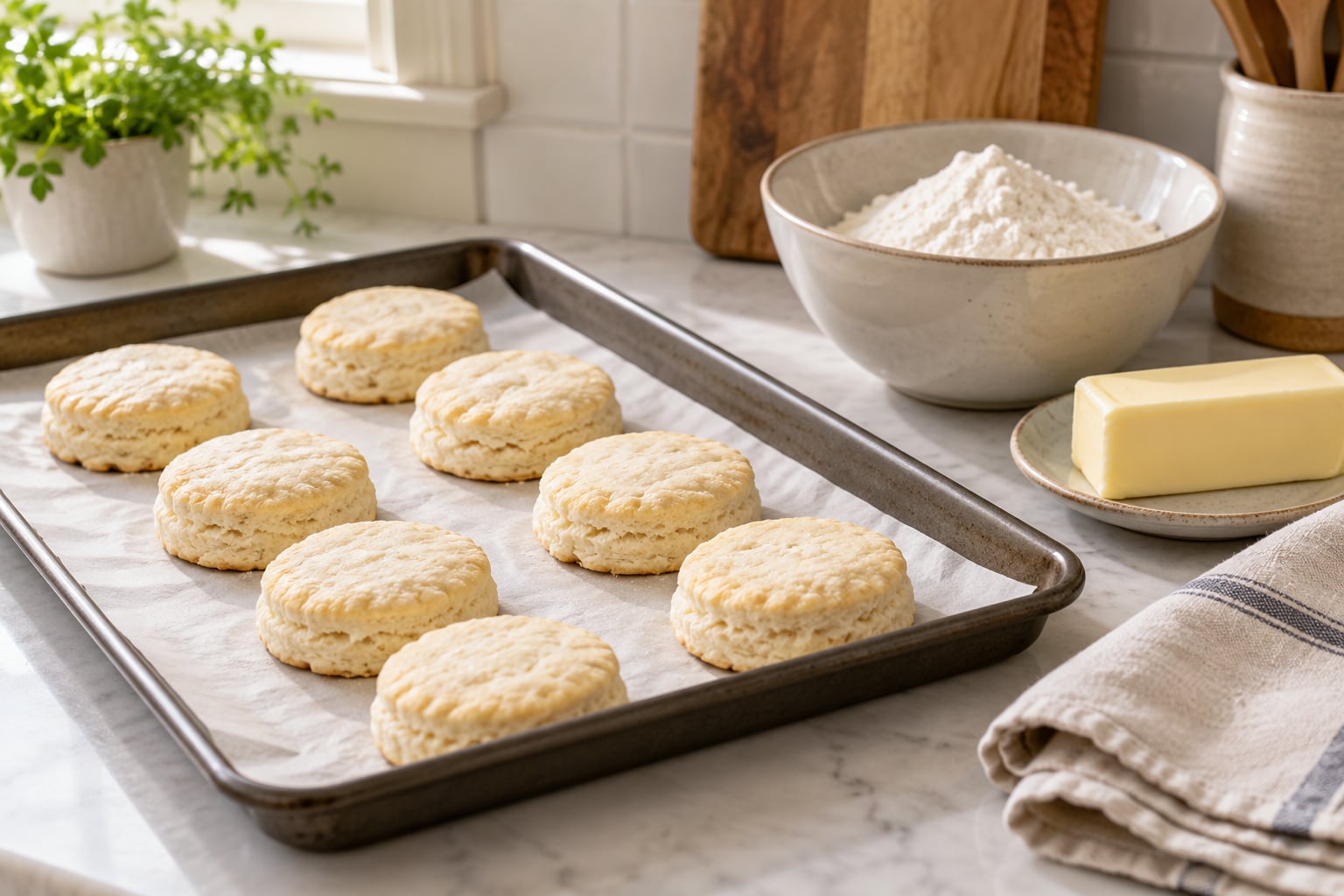
Why are my biscuits hard and flat? In almost every case it comes down to one of four things: dead baking powder, butter that was not cold enough, dough that got overworked, or an oven that was not hot enough. Biscuit dough leans on pockets of cold fat that melt in a very hot oven and push the dough upward before it sets, and each of those four mistakes takes that lift away.
Most bakers only change one variable at a time, then change a different one, and end up with a recipe that is fine and a technique that is not. The faster route is to identify the symptom first. Hard and flat together points to fat, leavening and oven temperature. Hard but tall points to overbaking or a dry crumb. Flat but soft points to spreading on the sheet.
Table of Contents
- What Makes Biscuits Hard and Flat?
- How to Fix Hard or Flat Biscuits
- How to Keep Biscuits Tender and Light
- How to Make Biscuits Rise Instead of Spread
- How to Tell When Biscuits Are Done Baking
- How to Store Biscuits Without Making Them Hard
- Frequently Asked Questions
- Why are my biscuits hard instead of flaky?
- Can overmixing make biscuits tough?
- Why do my biscuits spread out on the baking sheet?
- How do I keep biscuits soft overnight?
- Should I use an aluminum baking sheet for biscuits?
What Makes Biscuits Hard and Flat?
A biscuit is a stack of thin layers of fat and flour. In a 450°F oven that liquid fat turns to steam, the layers separate, and the dough expands fast in what bakers call oven spring. If any part of that chain breaks, the dough sets flat instead of lifting.
Fat that melted before baking gets absorbed into the flour rather than staying in distinct pockets, so the layers never separate. Gluten that was developed by kneading, rolling the scrap pile repeatedly, or mixing in a stand mixer forms a tight elastic web that squeezes gas into a dense, chewy crumb. Leavening that has lost its punch releases little or no gas, and gas is what the fat layers inflate. A cool oven does the rest: the dough firms up in the pan before enough steam has formed, so you get a pale, hard puck instead of a risen biscuit.
Add too much flour and you tighten the same web. Add too little liquid and the dough has no steam to work with. Bake too long and the last of the moisture leaves, which is the specific reason a biscuit can be tall and beautiful out of the oven and hard as a rock an hour later.
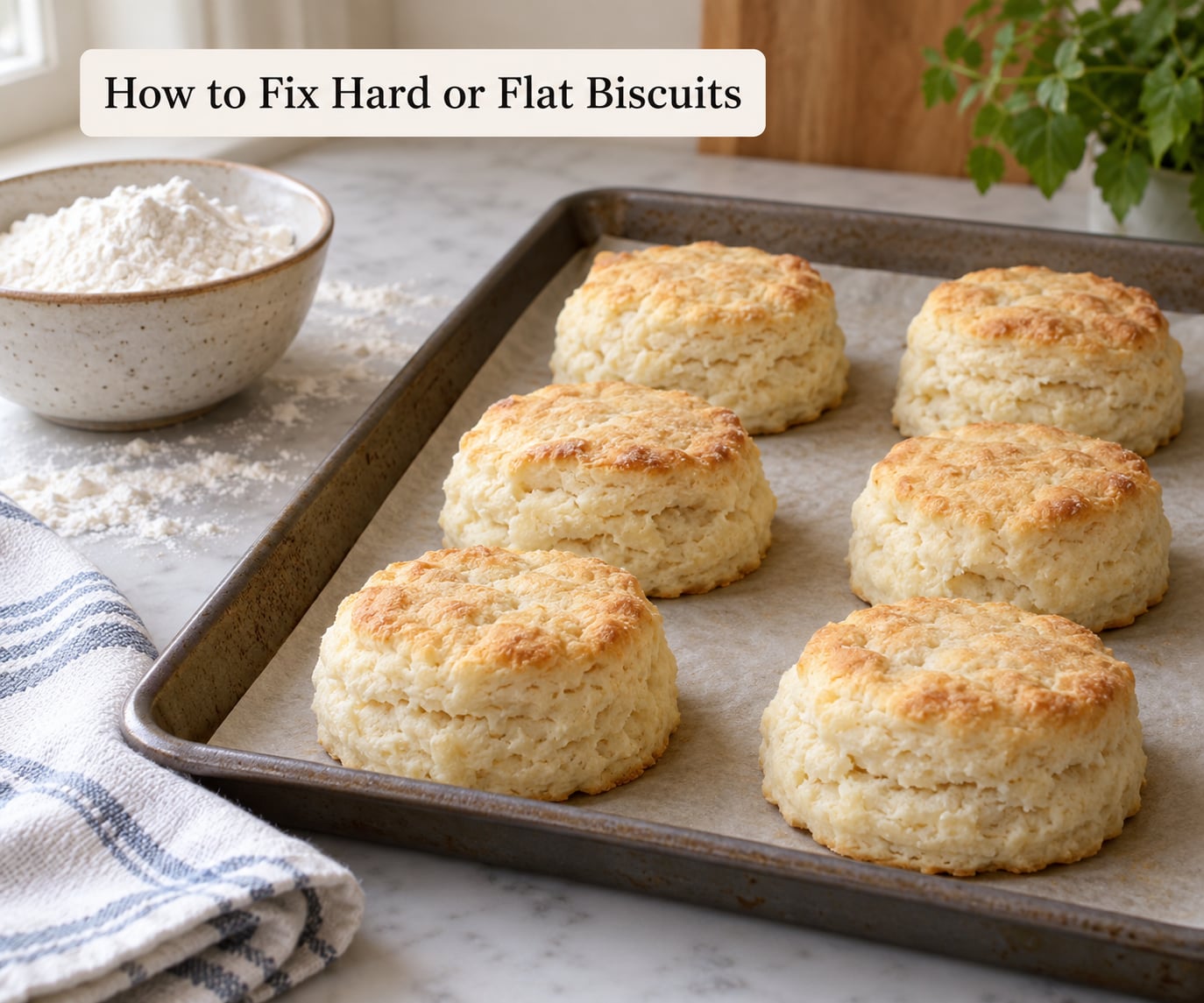
How to Fix Hard or Flat Biscuits
| What you see | Likely cause | Fix it | Check next batch |
|---|---|---|---|
| Hard and flat, pale | Baking powder has lost its strength | Replace it, or double it if the open date is past | Bubbles immediately in hot water |
| Hard and flat, greasy sheen | Butter was room temperature or melted in | Chill the dough 20 minutes before rolling | Dough is firm and cold to the touch |
| Hard, tall, dense center | Dough overworked | Mix only until the dry bits disappear, then stop | Shaggy dough, not smooth and elastic |
| Flat, spread out, thin edges | Oven too cool or biscuits spaced far apart | Bake at 450°F on a hot sheet, space 1 inch apart | Sheet is hot before dough goes in |
| Hard on the bottom, raw inside | Underbaked, or sheet not preheated | Add 3 to 5 minutes and check with a thermometer | Biscuit reads 200 to 205°F in the center |
| Hard all over after 1 hour | Left on the sheet, then uncovered | Cool on a rack 10 minutes, then store airtight | No condensation on the lid |
| Hard and flat in a mountain town | Altitude | Cut liquid 15 to 25 percent, add 1 to 2 teaspoons baking powder, raise oven 25°F | Biscuit rises within 3 minutes of baking |
Pick the row that matches what you saw and change only that one thing on the next batch. Changing three variables at once is how recipes get blamed for technique problems.
How to Keep Biscuits Tender and Light
Cut the fat in while it is still hard. Cold butter or shortening stays as separate chunks, and those chunks become the layers. Use a pastry blender, a fork, or your fingertips, and chill the bowl and the flour for 10 minutes first. A food processor works if you pulse rather than run the motor, and pulse until the fat is the size of peas, not until it looks like sand.
Stop mixing when the last dry patch disappears. Biscuit dough should still look ragged and slightly shaggy. A smooth, elastic ball is dough you have beaten past the point where it can rise, and no amount of baking powder brings that back.
Measure liquid by weight if you can, and keep it cold. Buttermilk, whole milk and cream all work, and buttermilk gives the best flavor and lift because its acidity reacts with baking soda. A quick substitute is one cup milk plus one tablespoon lemon juice or vinegar, rested five minutes before you add it.
Handle the dough with as few strokes as you can, and rest it. A 20 minute chill in the fridge after mixing lets the flour hydrate and the fat firm up again, which is why a rested dough rolls without needing more butter. Re-rolling the scraps a second and third time is the single most common way home bakers ruin texture, since each pass develops more gluten. Bake the first batch from fresh dough and let the scraps go, or roll them only once, as gently as you can.
How to Make Biscuits Rise Instead of Spread
Test your baking powder. Put a teaspoon in a cup of hot water and stir. Vigorous bubbling straight away means it is good, a few lazy bubbles mean it is weak, and nothing at all means you are baking biscuits with flour and butter and nothing else. Baking powder goes stale faster than most people expect once the box is opened, and that open container in the back cupboard is a surprisingly common culprit.
Keep the dough cold. Fat that starts warm melts into the flour before the oven ever sees it, and the biscuit spreads. Roll to about three quarters of an inch and cut straight down, pressing and lifting rather than twisting the cutter, which seals the layers shut and makes the biscuit thinner. Dock the top with a fork if the dough feels very wet, which lets steam escape and keeps the shape.
Heat the pan. Put the heavy sheet in the oven while it preheats at 450°F and slide the biscuits onto hot metal, which is where you get a crisp bottom and a fast first rise. Space them about 1 inch apart, touching if you want taller biscuits, since the dough spreads as it bakes. Do not open the door for the first 8 minutes, and move a rack-one-oven from the top for about 20 minutes. An oven thermometer on the middle rack is worth more than the dial, since many ovens run 25 to 50°F off what they claim.
Above about 5,000 feet, gas expands faster and dries out quicker. Reduce liquid by 15 to 25 percent, add 1 to 2 extra teaspoons of baking powder, and bump the oven 25°F. Mountain bakers report the same flat, dense results in Denver that most people assume is a recipe error, when it is really the air.
How to Tell When Biscuits Are Done Baking
Look at the top and the edges, not the clock. A finished biscuit is golden across the top with a distinctly deeper brown rim, puffed up, and the top springs back only slightly when you press it. Pale dough with a wet sheen is not done, and a biscuit that has gone from golden to dark tan is past done.
Check the middle. A thermometer pushed into the thickest part of a straight-sided biscuit should read 200 to 205°F, and that range holds across standard recipes. Small 2 inch biscuits bake in roughly 10 to 14 minutes, large 3 inch ones in 14 to 20, and frozen ones need about 20 to 25 minutes at 450°F. Baked from frozen, keep them at least 1 inch apart on the sheet, since thawing dough spreads more than it would fresh.
If the outside is browned and the center still feels dense, that is not a timing problem anymore, it is a shaping problem. The biscuit baked flat, so it needed more time anyway. Next time, cut thicker and chill the pan.
How to Store Biscuits Without Making Them Hard
Cool everything first. Biscuits stored warm trap steam, and that steam turns to condensation and soaks the crust and makes the crumb gummy. Ten minutes on a wire rack, then another few minutes before you close anything up.
For the same day and the next morning, an airtight container at room temperature is best. Slice the biscuits first if you can, and lay parchment or a paper towel between layers, since that keeps the cut faces from touching and going soft. A small apple in the container adds moisture in a way that works without making the biscuits soggy.
For longer than that, freeze them in a single layer, then move them to a bag or box. Thaw in the container at room temperature with the lid on, which traps the condensation and softens the crust. To bring stale biscuits back, a few minutes in a 350°F oven works, and a damp paper towel in a microwave for 20 to 30 seconds works faster, though the texture is better oven-refreshed.
Skip the refrigerator for anything beyond a day. Biscuit starch retrogrades in the cold, and refrigerated biscuits get hard and crumbly faster than biscuits left on the counter in an airtight container.
Frequently Asked Questions
Why are my biscuits hard instead of flaky?
Flaky layers come from fat that stays in distinct cold pockets until the oven hits it, and from dough that was barely mixed. If your biscuits are hard instead, the fat melted into the flour, the gluten got overdeveloped, or the biscuits baked too long. Chill the dough 20 minutes before rolling, mix only until the dry flour disappears, and pull them from the oven once the tops are golden.
Can overmixing make biscuits tough?
Yes. Overmixing develops gluten into a tight elastic web, and that web resists expansion and gives you a dense, chewy crumb instead of a tender one. Biscuit dough is not bread dough, so stop the moment the last dry patch disappears and leave the dough ragged. If your dough looks smooth and springy before it goes in the oven, that mixing has already gone too far.
Why do my biscuits spread out on the baking sheet?
Dough spreads when the fat was too warm to stay in pockets, when the dough is too thin, or when the oven is too cool for the fat to set quickly. Use cold butter, roll to about three quarters of an inch, and cut straight down without twisting the cutter. Bake at 450°F on a preheated sheet and space biscuits about 1 inch apart.
How do I keep biscuits soft overnight?
Cool them fully on a wire rack, then store at room temperature in an airtight container. Slice first if you can and put parchment or a paper towel between the layers so cut faces do not touch. Skip the refrigerator, since cold temperature makes biscuit starch firm up faster and the biscuits turn hard and crumbly by morning.
Should I use an aluminum baking sheet for biscuits?
Yes, a heavy aluminum or steel sheet gives the best results. It heats fast, so a sheet sitting in the oven during preheat is already hot when the dough lands on it, which means better bottom browning and a quicker first rise. Dark nonstick coating also works but runs hotter, so check the biscuits a few minutes early and pull them when the top is golden.
Start with the baking powder. Test a teaspoon in hot water, replace the box if it is quiet, then bake again with the dough well chilled and barely mixed. If the biscuits still come out hard and flat, put an oven thermometer on the middle rack and see what your oven is really doing. Between those two tests, the culprit is almost always found within a batch or two.