Updated for October 2026
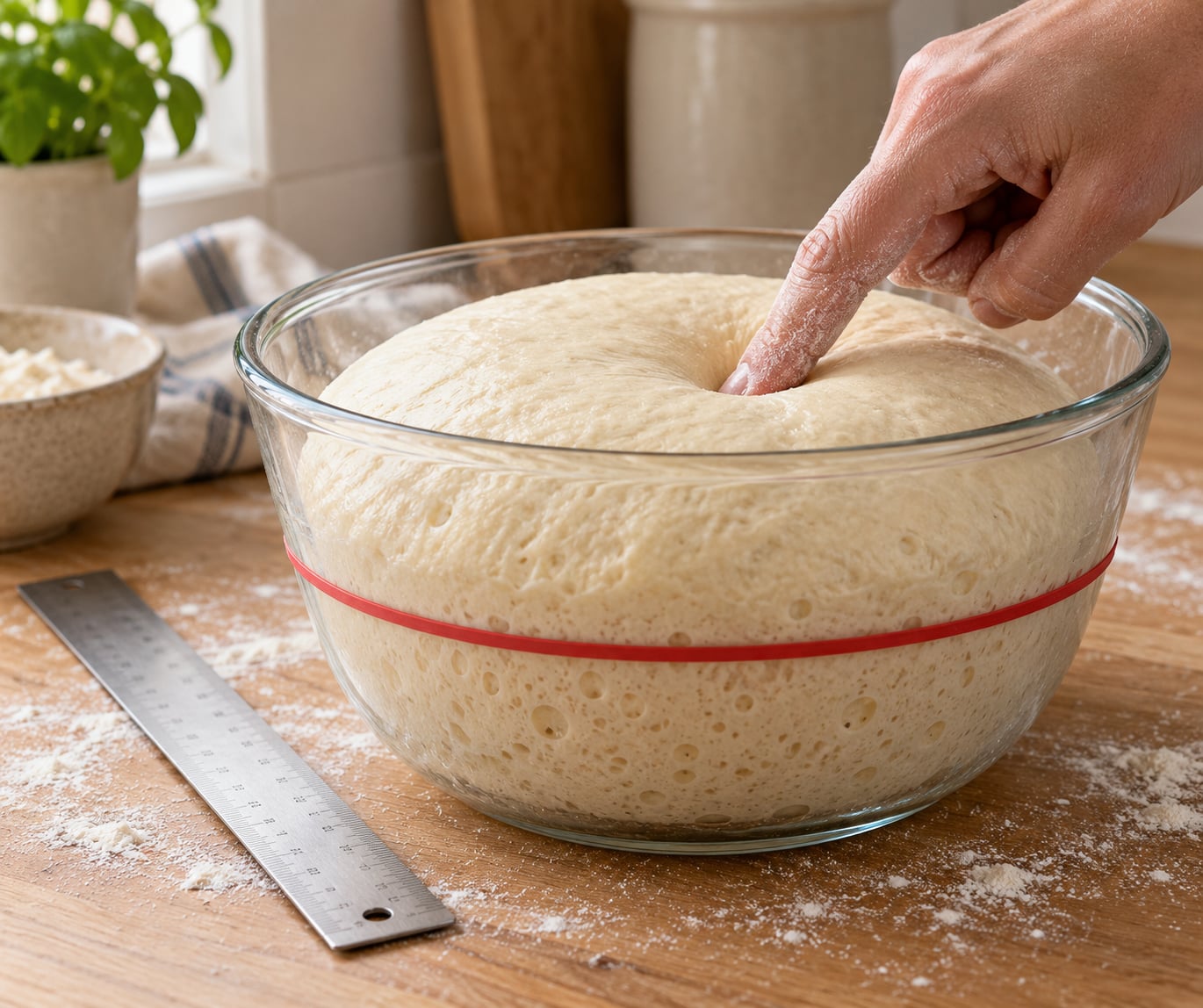
You can tell when bread dough has risen enough in two ways: poke it with a floured fingertip and watch how it springs back, or measure how far it has climbed in a straight-sided container. Ready dough springs back slowly and keeps a slight dent. Dough that fills the hole instantly needs more time, and dough that never lifts or starts to sag has gone too far.
Timing is the least useful signal you have. The same recipe can double in 40 minutes in one kitchen and take three hours in another, because yeast activity, dough temperature and room temperature all move at different speeds. Learning to read the dough takes about three bakes. After that it becomes second nature.
Table of Contents
- What You Need
- Step-by-Step: How to Tell When Bread Dough Has Risen Enough
- How to Tell When Bread Dough Has Risen Enough: Check the Volume
- Look for Air Bubbles and a Fuller Shape
- Use the Poke Test to Check Readiness
- Check the Dough’s Texture and Spring
- Use Time and Temperature as Supporting Clues
- Confirm the Proof Before Shaping or Baking
- Common Mistakes
- Tips for More Consistent Bread Dough
- Frequently Asked Questions
- How do I know if bread dough has risen enough?
- What should bread dough feel like when it has risen?
- Should dough double in size before baking?
- How do I know if I have overproofed my dough?
- Does sourdough need to double before shaping?
- Can I use the poke test after shaping bread dough?
What You Need
None of this needs special equipment. You need a container you can see through and a way to measure against it.
- A straight-sided container. A glass bowl, a plastic tub or a straight-sided jar. Curved bowls hide the rise, which is why dough in a round glass bowl looks finished when it is not.
- A marker. A rubber band around the bowl at the starting level, or a strip of tape on the side. Without a mark, your eye invents the starting point.
- A ruler or tape measure. For reading the rise in inches. Half an inch of rise and two inches of rise are not the same event.
- Flour or oil for your fingertip. Flour for wet, sticky doughs; a little oil works better for enriched doughs that grab at your skin.
- An instant-read thermometer. Dough temperature tells you more about the next hour than the recipe’s written time does.
- The recipe’s expected rise. A target percentage, not a stopwatch. Some doughs are meant to rise 50%, most sandwich bread doughs to double.
Step-by-Step: How to Tell When Bread Dough Has Risen Enough
Run the checks in this order. Two agreeing checks beat one confident check, and the order matters because the first two are non-destructive and the poke test leaves a dent you cannot unmake.
How to Tell When Bread Dough Has Risen Enough: Check the Volume
Measure the rise before you touch the dough. Put the rubber band or tape mark at the level of the dough right after mixing, before it has had time to do much of anything.
Read the height at the mark and again an hour later, or whenever you check. The number that matters is the increase, not the total height. A dough that climbs from 2 inches to 4 inches has doubled. A dough that goes from 2 inches to 3 inches has risen 50%.
There is no single percentage that means “ready” for every dough:
- Lean yeast doughs for sandwich bread and dinner rolls usually aim for a full doubling during bulk, then a second rise after shaping until the loaf sits about 1 inch above the rim of the pan.
- Sourdough usually stops around a 50% rise during bulk fermentation, judged by a domed surface, jiggly movement and bubbles at the edges. Waiting for a full double on sourdough is how bakers end up with flat loaves and a collapsed crumb.
- Enriched doughs with milk, egg, butter or sugar ferment more slowly and often rise less dramatically. Volume matters less than texture here.
- Overnight cold ferments in the refrigerator barely move at all. You are watching for how the dough feels once it comes to room temperature, not for a percentage.
Bakers who work this way often lift a small portion of dough into a little straight-sided container at the start and use it as a visible sample, since the dough slumps and spreads and its rise is hard to read in a mixing bowl.
Look for Air Bubbles and a Fuller Shape
A fermenting dough changes shape before it changes much in volume. The surface goes from matte and slightly wrinkled to smooth and faintly domed, and the edges pull away from the bowl in places.
Small bubbles collect along the sides where the dough meets the container, and in wet doughs you often see them move under the surface. The whole mass relaxes outward and spreads toward the corners of the tub.
Give the container a gentle nudge. Dough that has trapped gas shifts as one soft, jiggly body, like a water balloon that has lost some tension. Dough that is still working moves like a stiff paste. Sourdough bakers on r/Sourdough lean on this jiggly check specifically, and one baker there recommends reading visual signs over the poke test almost entirely.
The aroma helps too. Plain yeast dough turns pleasantly yeasty and slightly sweet. Sourdough shifts toward a tangy yogurt or vinegar note. A sharp, nail-polish-sour smell at full volume usually means the dough has passed its peak.
Use the Poke Test to Check Readiness
Flour or oil a fingertip, press straight down about half an inch to one inch, and lift. Watch the dough rather than the clock.
- Dip a clean fingertip in flour, or run a little oil over it for sticky enriched doughs.
- Press into the middle of the dough, not the very edge, roughly half an inch to one inch deep.
- Lift your finger straight up and watch the dent.
- Read the outcome using the table below, then decide.
| What you see | Spring-back | How the dough feels | What to do |
|---|---|---|---|
| Ready | Returns slowly and only partly, leaving a slight dent | Airy and pillowy, holds a soft shape | Shape it, or bake if it is already shaped |
| Needs more time | Bounces back quickly and completely fills the hole | Tight, dense, resistant under the finger | Cover and check again in 30 to 45 minutes |
| Over-risen | The dent stays completely, or the dough deflates around your finger | Slack, fragile, tears when you move it | Bake it now if you can. Expect a flatter loaf and a denser, holey crumb |
The poke test misleads in a few specific situations, and forums raise these repeatedly. Cold dough straight from the refrigerator is stiff and springs back far too readily, so let it warm up before you trust the result. Very stiff, low-hydration dough behaves the same way. A wet ciabatta or focaccia dough dimples and stays dimpled even when it is underproofed, so read those by volume and jiggle instead.
One sourdough baker reported results changing from one part of the dough to another, which happens when fermentation is uneven. Test twice, once in the middle and once near the edge, and trust the dough that feels more advanced. And press gently, because a hard stab releases gas you cannot put back and pushes you into the over-risen column by accident.
Check the Dough’s Texture and Spring
Readiness has a texture to it. Lift a corner of the dough gently, or slide a hand under the mass and let it settle back. Ready dough stretches, holds a rounded edge and settles rather than snapping.
Dough that needs more time feels tight, almost rubbery, and tears instead of extending. Dough that has gone too far feels loose and fragile, spreads on contact and sticks to everything, which is why bakers describe slack, wet dough as a bad sign.
Shake the container. If the dough moves as one soft mass with a wobble rather than a heavy lump sliding across the bottom, it has gas and structure. That wobble is the jiggle test, and it works well in sourdough where the poke test is unreliable.
Use Time and Temperature as Supporting Clues
Recipe times are estimates written for someone else’s kitchen. The variables below move the finish line far more than a few minutes ever will.
| What you change | Effect on rise speed |
|---|---|
| Room temperature | Warmer kitchen, faster rise; cooler kitchen, much slower |
| Dough temperature at mixing | Warms up faster and ferments faster |
| Yeast quantity and freshness | More or fresher yeast, faster rise |
| Salt | More salt slows yeast noticeably |
| Sugar and milk or egg | Feed the yeast and speed the early rise, then brown the loaf faster |
| Hydration | Wetter doughs feel lighter and rise more slowly |
| Starter strength | A starter that doubles reliably in 4 to 6 hours gives a predictable rise; a weak one does not |
This is why 30 minutes is not a rule. On a warm day with active dry yeast and a thin dough, 30 minutes can be most of the rise. In a cool kitchen with a stiff dough and a full spoon of salt, the same dough may barely move. An r/AskBaking baker who spent two weeks adjusting yeast and temperature on sandwich bread, without success, ended up with the answer that instant-rise yeast needed hotter liquid and a warmer room, not more yeast.
Confirm the Proof Before Shaping or Baking
Different doughs reach “enough” at different points, and for a few of them the answer is to move on immediately.
- Lean yeast bread: double during bulk, then shape, then proof until the dome sits about 1 inch above the rim of the pan. The poke test on the shaped loaf should leave a dent that fills only halfway.
- Sourdough: stop bulk at roughly 50% rise with a domed, jiggly dough and bubbles at the edges. Shape, then cold-retard and bake straight from the fridge. Sourdough rarely gets a second room-temperature rise.
- Enriched doughs: judge by feel and aroma. The dough is ready when it feels pillowy, smells sweet and yeasty, and a finger pressed in leaves a dent that fills slowly. Volume is a poor measure here because butter and egg change how the dough holds shape.
- Rolls and buns: a lighter target is fine, and slightly underproofed rolls bake with better height than slack ones. Poke, expect a slow partial rebound, and bake.
- Pizza dough: most pizza dough is ready earlier than bakers expect, often a modest rise with a slightly domed, relaxed surface. A fully doubled, slack dough spreads into a cracker when it hits the pan.
- Focaccia and ciabatta: wet dough dimples permanently under a finger, so use the container mark and the jiggle instead of the poke. Bubbles along the edges and a domed top are the reliable cues.
- Gluten-free dough: the standard cues fail here because there is no gluten network to trap gas. Most gluten-free doughs rise once, modestly, and hold very little structure. Watch for the modest rise and stop as soon as the top domes, since extra time gives a flat, gummy loaf rather than more height.
Common Mistakes
- Waiting for a full double on sourdough. A 50% rise with a domed, jiggly dough and edge bubbles is the endpoint. Doubling sourdough bulk usually means over-fermented dough and a flat loaf.
- Poking too hard. A deep stab releases the gas you were trying to measure. Press half an inch to one inch and lift cleanly.
- Assuming dough temperature from the room. Guessing is where the guesswork comes from. A thermometer reading at mixing tells you what the next hour will do.
- Testing sticky dough with a bare finger. Enriched and very wet doughs glue your finger to the bowl and tear the surface. Flour or oil the fingertip first.
- Using one rise number for every dough. Fifty percent for sourdough, roughly double for a sandwich loaf, and a shorter rise for pizza and rolls. One number cannot cover all of them.
- Confusing bulk fermentation with final proof. They are separate checks with separate targets. Bulk fermentation ends before shaping; the final proof happens after shaping and ends closer to doubled for pan bread.
- Baking straight from the fridge without judgment. Cold dough always underproofs in the oven’s first minutes. Bake from the fridge for flavor, but give it enough time to warm so it can spring before the crust sets.
Tips for More Consistent Bread Dough
- Log the dough temperature at mixing. A number in a notebook replaces a vague memory of how the kitchen felt.
- Mark the container every single time. Same container, same mark, same spot on the counter, and the numbers become comparable from bake to bake.
- Use the same checks in the same order each time. You are looking for a change in a signal you already know how to read.
- Change the environment instead of waiting. A switched-on oven light, a warm corner of the kitchen, or an hour in the fridge with the clock paused will move a stubborn dough faster than staring at it.
- Shape only when at least two checks agree. Volume plus poke, or poke plus jiggle. One check alone is a coin flip.
- Write down what the dough looked like when you shaped it. That note is how you recognize the same moment next time.
- Use a small sample portion when a dough is hard to read. A spoonful in a straight-sided jar shows the rise your main bowl hides.
Frequently Asked Questions
How do I know if bread dough has risen enough?
Combine at least two checks. Press a floured fingertip half an inch to one inch into the dough and watch what happens: a slow, partial spring-back that leaves a slight dent means ready. Measure the rise against a mark on a straight-sided container, and look for a smoother domed surface, bubbles at the edges, and a soft jiggle when you shake the bowl. A single test tells you less than two that agree.
What should bread dough feel like when it has risen?
Ready dough feels airy, light and pillowy rather than dense. Lifted gently, it extends and holds a rounded shape instead of tearing, and it settles back into the bowl softly. It should move as one jiggly mass when you shake the container. Dough that feels tight and rubbery still needs time, while dough that feels slack, fragile and sticky has usually fermented past its peak.
Should dough double in size before baking?
For lean yeast sandwich bread, close to a doubling during bulk and again after shaping, until the dome sits about 1 inch above the pan rim. Not every dough doubles. Sourdough bulk usually ends near a 50% rise, pizza dough is often ready earlier, and enriched or gluten-free doughs rise modestly and are judged by feel. The recipe’s own target rise is the number to follow.
How do I know if I have overproofed my dough?
The poke leaves a dent that does not fill at all, or the dough deflates around your finger. The surface looks dull and slack rather than taut and domed, the dough spreads flat, and it sticks to everything it touches. The smell turns sharply sour. Bake it as soon as you can. An over-proofed loaf comes out flatter, with a denser crumb and large irregular holes.
Does sourdough need to double before shaping?
Usually not. Most sourdough bakers end bulk fermentation at roughly a 50% rise, looking for a domed surface, a jiggle when the container is shaken, and bubbles forming at the edges. Pushing a sourdough to a full double tends to exhaust the dough’s structure and produces a flatter loaf with a dense, uneven crumb. Shape it while it still has strength left.
Can I use the poke test after shaping bread dough?
Yes, and after shaping it is the main test for pan breads like sandwich loaves and rolls. Press a floured finger about half an inch into the shaped dough: a slow rebound leaving a slight dent means it is ready for the oven, while an instant fill means it needs another 30 to 45 minutes. Sourdough and very wet doughs dimple too easily, so judge those by volume and jiggle.
Start with the poke test on your next bake. Mark the container when you mix, check the volume an hour later, then press a floured finger in and wait for the rebound. Once two checks agree, you will know how to tell when bread dough has risen enough without a timer telling you first, and that knowledge transfers to every kitchen you bake in.