If you have a loaf going stale on the counter, bread pudding is the answer. How to make bread pudding with leftover bread comes down to five moves: prep the bread, whisk an egg and milk custard, soak it, press it into a dish, and bake at 350 degrees for 40 to 50 minutes. It is a forgiving recipe, and the whole thing takes about an hour with prep. This is the version I bake every holiday season, retested in 2026 and written for home cooks with nothing but a cutting board and a bowl.
The whole trick is the ratio of bread to custard. Too much liquid gives you a wet, unset middle; too little gives you a dry, bouncy pudding that tastes mostly like egg. Once you know the numbers, you can swap in whatever bread you have left over.
Table of Contents
- What You Need
- How to Make Bread Pudding With Leftover Bread: The Custard Ratio Cheat Sheet
- Which Leftover Breads Work, and Which Need Less Liquid
- Step-by-Step: How to Make Bread Pudding With Leftover Bread
- 1. Choose and Prepare the Leftover Bread
- 2. Mix the Egg and Milk Custard
- 3. Add Flavor and Optional Ingredients
- 4. Soak the Bread Until Custardy
- 5. Bake Until Golden and Set
- 6. Cool, Serve, and Store
- Common Mistakes and How to Fix Them
- Why the middle turns out soggy or watery
- Why bread pudding comes out dry
- Why bread pudding falls in the middle
- Why bread pudding tastes too eggy
- Why the top browns but the center is still raw
- Frequently Asked Questions
- Are you supposed to use stale bread for bread pudding?
- How long do you bake bread pudding at 350 degrees?
- How do I know when bread pudding is done?
- Can I make bread pudding ahead of time?
- How do I reheat bread pudding without drying it out?
- How long does bread pudding keep, and can I freeze it?
What You Need
For a 9×13-inch baking dish, the standard starting point is 4 cups of torn or cubed leftover bread, 2 cups whole milk, 1/2 cup heavy cream, 3 large eggs, 3/4 cup brown sugar, 1 tablespoon vanilla extract, 2 teaspoons ground cinnamon, and 1/2 cup raisins if you like them. A pinch of salt and a small grate of nutmeg make it taste like a bakery version rather than a school version.
Heavy cream is the one thing worth substituting carefully. Bread pudding wants dairy fat, and it is what gives you that silky set instead of a rubbery one. If you only have half and half, use 2 1/2 cups of it in place of the milk and cream. Skim milk works, but expect a slightly tighter crumb and a lighter color.
Tools: a 9×13-inch baking dish or a 3-quart casserole, a large bowl for soaking, a whisk or fork, a rubber spatula, and a knife. Foil matters later, so pull off a sheet before you start. A bench scraper or your hands are better than a knife for tearing bread, since you want ragged edges rather than neat cubes, and the extra surface area is what gives the custard somewhere to grab.
Bread weight is the more honest measure than volume. 4 cups of cubed sandwich loaf is roughly 6 ounces, and 4 cups of torn croissant or brioche is closer to 5 ounces because the enriched dough is heavier. If you have a scale, weigh it. If you do not, fill your measuring cup loosely and level it, and do not pack the bread down.
How to Make Bread Pudding With Leftover Bread: The Custard Ratio Cheat Sheet
Most people ask for the ratio rather than the recipe, so here it is. The community rule of thumb from cooking forums is about 1 cup of milk and 1/4 cup of sugar per egg, with more bread than custard. Once you internalize that, any leftover loaf becomes a pudding.
| How much bread you have | Eggs | Milk | Sugar | Pan and bake time |
|---|---|---|---|---|
| 3 cups, small batch | 2 | 1 1/2 cups | 1/2 cup | 8×8-inch dish, 35 to 40 minutes |
| 4 cups, standard | 3 | 2 cups plus 1/2 cup cream | 3/4 cup | 9×13-inch dish, 40 to 50 minutes |
| 6 cups, doubled | 6 | 4 cups plus 1 cup cream | 1 1/2 cups | Two 9×13-inch dishes, 45 to 55 minutes |
| 8 cups, a whole large loaf | 8 | 6 cups plus 1 1/2 cups cream | 2 cups | Two 9×13-inch dishes plus one loaf pan, 50 to 60 minutes |
Dense bread drinks more. A 3-quart casserole is worth 2 cups of bread more than a shallow 9×13 pan, because the custard has less surface to evaporate from and sets from the middle outward.
Which Leftover Breads Work, and Which Need Less Liquid
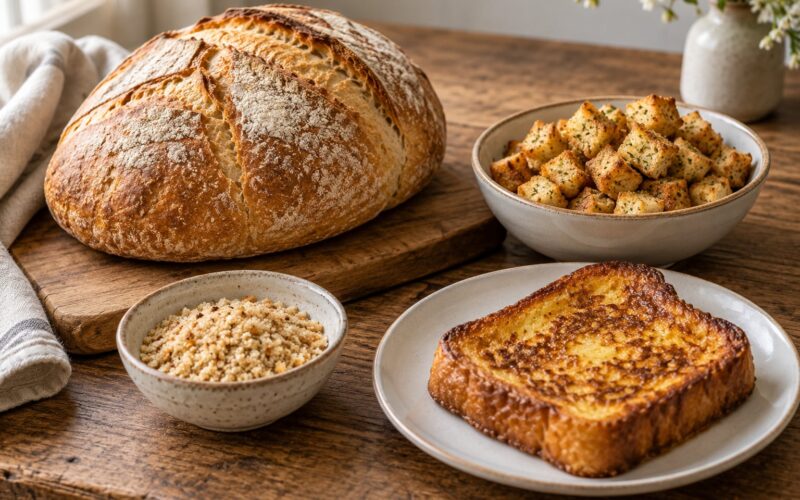
Are you supposed to use stale bread for bread pudding? No, but you are better off if you do. Stale bread has lost its surface moisture while keeping its starch structure, so it absorbs custard instead of dissolving into it. Bread that is a day or two old works well. Bread that is fresh from the bag soaks unevenly and leaves dry pockets inside the center of the pudding.
If your leftover bread is fresh, spread the torn pieces on a baking sheet and bake at 300 degrees for 10 minutes, then let it cool. That is enough to take the moisture out without turning it into croutons. If your bread is on the other end of the scale and dried hard, soak it in the custard for the full 30 minutes rather than 15, or the outside will turn to paste before the middle softens.
| Leftover bread | How it behaves | Adjustment |
|---|---|---|
| White sandwich loaf | The reliable default, soaks evenly | Use the standard ratio |
| Whole wheat or wheat | Denser and thirstier | Add 1/4 cup extra milk |
| Sourdough or rye | Very dense, holds together well | Add 1/2 cup extra milk and soak an extra 10 minutes |
| Brioche, challah, or enriched dinner rolls | Rich already, soaks fast | Reduce liquid by 1/2 cup, otherwise it turns to mush |
| Croissants or pain au chocolat | Flaky layers, very fast soak | Reduce liquid by 1/2 cup, tear rather than cube, add chocolate chips |
| Baguette or ciabatata | Crusty exterior, chewy inside | Standard ratio, cut into large chunks, remove heel pieces |
| Panettone | Sweety already, holds a lot of liquid | Cut the sugar by 1/4 cup |
| Bagels | Dense and chewy, pleasant texture | Standard ratio, slice then tear, good with cinnamon |
| Stale donuts or day-old cinnamon rolls | Sugar content way up, soaks very fast | Cut sugar by 1/3, reduce liquid by 1/2 cup, add 5 minutes of soak |
Whatever ends up in the dish works. A sourdough loaf, a bag of day-old rolls from the market, or a panettone left over from a holiday all land in the same place. The adjustments are small, and the forgiving middle of the recipe absorbs mistakes.
Step-by-Step: How to Make Bread Pudding With Leftover Bread
1. Choose and Prepare the Leftover Bread
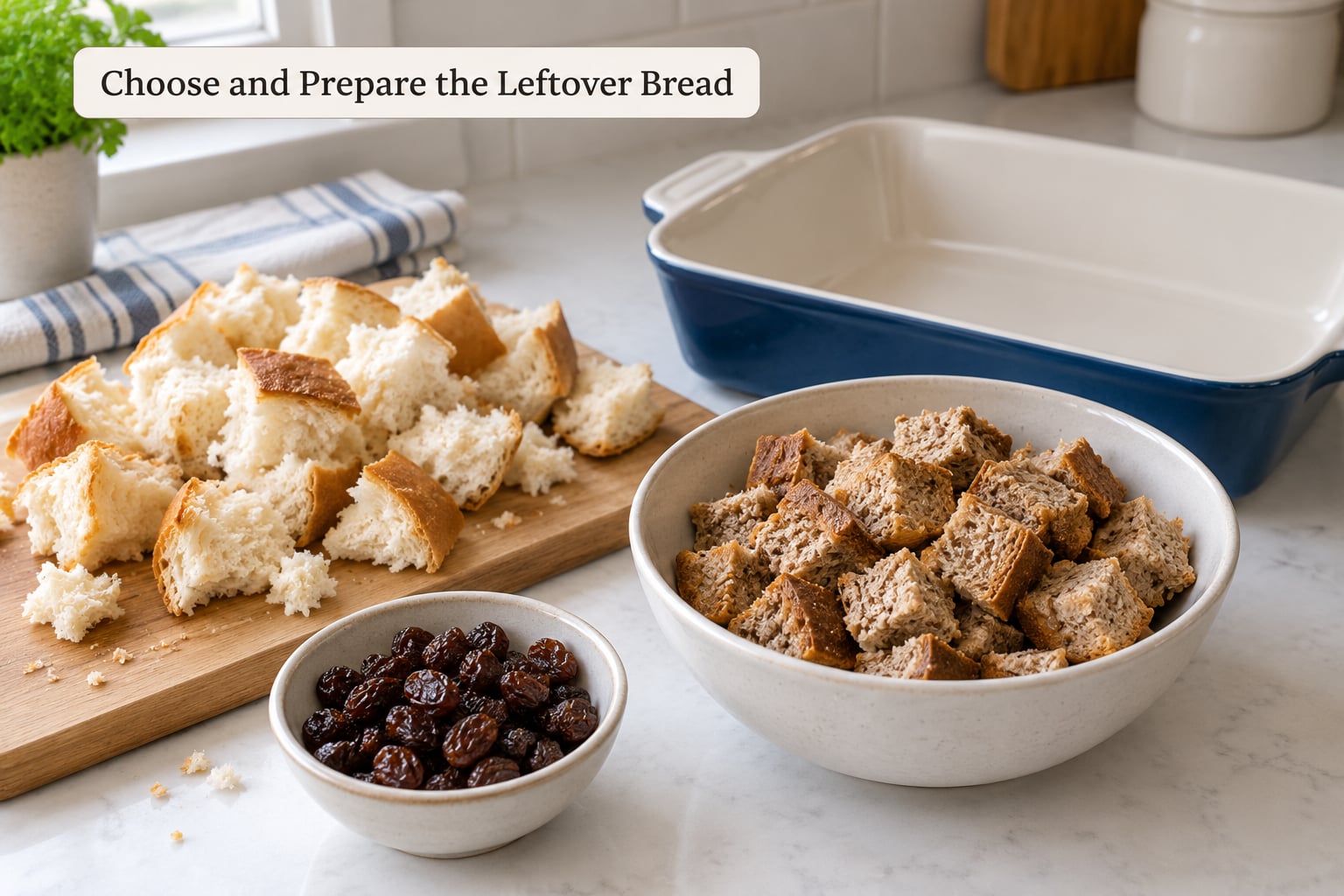
Tear the bread into chunks about the size of a walnut, or dice it with a serrated knife. 4 cups of torn bread is the amount you are aiming for, and it will look like more than you expect once it is in the bowl. Toss out anything rock hard, and cut the crusts off dense loaves if they are thick and chewy, since they stay tough through the whole bake.
Do not squeeze the bread to make it fit the measuring cup. Packing it is the most common reason a pudding ends up dense and pasty. Fill loosely, level the top, and move on. Prep takes about 10 minutes, and it is the step you can do a day ahead.
2. Mix the Egg and Milk Custard
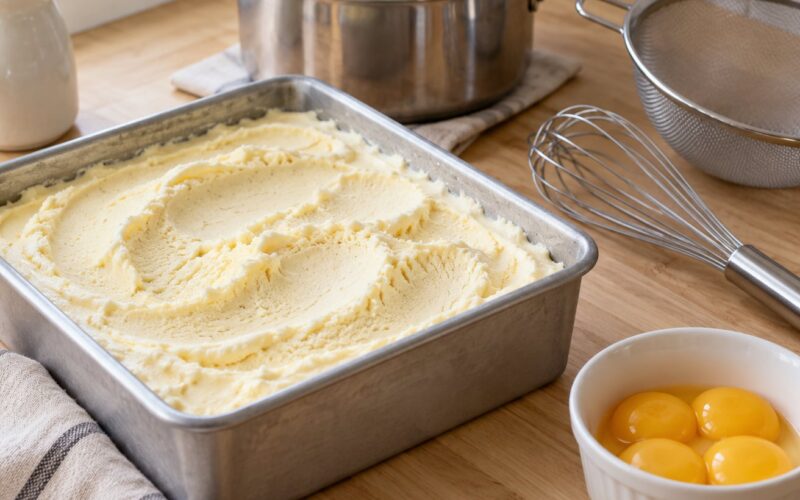
Whisk 3 large eggs with 3/4 cup brown sugar first, until the sugar dissolves and the mixture pales a little. Then stream in 2 cups of whole milk and 1/2 cup of heavy cream while whisking, followed by 1 tablespoon of vanilla, 2 teaspoons of cinnamon, a pinch of salt, and a grate of nutmeg. Whisk only until it is smooth and everything is combined, about a minute.
The sugar goes in first on purpose. Whisking it into the eggs dissolves it, and you avoid the gritty sugar streaks that show up when you dump it into a full liquid. Pushing hard for a long whisk adds air, and over-aerated custard bakes into a bouncy, spongy texture instead of something creamy and dense. Stop when it looks like plain cream.
3. Add Flavor and Optional Ingredients
Fold in 1/2 cup of raisins now, or leave them out if that is not your thing. A spoonful of rum or bourbon added with the raisins and left to sit for 15 minutes gives you the old-fashioned version, since the raisins plump instead of staying leathery. Ground cinnamon is already in; cardamom, a quarter teaspoon, is the other spice worth trying.
Other mix-ins that work: chocolate chips, chopped pecans or walnuts, apple chunks tossed with a little lemon juice to keep them from browning, or the zest of one orange to cut through a rich custard. Keep the total add-ins under a cup. Every extra solid takes up space the bread needs, and that is how a pudding turns heavy and wet in the center.
4. Soak the Bread Until Custardy
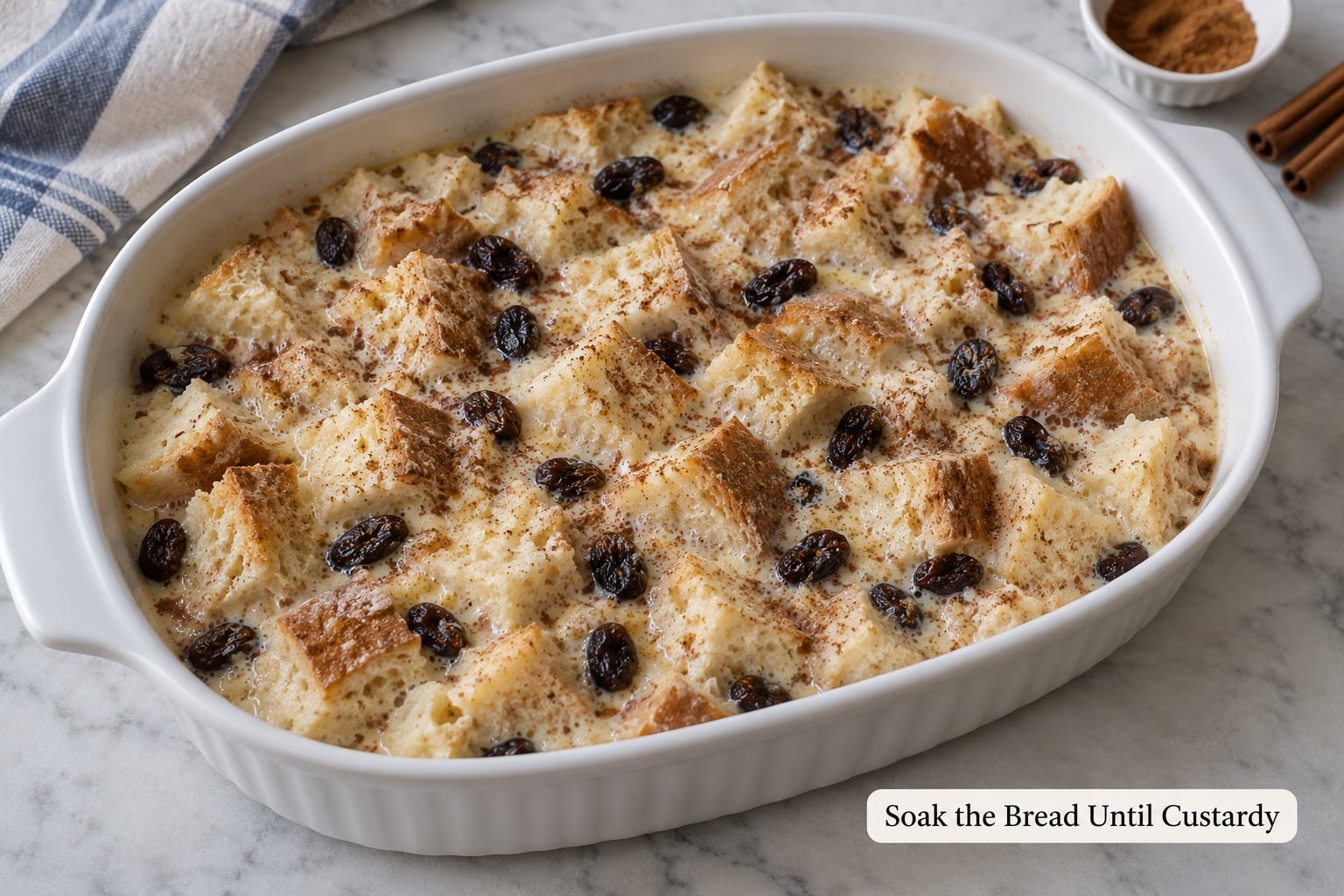
Add the bread and raisins to the custard bowl, pour the custard over the top, and press down with a spatula so every piece sits under the surface. Twenty to 30 minutes at room temperature is the standard, and an overnight soak in the fridge gives a noticeably firmer, more even set with deeper flavor. Longer soaking is the single highest-impact change you can make to an otherwise average pudding.
Here is the part that trips people up. When the bread is done soaking, the mixture should look loose and wet, with custard standing in the gaps between the chunks. It looks like a mistake. It is not, and it firms up in the oven as the eggs set. If the top of the bread is still dry and floating, press it down and give it five more minutes rather than dumping in more liquid.
5. Bake Until Golden and Set
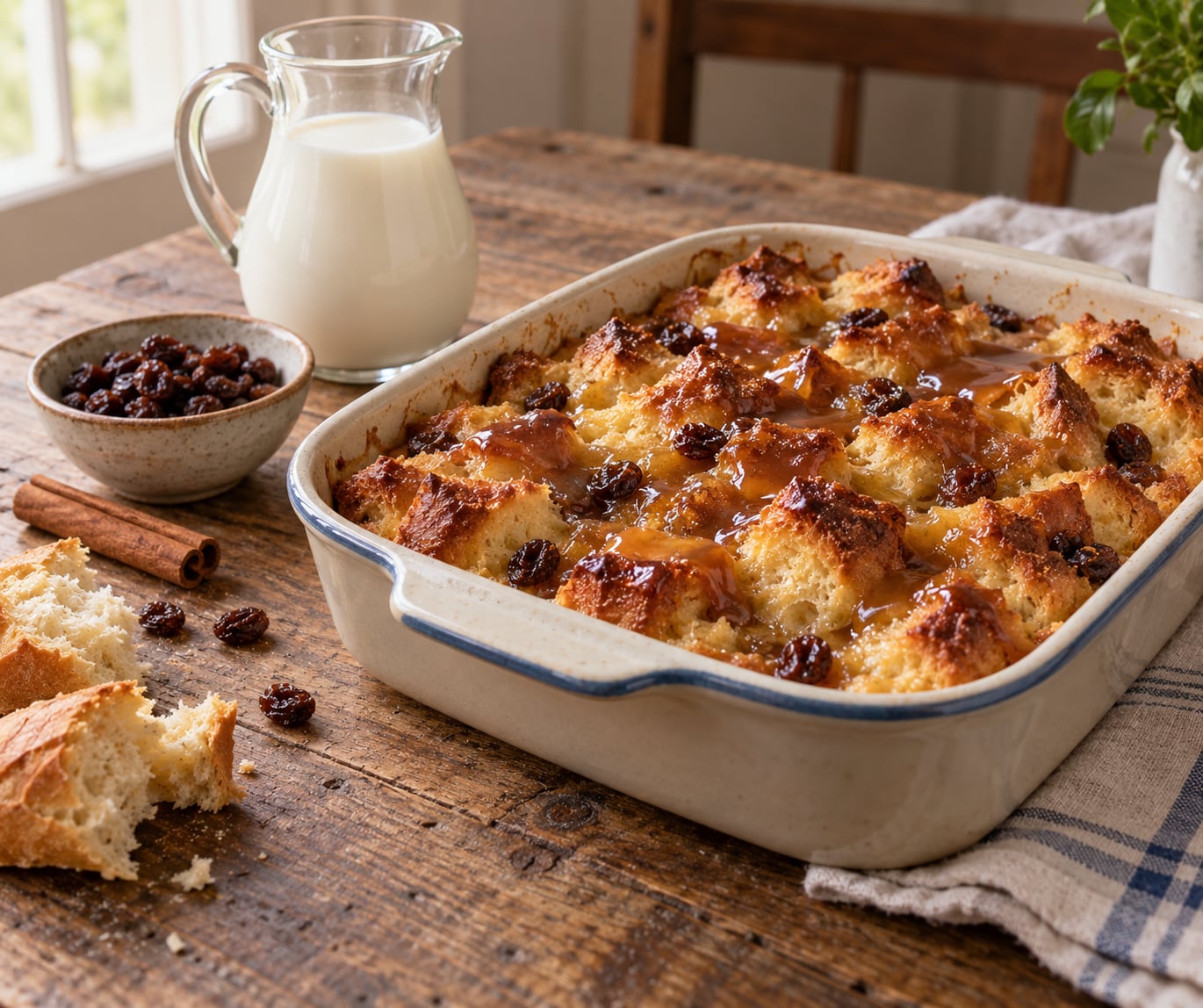
Heat the oven to 350 degrees. Butter a 9×13-inch baking dish, spread the soaked bread in an even layer about 2 inches deep, and scatter 2 tablespoons of brown sugar over the top for a crisp sugary crust. Cover with foil for the first 25 minutes so the top does not brown before the middle sets, then pull it off and bake another 20 to 25 minutes, until the top is golden brown and the edges have pulled slightly from the dish.
Start checking at 40 minutes with a knife in the very center. The custard should be set and give only slightly when you nudge the blade, and the internal temperature should read 160 degrees. A knife that comes out wet means 5 to 10 more minutes, not a panic. The raw custard carries eggs, so treat it like any other uncooked egg dish and keep it hot until the center is fully set.
6. Cool, Serve, and Store
Let the pudding rest in the dish for 20 to 30 minutes before cutting. The center is still cooking as it cools, so cutting early gives you a runny slice, and the rest is also what firms up the structure enough to hold together on a plate.
A five-minute caramel sauce is the classic pairing. Melt 1/2 cup of brown sugar with 2 tablespoons of butter and 3 tablespoons of heavy cream in a small saucepan over medium heat, stir until smooth, and pour it over the top right before serving. A warm vanilla sauce, cold cream, a scoop of vanilla ice cream, or a dusting of powdered sugar all work just as well.
Covered in the fridge, it keeps 3 to 4 days. To freeze, cool it completely, wrap the dish in foil, and freeze for up to 3 to 4 months. Thaw in the fridge overnight, then warm it covered at 350 degrees for 10 to 15 minutes. A splash of cream poured over the top before reheating keeps the middle from drying out. If you are serving a crowd, this is also the one dessert that happily travels, and a covered dish holds its heat well for an hour.
Common Mistakes and How to Fix Them
Almost every bad bread pudding traces back to the same three variables: liquid, soak time, and pan depth. Once you know which one bit you, the fix takes one adjustment next time.
Why the middle turns out soggy or watery
This is the number one complaint in every forum thread on the subject. The cause is almost always too much liquid for the bread, or too little time for the bread to drink it. Remember that stale bread is not dry, it is structurally open, so it keeps absorbing even after it looks saturated. Weigh your bread loosely, stay at the ratio above, and give it the full 30 minutes.
If a finished pudding is still loose, bake it another 5 to 10 minutes. If the top is already dark, tent it with foil. A watery pudding that has cooled also firms up overnight in the fridge, which is a decent rescue.
Why bread pudding comes out dry
Dryness comes from the other direction: bread that was too fresh, enriched bread with less crumb to hold liquid, or a bake that ran long. A fresh loaf needs the 300 degree dry-out first, and brioche or croissants need the liquid reduced. When in doubt, pull it at the low end of the time range and test with a knife rather than baking to the color alone.
Why bread pudding falls in the middle
Some collapse is normal and not a mistake. The eggs are the only thing giving the pudding structure, and the steam rising off the hot milk is what lifts it while it bakes. When that steam stops, the center settles. A deep dip is harmless; a hard crater usually means the middle was still liquid when it came out of the oven, so it never had structure to lose. Covering with foil for the first half of the bake prevents most of it.
Why bread pudding tastes too eggy
Too many eggs for the amount of bread. If your eggy flavor comes with a bouncy, rubbery texture, the custard is over-set: cut to 1 egg per 1 1/2 cups of bread, add more bread, or swap one whole egg for two yolks for a richer but lighter set. If the flavor is eggy but the texture is fine, it is usually a pan that was too deep, so the custard cooked before it could caramelize.
Why the top browns but the center is still raw
Direct oven heat reaches the surface while the middle lags by 20 minutes. That is what the foil is for. Cover after ten minutes, not 25, if your oven runs hot, and check the center with a knife at the 30 minute mark instead of waiting for the top. If your dish is more than 2 inches deep, split the batch rather than fighting the bake time.
Two habits prevent most problems. Weigh or loosely scoop your bread instead of guessing, and choose a pan where the soaked bread sits about 2 inches deep with room around the edge for the custard to set. Test doneness in the middle, every time, and trust the knife over the color.
Frequently Asked Questions
Are you supposed to use stale bread for bread pudding?
No, but you are better off if you do. Day-old or two-day-old bread works well because it has lost surface moisture while keeping its starch structure, so it drinks up the egg and milk custard without dissolving. Truly fresh bread soaks unevenly and leaves dry pockets. If yours is fresh, spread the torn pieces on a baking sheet, bake them at 300 degrees for 10 minutes, and let them cool before soaking.
How long do you bake bread pudding at 350 degrees?
A 9×13-inch dish takes 40 to 50 minutes at 350 degrees. Start checking at 40 minutes with a knife in the center. Deeper or smaller dishes need 5 to 10 minutes more, and if the top browns before the middle sets, tent it with foil for the last stretch. Baked from cold after an overnight soak, add 5 to 10 minutes to the total.
How do I know when bread pudding is done?
Insert a knife in the very center. It should come out clean or with a faint custard smear, never wet, and the internal temperature should read 160 degrees. The top should be golden brown and the edges will have pulled slightly from the dish. A pudding that still sloshes needs 5 to 10 more minutes, and it firms up further as it cools.
Can I make bread pudding ahead of time?
Yes, and it is the easiest way to cook for a crowd. Assemble it, cover the dish, and refrigerate for up to 12 hours before baking. Bake from cold and add 5 to 10 minutes to the stated time, since the cold custard takes longer to reach 160 degrees. The long slow set gives a slightly firmer, more even pudding than a same-day bake.
How do I reheat bread pudding without drying it out?
Cover and warm it in a 350 degree oven for 10 to 15 minutes, or microwave a single serving for 45 to 60 seconds. Pour a splash of milk or cream over the top first to keep the interior creamy. Reheating uncovered dries the edges quickly, which is the fastest way to ruin a pudding that was otherwise good.
How long does bread pudding keep, and can I freeze it?
Covered in the fridge it keeps 3 to 4 days. To freeze, let it cool completely, wrap the dish tightly in foil, and freeze for up to 3 to 4 months. Thaw it in the fridge overnight rather than on the counter, then warm gently. Freezing softens the crumb slightly, so thawed portions taste best served warm.
Start with the simple version: 4 cups of torn bread, 3 eggs, 2 cups of milk, 1/2 cup of cream, 3/4 cup of brown sugar, and cinnamon. Soak it 30 minutes, bake it covered at 350 degrees, and check the center at 40 minutes with a knife.
Once that one works, the only real variable is the bread. Rich or fresh bread gets less liquid and a shorter soak; dense or stale bread gets more liquid and a longer one. That adjustment is the whole difference between a decent bread pudding and the one people ask you for the recipe of.