You should bake with a kitchen scale because a cup of flour is not a fixed amount of anything. Weighing ingredients by mass removes the guesswork from packing and scooping, so a recipe that works on a Tuesday works again on Saturday, and it lets you scale the same dough up or down without losing your ratios.
There is one more practical reason worth naming early. If you learn to read a scale, you can bake from any recipe, including the metric ones, without owning a full set of British measuring jugs.
Table of Contents
- Why You Should Bake With a Kitchen Scale?
- How Does a Kitchen Scale Make Baking More Accurate?
- Packing density is the whole problem
- Density is why a cup of oil and a cup of milk never match
- What Changes When You Weigh Baking Ingredients?
- Why you should bake with a kitchen scale for repeatability
- Scaling up and down works only from weights
- How to Use a Kitchen Scale for Recipes
- Set the scale up once, properly
- Weigh straight from the bag instead of pre-measuring
- Reading the display
- Converting a volume recipe to weights
- Should You Use Grams or Ounces?
- Which Recipes Benefit Most From Weighing?
- What Are the Limits of a Kitchen Scale?
- The four traps that ruin a weighed bake
- When a measuring cup is perfectly fine
- Frequently Asked Questions
- How do I convert cup measurements to grams?
- How do I weigh flour correctly on a kitchen scale?
- Do I need a kitchen scale for bread baking?
- What accuracy and capacity should I look for in a scale?
- When are measuring cups still the better choice?
- Conclusion
Why You Should Bake With a Kitchen Scale?
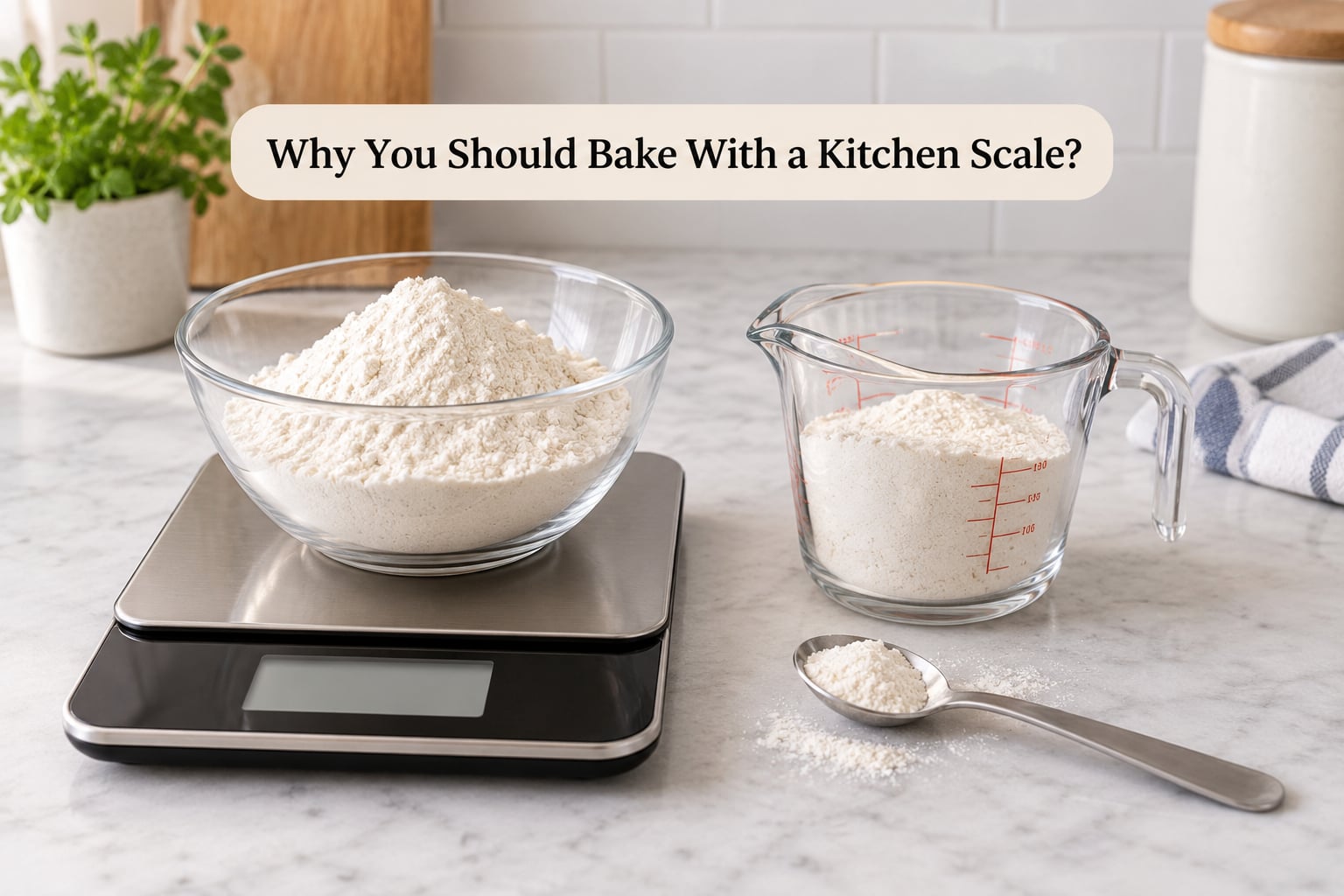
Bake by weight for three reasons: volume measurement is variable, weight measurement is exact, and the difference shows up in the texture of the bake. A quarter cup more flour is not a small error. In a cookie it means a flatter, drier cookie, and in a cake it means a denser crumb.
The clearest way to see this is to look at what reputable sources publish for the same ingredient. Deb Perelman of Smitten Kitchen put it plainly: a cup of flour, packed different ways, can weigh anywhere from 4 to 7 ounces. That is a 3-ounce spread on a single ingredient in a single recipe, and no baker involved is doing anything wrong.
A cup of flour, packed different ways, can weigh anything from 4 to 7 ounces. But a 4.5 ounce cup will always be a 4.5 ounce cup.
Deb Perelman, Smitten Kitchen
Samuel Fromartz made the same point on Food Network, quoted later by Mashed: if one person measures a cup of flour and another does the same, the two amounts will not match. Nobody is cheating. Volume simply does not hold still the way mass does.
How Does a Kitchen Scale Make Baking More Accurate?
It helps by removing four separate errors at once: how tightly the ingredient is packed, how the cup is filled, how the ingredient sits in the measuring cup, and the small difference between one level scoop and the next.
Packing density is the whole problem
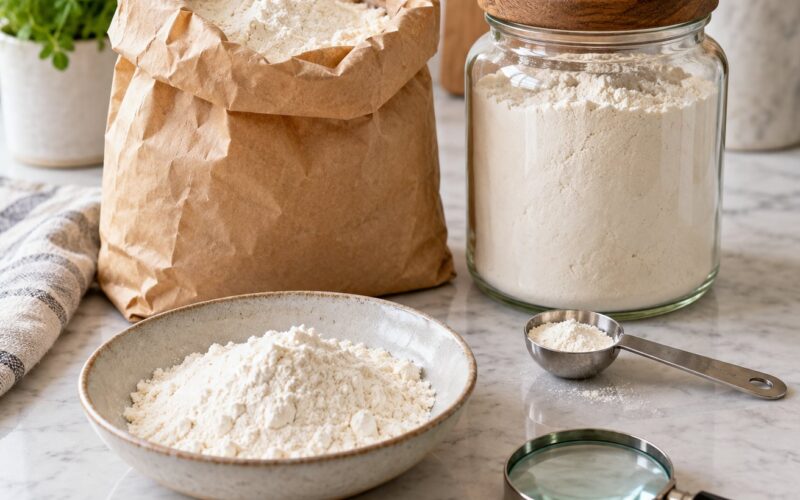
Packing density is how much space a given weight of ingredient takes up. Scoop a cup of flour from the bag and tap it level, and you get one weight. Dip a measuring cup into the bag, shake off the excess and level it, and you get a heavier weight. Pack that cup down with the back of a spoon and you get heavier still.
Brown sugar is the extreme case, which is why recipes tell you to pack it. Its weight depends almost entirely on how hard you compress it. Flour, cocoa powder, powdered sugar and nutmeats all behave the same way, just less dramatically.
Density is why a cup of oil and a cup of milk never match
Density is the mass an ingredient occupies per unit of volume, and it differs from one ingredient to the next. One cup of water weighs 240 grams. One cup of milk weighs about the same, around 240 grams. One cup of granulated sugar weighs roughly 200 grams, and one cup of honey weighs about 340 grams. All of them fill the same cup.
This matters whenever a recipe mixes volume units with weight units, or when someone converts a metric recipe by guessing at cups. The guess is never neutral, because the ingredients do not weigh the same per cup.
Here is the disagreement table, and it is the whole argument in miniature. These are the published weights for one cup of plain all-purpose flour, scoop and level, in US recipes:
| Source | One cup of all-purpose flour | In ounces |
|---|---|---|
| King Arthur Baking | 120 g | 4.2 oz |
| Deb Perelman, Smitten Kitchen | about 130 g | 4.6 oz |
| America’s Test Kitchen | 140 g | 4.9 oz |
| Same cup, packed down instead of scooped | about 155 g | 5.5 oz |
| Same cup, loosely filled straight from the bag | about 115 g | 4.1 oz |
Three reputable kitchens disagree by 20 grams on the same cup. Add in the way it was filled and the range widens past 40 grams, which is close to a third of the ingredient. Now multiply that error across the other dry ingredients in a cake and you have a different recipe.
What Changes When You Weigh Baking Ingredients?
What changes is repeatability first, and everything else follows from it. Weighing does not make you a better baker, but it makes the same baker produce the same result repeatedly, which is what lets you actually learn from a failure.
Why you should bake with a kitchen scale for repeatability
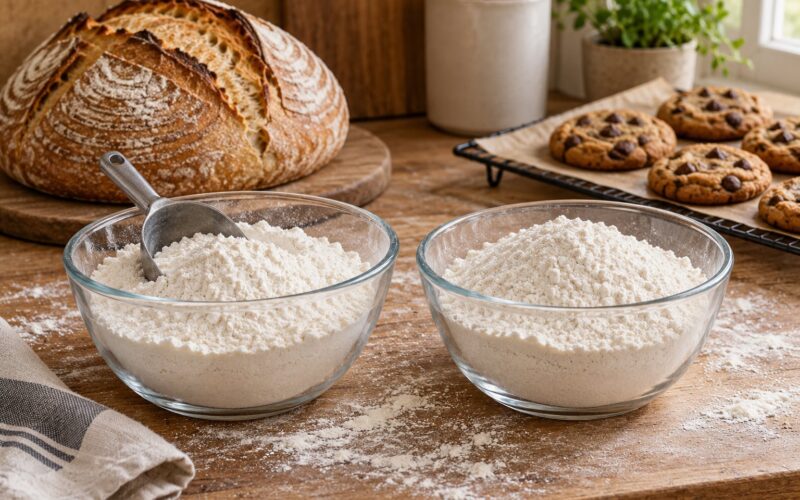
Cookies are where most people notice first. Scooped and level dough balls vary in size by a few grams each, and a slightly larger ball spreads more in the oven. Portion the same dough into identical weights and every cookie bakes the same way.
Cake layers behave the same way through the tin. Equal batter weights per tin means equal bake times, and one layer does not come out drier than the other. Frosting and ganache get easier too, because butter and powdered sugar get weighed rather than estimated.
Bread is the one most bakers care about. A dough is mostly flour and water, so a 10 percent error in the flour changes hydration without changing the recipe. That is the difference between a slack, spread loaf and one that holds its shape. Weighing flour and water is how sourdough bakers talk about hydration in the first place.
Laminated pastry is the opposite case, where a small change in butter temperature and weight matters more than in any other dough. When butter is a number on the display rather than a guess at a slab, the layers stay even.
Scaling up and down works only from weights
Scaling a volume recipe means multiplying cups, and the error multiplies with them. Doubling a recipe that was already 20 grams light on flour gives you 40 grams of error instead of 20.
Weights scale cleanly. A cookie formula of 300 grams of flour, 200 grams of sugar and 150 grams of butter is 3-2-1.5, and you can run it at half, double or any multiple in between, and the ratio never drifts. That habit is the doorway to baker’s percentages, where the flour is 100 percent and every other ingredient is written as a percentage of it.
There is a practical bonus. Weighing straight into the bowl you are mixing in removes the measuring cups, the spoons and the pile of small dishes that usually sit on the counter during a bake. Fewer dishes is not a small thing at the end of a long afternoon.
How to Use a Kitchen Scale for Recipes
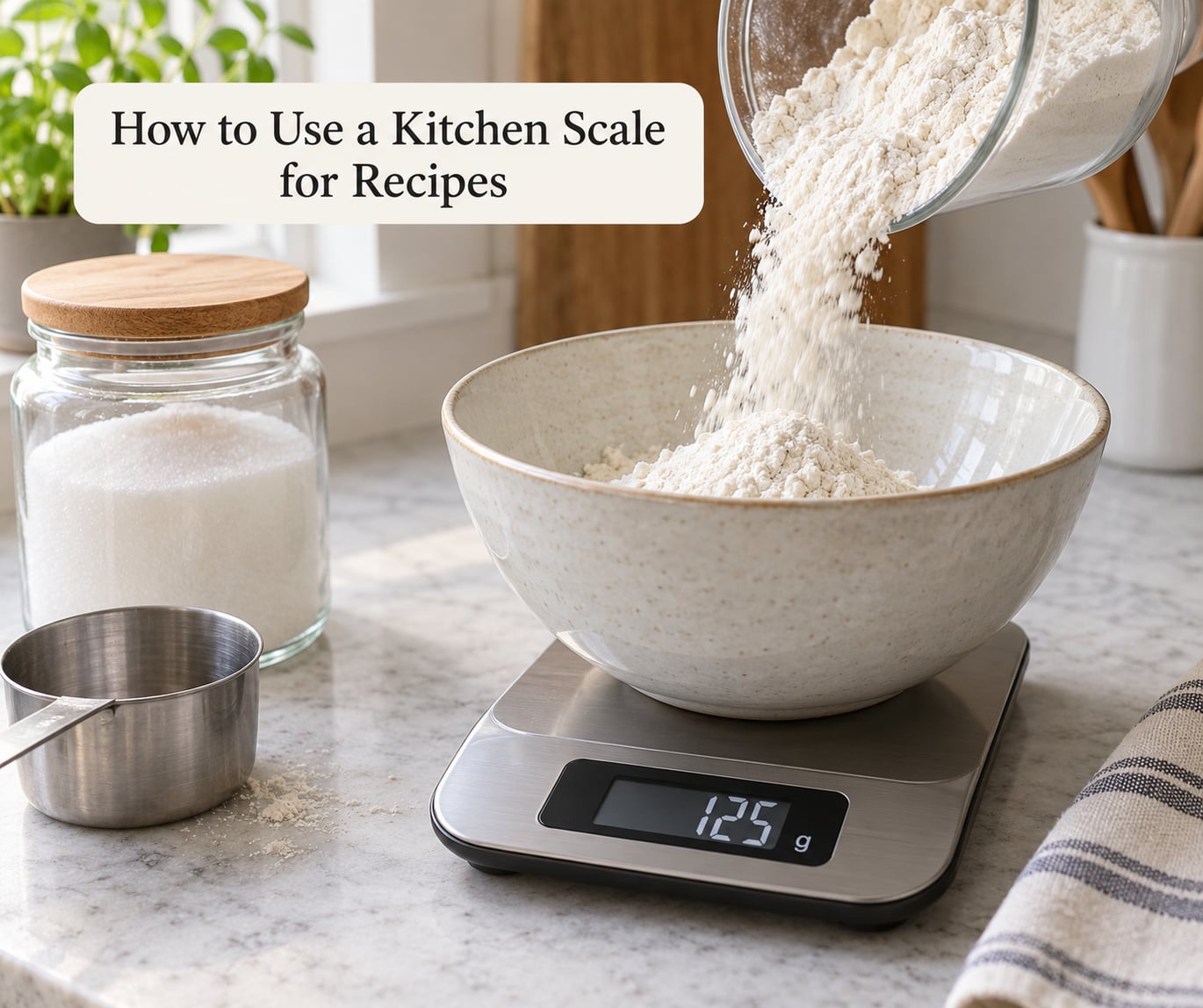
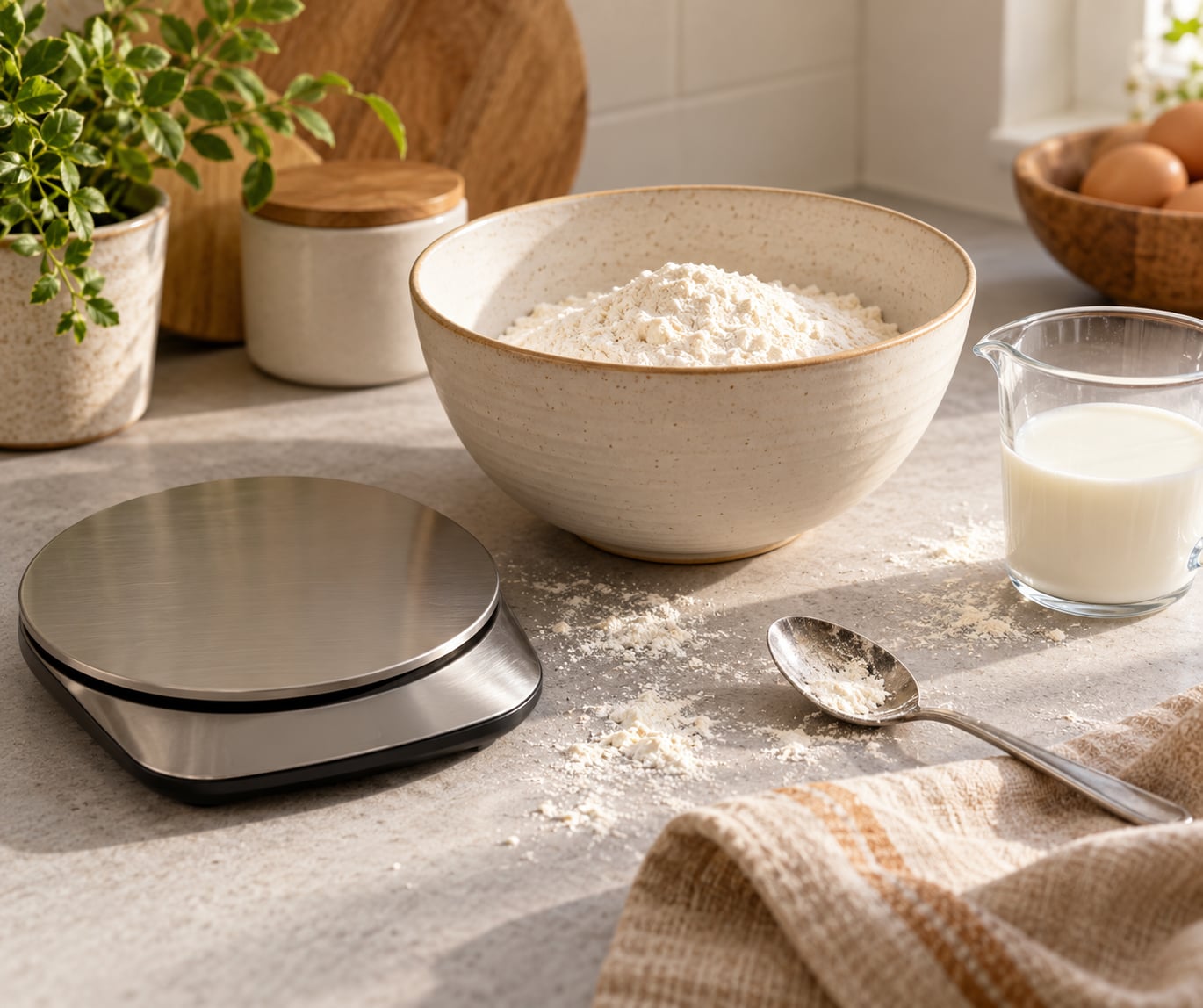
Set the scale on a flat, hard counter away from vibration, switch it to grams, and let it settle for a few seconds. Most digital scales drift slightly for the first moments after you move them, and a flat surface is what keeps the load cell reading steady.
Set the scale up once, properly
- Put the scale on a hard flat surface, not a cutting board or a folded towel.
- Turn it on and set the unit to grams. Grams avoid the decimal confusion of pounds and ounces.
- Wait a few seconds until the display settles at zero before you add anything.
- Press the tare or zero button with an empty bowl sitting on the platform.
Taring is the step people skip, and it is the one that makes single-bowl mixing possible. With the bowl on the scale and the reading zeroed, add flour to 300 grams, press tare, add sugar to 200 grams, press tare, and keep going. The display only ever shows what you just added.
Add in two stages for anything dry. Get close to the target, then add the last few grams slowly, because flour shifts as it settles and the reading drifts while you pour.
Weigh straight from the bag instead of pre-measuring
Place the bag of flour on the scale, tare it, then scoop out flour until the display shows the amount you need, and knife off the excess. This divide-in-place method means you never scoop and then re-scoop, and the difference between 120 and 130 grams becomes visible rather than theoretical.
For liquids, set the scale under an empty measuring jug, tare it, and pour. A note on the milliliter setting below, because it catches almost everybody once.
Reading the display
When a scale shows pounds and ounces, the number before the colon is pounds and the number after is ounces. So 1:12.7 is one pound and 12.7 ounces, which is a little under two pounds. A 3:00 reading is exactly three pounds.
Many scales also read small negative numbers, which happens when you press tare with something on the platform and then remove it. That is not a broken scale, and it is also what lets you subtract a container’s weight from a measurement taken in a different container.
Converting a volume recipe to weights
You do not need a special chart. Look up the grams-per-cup figure for the ingredient, multiply by the number of cups, and round to a sensible number.
A chocolate chip cookie calling for 2 cups of all-purpose flour becomes 2 times 120 grams, so 240 grams. 3/4 cup of granulated sugar at 200 grams per cup becomes 150 grams. Half a cup of butter at 227 grams per cup is 113 grams, which is one US stick. Work through a recipe line by line like that and the conversion takes about five minutes.
Be honest about the precision here. Different sources list different grams-per-cup, so your converted recipe is a good recipe, not the original recipe. It will still be repeatable, which is more than the cup version offered.
Should You Use Grams or Ounces?
Use grams. Ounces work fine and American recipes use them by default, but grams are the international baking standard, every metric recipe is written in them, and a 1 gram resolution reads far more clearly on a small display than 0.1 of an ounce.
There is a familiar snag on the imperial side. American recipes call for butter by the stick, one stick being 113 grams, while metric recipes come as a 200 gram block. A recipe written for metric butter that gets handled with a US stick wrapper is how people accidentally double the butter in a dough.
| Ingredient | One cup | One tablespoon |
|---|---|---|
| All-purpose flour | 120 g (4.2 oz) | 8 g |
| Bread flour | 127 g (4.5 oz) | 8.5 g |
| Whole wheat flour | 113 g (4 oz) | 7.5 g |
| Granulated sugar | 200 g (7 oz) | 12.5 g |
| Light brown sugar, packed | 213 g (7.5 oz) | 13 g |
| Confectioners sugar | 113 g (4 oz) | 7.5 g |
| Butter | 227 g (8 oz, 4 sticks) | 14 g |
| Water | 240 g (8.5 oz) | 15 g |
| Whole milk | 240 g (8.5 oz) | 15 g |
| Vegetable oil | 218 g (7.7 oz) | 13.5 g |
| Honey | 340 g (12 oz) | 21 g |
| Cocoa powder | 85 g (3 oz) | 5.5 g |
| Rolled oats | 90 g (3.2 oz) | 6 g |
| Chocolate chips | 170 g (6 oz) | 10.5 g |
| Chopped walnuts | 115 g (4 oz) | 7 g |
| One large egg | 50 g without the shell | not applicable |
Two notes on the table. Oils vary by type, so a bottle of olive oil will not match a bottle of refined canola exactly, and a stick of butter is 113 grams while a metric block is 200 grams, which is worth writing on the wrapper.
Which Recipes Benefit Most From Weighing?
The recipes that benefit most are the ones with a high ratio of dry flour to everything else, and the ones where a small amount of an ingredient does a lot of work. Yeast, salt, baking powder and almond extract all fall into the second group.
| Recipe | What the weight buys you |
|---|---|
| Sourdough and bread dough | Accurate hydration, which is the number the whole dough hangs on |
| Pizza dough | The same hydration every time, so bakes behave the same way |
| Puff pastry and croissants | Even butter layers; butter measured by weight stays at a workable temperature |
| Macarons | Finely tuned meringue and batter ratios, where a 2 gram shift changes the shells |
| Meringue and custard | Eggs, cream and sugar weighed so the finished texture is repeatable |
| Cookies | Identical dough balls, so every one spreads and browns the same |
| Cake layers | Equal batter per tin means equal bake time |
| Icing and buttercream | Powdered sugar and butter weighed rather than guessed |
| Yeast, salt, leavening, extracts | The amounts that are small enough for a spoon to be a blunt instrument |
Brown sugar deserves a line of its own. Weighing it means the packing step simply disappears, which longtime bakers in comment threads consistently call the best part of the switch.
What Are the Limits of a Kitchen Scale?
A scale measures mass, not volume, and a recipe written in cups is still a recipe written in cups. A scale cannot rescue a formula that was never tested, and it cannot fix flour that has gone rancid or a chocolate that has seized. It fixes one variable, the one most bakers are fighting.
The four traps that ruin a weighed bake
- The milliliter setting is calibrated for water. One milliliter of water is exactly one gram; one milliliter of oil is not. A baker who poured oil into a jug on the milliliter setting and read that as grams ended up with an unpleasantly oily cake, and it is a well-documented mistake.
- Capacity limits stop the recipe mid-pour. A scale that maxes out at 5 pounds can zero out partway through adding flour and lose everything already in the bowl. Check the maximum weight on the base before a big batch, and buy for the biggest recipe you make, not the smallest.
- Dry cups and liquid cups are different sizes. A dry cup is filled and leveled, a liquid cup is filled to a line further down. A US fluid ounce and a UK fluid ounce are not the same measure either. Mixing them up is how a metric recipe ends up 15 percent heavy on liquid.
- 1 gram resolution runs out on the tiny stuff. Fine for bread and cakes. Too coarse for a teaspoon of yeast or a 3 gram pinch of saffron, which is the one case where a 0.1 gram scale earns its counter space. Many bakers keep a small spoon for vanilla and a scale for everything else.
When a measuring cup is perfectly fine
Any recipe where the leavening is forgiving and the ingredient list is short. A plain loaf cake, a batch of brownies, a soup. In those, a level cup gets you a good bake, and the extra step is not worth it.
Measurements by volume also remain genuinely convenient for stable liquids in larger quantities, where a jug is faster and more accurate than pouring onto a scale in stages. Nobody is wrong to reach for a jug of water.
The honest framing is this. A Reddit thread arguing that weighing is elitist has a fair point for many recipes. Cooking is not a laboratory, and most food does not need 0.1 gram precision. But once a recipe has a real ratio in it, once the flour, butter and sugar have to relate to each other in exact proportion for the texture to come out right, volume stops being a shortcut and starts being the reason the same recipe gave you a good cake last month and a flat one this week.
Frequently Asked Questions
How do I convert cup measurements to grams?
Find the grams-per-cup figure for the ingredient in a baking weight table, then multiply by the number of cups. Two cups of all-purpose flour at 120 grams per cup is 240 grams. Three-quarters cup of sugar at 200 grams per cup is 150 grams. Round to a sensible number, because published grams-per-cup figures disagree by up to 20 grams, so a converted recipe is repeatable rather than exact.
How do I weigh flour correctly on a kitchen scale?
Set the scale to grams, wait until the reading settles at zero, and decide whether you are measuring packed or scooped. Most published figures assume a scoop, level and no shaking. Add flour in two stages, getting close first, then the last few grams slowly, because the display drifts as flour settles. Weigh into the mixing bowl if you can, since pouring back and forth loses flour to the bench.
Do I need a kitchen scale for bread baking?
It helps more for bread than for almost anything else, because dough is mostly flour and water, so an error in the flour changes hydration without changing the recipe. A 10 percent swing in flour is the difference between a slack, spreading loaf and one that holds shape. That is why sourdough bakers describe hydration as a percentage of flour weight in the first place, and why a scale is standard equipment in bread bakeries.
What accuracy and capacity should I look for in a scale?
A 1 gram resolution scale handles bread, cookies, cakes, dough and almost every baking recipe. A 0.1 gram scale only matters for macarons, meringue, yeast-forward starters and very small spice amounts. For capacity, check the maximum weight on the base and buy for your largest recipe, since a low maximum scale can zero out mid-pour and lose the work already done. A tare button is the other feature worth insisting on.
When are measuring cups still the better choice?
For short ingredient lists where the leavening is forgiving, such as a plain loaf cake, brownies or a soup. Large volumes of stable liquids are also faster in a jug than poured onto a scale in stages. The rule of thumb is that a scale pays off once a recipe has a real ratio in it, where flour, butter and sugar must relate to each other exactly for the texture to work.
Conclusion
Why you should bake with a kitchen scale comes down to one sentence: a cup is a guess, and a weight is a fact. Weighing removes the variables that make the same recipe land differently twice in a row, and it scales cleanly when you want a double batch or a single portion.
Start with one recipe you have already made from cups. Weigh it exactly, compare the two side by side, and keep the scale out on the counter. Most bakers reach for it themselves from there, because counting the dishes you did not dirty is its own kind of convincing.