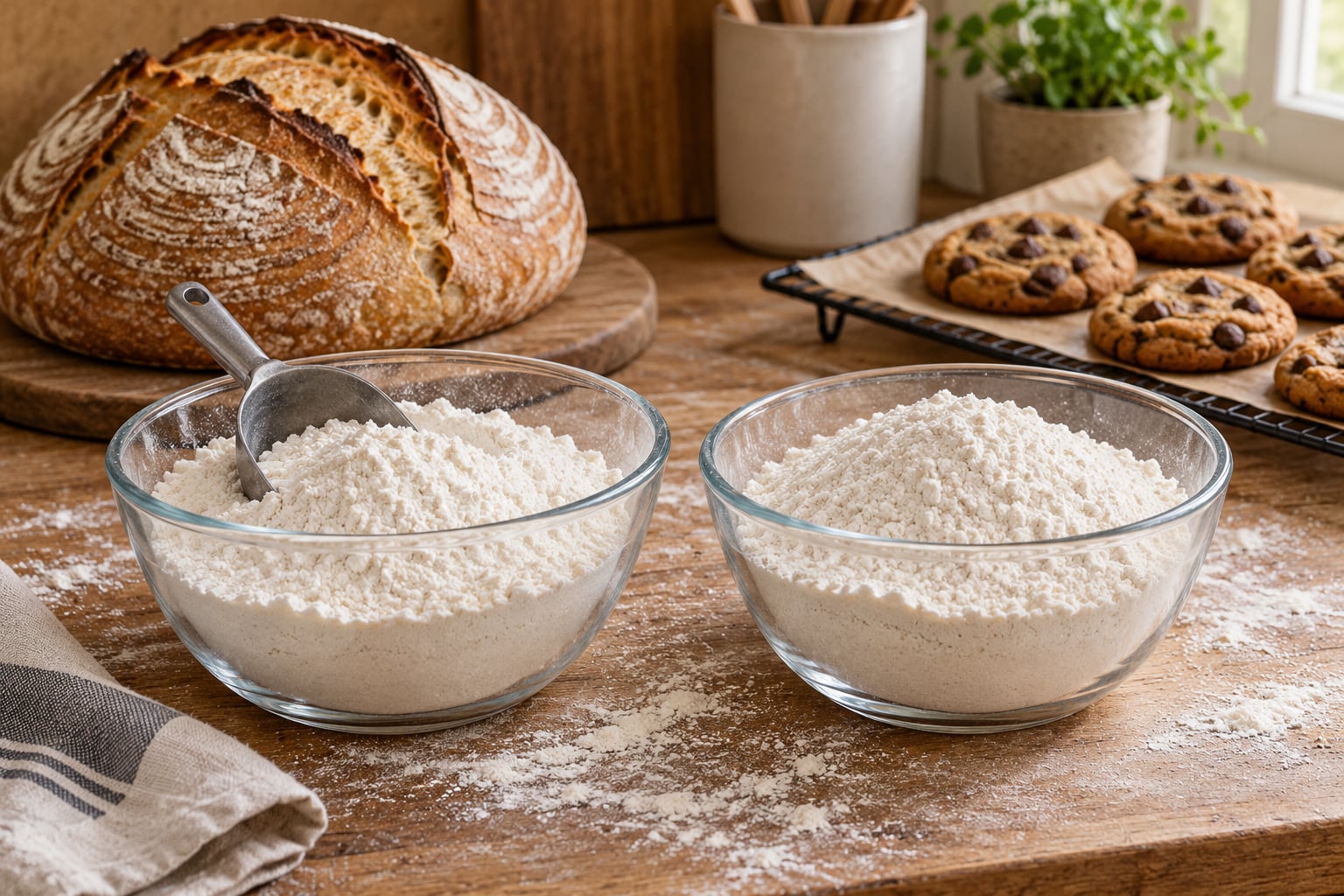
The difference between bread flour and all-purpose flour is protein content. Bread flour runs about 12-14% protein and all-purpose flour about 9-12%, and that protein turns into gluten when flour meets water. More gluten means a stronger dough that rises higher and bakes chewier. Less gluten means a tender crumb that cakes and biscuits depend on.
That is the whole answer, but it leaves the practical part open: which bag goes on the counter for the thing you are baking tonight, and what happens if you grab the wrong one. A loaf of country bread, a tray of pizza dough, and a layer cake want three different answers.
Both flours are refined white wheat flour, meaning the bran and germ are milled out. What remains is starch and two protein families, glutenin and gliadin, that link into gluten when you hydrate and work the dough. The difference between the two bags is how much of that protein survived the milling and blending process.
Table of Contents
- What Is the Difference Between Bread Flour and All Purpose Flour at a Glance
- How Protein and Gluten Affect the Dough
- How to read the protein number on the bag
- What Is the Difference Between Bread Flour and All Purpose Flour in Texture?
- How Hydration and Yeast Handling Change
- What to do if you grabbed the wrong bag
- How Flavor, Color, and Baking Time Differ
- Can You Use Bread Flour in Place of All-Purpose Flour?
- All-purpose flour for bread flour
- Bread flour for all-purpose flour
- How to make bread flour from all-purpose flour
- Which Should You Choose?
- Frequently Asked Questions
- Is bread flour healthier than all-purpose flour?
- What protein percentage should home bakers look for?
- Can I use all-purpose flour to make bread?
- Is bread flour better for cookies and cakes?
- Does bread flour need to be sieved before use?
- Choose by Your Recipe, Not the Flour Name
What Is the Difference Between Bread Flour and All Purpose Flour at a Glance
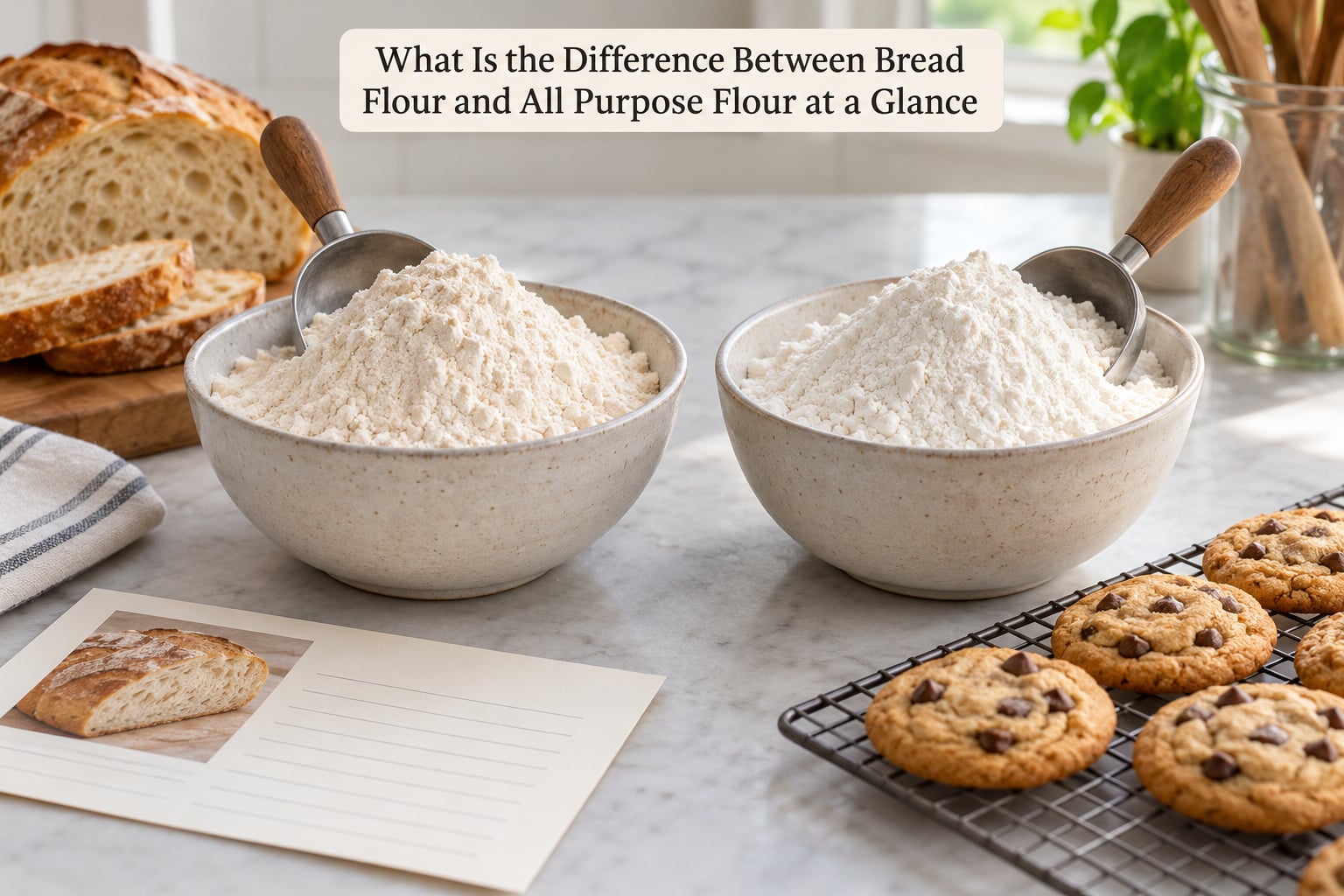
| Factor | Bread flour | All-purpose flour |
|---|---|---|
| Protein content | 12-14% | 9-12% |
| Gluten strength | Strong, elastic, shape-holding | Moderate, forgiving, tender |
| Water absorption | Higher; wants more liquid | Moderate; holds shape easily |
| Milled from | Mostly hard red spring wheat | Hard red winter or a blend with soft wheat |
| Flavor and color | Mild, slightly deeper bake color | Mild, neutral, pale white |
| Crumb result | Open, chewy, irregular holes | Tender, fine, even crumb |
| Best uses | Rustic loaves, baguettes, bagels, pizza, pretzels, doughnuts | Cookies, cakes, muffins, biscuits, pie crust, beginner sandwich bread |
| Works without recipe adjustment | No, if the recipe was written for AP | Yes, for most everyday baking |
Read the last row twice, because it is where most home bakers get tripped up. All-purpose flour is the forgiving default that recipes are written around. Bread flour is the specialist: better at its job, and less forgiving when you use it outside that job.
How Protein and Gluten Affect the Dough
Protein content is the only real difference between the two flours. Everything else follows from it. When water is added and the dough is kneaded or stretched, glutenin and gliadin proteins unfold and bond into long elastic strands. That network is what holds bubbles of carbon dioxide released by yeast, and what stops the walls of a loaf from collapsing under their own weight.
More protein means more strands, so a bread-flour dough can be pushed further: longer rises, sharper oven spring, a shape that survives a second rise, and a crumb with holes you can see from across the counter. All-purpose flour builds enough network for a decent loaf, just not enough for the dramatic rise and open crumb of an artisan bread.
More protein is not automatically better. A cake wants a weak, short gluten network so the crumb stays tender. Bread flour in a cake gives you a dense, chewy, slightly bouncy crumb that most people do not want.
How to read the protein number on the bag
Flour labels vary more than most people expect, which is why “high protein” on its own tells you almost nothing. King Arthur Baking lists all-purpose at 11.7% protein and its bread flour at 12.7%. Gold Medal unbleached all-purpose sits around 10.5%. Bleached all-purpose brands such as White Lily run lower, closer to 8-9%.
So two bags both labeled all-purpose can behave differently, and one bag labeled all-purpose can outperform a cheap bag labeled bread. Weighing with a kitchen scale instead of measuring cups is worth it here, since flours differ in density per volume and a cup of one is not the same weight as a cup of the other.
What Is the Difference Between Bread Flour and All Purpose Flour in Texture?
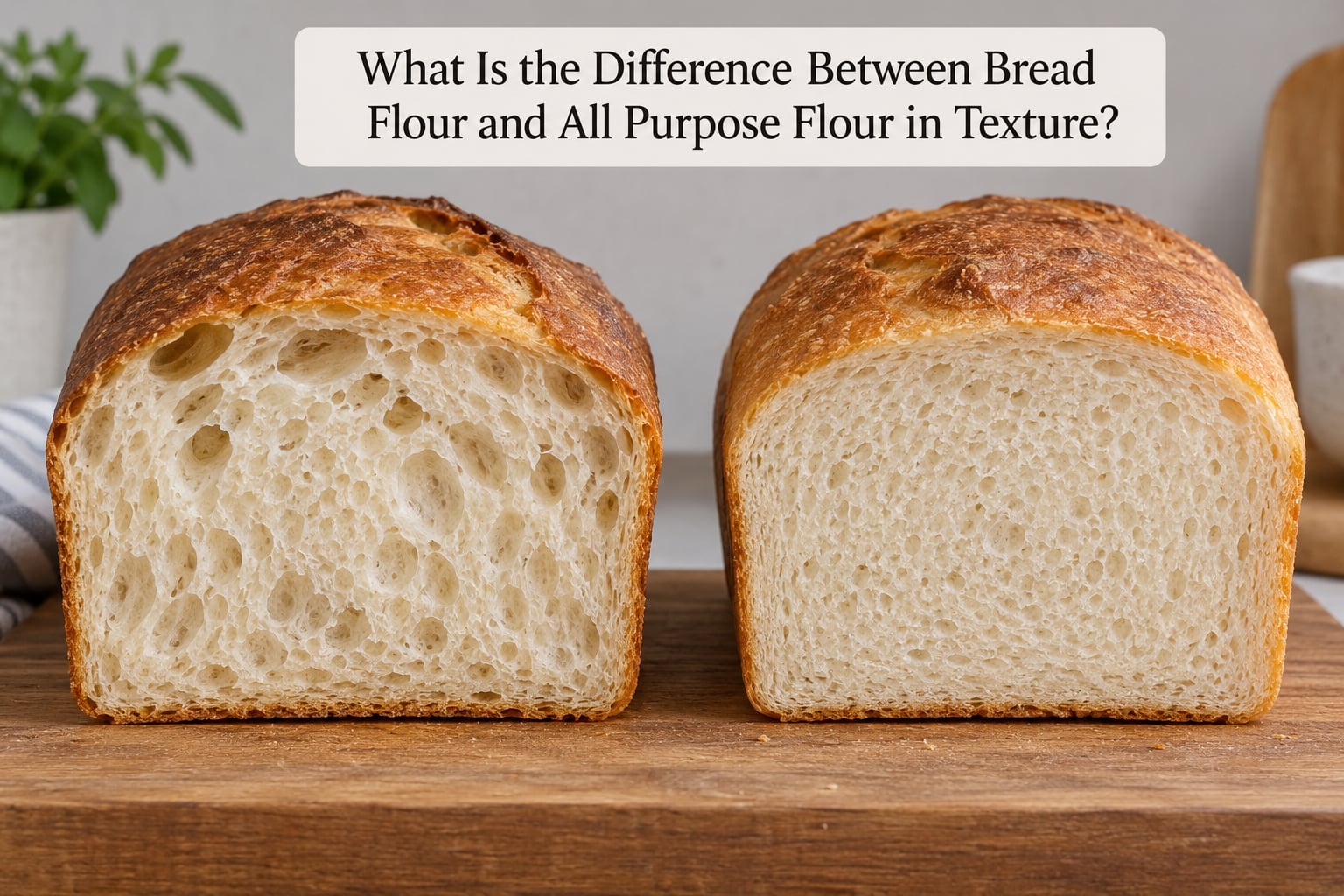
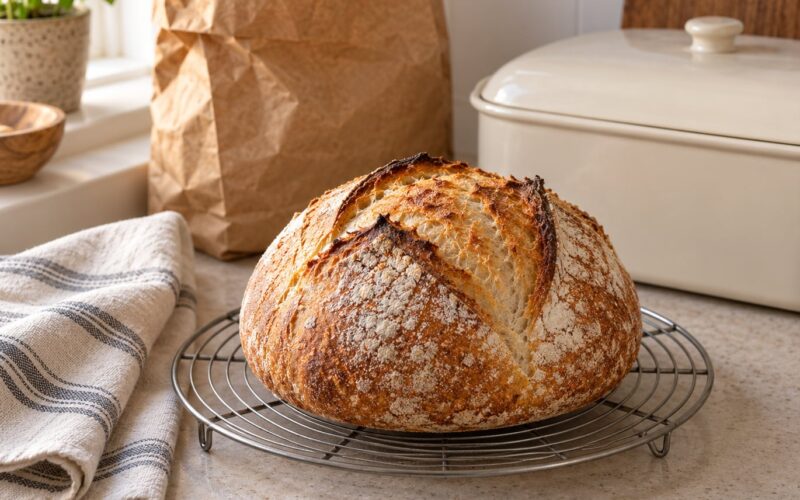
The texture difference is easy to taste and easy to see once you have both loaves side by side. Bread flour gives an open, irregular crumb with a chew that keeps working as the loaf cools. All-purpose flour gives a finer, more even crumb with a softer, more tender bite. The bread-flour crumb pulls; the all-purpose crumb gives way.
In biscuits the same protein difference shows up as height rather than chew. Biscuit recipes are usually written for all-purpose flour at low hydration, and they use cold butter and a light hand for lift. Swap in bread flour and the dough drinks more water and develops more gluten, which fights the flaky layers those recipes are built around. High-protein biscuits come out taller but heavier and more cakelike, which is a matter of taste, not failure.
Pizza dough is the reverse case. A home oven pizza with all-purpose flour bakes fine and slices cleanly, but the crust is more tender and slightly thinner, and it dries out faster on the second day. Bread flour gives you more chew, a sturdier rim that holds up under toppings, and better color on the bottom crust. Most Neapolitan-style recipes call for a high-protein or 00 flour for exactly this reason.
Sandwich bread is where the two genuinely meet. A soft white loaf made with all-purpose flour, milk, sugar, and butter has enough fat and sugar to stay soft for days, so the moderate protein is an advantage. A lean country loaf with only flour, water, salt, and yeast needs bread flour to rise properly.
How Hydration and Yeast Handling Change
Bread flour usually absorbs more water than all-purpose flour, and it absorbs it more slowly. That is why bakers report dough that feels stiff and tears when they expected it to be slack and extensible. When you swap all-purpose flour into a bread recipe written for bread flour, cut the water by roughly 2-5% of the flour weight and watch the dough during the first few minutes of mixing. It will usually relax into shape on its own.
The reverse swap needs the opposite treatment. Going from bread flour to all-purpose, add a couple of percent more water, because lower-protein flour gives up water more readily and the dough can tighten and tear at the edges as it mixes.
Neither of those numbers is a law. The flour label is the better guide, and so is the dough itself. A high-protein flour that lists 13.5% behaves differently from a 12% bread flour, and whole wheat or rye blended in will change absorption dramatically. Treat the percentages as a starting point and let the dough tell you the rest.
Yeast handling changes for a related reason. Yeast releases carbon dioxide, and stronger gluten holds those bubbles better. A weak dough in a cold kitchen can lose its gas before the structure is strong enough to keep it, so the loaf comes out flat and dense with a pale, gummy crumb. That is the classic all-purpose-instead-of-bread-flour failure.
What to do if you grabbed the wrong bag
If the dough is already mixed and feels slack and sticky, cover it, let it rest 20-30 minutes, then knead in a small amount of extra flour. The dough will fight you less the second time through.
If the dough feels stiff, tear-resistant, and tears instead of stretching, let it rest covered for 20-30 minutes before adding any more flour. Resting usually solves it. If it is still tight, add warm water a tablespoon at a time and mix again.
If the dough mixes fine but the finished loaf is flat and dense, the damage is structural rather than hydratable. The next bake, use bread flour, or blend in bread flour at a 50/50 ratio by weight with your all-purpose flour. Blending is a legitimate technique, not a compromise, and many experienced bakers use it for everyday loaves.
If a cookie or cake comes out tough, chewy, or slightly bouncy, the flour was not the problem, or it was the wrong direction of problem. Check the baking time and the ratio of sugar and fat next.
How Flavor, Color, and Baking Time Differ
Neither flour tastes strongly on its own. Bread flour can carry a faint, slightly nutty or wheaty note, and all-purpose flour is close to neutral, which is why it works in so many sweet recipes. Any flavor you notice in a finished loaf comes mostly from fermentation time, the amount of whole-grain material, and additions like butter, seeds, or malt.
Color differs a little. Bread flour tends to brown a shade deeper at the same bake time, partly from its own color and partly from the fact that a higher-rise loaf exposes more surface to the oven. The difference is subtle enough that you will not chase it.
Baking behavior inside the oven is where flour shows up again. A bread-flour dough holds its shape through the first 15 minutes of oven spring and browns steadily after. A lower-protein dough often spreads a little more on the baking stone or sheet and sets its crust earlier. Once the loaf is out, the higher-protein crumb stays flexible as it cools, while an all-purpose crumb can feel slightly firmer within an hour.
None of that overrides the recipe. Ingredient weight, sugar, fat, salt, oven temperature, and how long the dough fermented will move the finished loaf further than the flour swap does. Sugar and fat tenderize and slow browning; a longer ferment adds flavor and deepens color; a hot oven sets the crust faster. Change one variable at a time when you are troubleshooting.
Can You Use Bread Flour in Place of All-Purpose Flour?
Yes in some directions and no in others, so it is worth taking the two substitutions separately.
All-purpose flour for bread flour
This is the safe one. All-purpose flour in a bread recipe makes perfectly good everyday bread. The differences are chew and oven spring, not failure. It works well for sandwich bread, dinner rolls, focaccia, a simple no-knead loaf, and even a 24-hour sourdough where a slightly tighter crumb is a matter of preference rather than a flaw.
Reduce the water by roughly 2-5% of the flour weight, mix, and let the dough tell you whether that was enough. Skip the swap for bagels, pretzels, and pizza if you want maximum chew, and think twice on long-fermented artisan loaves where a weak network can struggle to hold an open crumb. For those, a 50/50 blend of all-purpose and bread flour gets you most of the way without a new bag on the shelf.
Bread flour for all-purpose flour
This one is useful in a narrower set of recipes. In a chocolate chip cookie, replacing some or all of the all-purpose flour with bread flour gives a chewier, thicker cookie that stays soft for days. Using all bread flour pushes it toward a very soft, almost cakey chew.
Leave bread flour out of cakes, cupcakes, muffins, pancakes, waffles, quick breads, brownies, and delicate pastry. Those recipes depend on short gluten strands and a small amount of structure, and extra protein makes them tight, dry, and heavy. Pie crust is mixed, not developed dough, so it is a wash either way, but all-purpose keeps things simple.
How to make bread flour from all-purpose flour
If you cannot find bread flour where you live, you can build the effect yourself. The most-upvoted advice in the r/Breadit community is that bread flour is roughly all-purpose flour with more protein, and you can close the gap.
Mix one tablespoon of vital wheat gluten into each cup of all-purpose flour and whisk it through thoroughly so no pockets remain. Use it the same way you would bread flour, and expect results closest to bread flour from the lower end of the range. It will not match a 13% flour exactly, and it works best in loaves, rolls, and pizza dough rather than anything delicate.
In the UK, Australia, and much of the world, “plain flour” means all-purpose flour, and bread flour carries its own protein percentage. If a bag does not state a number, treat it as a general all-purpose until you have measured it.
Which Should You Choose?
Choose bread flour for rustic loaves, baguettes, sourdough, pizza dough, bagels, pretzels, dinner rolls, focaccia, and doughnuts. These are doughs that need to rise, hold shape, and take a beating during shaping, and protein is exactly what they are short on otherwise.
Stay with all-purpose flour for cookies, cakes, muffins, biscuits, scones, quick breads, brownies, and pie crust. It is also the sensible starting point for a beginner making a simple sandwich loaf, because recipes written for it work without adjustment and the results are forgiving.
| Baking | Flour to reach for |
|---|---|
| Country loaf, sourdough, baguette | Bread flour |
| Pizza dough | Bread flour, or a 50/50 blend |
| Bagels and pretzels | Bread flour, higher protein if you have it |
| Focaccia and dinner rolls | Either works; bread flour for chew |
| Chewy chocolate chip cookies | All-purpose with part or all bread flour |
| Cakes, cupcakes, brownies | All-purpose flour |
| Muffins and quick breads | All-purpose flour |
| Pie crust and biscuits | All-purpose flour |
When the named flour on the shelf will not get you what the recipe wants, reach past the two basics. For chew and structure at the top end, a high-protein or bread flour labeled 13-14% behaves like a light rye blend in the dough. For tenderness on the other end, cake flour at roughly 7-9% protein, or a simple AP-and-cake-flour blend, is closer to pastry than bread. Self-rising flour is all-purpose with leavening and salt already in it, useful for biscuits and quick breads but never for a slow yeast dough.
Frequently Asked Questions
Is bread flour healthier than all-purpose flour?
Not meaningfully. Both are refined white flours with the bran and germ removed, so the fiber and micronutrients are largely gone either way. The protein difference changes how a dough behaves and how a loaf feels, not how many nutrients survive the mill. If nutrient density is the goal, neither is the answer, and whole wheat flour or a whole-grain blend is the choice to compare.
What protein percentage should home bakers look for?
For everyday bread, rolls, and pizza, 12-13% protein is a sweet spot. Breads that lean on long fermentation and shaping, such as bagels and sourdough, handle 13-14% well. For cakes, biscuits, and cookies, all-purpose at 10-12% is right, and anything past about 12% starts making baked goods tough and cakelike. Read the label rather than trusting the name.
Can I use all-purpose flour to make bread?
Yes, and plenty of people do it every week. All-purpose flour makes good sandwich bread, dinner rolls, and a simple loaf, and the difference shows up as chew and oven spring rather than as a failed bake. Cut the water by roughly 2-5% of the flour weight when you swap, and expect a tighter, slightly denser crumb. For an open artisan crumb, blend in bread flour.
Is bread flour better for cookies and cakes?
For cookies, sometimes. Replacing all or part of the all-purpose flour in a chocolate chip cookie with bread flour gives a thicker, chewier cookie that stays soft for days. For cakes, cupcakes, and muffins, bread flour is worse. Those recipes want tender crumbs from weak gluten development, and extra protein makes them dense, dry, and heavy.
Does bread flour need to be sieved before use?
Rarely. Modern milled flour is fine enough that sifting mainly removes the occasional stray clump from packaging, and you lose nothing important by skipping it. Sieve if your flour is old and has been stored with any moisture, if you are straining vital wheat gluten into a dough, or if a delicate recipe such as a sponge cake depends on an aerated, lump-free dry mix. For a rustic loaf, skip the step.
Choose by Your Recipe, Not the Flour Name
One rule covers most of it: match the protein to what you want the crumb to do. High protein for doughs that must rise and hold shape, moderate protein for anything meant to stay tender.
Before you buy, check two things. Read the protein percentage on the bag, because two bags with the same name can sit two full points apart. Then look at how much liquid your recipe uses per cup of flour, since that ratio tells you how much structure the dough is asking for.
If you are new to bread and starting from an all-purpose-flour recipe, use all-purpose flour. Fix the flour later if the loaf feels flat or the crumb turns out tight. Learning to read dough feel matters far more than owning a specialized bag, and the swap back is one ingredient away whenever you want it.