What to look for at a bakery counter comes down to a handful of sensory checks you can run in about a minute: look at crust color and sheen, press the loaf to see if it springs back, smell for aroma rather than refrigeration, and read the label for bake time and allergens. Freshness looks nothing like quality, so your eyes alone will mislead you.
That last point is the whole game. A bakery case is a sales display first, and everything in it was arranged to flatter. The baker who cares about their reputation puts out fresh stock all morning and marks honestly what is left at the end of the day. The one who does not will reheat yesterday’s danish until the glaze looks new again.
Table of Contents
- What to Look for at a Bakery Counter
- How Can You Tell That a Baked Good Is Fresh?
- Freshness cues for bread
- Freshness cues for pastry
- Freshness cues for cake and filled items
- Ignore the color-coded bread tag
- What Does the Label Tell You?
- Ingredients and their order
- Allergens
- Dates and date codes
- Storage instructions and claims
- How Do You Choose Bread, Pastries, Cakes, and Savory Bakes?
- Which details matter for different meals
- Spotting a bakery that bakes on site
- What Questions Can You Ask the Baker?
- Production questions
- Allergen and ingredient questions
- Order and service questions
- How Should You Store Bakery Purchases?
- Crusty bread
- Soft bread, cakes, and pastries
- What to freeze and for how long
- Frequently Asked Questions
- What are the key red flags to look for in a bakery?
- What are the signs of a high quality bakery?
- How to know if bread is still fresh?
- Should I refrigerate pastries to keep them fresh?
- How long do bakeries keep pastries, and how do I keep mine fresh?
- How to freshen up day-old pastries?
- Conclusion
What to Look for at a Bakery Counter
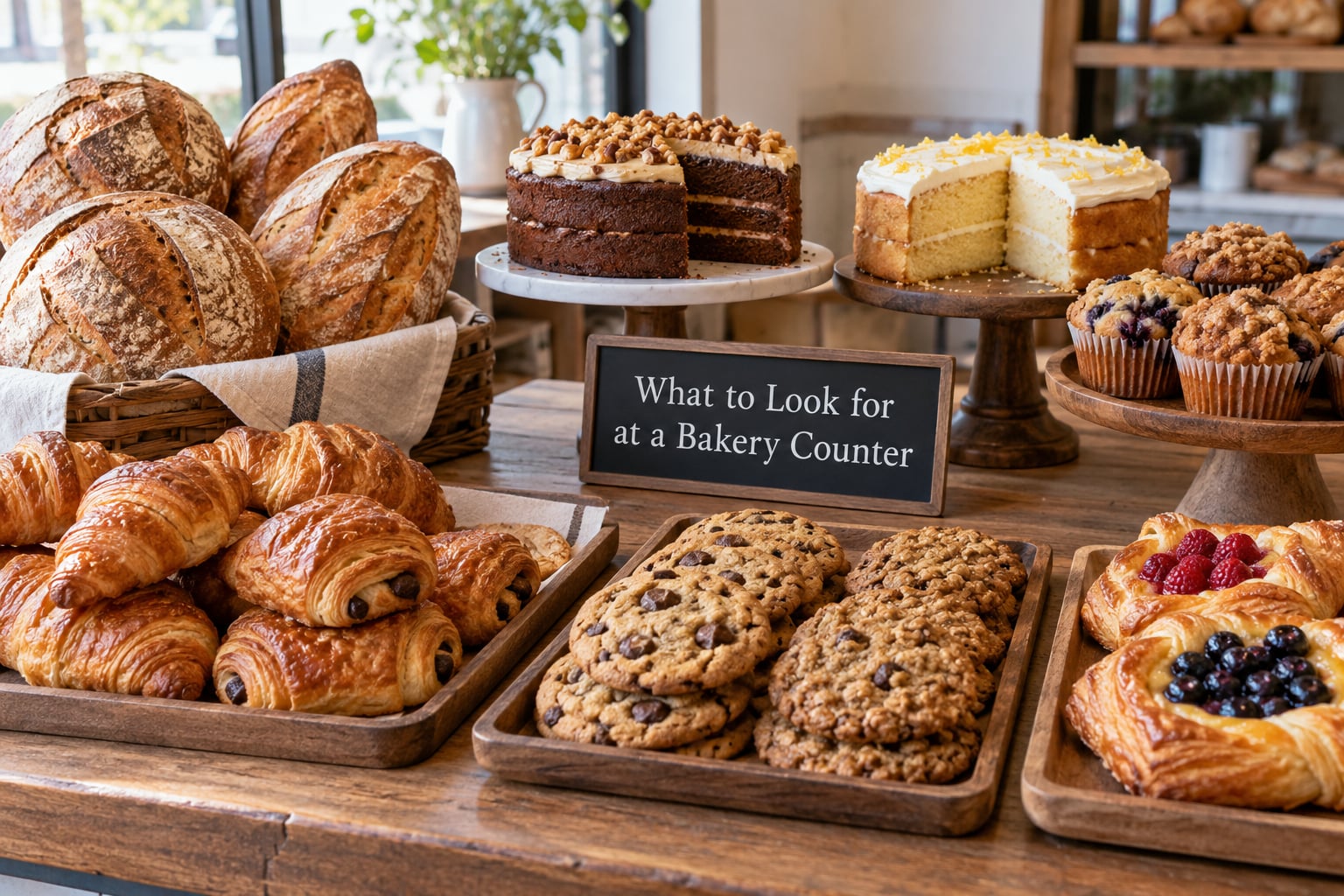
Six things tell you most of what you need to know: how the crust looks, how the item smells, how it responds to pressure, how heavy it feels for its size, what the label says, and whether it fits how you plan to use it.
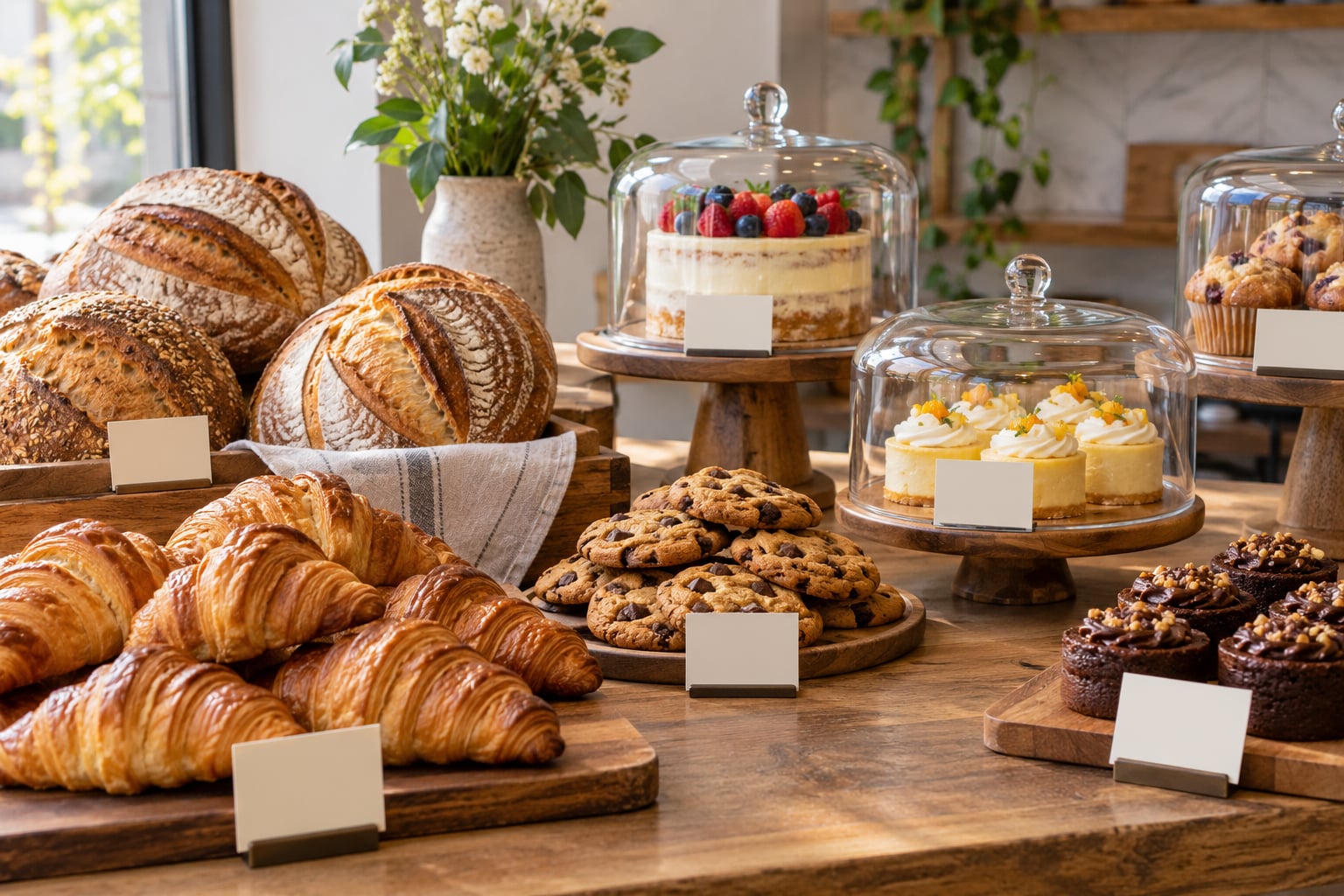
Appearance is the fastest filter. A loaf should be evenly golden to deep brown, blistering where the crust formed bubbles, and scored or slashed if it’s a sourdough or a wheat-heavy country loaf. Pale patches usually mean uneven baking. A very dark surface with a burnt smell underneath is scorched, not deeply baked.
Aroma is the second filter and the one most people skip. Fresh bread smells of toasted crust, butter, yeast, or whatever the flour was made from. Old bread smells flat and faintly dusty, sometimes with a sour edge that has nothing to do with starter.
Texture is the third. Press the loaf with a fingertip. A fresh loaf dents slightly and springs most of the way back within a second or two. If the dent stays or the loaf feels heavy and dense for its size, the moisture has gone.
Weight matters more than most shoppers expect. A well-proofed loaf with good aeration is light for its size, and a croissant should feel nearly weightless in your hand. Dense weight usually means underproofed or underbaked dough, not more value.
Labels and claims come next, and they matter more for your health than for your palate. Ingredient order tells you what a product mostly is. Allergen statements tell you whether it is safe for you. Claims such as local, organic, or made in-house tell you about the bakery’s sourcing and production, not about whether today’s batch is fresh.
Finally, match the item to the plan. A loaf you will eat today can be served warm and slightly delicate. A loaf meant for sandwiches three days from now wants more structure. Picking the wrong one for the job is the most common way good bakery bread gets wasted.
How Can You Tell That a Baked Good Is Fresh?
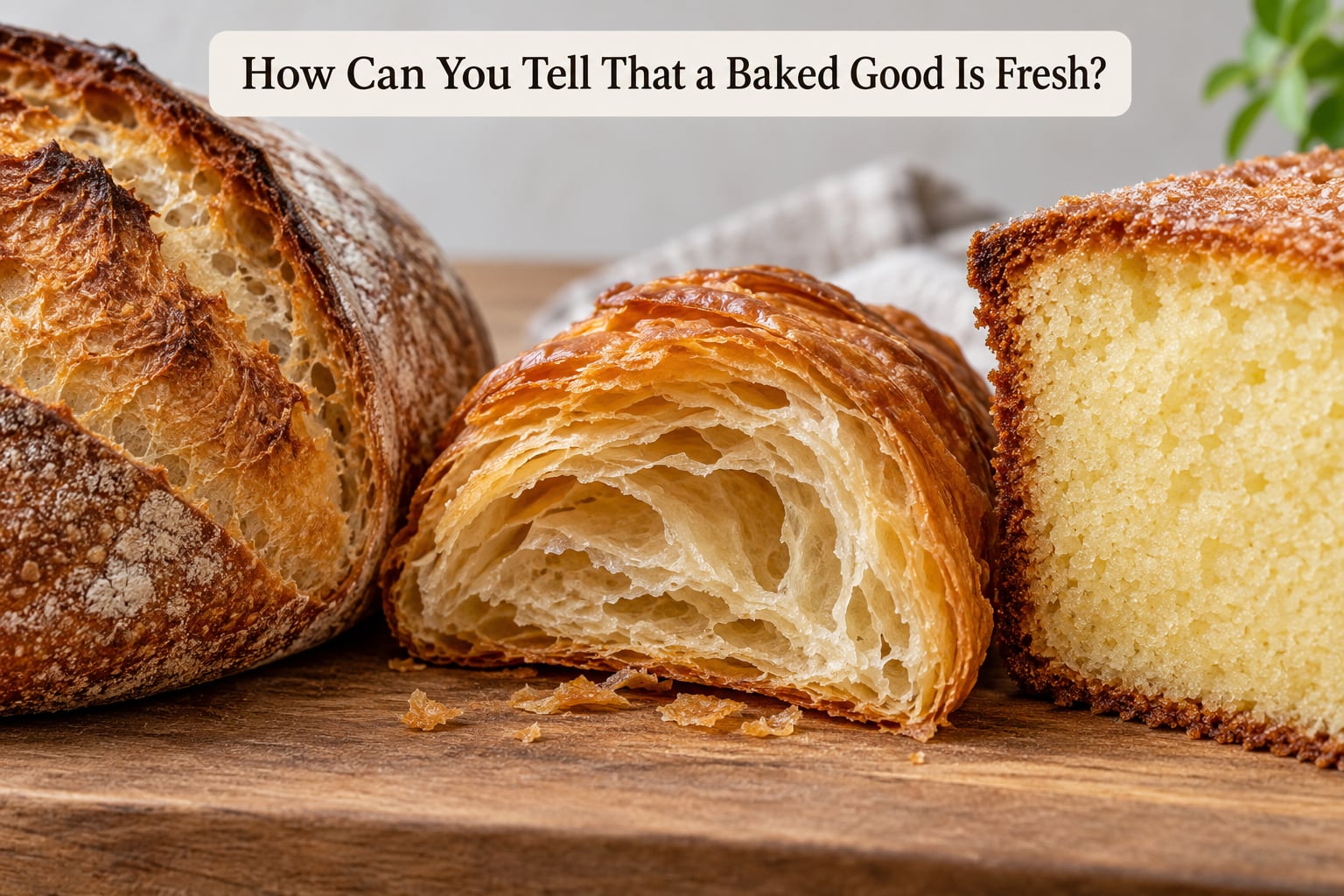
Fresh goods show three things at once: a surface that still looks recently heated, an aroma rather than a scent of storage, and interior structure that has not collapsed.
| Feature | What fresh looks like | What to walk away from |
|---|---|---|
| Crust color | Evenly golden to deep brown | Pale spots or scorch-black edges |
| Crust surface | Blistering, matte to lightly glossy, audible crackle | Dull, leathery, hard-looking shell |
| Finger press | Dents, then springs back within a second or two | Dent stays; feels heavy and dead |
| Weight | Light for its size | Dense, like unbaked dough |
| Crumb | Open, irregular holes with thin walls | Tight gummy hole or raw dough patches |
| Aroma | Toasted crust, butter, yeast | Flat, dusty, faintly sour |
| Pastry lamination | Visible distinct layers, audible flake | Dense, chewy, layers fused together |
| Frosting | Firm, matte or satin, holds its edge | Beading, weeping, or sweating onto the box |
| Under the dome | Dry surface | Condensation fogging the plastic |
| Label | Specific bake date or time, named ingredients | No date, or only “fresh daily” |
Freshness cues for bread
Listen first. A fresh loaf cracks audibly when you squeeze it. Then press the crust near the base, where moisture escapes fastest. The inside should look slightly glossy and the holes should be irregular, not machine-uniform.
Home bakers on r/Sourdough describe the target loaf as airy and crumbly, dry in a good way, with a golden blistery crust and big yet consistent bubbles. That is a useful description of an open crumb: many irregular holes, thin walls between them, no dense stretch anywhere in the slice.
Freshness cues for pastry
A good croissant is audibly flaky when you squeeze it, and light enough that your hand registers almost nothing. Bend the tip gently; it should crack and separate rather than fold like rubber. Look at the layers at the cut end, where you want dozens of visible sheets rather than one solid piece of dough.
Buyers on r/traderjoes recommend buying croissants earlier in the day rather than at close, when they may have been sitting out since morning. Butter leaches into the dough as a croissant cools, which softens the flake and weighs it down. That is a normal change, but it is a change you can taste by evening.
Freshness cues for cake and filled items
For cake, judge the frosting rather than the sponge. A fresh cake has frosting that holds a sharp edge where it meets the side of the pan. Beading or weeping frosting means water has moved out of the filling or the cake itself and the item has been sitting too long or too warm.
For filled pastries, danishes, and cream horns, check the base for a soggy or translucent underside. Liquid filling seeps into the dough, and the pastry is finished at that point. Also confirm the case has been refrigerated if the filling is dairy-based.
Ignore the color-coded bread tag
The colored plastic clips on grocery store loaves are a baking convention used so staff can read the bake day at a glance. They are not a freshness rating, and they say nothing about how a loaf was made or stored. A discussion on r/occlupanids makes the same point: the tag tells you a day, not a quality. At a bakery counter, ask the person behind it for the bake time instead.
What Does the Label Tell You?
A good label answers four questions in order: what is in it, what allergens it contains, when it was made, and how to keep it.
Ingredients and their order
Ingredients are listed by weight, descending. Flour first in bread means flour leads the dough. Sugar first in a cookie means you are buying a sweet cookie, not a buttery one. In laminated dough, if butter is not near the top, the flake will be thin and the pastry heavy.
Allergens
US labeling requires wheat, milk, eggs, soy, peanuts, tree nuts, fish, shellfish, and sesame to be declared in a Contains statement. Wheat sits in nearly every bakery product, and cross-contact is common in a small kitchen where flour from bread is airborne near croissants and cakes.
If you have a serious allergy, ask about dedicated equipment and separate prep surfaces rather than assuming the allergen statement covers it. A baker who pauses and answers precisely is worth more than one who says “probably fine.”
Dates and date codes
A specific bake date beats “baked fresh daily,” which is a marketing line rather than information. Some counters mark trays with the out-of-the-oven time; that is the single most useful number on the display.
Storage instructions and claims
The storage line tells you how the bakery wants the product handled and roughly how long it expects to last. Claims like local, organic, stone-milled, made in-house, and sourdough describe sourcing and method. They tell you nothing about today’s batch, which is why you still need to press, look, and smell.
How Do You Choose Bread, Pastries, Cakes, and Savory Bakes?
Different categories reward different cues, and the table gives you one reliable cue per category plus the warning sign.
| Item type | Key visual cue | Key tactile or smell cue | Red flag |
|---|---|---|---|
| Country or sourdough loaf | Blistered, deeply scored crust | Light for size; open irregular crumb; audible crackle | Dense weight; tight gummy crumb |
| Sandwich or soft loaf | Even, pale golden top | Soft but not slick; springs back slowly | Sticky surface; squashed shape |
| Baguette or baton | Deep diagonal scoring | Crisp crust; hollow sound when tapped | Bent or limp; dry ends |
| Croissant | Defined layers at the ends; even browning | Nearly weightless; flaky when bent; butter aroma | Chewy, dense, fused layers |
| Danish or filled pastry | Even glaze; dry base | Fruit or nut filling with real aroma; flaky shell | Soggy underside; reheated sheen |
| Cookies and biscotti | Deep color at the edges | Crisp snap in the middle; fat reads as butter | Chewy center; pale and soft-edged |
| Layer cake | Frosting holds clean edges; tall layers | Firm frosting; moist crumb without gummy patches | Beading or weeping frosting |
| Tarts and quiche | Even browning, no weeping filling | Set filling; buttery shortcrust | Liquid pooling in the tin |
| Savory bakes and scones | Golden top and base | Warm aroma; center cooked through | Pale wet center; raw batter taste |
Which details matter for different meals
For a sandwich that will be assembled tomorrow, choose a soft loaf with enough structure to hold filling without going squashed, and skip anything with a very wet crumb. For serving with soup, pick the crustiest baguette or country loaf you can find; structure survives the reheating.
For breakfast on the go, buy the croissant or pain au chocolat earlier in the day and eat it the same morning. For a weekend brunch that happens four hours from now, choose a loaf or a sturdy scone instead; laminated pastry does not reward waiting.
For a celebration cake, ask when it was assembled. A cake baked this morning with frosting applied today will taste fresher than one assembled two days ago, even from the same baker. Book ahead for custom cakes and ask for the assembly time in writing.
Spotting a bakery that bakes on site
Look at what is behind the counter: ovens, proofing racks, flour dust, and a mixing area in view. A dedicated bakery smells like baking when you walk in and sells out of certain items by mid-afternoon. A market stall or grocery counter that resells wholesale bread often has all its stock arrive at once in the morning, which is why everything looks equally fresh at 9 a.m. and equally tired by 4 p.m.
The service style gives it away too. Staff at a from-scratch bakery know the flour, the starter name, the hydration of the country loaf, and which batch is coming out next. Staff at a reselling counter read a packing slip.
What Questions Can You Ask the Baker?
Asking is the fastest way to read a bakery’s quality, because the answer tells you how much attention the place pays to its own product. Keep questions short when the counter is busy, buy something small while you ask, and skip the interrogation if the line is deep.
Production questions
- What came out of the oven this morning, and what time?
- What is baked here on site versus delivered?
- What is in this loaf, and how should I keep it?
- Does this come from a starter, and is it a levain or a commercial yeast?
- Is there a batch coming out later today that I could wait for?
Allergen and ingredient questions
- Which items contain wheat, milk, egg, soy, or nuts?
- Is there a gluten-free item made on separate equipment, not just made without wheat?
- Are the nut products made on a surface used for other allergens?
- Is that filling dairy-based, and is it kept refrigerated?
Order and service questions
- Can you hold a loaf until a certain time?
- Do you take custom cake orders, and how much notice do you need?
- Will you slice and package a loaf bought whole?
- What do you recommend for a specific use, such as a sandwich loaf or a dessert plate?
A useful signal: a good baker will tell you what not to buy. If you only want to eat a croissant now, ask, and they will steer you toward the freshest batch instead of the one they need to move.
How Should You Store Bakery Purchases?
Storing bread properly is mostly about managing moisture and airflow, because starch retrogrades quickly at room temperature. Cooling and airflow fix it better than any bag.
Crusty bread
Let the loaf cool completely before you store it, then keep it in a paper bag or an open basket for the first few hours. Paper breathes. Once you have eaten part of it, move the rest to a cut loaf bag or a sealed container, where it softens gently instead of drying into a rock.
Reviving a stale loaf works well at around 350°F for five to ten minutes with a splash of water in the oven, or for three to five minutes in a toaster with the slice standing up so the cut face warms first.
Soft bread, cakes, and pastries
Soft bread and frosted cake go in airtight containers at room temperature for a day or two. Cakes with whipped cream, custard, cream cheese frosting, or mousse belong in the refrigerator at or below 40°F, which is where any food bakery item should sit when it contains dairy filling.
Refrigerating plain pastries and cookies is not freshness. Cold without sealed protection invites drying, and the starch changes faster in the refrigerator than on the counter. Most plain pastries and cookies are comfortable in an airtight container at room temperature for a couple of days.
What to freeze and for how long
Freezing is the better answer for longer storage. Wrap bread tightly in plastic plus foil or bag it, and freeze at 0°F for up to three months. Croissants and danishes freeze best when each one is wrapped individually so you can thaw a single piece. Layer cakes freeze well without the frosting if you freeze them in a box; frosted cakes fare better wrapped in a cake carrier.
Thaw frozen bread in the wrapping at room temperature, then refresh in the oven. Thaw pastry in the fridge overnight for the flakiest result, and never refreeze a thawed item. Thaw cakes in the box for several hours so the frosting does not sweat onto the wrapping.
Food safety rules still apply. Treat cream-filled, custard, or mousse items as perishable: refrigerate them, and do not let them sit out longer than two hours at normal room temperature, or one hour if the day is hot above 90°F.
Frequently Asked Questions
What are the key red flags to look for in a bakery?
The clearest red flags are heavy discounting at closing time, condensation inside a display dome, frosting that beads or sweats, laminated pastry that is chewy or dense instead of flaky, bread that stays dented after a press, and displays with no labeling at all. Frozen-then-thawed product and reheated pastries look identical to fresh-baked goods on the shelf, so lean on aroma, spring-back, and honest bake dates instead.
What are the signs of a high quality bakery?
Signs of a high quality bakery include a clean, busy counter where staff can tell you what came out of the oven and when, honest labeling with specific bake dates rather than vague claims, and bread with an even golden blistered crust that is light for its size and springs back when pressed. Consistent product through the whole day matters more than any single impressive item in the morning.
How to know if bread is still fresh?
Press the loaf with a fingertip. Fresh bread dents slightly and springs most of the way back within a second or two. Fresh bread also cracks audibly when squeezed, smells of toasted crust or yeast rather than flat and dusty, and weighs little for its size. A dent that stays, a dull leathery crust, or a tight gummy crumb all mean the moisture is gone.
Should I refrigerate pastries to keep them fresh?
Usually not. Plain pastries, croissants, and cookies stay better for a day or two in an airtight container at room temperature, where they avoid both drying out and the faster staling starch changes cause in the fridge. Refrigerate items with dairy fillings such as cream, custard, cream cheese frosting, or mousse, and always keep them at or below 40u0026deg;F.
How long do bakeries keep pastries, and how do I keep mine fresh?
Most plain pastries and cookies hold their best for a day or two, and croissants are at their peak the morning they are baked. To extend that, freeze croissants and danishes individually, wrap bread tightly and freeze it for up to three months, and thaw in the wrapping before refreshing in a hot oven. Filled pastries with dairy filling must stay refrigerated.
How to freshen up day-old pastries?
For day-old croissants and danishes, warm them at 350u0026deg;F for five to eight minutes; the buttery layers soften and flake again briefly. Day-old bread responds well to a few minutes in a hot oven with a splash of steam or water in the pan. Cookies revive in five minutes at 300u0026deg;F. Filled or cream pastries are not worth reheating, because the filling leaks as they warm.
Conclusion
Start at the counter with four actions. Press a loaf and see if it springs back. Look for even color and blistering on the crust, and visible layers in a croissant. Read the label for allergens, ingredients, and a specific bake date instead of trusting the colored clip or the phrase “baked fresh daily.” Then ask the person behind the case what came out of the oven today and when.
Finally, buy for the plan rather than the display. Eat laminated pastry today, choose a sturdier loaf for tomorrow’s sandwiches, and refrigerate anything with dairy filling. A bakery counter rewards attention, and two minutes of it changes what you end up eating for the next three days.