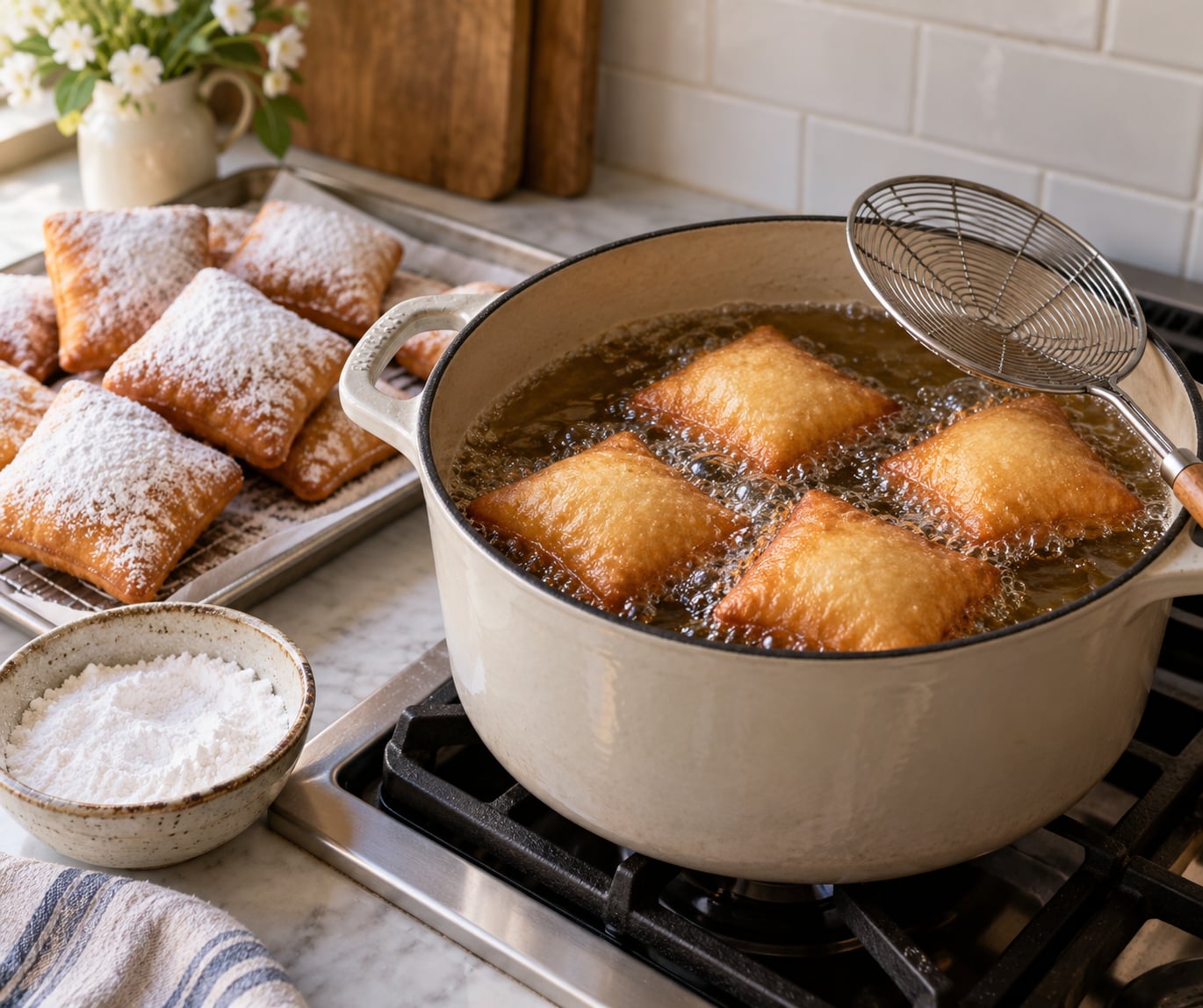
A New Orleans beignet is a square of yeasted dough rolled thin, cut, and deep-fried at 350°F until it puffs into a golden pillow under a heavy fall of confectioners’ sugar. Learning how to make beignets at home takes about three hours start to finish, though only 30 to 45 minutes of that is hands-on work, and the dough can chill while you get on with the rest of your day.
The dish is far more forgiving than it looks. Four things decide whether you get a pillowy beignet or a flat, greasy one: water warm enough to wake the yeast but not hot enough to kill it, a dough mixed gently enough to stay tender, a rise you actually wait for, and oil held steady between 340°F and 350°F.
Table of Contents
- What You Need
- For the dough
- For frying and finishing
- Tools
- Step-by-Step: How to Make Beignets at Home
- How to Make Beignets at Home: Activate the Yeast and Mix the Dough
- Knead and Chill the Beignet Dough
- Roll and Cut the Beignets
- Heat the Oil Safely
- Fry Until Golden and Puffy
- Drain, Cool, and Finish
- Common Mistakes
- Frequently Asked Questions
- Do I need to deep-fry beignets, or can I use an air fryer?
- Why are my beignets flat or dense instead of puffy?
- What oil is best for frying beignets at home?
- Can I make the beignet dough ahead of time?
- How should I reheat beignets so they stay crisp?
- Conclusion
What You Need
Everything for the dough comes together in one bowl, and the whole thing rests overnight if you want the flavor a cold ferment gives. Measure accurately before you start, because yeast dough responds badly to loose handfuls of flour.
For the dough
- 3/4 cup (180 ml) warm water, 100°F to 110°F (38°C to 43°C)
- 3/4 teaspoon active dry yeast, or 1 teaspoon instant yeast
- 2 tablespoons granulated sugar
- 1 1/2 cups (355 ml) evaporated milk
- 1/2 cup (113 g) unsalted butter, melted and cooled a few minutes
- 1 large egg
- 4 cups (about 480 g) bread flour, plus more for rolling
- 2 teaspoons baking powder
- 1 teaspoon salt
- Finely grated zest of 1 lemon, optional
- 1/4 teaspoon mace, optional but worth it
For frying and finishing
- 2 to 3 quarts of peanut oil, canola oil, or another neutral frying oil
- 1 cup (120 g) confectioners’ sugar for the final dust
Bread flour is the flour that gives a beignet its slight chew. All-purpose flour works and produces a lighter, cakier crumb, so if that is all you have, use it without apology.
Tools
A heavy-bottomed pot or an enameled Dutch oven of 6 to 8 quarts is the one piece of equipment worth buying for this. A deep fryer thermometer is the second, and it is what separates good beignets from luck. Everything else you almost certainly own: a rolling pin, a bench scraper or pizza wheel for cutting, a wire spider or slotted spoon, and a baking sheet lined with paper towels for draining.
Step-by-Step: How to Make Beignets at Home
This method works whether you fry the whole batch an hour after rolling or let the dough chill overnight. Read it through once, then follow it in order.
How to Make Beignets at Home: Activate the Yeast and Mix the Dough
Test your yeast first. Stir the 3/4 cup of warm water with the sugar, sprinkle the yeast on top, and wait 5 to 10 minutes. A foamy, creamy layer on the surface means the yeast is alive and the water temperature is right.
If nothing happens after 10 minutes, the water was either too hot or the yeast is old. Pour that water out, start over with fresh water at 105°F, and add fresh yeast. There is no fixing dead yeast later, which makes this the step beginners should slow down for.
Add the evaporated milk, melted butter, and egg to the activated yeast and stir until smooth. Beat in the bread flour, baking powder, salt, lemon zest, and mace a cup at a time, mixing only until no dry flour is left.
Knead and Chill the Beignet Dough
The dough will look rough and slightly lumpy at this point. That is correct. Knead it on a lightly floured surface for 3 to 5 minutes, until it feels smooth, elastic, and tacky rather than sticky or wet. Longer kneading is the single most common way to ruin beignets, because it develops gluten you do not want here.
For a room-temperature rise, cover the bowl with a damp towel or plastic wrap and leave it in a warm spot until the dough has roughly doubled in volume, usually 1.5 to 2 hours.
For the better version, cover and refrigerate for at least 2 hours and up to overnight. A cold ferment slows the yeast down, so the flavor gets deeper and slightly tangy, and the dough firms up enough to roll cleanly without fighting you. This is also what makes beignet dough a make-ahead option.
Roll and Cut the Beignets
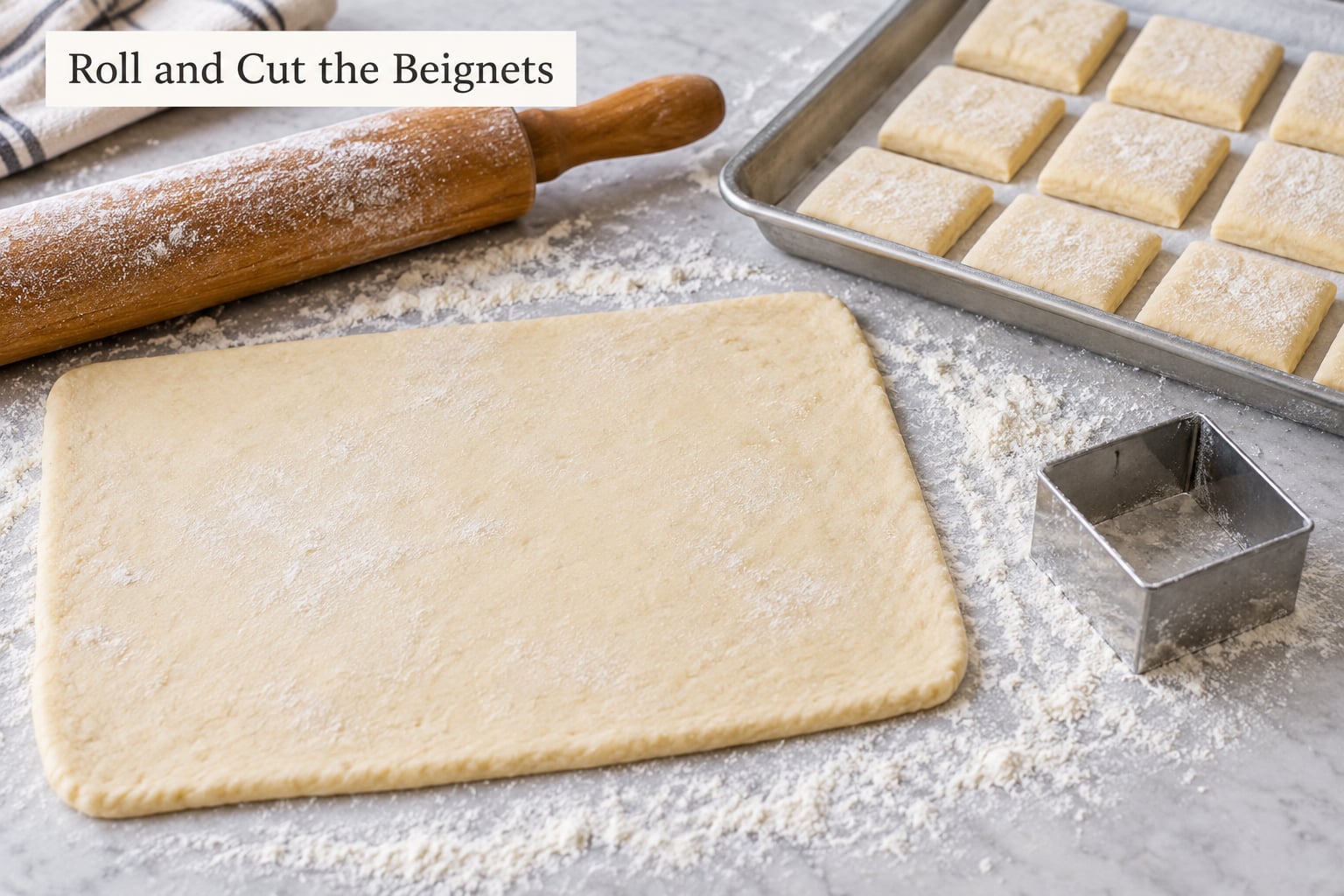
Flour a work surface generously, though a dusting is enough, and do not pack flour into the dough. Turn the dough out and roll it from the center outward into a rectangle about 1/4 inch thick, 3/8 inch at most.
Thickness changes the result more than anything else in this recipe. Dough rolled to 1/8 inch cooks through before steam can inflate it, and dough rolled to 1/2 inch fries dark outside before the center is done. Aim for the thickness of a thin wallet.
Cut squares of about 2.5 inches, or cut diamonds by rolling the dough and slicing on a diagonal. Keep pieces as even as you can, since odd sizes fry unevenly in the same oil.
Gather the scraps into a lump, reroll them, and cut again. Do not pack small scraps into one fat wad, because that piece will fry like a fritter and cook unevenly through the middle. Lay the cut pieces on a floured tray so they do not dry out while the oil heats.
Heat the Oil Safely
Fill your pot no more than one-third full with oil. A fuller pot rises dangerously when the dough goes in, and it leaves too little room for the oil to recover between batches.
Clip a fry thermometer to the side of the pot without letting the tip touch the metal, and heat the oil to 350°F (177°C). Wait until the thermometer steadies and the oil shimmers when you hover your hand a few inches above it. Do not wait for smoke.
Hot-oil safety, briefly: dry your hands and every utensil before you go near the pot, use long tongs or a spider rather than your fingers, keep water, towels, and children well back from the stove, lower the dough away from you with a spider rather than dropping it from height, and never leave the burner unattended.
Fry Until Golden and Puffy

Lower 4 to 6 pieces into the oil, spaced apart, using the spider. An even, steady sizzle is what you want, not aggressive splashing, and the pieces should swell and float almost immediately.
Fry each side 2 to 3 minutes, turning once with tongs. Watch the thermometer as you go and nudge the heat so the oil stays between 340°F and 350°F. Crowding drops the temperature fast, and cold oil is the main reason home beignets turn greasy and flat.
Pull them out when deep golden brown on both sides and puffed, about 3 minutes total per batch. Underfryed beignets are pale, soft, and bendy, and they soak up oil. Overfryed beignets are dark brown to the point of black at the edges, with a hard, papery shell and a raw, gummy center.
Drain, Cool, and Finish
Lift each batch out and rest it on the paper-towel-lined baking sheet for 2 to 3 minutes, so the residual oil drains off the bottom. Beignets go soggy fast when they sit in a pile, so drain them in a single layer and resist stacking them with a towel on top.
Dust them while still faintly warm with a heavy sift of confectioners’ sugar, right before serving. A squeeze of lemon or a dusting of cinnamon is welcome, but the sugar is the finish.
Beignets are at their best in the first few hours. Keep them at room temperature in a loosely covered container for up to about 4 hours. If you must go longer, refrigerate them for up to a day, but know that reheating is what brings back the crust.
To reheat, put five or six on a baking sheet and into a 350°F oven for 6 to 8 minutes, or give them 60 to 90 seconds in a hot air fryer basket. Skipping the microwave is worth the effort, since it makes the crust soft and leathery.
Common Mistakes
Almost every disappointing batch traces back to one of these. Match what you see to what caused it, then fix it on the next round.
The dough springs back while you roll it. That is tight gluten, and it comes from mixing too long or kneading too hard. Rest the dough under a cloth for 15 minutes so it relaxes, then roll in short passes with the pin rather than pushing it in one direction.
The beignets come out flat and dense. Three causes account for nearly all of these: dough rolled thinner than 1/4 inch, dough that was rolled before it finished its rise, or oil that was under 340°F. Check the thickness with a ruler the first time, wait for the dough to visibly double, and check the thermometer rather than the clock.
They are pale and greasy. The oil was not hot enough, or the dough was too wet, or you dropped too many pieces in at once. Hold 340°F to 350°F and fry four to six pieces per batch.
Dark outside, raw inside. The oil was above about 365°F, or the pieces are much thicker than 3/8 inch. Lower the heat and let the oil settle back down between batches.
The dough is too sticky to handle. You went over on the evaporated milk or the egg. Sprinkle in flour a tablespoon at a time until the dough holds its shape, and dust the work surface properly rather than kneading more flour into the dough.
The oil temperature crashes the moment you add the dough. That is crowding, and it is the most common complaint from home cooks. More oil in a wider pot, fewer pieces per batch, and a few extra seconds of preheating all solve it.
They turn soft and chewy after an hour. Two things: they were stacked while still steaming, or they were sealed into a container while warm. Drain them in a single layer and let steam escape before closing anything up.
The dough did not rise and you want to save it. There is no way to bring yeast back to life. A dough that has doubled, then collapsed, has died or was held too long, so discard it and check your yeast next time.
A few habits that help more than any single trick: mix with a spoon instead of a mixer if you have one, use bread flour for chew and all-purpose for a softer crumb, weigh your flour with a scale for even results, and fry a single test piece before committing the whole batch.
Frequently Asked Questions
Do I need to deep-fry beignets, or can I use an air fryer?
An air fryer works, but expect a different result. It renders the outside crisp and gives you almost no puff, so the center stays flatter and slightly denser than a fried beignet. A 375°F (190°C) basket, dough sprayed lightly with oil, 6 to 8 minutes flipped halfway, gives the best air-fried version. For a true New Orleans puff you need immersion frying at 350°F.
Why are my beignets flat or dense instead of puffy?
Three things cause this: dough rolled thinner than 1/4 inch, dough that never got its full rise, and oil cooler than 340°F. Steam inside a thin, under-risen, cold-oil piece cannot lift the dough fast enough to puff it. When you learn how to make beignets at home, roll to 1/4 to 3/8 inch, wait for the full double, and hold 340°F to 350°F with a thermometer.
What oil is best for frying beignets at home?
Peanut oil is the traditional choice, with a high smoke point and a nutty warmth that suits 350°F frying. Canola, corn, sunflower, and vegetable oil all work and taste more neutral. Olive oil works, but its flavor shows and it costs more per batch. Skip butter, since milk solids burn at frying temperature and turn the oil bitter.
Can I make the beignet dough ahead of time?
Yes, and this is the best part of the recipe. Cover the mixed dough and refrigerate it for at least 2 hours and up to 24 hours before rolling. A long cold ferment gives a deeper, slightly tangy flavor and makes the dough easier to handle. You can also fry half the batch after two hours and the rest the next morning from the same cold dough.
How should I reheat beignets so they stay crisp?
Use a 350°F oven for 6 to 8 minutes, or a hot air fryer for 60 to 90 seconds. Both drive the moisture back out of the center and re-crisp the shell. The microwave is the one method to avoid, because it softens the crust and makes it leathery. Reheat only what you plan to eat, then dust with fresh confectioners’ sugar right before serving.
Conclusion
Start by measuring the flour and testing the yeast in warm water. If it foams, the yeast is alive and the water was the right temperature, and everything after that is easier. If it sits flat, throw it out and start that step again.
After that, three variables decide the result: even dough thickness of about 1/4 inch, oil held steady between 340°F and 350°F with a thermometer, and draining the beignets promptly on a rack before you pile them up. Nail those and the rest is just waiting.