What to ask a butcher when buying steak comes down to four things: which cut suits how you plan to cook it, where the animal came from and how it was raised, how the beef was aged and graded, and how you want it trimmed and portioned. Ten minutes of questions at the counter closes the gap between a bargain steak and a premium one more reliably than anything printed on the label.
The catch is that most people arrive at the case with nothing but a cut name in mind, freeze on the shelf, and take whatever the person behind the counter points at first. Ask in a different order and the whole conversation changes.
Below is the order that works: cooking plan, cut, grade and marbling, age and freshness, trimming and portions, then substitutions and price. Each question comes with the follow-up to ask when the first answer is thin.
Table of Contents
- What You Need
- Step-by-Step: What to Ask a Butcher When Buying Steak
- Step 1: Start With How You Plan to Cook It
- Step 2: Ask Which Cut Fits Your Appetite
- Step 3: Grade and Marbling, Without the Lecture
- Step 4: Age, Freshness and How to Get It Home
- Step 5: Trimming, Thickness and Portions
- Step 6: Substitutions and What the Case Actually Has
- Common Steak-Buying Mistakes
- How to Choose the Right Steak for Your Cooking Method
- Frequently Asked Questions
- What are good questions to ask a butcher?
- How can you tell if a steak is high quality?
- Is dry aged or wet aged steak better?
- What cut is a poor man’s filet mignon?
- Is a butcher shop steak worth more than a grocery store steak?
- What is the 3-3-3 rule for steak?
- Conclusion
What You Need
Nothing to buy and nothing to bring. You need four decisions made before you open your mouth, and every one of them changes what the butcher shows you.
Your cooking method. Grill, cast iron pan, oven roast, smoker, or a quick weeknight sear. Thickness and cut follow from this, not the other way round.
Your serving size. How many people, and are you feeding people who eat a lot or a little. A useful default is about 8 ounces raw per person for a main, less if it shares the plate with sides.
Your texture preference. Tenderness or flavor. That is the whole argument for a tenderloin versus a ribeye, and saying it out loud takes about four seconds.
Your budget range. Not an exact number. Saying “I am trying to stay in the high teens a pound” gets you a real answer; pointing at the case and hoping does not.
One more piece of information helps more than people expect: what you are already serving. Butchers will steer you away from an ultra-marbled ribeye if you are bringing a rich salad and a heavy sauce to the table.
Step-by-Step: What to Ask a Butcher When Buying Steak
Here is the twelve-question script in the order it pays to ask it. Question one and two do the heavy lifting, because everything after them depends on the answer to those two.
- How do you plan to cook this?
- Which cut do you recommend for that method?
- How thick should it be cut for my pan or grill?
- Is this fresh, dry aged, or wet aged, and for how long?
- What USDA grade is it, and where does the marbling sit?
- What breed and raising style, grass fed or grain finished?
- How much fat cap should I have you leave on?
- Can you denude it or french trim it for me?
- How many ounces per portion, and how am I feeding?
- Can you slice, mince, or vacuum seal the extra?
- What else in the case today would you buy instead?
- What is the price per pound, and what does it include?
That last question matters more than it sounds. A case price can include aging, trimming, and case weighting, and two tags with the same per-pound number are rarely comparable.
Step 1: Start With How You Plan to Cook It
Ask this before anything else. “I am doing a cast iron sear and a light salad, four people” produces a completely different answer than “I am grilling eight people and want a showpiece.”
The practical payoffs are thickness and cut. For a hard sear, you want something at least 1.5 inches thick, because anything thinner burns on the outside before it cooks through. For a smoker running at 250°F for hours, an entire primal is fair game and so is a much cheaper cut.
If your answer is a midweek pan-sear, say the word “weeknight” out loud. It tells the counter you want something that lands in twelve minutes, not something that needs a weekend.
Step 2: Ask Which Cut Fits Your Appetite
This is where most people freeze, so the framing matters. Saying “what to ask a butcher when buying steak” is vague enough to get a vague answer; saying “I want flavor over tenderness” gets a cut named in two seconds.
Good butchers put it the same way: buy for your appetite, not for the prestige of a name. Flavor or tenderness? Bone-in or boneless? Fatty or lean? Thicker is better.
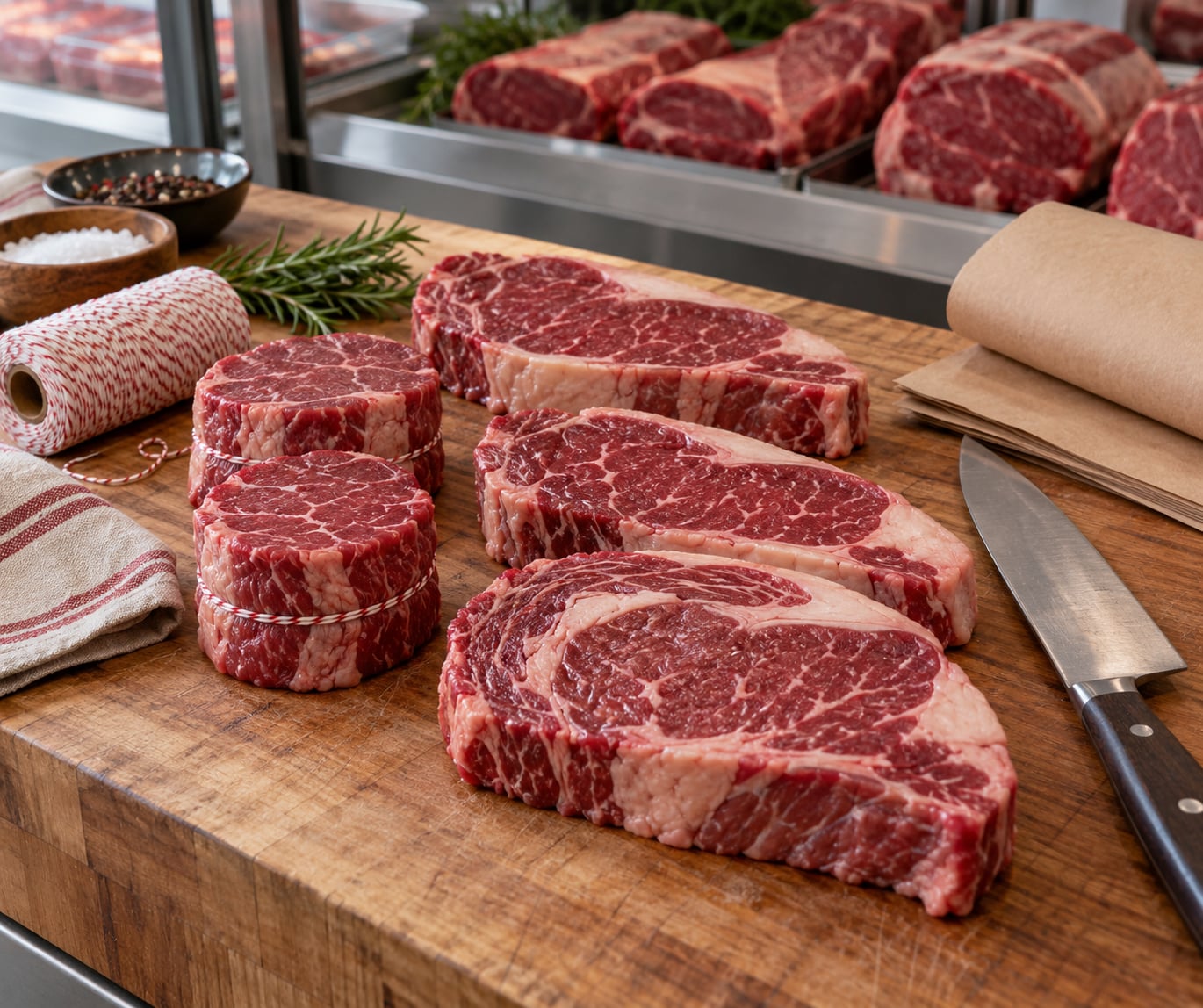
Rough map, and it is rough on purpose. Ribeye for richness and marbling. Strip steak for a familiar, grill-friendly option with a clean beefy flavor. Tenderloin for maximum tenderness and almost no work. Sirloin for value that still eats well. Skirt and hanger for steakhouse flavor at butcher-shop prices.
Tell them which of those four you want and you have given them permission to stop selling you the ribeye. That is a good trade.
Step 3: Grade and Marbling, Without the Lecture
USDA grades beef on tenderness, marbling, and yield grade. Prime has the highest marbling, Choice sits in the middle, Select is leaner. It is a useful sorting tool and it is not the whole story.
The number worth more than the grade is how the fat is distributed. Marbling, which the USDA calls intermuscular fat, is the flecking inside the muscle itself and it is what stays tender. A fat cap is the layer on the outside; it bastes the steak but does almost nothing for tenderness.
Buyers confuse the two constantly. A Select steak with a two-inch fat cap can be tougher than a well-marbled Choice steak trimmed down, and no label on the case is going to tell you that.
Ask where the marbling sits rather than asking what the grade is. “Is the marbling through the eye or mostly along the edge” is a question a butcher respects, because it shows you know what you are looking at.
Step 4: Age, Freshness and How to Get It Home
Ask two things: is this fresh or aged, and how long has it been out of the case. Fresh-cut beef is sold inside roughly two weeks of slaughter. Wet aged means sealed in vacuum bags, which keeps the surface moist and the texture mild. Dry aged means hanging in a cooler for weeks, which concentrates flavor, firms up the surface, and costs real money.
Ten to fourteen days of dry aging is the common request people who age at home use. Anything past about 21 days starts costing more than most weeknight steaks can justify.
Freshness at the counter reads visually. Bright red muscle with clear white or cream fat, a moist-looking surface rather than a dry matte one, and no gray or brown edges. Meat that has been sitting out is a walk-away, and the smell is the fastest test of all, clean and faintly sweet rather than sour.
Finish with the transport question: how do I get this home cold, and how long can I keep it. Whole cuts of beef refrigerate for three to five days and freeze well for longer. Get it home cold, put it on ice if you are driving more than twenty minutes.
Step 5: Trimming, Thickness and Portions
Over-trimmed steaks are the single most common complaint from buyers, and the fix is simply to ask in advance. Tell the butcher how much fat cap you want to remain and where. A quarter inch of cap is plenty for basting; an inch is a lot unless you are finishing it directly over coals.
Denuing means removing external fat entirely, french trimming means cutting the cap into a uniform strip. Both are ordinary requests at a butcher shop and often free. The jargon is not the point, the amount is: “an eighth inch of fat, no more” gets you what you mean.
Portioning works the same way. Say how many people, how many ounces each, and whether you want the steaks kept whole or sliced across the grain at home. Ask them to vacuum seal anything you will not cook, and ask them to slice the rest thinly for stir-fry or leftovers while you wait.
One request worth making every time: what do you recommend instead. A butcher who volunteers that the flat iron is better today than the strip in the case has just told you something about themselves, and shoppers consistently read that as the mark of a good shop.
Step 6: Substitutions and What the Case Actually Has
Two questions close the conversation and both are worth asking out loud. First, if the cut you wanted is out, what would you buy instead. Most counters carry at least a version of every steak, and the substitute is often the better deal.
Second, is there anything in the back that is not on display. Shops routinely hide their best and least familiar cuts: hanger steak, tri-tip, bavette, outside skirt, flat iron, Denver steak, picanha, and sirloin cap. None of them are bad; they are just unfamiliar and they do not sell themselves.
Then confirm the per-pound price out loud before you pay, and ask whether the case price already accounts for aging and trimming. If you cannot get a straight answer to that, the meat itself is rarely the problem.
| Question | What a good answer sounds like | Ask next if the answer is vague |
|---|---|---|
| Which cut for my method? | “For a hot cast iron pan, a 1.5 inch ribeye or a New York strip” | “What is tender enough that I cannot ruin it?” |
| How thick? | “At least 1.5 inches for a hard sear” | “Can you cut this thicker from the next primal?” |
| Aged how? | “Wet aged, or dry aged 21 days in our cooler” | “How long exactly, and does that price include it?” |
| Grade and marbling? | “Choice grade, marbling through the eye” | “Can you show me the seam fat on this one?” |
| Raising? | “Grain finished, or grass finished for the last 60 days” | “For how many months of the animal’s life?” |
| Fat cap? | “I will trim it to a quarter inch unless you say otherwise” | “Can you denue it instead?” |
| Portions? | “Four portions at 10 ounces, vacuum sealed” | “Will you slice the extra thin for me now?” |
| Better alternative? | “The flat iron is better than the strip today” | “What would you buy for this meal?” |
Common Steak-Buying Mistakes
Buying by cut name alone. A name tells you the part of the animal, not the quality of it. The same premium cut is sometimes tender and sometimes not, which is the single biggest frustration buyers report. Fix: ask where the beef came from and how long it aged, every time.
Ignoring thickness. A one-inch ribeye cannot be seared hard without burning. Fix: state your cooking method first and let thickness follow.
Reading marbling as the fat cap. Internal marbling is what makes a steak tender; the cap is flavor and basting. Fix: look for flecking inside the muscle, not just a thick white edge.
Treating an unfamiliar label as a premium charge. Prime and grass fed both get used loosely, and grass fed on its own says little about the finish. Fix: ask how many months of the animal’s life were spent on pasture. Grass finished is the term that matters; grass fed alone is not the finish.
Over-trimming or letting the counter trim by default. You come home with a steak that has nothing to baste with. Fix: ask how much cap you want to remain, in fractions of an inch.
Storing it wrong on the way home. A warm car ruins a good steak faster than a cheap one. Fix: get it cold within twenty minutes and refrigerate it immediately.
Asking for a cut without saying how you will cook it. Fix: lead with the method, the number of guests, and your texture preference, and the counter will do the sorting for you.
How to Choose the Right Steak for Your Cooking Method
Pairing the technique to the cut is where the questions you asked at the counter pay off. Here is the cheat sheet, and it is built for a home kitchen rather than a restaurant line.
| Cut | Flavor and texture | Best method | Relative price | What to say at the counter |
|---|---|---|---|---|
| Ribeye | Rich, very marbled, tender | Grill or hard sear, 1.5 to 2 inches | Highest tier | “Something marbled for a Saturday grill” |
| New York strip | Clean beefy flavor, firmer edge fat | Grill or sear, 1.25 to 1.5 inches | High tier | “Strip for four, no tenderizer” |
| Tenderloin | Mild, very tender, lean | Pan sear or roast, no overcooking | Highest tier | “Two tenderloifs, medium rare” |
| T-bone or porterhouse | Two textures in one cut | Grill or sear, thick | High tier | “T-bone, and please trim the tail” |
| Sirloin | Good beef flavor, moderately lean | Grill, sear, slice thin for leftovers | Mid tier | “Sirloin for five, thick end for me” |
| Flank steak | Bold, lean, fibrous | Grill or sear, slice thin against grain | Mid tier | “Flank, sliced thin for tacos” |
| Hanger steak | Intense flavor, very tender | Sear hard, slice thin | Mid to low tier | “Do you have hanger today?” |
| Bavette | Silky, tender, rich | Pan sear or grill, thin | Mid tier | “A bavette, denued, for two” |
| Outside skirt | Greasy, beefy, forgiving | Grill hard, slice thin | Low tier | “Skirt steak, does it come in?” |
| Flat iron | Marbled, tender, uniform | Sear, slice thin, great sliced cold | Low tier | “Flat irons for the party, four of them” |
| Tri-tip | Sweet, peppery, tender on one end | Roast or grill low, slice across grain | Low tier | “Tri-tip, and can you leave the fat on?” |
| Picanha / coulotte | Beefy, fat cap is the point | Roast or grill over coals | Mid tier | “Coulotte with a quarter inch of cap” |
Two rules of thumb carry most of the weight. Thicker and well marbled cuts reward a hard, fast sear. Leaner cuts reward a gentler finish, because lean meat has no fat to keep it from drying out.
Whoever buys it for you should cook whole cuts of beef to a minimum internal temperature of 145°F, which is 63°C, then rest it before slicing. Rare is a preference, but rare is not the safe choice.
Frequently Asked Questions
What are good questions to ask a butcher?
Start with how you plan to cook it and how many people you are feeding, then ask which cut suits that, how thick to cut it, whether it is fresh or aged and for how long, what the USDA grade and marbling look like, how much fat cap to leave on, whether it can be portioned and vacuum sealed, and what the per-pound price includes. That order matters, because the first answer determines the rest.
How can you tell if a steak is high quality?
Look for bright red muscle with white or cream fat, flecking of marbling inside the muscle rather than only a thick outer cap, a moist surface, and no gray or brown edges. Pick it up: good beef is firm and cold to the touch. Smell it and you want clean and faintly sweet. If the case is warm or the meat has dulled in color, skip it no matter what the tag says.
Is dry aged or wet aged steak better?
Neither is better, they are different. Wet aged beef is sealed in vacuum bags for up to a couple of weeks and keeps a mild, uniform texture. Dry aged beef hangs in a cooler for several weeks, which concentrates flavor and firms the surface, and it costs meaningfully more. For a weeknight pan-sear, wet aged is usually enough. For a grill centerpiece, dry aged 21 days is worth the difference.
What cut is a poor man’s filet mignon?
Bavette and hanger steak are the two most common answers. Both come from less-tender muscles, but they have enough natural marbling to stay tender if you do not overcook them. Both cost a fraction of tenderloin and both sear beautifully. Bavette is a thicker, richer cut; hanger is thinner, cheaper, and has a more pronounced beefy flavor.
Is a butcher shop steak worth more than a grocery store steak?
Sometimes. A full-service shop can cut to your thickness, trim to your spec, portion, vacuum seal, and tell you what came in that week. A grocery meat counter can often do one or two of those things, and its cutting is standardized. The premium is worth it when you are buying more than one steak, ordering a special cut, or want an honest opinion about what is best that day.
What is the 3-3-3 rule for steak?
It is a cooking convention, not a buying rule, and it is not universal. One common version means three minutes per side for a first sear, three minutes for a second sear, and three minutes of rest. Treat it as a starting point and adjust for thickness. When you are at the counter, thickness is the number that matters, not the timing formula.
Conclusion
Walk up to the counter and say four things: how you will cook it, how many people you are feeding, whether you want flavor or tenderness, and what you are comfortable spending per pound. Then let the butcher recommend a cut before you name one.
Your five-line cheat sheet:
- Method first, cut second, price third.
- Fresh, wet aged, or dry aged, and for how long.
- Marbling inside the muscle, not just a fat cap.
- An eighth inch of fat cap is plenty unless you say otherwise.
- Ask what they would buy instead, and listen to the answer.