Bread that is actually fresh baked comes out of the oven within the last few hours, and you can tell by running an ordered set of checks: find the bake time, look at the crust, smell it, feel the weight, listen for a snap, and look at the crumb. No single sign proves it, which is why a printed claim on a bag is the weakest evidence of all. The whole sequence takes about a minute at a market stall.
Getting this right matters more than it sounds. A sell-by date tells you about a vendor’s liability window, not the day the loaf was baked, and soft bread can be two days old. This guide is written for market shoppers picking up a loaf at a counter and for home bakers checking a loaf straight from the oven, and it is reviewed for 2026.
Table of Contents
- What You Need
- Step-by-Step: How to Tell if Bread Is Actually Fresh Baked
- 1. Check When the Loaf Was Baked
- 2. Look at the Crust
- 3. Smell the Bread
- 4. Assess the Weight and Firmness
- 5. Listen for a Crisp Crust
- 6. Inspect the Crumb When You Can
- 7. Ask the Baker or Read the Label Correctly
- Common Mistakes
- Frequently Asked Questions
- How long does bread stay fresh after baking?
- Should fresh bread be soft?
- How can I revive day-old bread?
- Does storing bread in the refrigerator make it go stale faster?
- Is bread labeled baked today always fresh?
- What to Do First
What You Need
You need no tools. The useful equipment is information: the bake date or bake time, the batch code, the name of the bakery, and, failing all of that, a baker within earshot. The rest is your own senses, in this order: sight, smell, touch, hearing, and finally taste.
Two honest caveats before you start. Fresh does not always mean soft, and some artisan breads actually taste better on day two once the crumb has set and the starch has finished settling. A dense rye at 36 hours can be a better loaf than a sandwich loaf at four.
If you bake at home, an instant-read thermometer is the one tool worth owning. Temperature is the only objective freshness and doneness measurement available to a home baker, and it is the one check that can settle a disagreement about whether a loaf is underbaked.
Step-by-Step: How to Tell if Bread Is Actually Fresh Baked
Run these seven checks in order at a public-market bakery, a grocery bakery counter or a restaurant counter. Each step is worth something on its own, and no single one is conclusive on its own either.
1. Check When the Loaf Was Baked
Start with the most objective evidence available: when it came out of the oven. Look for a bake date, a bake time, a batch code, or a day-of-week stamp. Many market bakers post a baking schedule, and some tag loaves with the hour, which is the most useful thing you will find.
Pay attention to precision. A tag that says 6:40 am tells you the loaf is perhaps four hours old. A bag that says baked today could mean it came out of the oven two minutes ago or yesterday evening. Precise timing beats broad phrasing every time.
Here is the script home bakers report wishing they had used at a stall: ask when the batch came out of the oven and whether it was chilled. Nobody has ever minded the question.
2. Look at the Crust
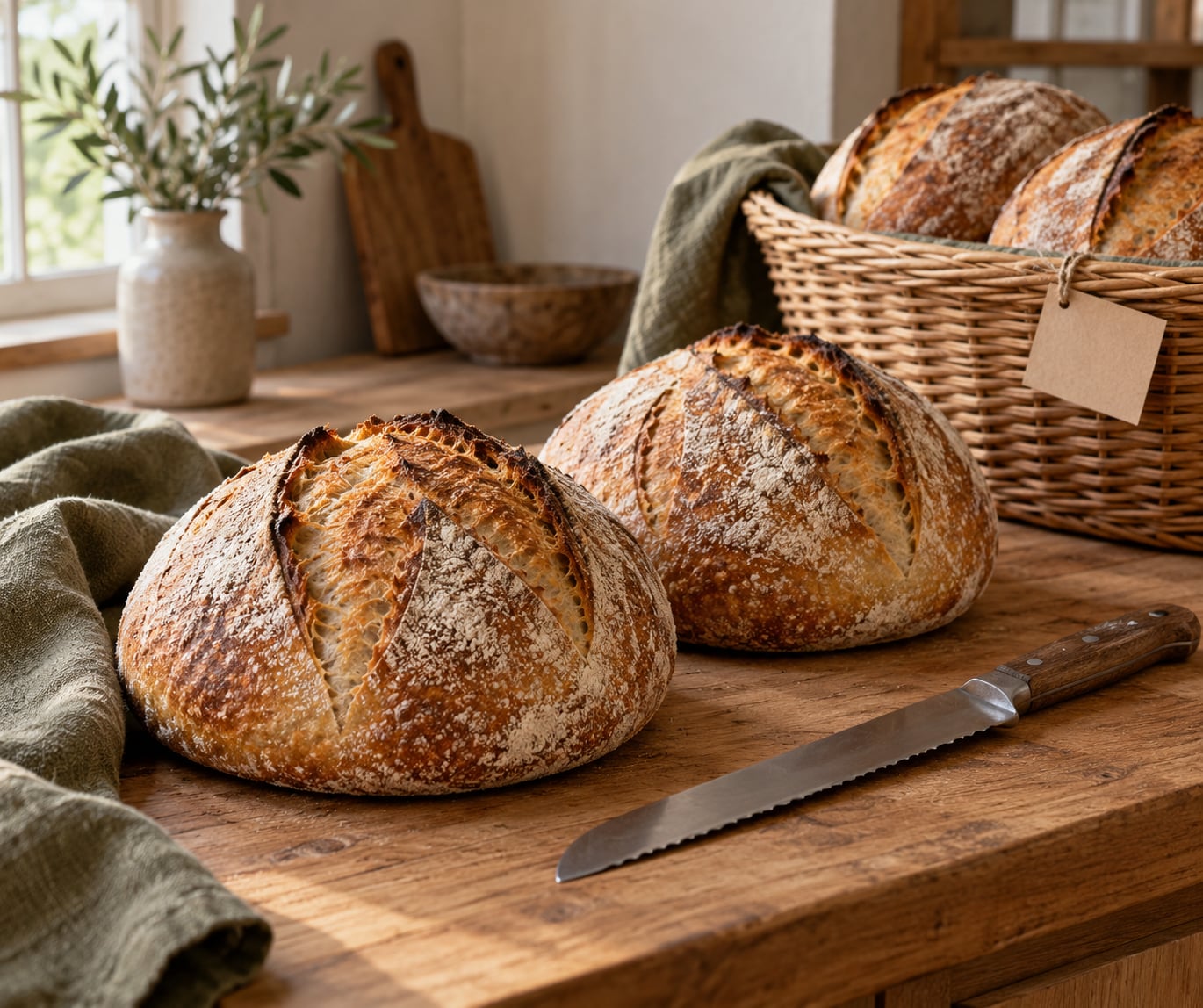
A fresh crust is evenly golden brown with a slight sheen, a little blistering, and a matte-dry finish where the moisture has escaped. Colour tells you more than most people expect, but you have to know the style first.
Rye is naturally dark, not burnt. Enriched doughs with milk, sugar, egg wash or butter brown faster and darker than a lean country loaf. Seeded and flour-dusted loaves look pale on top by design, and loaves baked on a dark stone or deck pick up colour on the bottom long before the top changes.
What a good crust will not tell you is what is happening inside. A beautiful crust on a loaf that came out of the oven yesterday is still yesterday’s bread, and pale patches that should have coloured are a fair warning of uneven baking.
3. Smell the Bread
Fresh bread smells of yeast, warm crust and whatever the recipe intended: butter, milk, olive oil, herbs, garlic, coffee. A yeast note that fills the room the second you lift the bag is a genuinely useful signal.
Learn the failure smells too. Stale bread smells flat, doughy, or faintly cardboard-like. Bread that has been reheated and left too long smells of warm toast gone cold. A loaf that has been sitting in a warm, humid bag for days can pick up a sour, vinegary edge that is fermentation rather than freshness.
One counterintuitive note: an overwhelmingly raw-yeast smell in a large country loaf sometimes means the dough was underbaked, because the interior never got hot enough to bake off. If the crust looks pale and the yeast smell is overpowering, treat it with suspicion and check the crumb.
4. Assess the Weight and Firmness
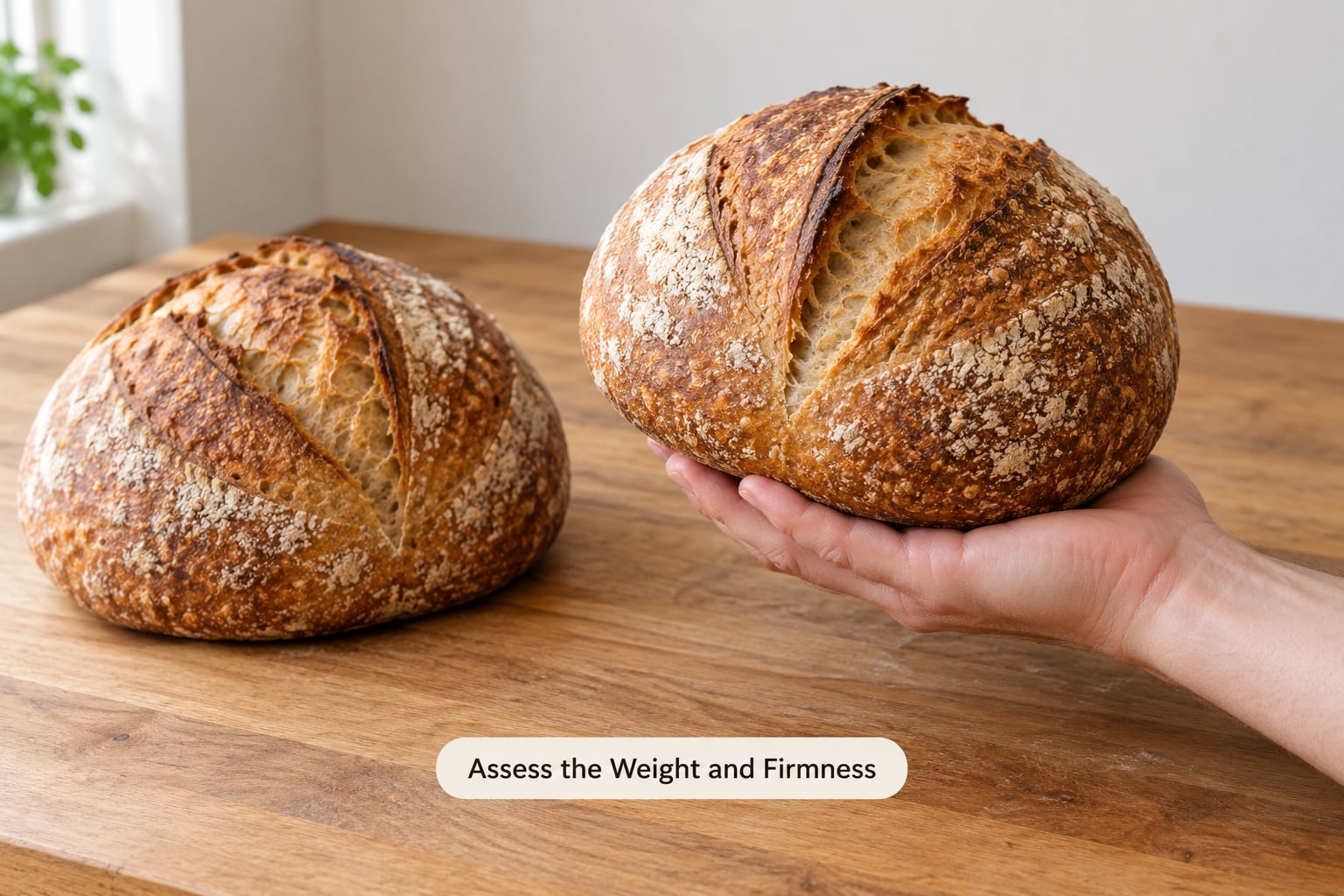
A fresh loaf feels substantial for its size. Press gently with your thumb: it resists, then springs back, leaving maybe a small dent that fills in within a second or two. A loaf that is stale takes the dent and keeps it.
Do not squeeze packaged bread to test it. Loaves stacked and compressed in a delivery truck and on a shelf have been pressed together for hours, and the dent tells you about the packaging, not the bake.
Where you can, buy two loaves of the same style and compare. The one that feels heavier and firmer for its size is usually the fresher bake, and it is the most reliable comparison you can make with your hands alone.
5. Listen for a Crisp Crust
Press the crust near the top of the loaf and listen. Fresh bread with a dry crust makes a light crackle or snap as it flexes, a sound that gets duller by the day as the crust absorbs moisture from the crumb and from the air.
This test has real limits. Packaged bread has usually softened in the bag, soft-crusted sandwich loaves and rolls may never crackle at all, and a very fresh loaf with a thin crust can be quiet in the hand. Use it to compare two similar loaves, not to condemn a different style.
6. Inspect the Crumb When You Can
The crumb is the most informative part of the loaf and the one most buyers never see. Look for an open, irregular structure with some variation, and for a slight moist sheen just inside the crust that fades toward the center. Tender but not slick is what you want.
Many professional bakeries will hand you an end piece, or you can ask to slice a heel. Buy a sandwich loaf and you get the cut face for free, which is why grocery bakery bread is often the easiest to assess and the most revealing.
Two myths to clear up here. Large air holes are not proof of freshness, they mostly reflect hydration, fermentation and shaping, and a loaf can be a week old with dramatic holes. A wet-looking, gummy, dense crumb is the opposite signal: that is underbaked dough, and it is not pleasant to eat straight away because the starch has not set.
7. Ask the Baker or Read the Label Correctly
At a market with no labels, the questions that get you real answers are short: when did the batch come out of the oven, was it chilled, and is this the current bake or yesterday’s? Bakers answer these constantly, and the chilled answer matters because cooling too fast or storing warm can affect texture.
When you are stuck with packaging, translate rather than trust. Baked today and same-day are claims, not measurements. Naturally leavened tells you about the dough, not the bake date. Preservative-free means no added preservatives, which is a statement about ingredients and says nothing about how old the loaf is. Sell-by and best-before dates are about a vendor’s guarantee window and a quality expectation, not a promise of a same-day bake.
What is worth reading is a real date, a real time, or a batch code you can ask about. Everything else is marketing, and r/Breadit posters are fond of pointing out how little the printed date on a supermarket loaf has to do with the day it was baked.
Common Mistakes
Judging by appearance alone. A golden, glossy, photographed-looking crust is the easiest thing to fake and the least reliable. It tells you how the loaf was baked, not when.
Treating soft as fresh. Softness means moisture, and moisture is what preservatives and sealed plastic bags deliver cheaply. Many people assume a soft loaf left untouched for two days is fresh, and home bakers on r/Breadit keep running into the same surprise: a beautiful country loaf that turns firm partway through by about day three.
Expecting every crust to crackle. Enriched sandwich loaves, milk breads and soft rolls are not supposed to. If the recipe is meant to be soft-crusted, snapping is not a freshness test at all.
Reading big crumb holes as a sign of freshness. Openness comes from hydration and fermentation, not from the clock. A stale loaf can have dramatic holes.
Assuming no preservatives means freshly baked. A preservative-free loaf from a shelf can be a week old. It will also mold faster, which is exactly what people notice: home bakers report store-bought bread molding within about five days, while a Facebook food community poster described loaves that sat for four months without molding or drying out. Neither fact tells you anything about a bake time.
Touching every loaf. Pressing a display loaf to test it is how a market bakery loses stock, and some bakers will not let you, fairly enough. Check the end piece or ask instead, and buy two of the same style so you can compare at home.
Mistaking flour dust for mold. A dusting of white flour on a scored crust, or a fine white coating on a rye, is normal and comes off the knife or the bench. Mold is fuzzy, it spreads in patches, and it is usually green, white, blue or black. Do not cut and taste to check. If in doubt, throw it out. That is the one mold question with no debate, and Reddit threads asking whether you can just cut it off are unanimous on it.
Once you have bought the loaf, storage matters more than any label. Sliced bread goes stale roughly twice as fast as a whole loaf, so keep the loaf whole and slice as needed. Paper bag or cloth for a crusty loaf, a bread box or sealed plastic for a soft sandwich loaf, and never the refrigerator, which chills the starch in the crumb and speeds up staling even as it slows mold. Freeze for anything beyond a couple of days, and revive a tired loaf by misting it with water, wrapping it tightly in foil, and baking at 300F for five to ten minutes, which is the method r/foodhacks readers use most.
Frequently Asked Questions
How long does bread stay fresh after baking?
It depends almost entirely on the type. Baguettes and rolls are at their best within hours and decline fast. A sourdough or country loaf holds its character for two to three days on a counter, dense rye longer, and an enriched sandwich loaf can stay acceptable for several days because of the fat and sugar in the dough. Staling is not spoilage, so bread past its best day is still safe, just less good.
Should fresh bread be soft?
Not always. A crusty artisan loaf is supposed to feel firm and slightly springy, and a day-old sourdough is often more pleasant than a squishy one straight from the oven. What fresh bread should never feel like is damp, heavy or gummy, which points to underbaking rather than freshness. Softness on its own is a poor freshness signal because sealed plastic and preservatives produce it cheaply.
How can I revive day-old bread?
Lightly mist the loaf with water, wrap it tightly in foil, and put it in a 300F oven for five to ten minutes. The water restores moisture to the crust and the heat brings back the crispness. For a whole loaf, leave it in the foil for a few extra minutes so it warms through. Sliced bread revives faster on a baking sheet, uncovered, for three to four minutes.
Does storing bread in the refrigerator make it go stale faster?
Yes. Refrigeration holds the crumb at a temperature where the starch recrystallizes fastest, so the texture firms up in hours instead of days. It is useful only for breads with high moisture and acidity, and for keeping mold at bay when a loaf will sit more than a couple of days. A sealed bag at room temperature, or the freezer, will keep a loaf tasting better for longer.
Is bread labeled baked today always fresh?
No. Baked today and same-day are claims, and they are unverifiable from the bag. The label can cover a bake from six this morning or eight last night. Look instead for a time, a batch code, or ask the baker. Combine that timing with the sensory checks, and if the crust is dull, the crumb is dry or the aroma has gone flat, the label is not going to change the evidence.
What to Do First
Check the bake time before anything else, then look at the crust, weigh the loaf gently in your hand, and ask the baker if the evidence is thin. No single sign tells you how to tell if bread is actually fresh baked on its own. Timing plus one or two sensory cues is what makes the call, and if the timing is unknown, say so and buy accordingly.