You fry doughnuts without a deep fryer by heating 3 inches of neutral oil in a heavy pot, Dutch oven, or deep saucepan to 350–365°F, then lowering the rings in by hand and turning them with a slotted spoon. Small batches, a clip-on thermometer, and a wire rack for draining do the rest.
A countertop fryer’s only real advantage is its built-in thermostat. Once you learn to hold temperature in a pot, the technique is identical, and the pot gives you one thing a fryer does not: full control over batch size.
Budget about 30 minutes of active work for a dozen doughnuts, plus proofing time if you use yeast dough. It is a medium-difficulty job. The frying itself is a two-minute process, but the oil heats slowly and the first few attempts usually produce one batch of pale, greasy rings before the temperature settles.
Table of Contents
- What You Need to Fry Doughnuts Without a Deep Fryer
- Which pot works best
- Which oil to use
- Safety gear worth having
- Step-by-Step
- How to Fry Doughnuts Without a Deep Fryer: Mix and Shape
- How to Fry Doughnuts Without a Deep Fryer: Heat the Oil
- Fry, Drain, and Cool the Doughnuts
- Common Mistakes
- Tips for Evenly Golden Doughnuts
- Frequently Asked Questions
- What kind of pot is safest for frying doughnuts without a deep fryer?
- How deep should the oil be when frying doughnuts in a regular pot?
- What oil temperature gives doughnuts an even golden-brown exterior?
- Can I use a regular saucepan to fry doughnuts?
- How should I store leftover frying oil?
- Why is my oil smoking when I fry doughnuts?
- Conclusion
What You Need to Fry Doughnuts Without a Deep Fryer
The whole method depends on one thing: a vessel that holds heat and does not tip. Everything else is ordinary kitchen gear.
- A heavy pot, Dutch oven, or stockpot at least 4 inches deep, with a base wider than your largest doughnut and room for the oil to stay well below the rim.
- Neutral high-heat oil — canola, peanut, safflower, or sunflower/vegetable oil, enough to reach 3 inches deep.
- A clip-on deep-fry or candy thermometer, the one piece of equipment worth buying for this.
- A spider skimmer or slotted spoon for lowering, turning, and lifting.
- A wire cooling rack set over a parchment-lined tray. A rack drains doughnuts from underneath; paper towels alone trap steam and leave the bottom soggy.
- Parchment or baking paper for shaping rings and for parking the finished doughnuts.
- Tongs for glazing while the batch is still warm.
Which pot works best
Weight matters more than brand. Cast iron and thick stainless steel hold a set temperature through a whole batch; thin nonstick pans swing 30°F every time a cold doughnut goes in.
| Vessel | Oil depth it holds safely | Rings per batch | Heat retention | Good for |
|---|---|---|---|---|
| Cast iron Dutch oven | 3 inches | 3 to 4 | Excellent | Best all-round choice |
| 4-quart heavy saucepan | 2.5 to 3 inches | 2 to 3 | Good | Small weekend batches |
| 8-quart stockpot | 3 to 4 inches | 5 to 6 | Very good | Holiday batches, a full dozen at once |
| Cast iron skillet | 1 to 1.5 inches | 1 to 2 | Fair | Shallow frying and doughnut holes |
| Wok | 2 inches | 2 to 3 | Poor | Not recommended, temperature swings too fast |
A shallow skillet is a real option, but it is shallow frying, not deep frying. The doughnut sits on the metal more than it floats, so it browns unevenly and drinks oil. If that is the only pan you have, drop the oil temperature slightly and turn the rings more often.
Which oil to use
Any oil that can take 365°F without smoking and tastes close to nothing will work. Avoid olive oil, which flavors the doughnut, and anything with a low smoke point such as butter or a blend with a high fraction of it.
| Oil | Flavor | Best for |
|---|---|---|
| Canola | Neutral, very light | Everyday batches, mild flavor |
| Peanut | Slight nuttiness | That classic shop doughnut taste; clear the allergy question first |
| Safflower | Completely neutral | Cakes and rings where you want no oil flavor at all |
| Sunflower or vegetable | Neutral | Budget option, works the same as canola |
Shop doughnuts usually fry in a blend, and several bakers on r/donuts argue that a portion of solid shortening gives a more even, cakey crumb. It works, but neutral oil is easier to handle and easier to store and reuse.
Safety gear worth having
Hot oil fires start fast and go from a smolder to a flame-pot in seconds. Before you heat anything: dry your hands and every tool that will touch the oil, keep a lid for the pot within arm’s reach, and set a fire extinguisher or a metal lid plus baking soda nearby. Never pour water on hot oil, and never carry a pot of it across the kitchen.
On a gas stove, keep the flame under the base of the pot rather than licking up the sides. A flame that wraps the pot climbs toward the oil headroom, and that is the single most avoidable way to start a kitchen fire.
Step-by-Step
How to Fry Doughnuts Without a Deep Fryer: Mix and Shape
Whether you use a yeast dough or a quick-rise batter, the shaping rules are the same. Consistent weight means consistent frying time, and one slightly small ring is the one that burns while the rest finish.
Mix the dough, then chill it for at least 30 minutes. Cold dough is firmer, sticks far less to your hands, and holds a clean edge. Bakers on r/AskCulinary go further and chill shaped rings overnight on parchment squares, which is the single best fix for dough that is too sticky to handle or drops apart in the oil.
Roll the dough about 1/2 inch thick and cut rings with a doughnut cutter. No cutter? A 3-inch round biscuit cutter with a 1-inch cap or a small jar lid pressed into the center works fine. Reroll the scraps gently, or save them for doughnut holes.
The visual test for a good ring: the outer wall is smooth with no cracks or bubbles of flour, the surface is dry to the touch, and every piece is within half an inch of the others in diameter. Dry dough matters more than most people expect, since water hitting hot oil spatters violently.
If you are using yeast dough, proof the shaped rings until they look puffy and spring back slowly, usually 60 to 90 minutes at room temperature. They should feel aerated and light, not dense. Underproofed rings fry into doughnut holes; overproofed ones collapse in the oil.
How to Fry Doughnuts Without a Deep Fryer: Heat the Oil
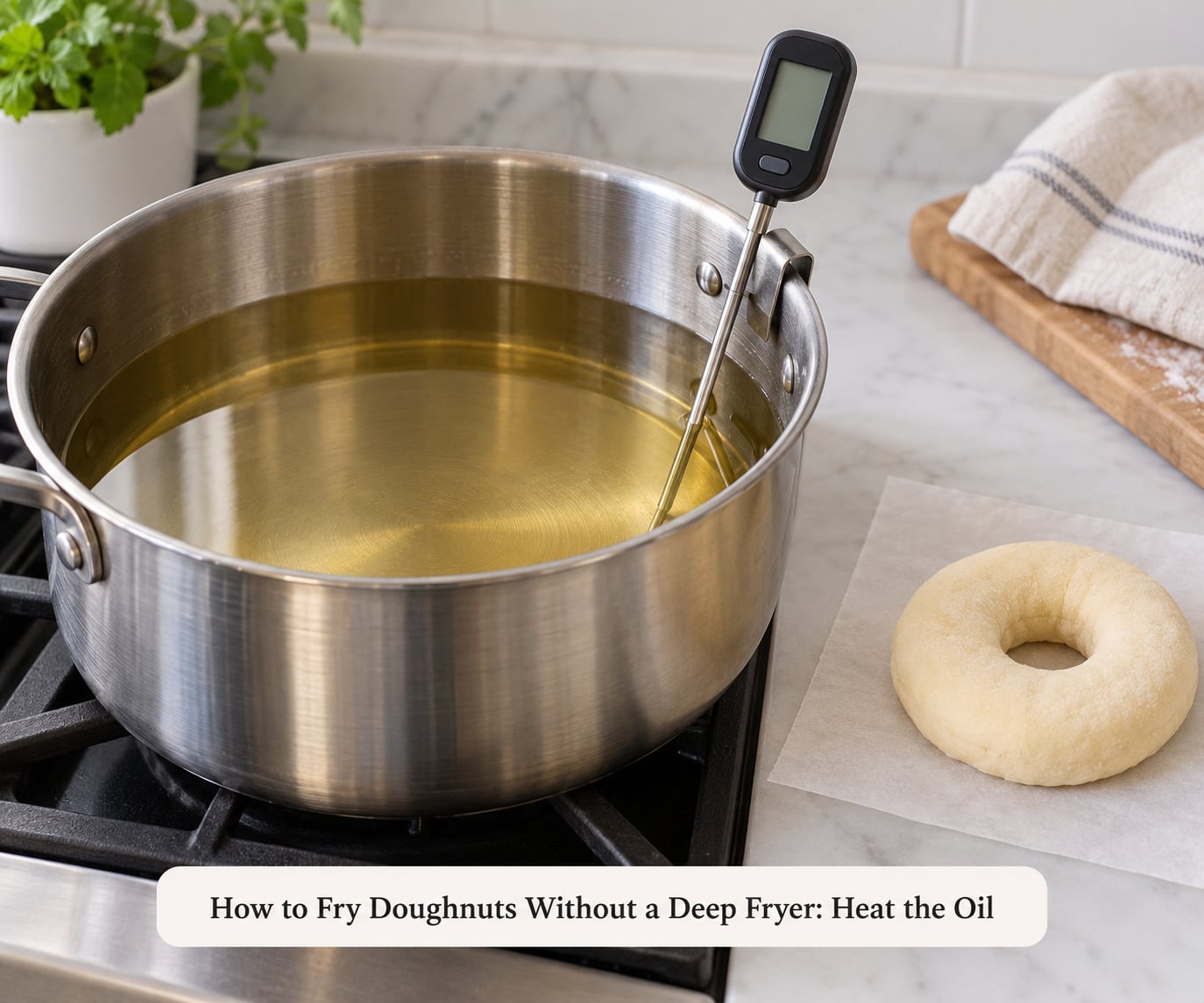
Set the pot on the burner and add 3 inches of oil. Never fill a pot more than halfway with oil, and keep at least 3 inches of empty space between the oil surface and the rim, because every doughnut rises as it fries.
Clip the thermometer to the pot with the tip in the middle of the oil, not against the side or the base. Then heat slowly to 350–365°F.
Before dropping anything in, drop one test piece. At the right temperature, bubbles form steadily all around it within about a second and it sinks slowly. If it sits motionless on the bottom, the oil is too cool. If it browns in under 15 seconds, pull the pot off the heat and let it cool.
Do not rush the heat-up. Once the oil reaches 350°F, drop the burner to low or medium and hold there. The pot’s stored heat carries you through a whole batch at that setting.
Fry, Drain, and Cool the Doughnuts
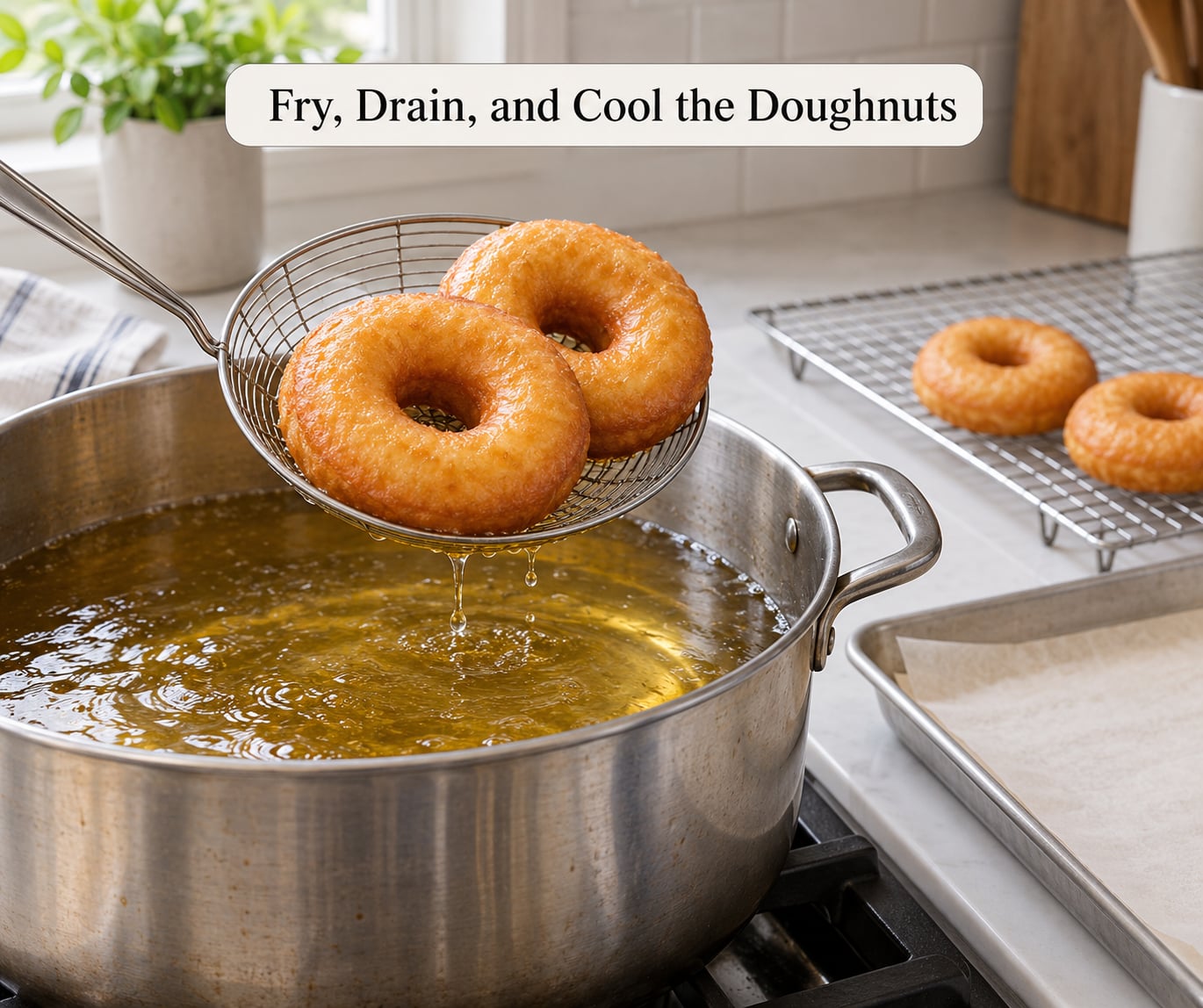
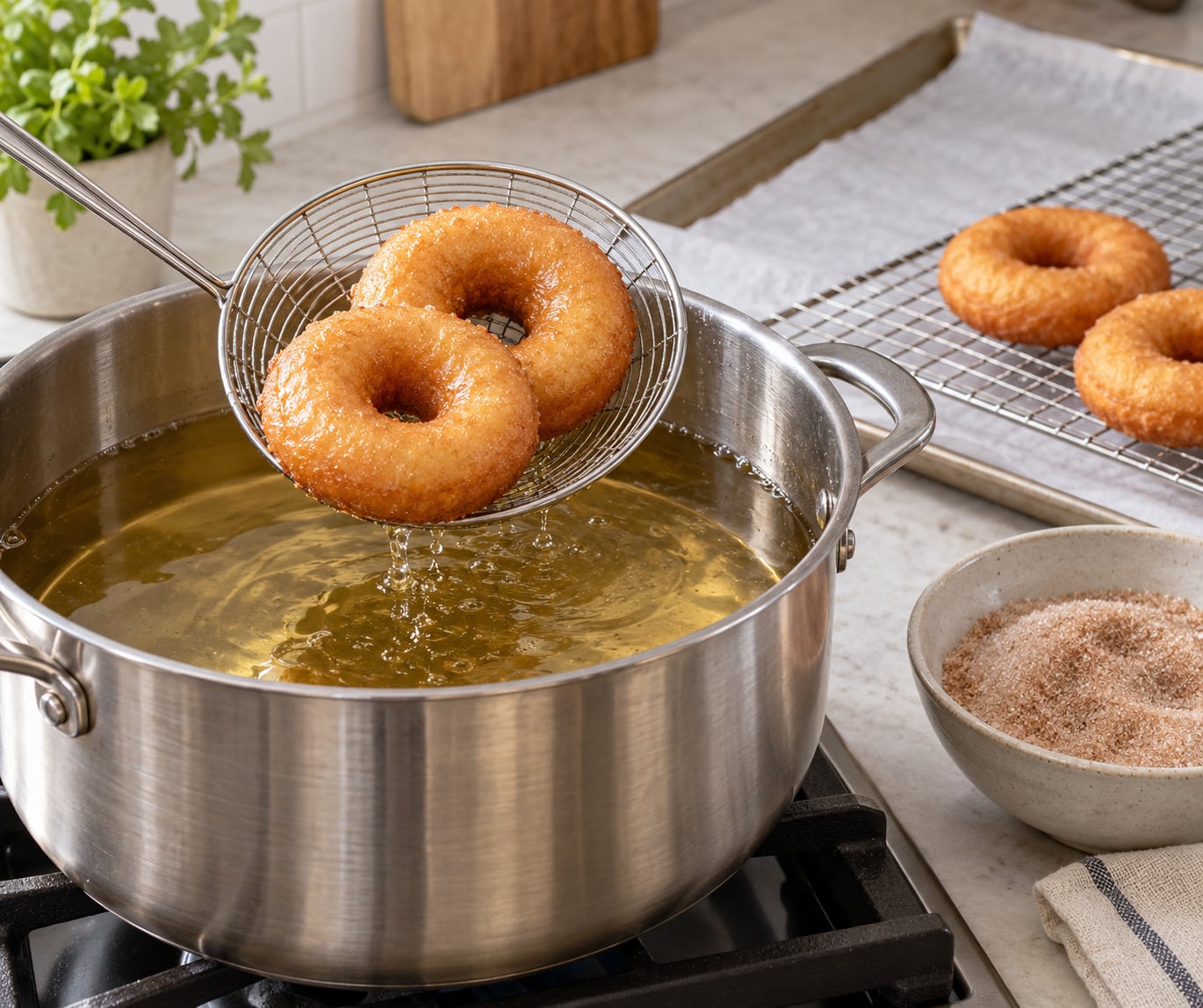
Slide 3 to 4 doughnuts into the oil one at a time, holding each ring at its edge with the spider. Lower them away from your body and away from the flame. They should sink, then rise and float as the water inside turns to steam, usually within 30 to 60 seconds.
Keep the thermometer in the oil the whole time. Cold dough and crowding both pull the temperature down, and a sudden drop below 340°F is what turns a batch greasy. If the reading falls, raise the burner slightly; if it climbs past 365°F, turn it down.
Turn each ring once, when the underside is golden brown, roughly 45 to 60 seconds in. Total fry time is about 90 to 120 seconds per side for a standard yeast ring. Thinner, batter-based rings finish in 45 to 55 seconds per side, and filled or thick rounds want a cooler oil and 3 to 4 minutes total.
Three cues tell you a doughnut is done: it floats steadily rather than sinking, both sides are an even deep gold rather than one dark side, and the center springs back when you press it lightly. A piece that floats is usually close, since that means the interior has reached the temperature where the water has turned to steam.
Lift the batch out with the spider, letting the oil drain back into the pot for a few seconds, and transfer to the wire rack. Let each batch drain for a full minute, then fry the next. Crowding the pot or rushing the batches gives you uneven color and a second wave of greasy doughnuts.
Glaze while the doughnuts are still warm, not hot. Dip each ring in a thin vanilla or chocolate glaze for three seconds, or shake it in cinnamon sugar mixed with a spoonful of granulated sugar. Powdered sugar goes on last, once the surface has cooled enough not to melt it.
Common Mistakes
Almost every disappointing batch traces back to one of these. The symptom tells you which one.
| What went wrong | Why it happened | How to fix it |
|---|---|---|
| Doughnuts greasy and heavy | Oil below 340°F absorbed into the dough | Hold 350–365°F and fry fewer at a time |
| Dark outside, raw center | Oil above 375°F, or the ring was underproofed | Lower the heat, check your proof before the next batch |
| Falls apart in the oil | Dough too sticky, too cold, or dropped from height | Chill longer, shape tighter, lower rings gently |
| Uneven browning | Doughnut touched the pot, or oil was too shallow | Keep 3 inches of depth and turn the pot for even heat |
| Soggy bottom | Drained on paper towels in a pile | Use a wire rack so air reaches all sides |
| Oil splatters hard | Doughnuts went in wet or crowded | Dry every piece, keep the pot half full |
Oil that is too shallow is the most common home mistake. Below 2 inches, the doughnut rests on the pot, the temperature crashes every time you add one, and the underside steams instead of frying.
Crowding causes the second-most problems. Each cold doughnut drops the oil several degrees, so a crowded pot fries everything at 330°F and the centers cook unevenly. Three at a time in a Dutch oven is plenty.
Dough that sticks during shaping means the dough is too warm or too wet. Chill it another 30 minutes, dust the bench lightly with flour, and work on a floured surface. Skip the rolling pin and use two cutters to press the ring out if it keeps sticking to everything.
Cooling glazed doughnuts too soon traps steam under the glaze. Let them sit on the rack for 10 to 15 minutes first, then dip and let the glaze set for another 15 minutes before stacking.
Tips for Evenly Golden Doughnuts
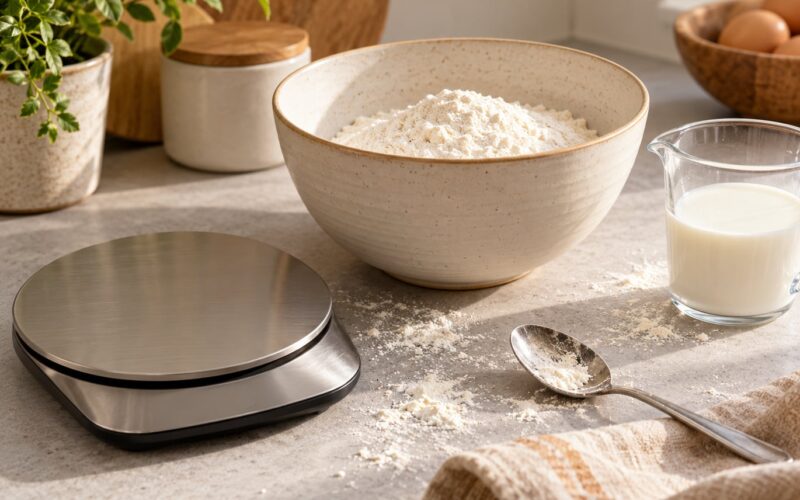
Weigh your portions if you have a kitchen scale. Rings within a few grams of each other all hit doneness at the same moment, which is the difference between a batch that looks intentional and one with two odd ones left over.
Rotate the pot a quarter turn every so often during the heat-up. Gas and electric burners both cook unevenly, and the spot sitting over the element browns first if you never move it.
Fry one doughnut first as a real test, not a scrap. It costs you a minute and tells you more than any table: how long your pot takes to recover, whether your rings are the right size, and whether the recipe’s proofing was right.
Read the temperature between every piece, not just every batch. Dropping five rings at once into a pot that was at 350°F can put you under 340°F within seconds, and that is where greasiness starts.
Drain twice for the best crust. Let the doughnuts sit on the spider above the pot for five seconds, then move them to the rack. A double drain removes the surface oil that turns a crisp crust soft.
Save the oil. Cool it completely, strain it through a fine sieve into a jar, and keep it for three or four more batches of something else before it degrades. If it smokes before you reach temperature, it is past its useful life.
Store doughnuts at room temperature in a single layer or in a loose bag with the top folded, not sealed. They stay good about a day. To bring a day-old doughnut back, microwave it for 10 to 15 seconds; a few bakers on cooking forums do this every time, and the crust comes back close enough to fresh.
If you would rather not deal with 3 inches of oil at all, air fryers and ovens both work. Air fryed doughnuts often stick to parchment and read as undercooked, as bakers on r/BakingNoobs report, so expect a baked result more than a fried one. Oven-baked rings need a spray or a little melted butter to brown at all.
Frequently Asked Questions
What kind of pot is safest for frying doughnuts without a deep fryer?
A heavy pot with a flat base, straight sides, and a 4-inch interior depth is safest. Cast iron or thick stainless steel holds heat steady, and straight sides let the spider slide underneath a ring without tipping it. Skip thin nonstick pans, woks, and any pot so wide that the burner flame licks up the sides.
How deep should the oil be when frying doughnuts in a regular pot?
Aim for about 3 inches of oil, and never fill the pot more than halfway. The depth has to rise at least halfway up a doughnut so it partially floats, and you need several inches of empty pot above the oil because every ring expands as it fries. Below 2 inches, the doughnut touches the pot and fries unevenly.
What oil temperature gives doughnuts an even golden-brown exterior?
Hold the oil between 350 and 365°F. Below 340°F, the doughnut soaks up oil and comes out greasy; above 375°F, the outside browns before the center cooks. Clip a thermometer to the pot with the tip in the middle of the oil, and adjust the burner between every doughnut since the temperature dips each time you add one.
Can I use a regular saucepan to fry doughnuts?
Yes, as long as it is heavy and deep enough for 3 inches of oil with several inches of headroom. A 4-quart saucepan takes two or three rings per batch, which is slower than a Dutch oven but works identically. Thin nonstick saucepans are the problem, since they lose temperature fast and the doughnuts brown unevenly.
How should I store leftover frying oil?
Let it cool completely, then strain it through a fine sieve or a cheesecloth into a jar. Store it sealed in a cool dark place and use it within a few weeks for three or four more batches before it darkens or smokes too early. Never store oil near the stove, and pour old oil into the trash rather than the sink.
Why is my oil smoking when I fry doughnuts?
Smoking means the oil is past its smoke point, usually because the burner is set too high, the pot is too small for the flame, or the oil has already been used several times. Turn the heat down, give the oil a minute to settle, and check the thermometer. If it still smokes near 350°F, the oil needs replacing.
Conclusion
Frying doughnuts without a deep fryer comes down to four things: a heavy pot, 3 inches of neutral oil with plenty of headroom, a steady 350–365°F, and batches small enough that the temperature holds. Everything else is timing and a rack to drain on.
Start by picking your pot, then clip on the thermometer. The first thing to do before you shape anything is heat the oil and fry a single test piece; it will tell you everything your thermometer alone cannot.