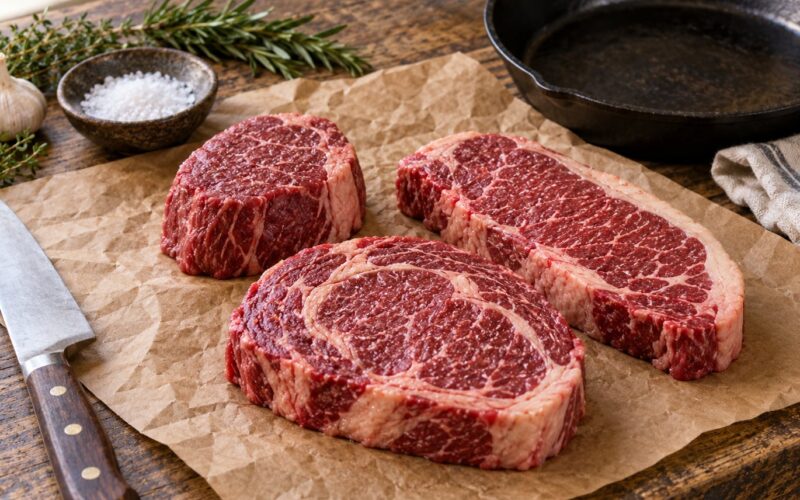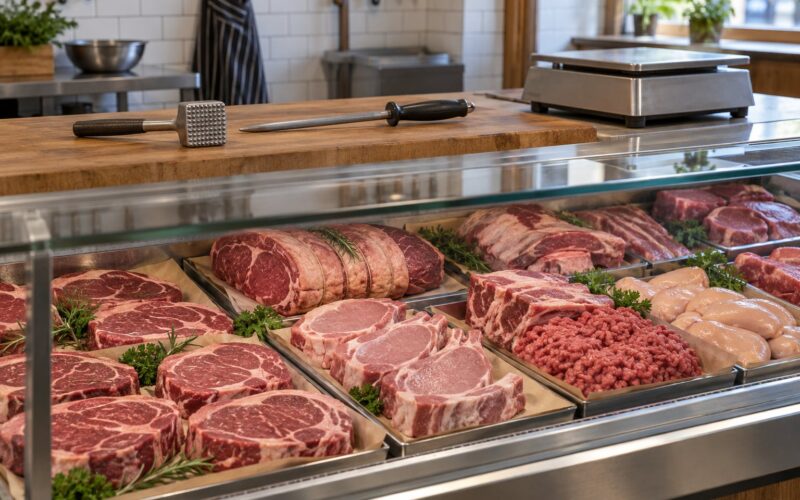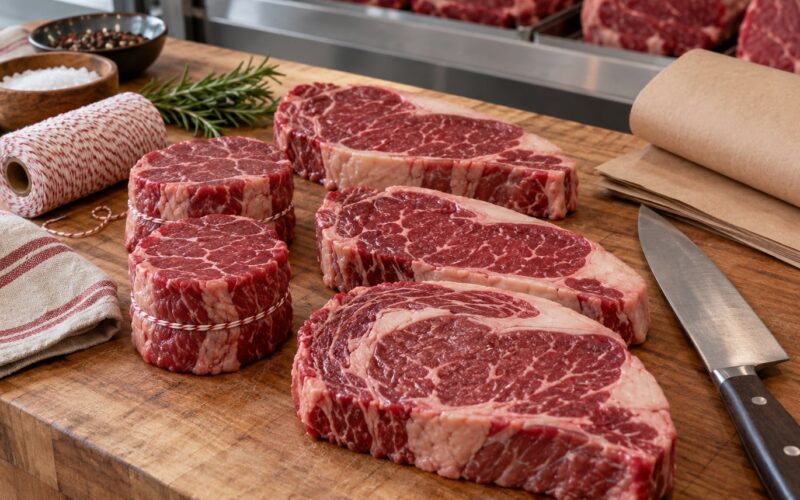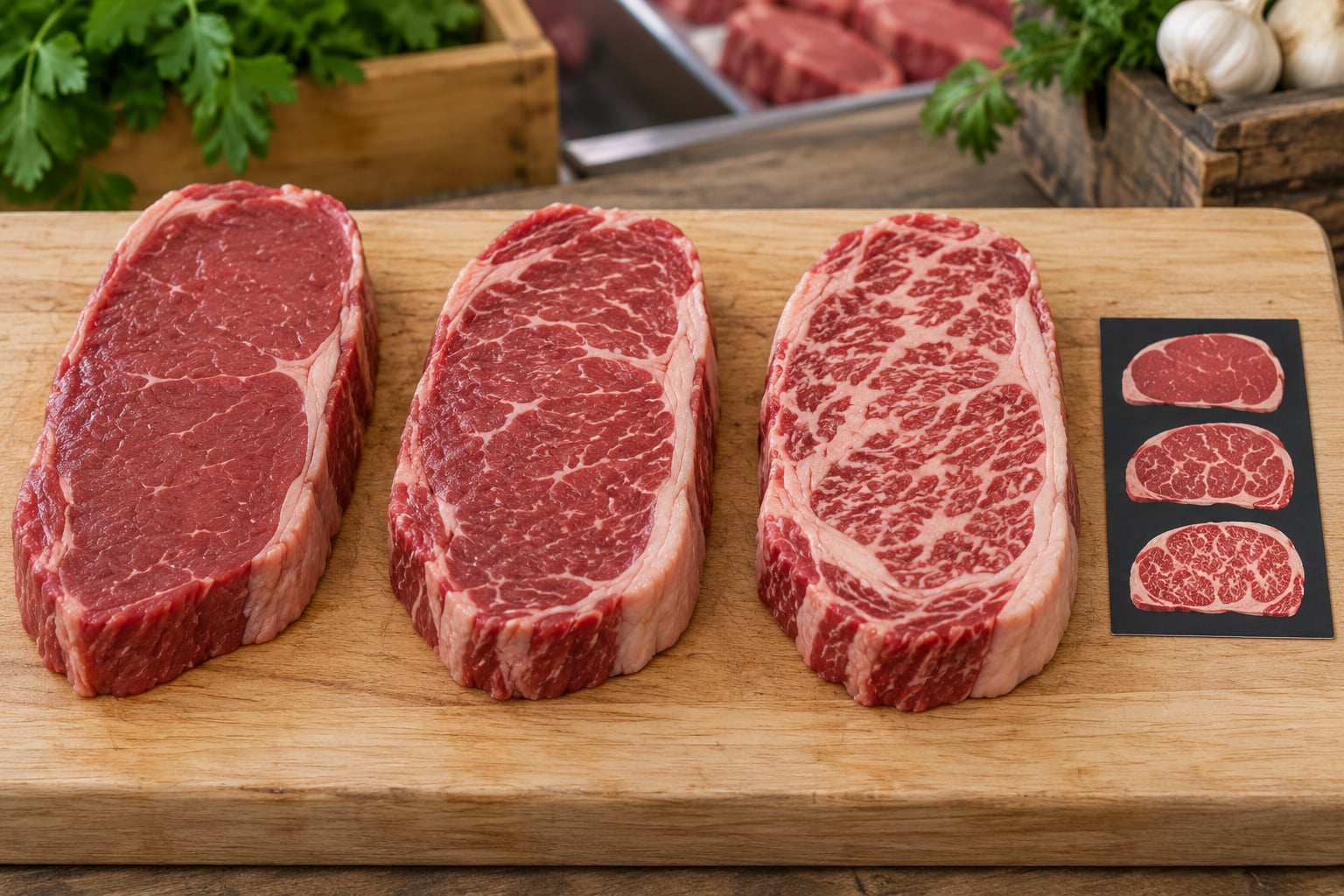
The difference between prime choice and select beef is mostly one thing: marbling, the fat that runs through the muscle. USDA Prime has the most of it, Choice sits in the middle, and Select has the least. That fat is what makes a steak taste buttery and tender instead of lean and mild.
Which one you want depends on the cut and how you are cooking it. Buy the right cut first, then decide whether the extra marbling is worth paying for.
Table of Contents
- What Is the Difference Between Prime Choice and Select Beef at a Glance?
- What Do Prime Choice and Select Mean in Beef Grading?
- What is the difference between prime choice and select beef? Fat content, not breed
- Is grading required, and where do you see it?
- Is Prime the only top grade?
- What about the word Prime on a menu?
- How Does Marbling Change Tenderness and Flavor?
- What else changes the result besides grade?
- Which Beef Is Better for Everyday Cooking?
- When the cut matters more than the grade
- How Much More Does Prime Choice Beef Cost?
- Why Prime is not always the most expensive thing in the case
- How to Choose Beef at a Market or Butcher Counter
- What About Safety, Storage, and Cooking Temperatures?
- Frequently Asked Questions
- Is select beef bad quality?
- Is prime choice always better than select?
- Is prime choice worth the extra cost for burgers?
- Which is better for steaks, and which is better for slow cooking?
- Does select beef need to be cooked differently from prime choice?
- Conclusion
What Is the Difference Between Prime Choice and Select Beef at a Glance?
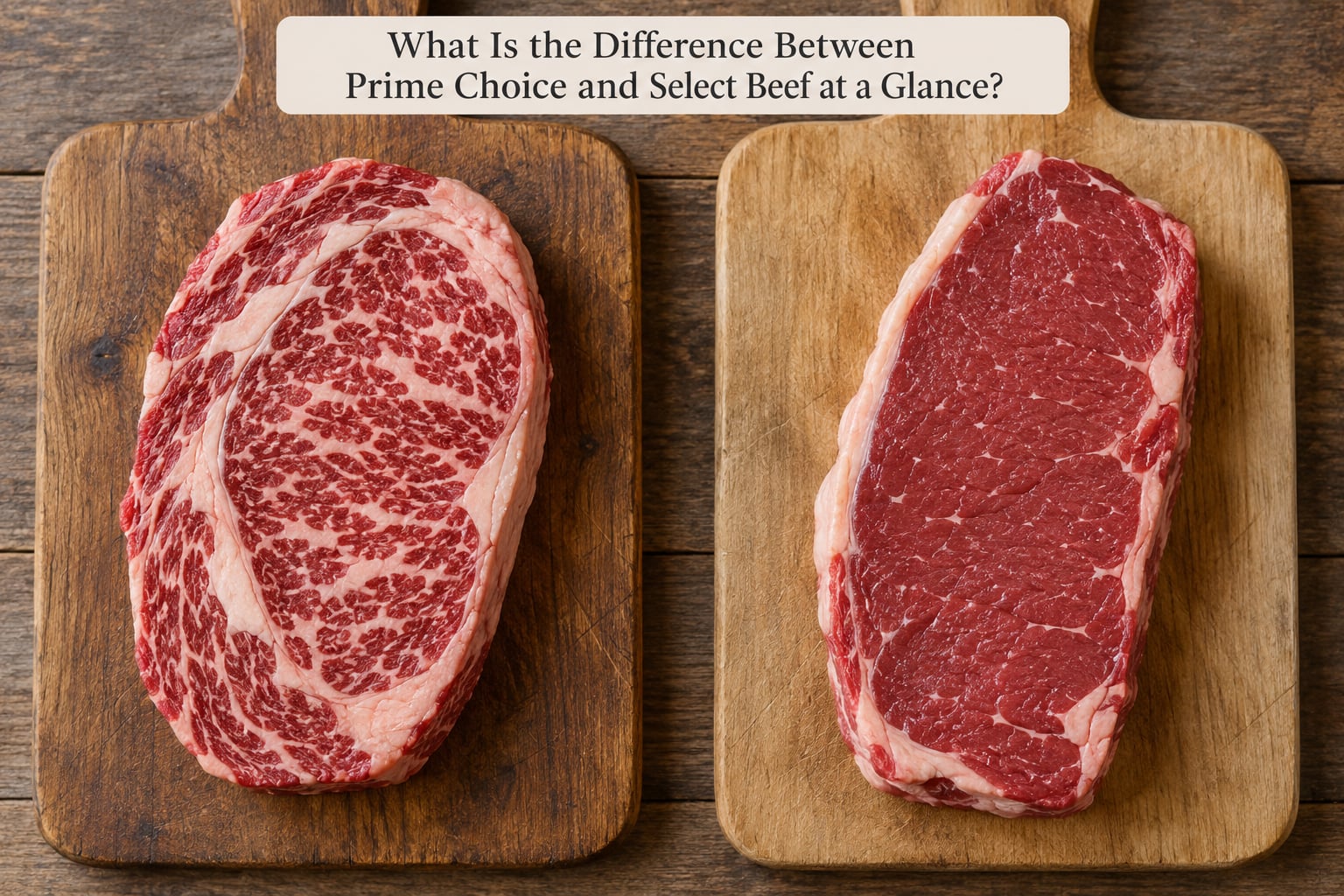
| Grade | Marbling | Tenderness and Flavor | Leanness | Relative Price | Best For |
|---|---|---|---|---|---|
| USDA Prime | Slightly abundant or higher | Very tender, rich and buttery | Least lean of the three | Highest | Steakhouse-style searing, ribeye and strip, special occasions |
| USDA Choice | Small to moderate | Tender, clean beef flavor | Moderate | Middle | Weeknight steaks, roasts, burgers, the everyday default |
| USDA Select | Slight | Lean and mild, firmer texture | Leanest | Lowest | Tacos, stir-fries, stews, kebabs, large-batch cooking |
One note before the detail gets buried: those three grades describe fat content and eating quality, not how the animal was raised or what breed it was. A grass-fed ribeye and a grain-fed ribeye can carry the same grade, and a Certified Angus label sits on a completely different track.
What Do Prime Choice and Select Mean in Beef Grading?
What is the difference between prime choice and select beef? Fat content, not breed
Short version: the difference between prime choice and select beef is the amount of intramuscular fat the grader sees, and little else. Prime needs slightly abundant marbling, Choice needs small to moderate marbling, and Select needs only a slight amount. Everything below unpacks how that gets measured and what it changes in the pan.
Beef grading in the United States runs through the USDA Agricultural Marketing Service. A trained grader looks at the carcass after slaughter and assigns two separate numbers.
The first is the quality grade, which is Prime, Choice, Select, Standard, Utility, Cutter or Canner. It is based on marbling, the maturity of the animal, and the color and texture of the lean. Prime sits at the top of the eight-grade scale, Choice is second, and Select is third.
The second is the yield grade, a 1 to 5 estimate of how much saleable lean meat comes off that particular carcass. A yield of 1 means a lot of usable meat and little waste fat. A yield of 5 means a heavily fat-covered animal with more trim and waste.
These two numbers get confused constantly. Quality grade is what you taste. Yield grade is what the packer gets out of the animal. Marbling drives quality grade and has almost nothing to do with yield.
Is grading required, and where do you see it?
Grading is optional and the packer pays a fee for it. That is why plenty of beef in the case carries no grade at all, particularly ground beef and value cuts. When meat has been graded, the grade appears inside a shield shape on the front of the package. If there is no shield, the meat is ungraded, no matter what the box says elsewhere.
Is Prime the only top grade?
No. Prime is simply the highest of the eight. Below Select come Standard, Utility, Cutter and Canner, with Utility and Canner sitting in the same band. Those lower grades are uncommon in a fresh retail case and mostly turn up as stew meat, soup beef, sausage and hot dogs.
What about the word Prime on a menu?
A restaurant that advertises prime steaks is often using the word loosely. Unless the menu says USDA Prime, or a grade shield is visible, treat it as marketing. The same goes for store-brand packaging that leads with the word prime in large type and buries the grade in fine print.
How Does Marbling Change Tenderness and Flavor?
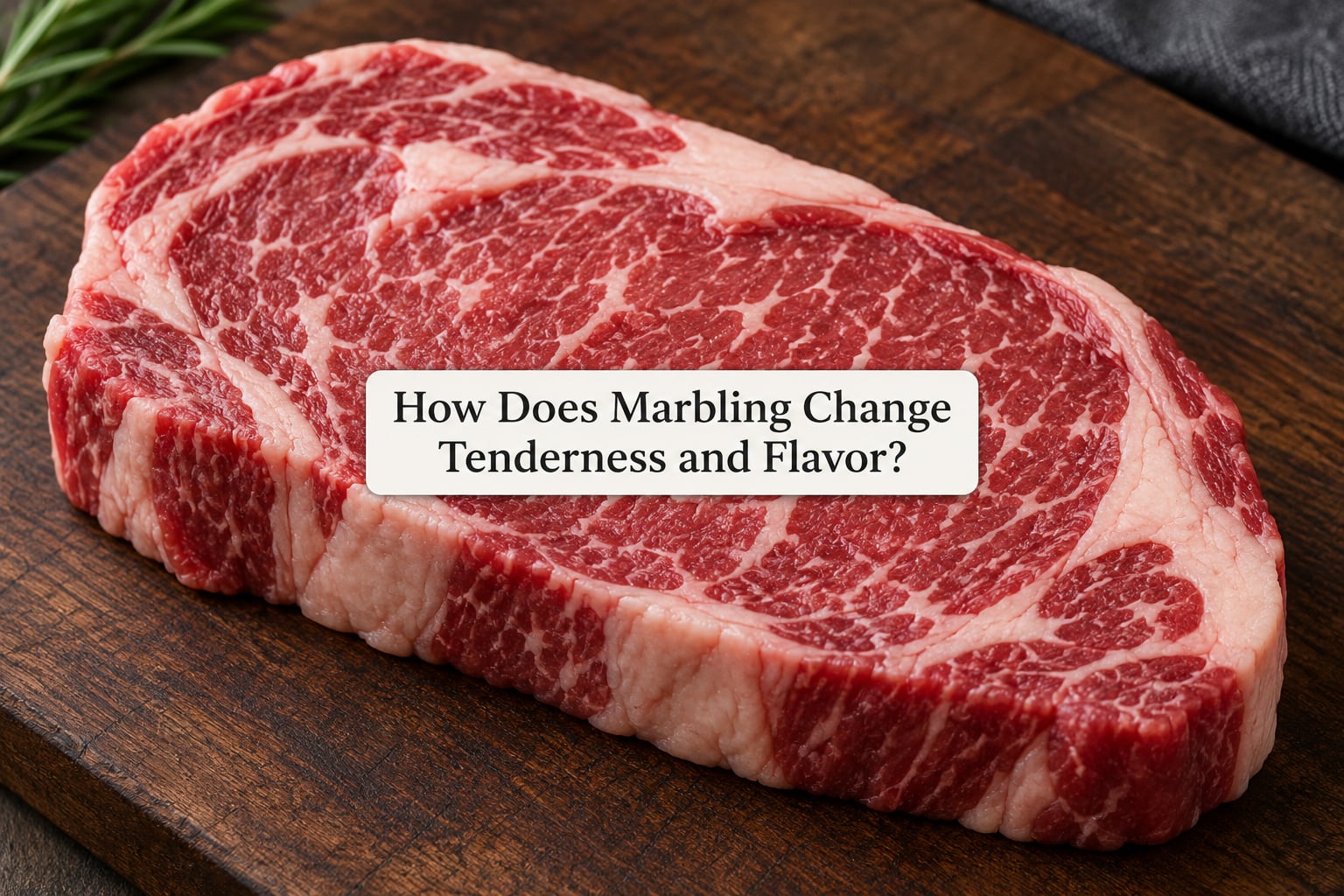
Marbling is the fat deposited inside the muscle itself rather than along its edges. When you cook it, that fat melts and does three jobs at once.
It lubricates the muscle, which is why heavily marbled beef feels tender instead of chewy. It bastes the meat during cooking, which adds flavor that trimming and seasoning cannot. And it carries juices, so a well-marbled steak tastes like something after you take a bite rather than nothing.
Select beef has almost none of this. It is not bad meat, it is simply less interesting in the mouth. The right technique compensates. Marinate it, use a tenderizing rub, cook it fast over high heat, or slice it thin and cook it fast in a hot wok. Give it a long slow braise and it will tighten up and turn chewy.
What else changes the result besides grade?
Marbling is a strong predictor, not a guarantee. A few other variables matter just as much at the counter.
- Cut. A prime chuck roast does not beat a choice filet at dinner. Muscle use decides tenderness before fat does.
- Freshness. Well-fed, well-handled beef graded higher to begin with. Beef that has been sitting too long will not cook its best at any grade.
- Aging. Dry-aged beef gains a deeper flavor and loses moisture. That is a deliberate choice made by the butcher, separate from grade.
- Diet. Grass-fed versus grain-fed is a question of raising method, not quality grade, and it is the source of most of the arguments people have about Prime.
- Temperature handling. Most tough results trace back to a cold pan, an oven door left open, or resting meat that got skipped.
Which Beef Is Better for Everyday Cooking?
For most weeknight cooking, Choice is the answer. It carries enough marbling to sear well and taste like beef, and it is the grade most grocery cases are built around. Prime earns its premium on a thick steak cooked hot and fast and sliced properly, and on little else.
For hamburgers, the cut matters more than the grade. Chuck and brisket blend, ground and formed into patties will taste better than a tenderloin blend no matter which letter is on the package. Spend on the blend, not the grade.
For roasts, Select can do the job. A select chuck or round braised with liquid is tender and saucy, and the leanness means less grease down the side of the pot. For a dry-heat roast, choose Choice instead.
For stir-fries, thin slices, fajitas and kebabs, Select works well. Cook it fast and hot and you want lean muscle that sears rather than fat that bleeds into the pan.
For slow cooking and smoking, either grade is fine, and the leanness of Select is closer to what smoke cooking wants.
When the cut matters more than the grade
| Cut | Best Grade to Buy | Why |
|---|---|---|
| Ribeye | Prime or Choice | Intrinsic fat is the point of the cut |
| New York strip | Choice | Priming the flavor balance is enough |
| Filet mignon | Choice | Already the tenderest cut in the case |
| Sirloin | Choice | Wide price gap for a small flavor gain |
| Brisket | Choice | Long cook forgives the difference |
| Chuck roast | Choice or Select | Braising carries the dish |
| Round | Select | Lean and economical |
| Shank | Select | Connective tissue does the tenderizing |
| Ground beef | Any grade | Fat is mixed through anyway |
If you buy a whole half or a quarter from a butcher, ask what the yield grade is and what cut you want carved from it. Grade and yield together tell you how much usable meat you will end up with.
How Much More Does Prime Choice Beef Cost?
Prime usually costs more than Choice, and Choice usually costs more than Select. These are typical United States ranges that shift with the cut, the market, the region and the week, so treat any figure you see as a snapshot rather than a fact.
The premium exists because Prime has stricter requirements. More marbling means cattle raised on richer feed for longer, and only about two to three percent of graded beef earns the Prime label. Choice accounts for roughly half of all graded beef, which is why it is the default on shelf and in the case.
Why Prime is not always the most expensive thing in the case
Shoppers run into this and it feels wrong. A Prime brisket sitting under Choice sirloin in the same case is not a pricing error. The packer paid for that fat, much of which gets trimmed away or stays in the package, and the brisket’s price per pound reflects what is usable.
The same thing happens with yield grade. A prime carcass with a yield of 4 delivers less saleable meat than a Choice carcass with a yield of 2, and the rack price can land anywhere depending on which cuts came off it. Cut, yield and grade all move the number. Grade alone does not set it.
How to Choose Beef at a Market or Butcher Counter
Reading beef takes about a minute. Here is what I do at the case.
- Find the shield first. Look at the front of the package for the grade mark. No shield means ungraded, and you are guessing.
- Read the label for the cut. The cut name matters as much as the grade. Ribeye, strip and tenderloin are worth grading. Chuck, shank and round are not.
- Look through the meat. Prime shows white flecks and small ribbons spread across the cut. Choice shows smaller flecks. Select is nearly clean muscle with thin lines along the edges.
- Check for color and firmness. Bright red color with a fine, firm texture is a good sign. Brown edges, dried surfaces or a slimy feel mean the cut has been sitting too long.
- Ask the person behind the case. A butcher can tell you the grade, the cut, whether it was dry-aged and how it should be cooked in about ten seconds. Ask.
- Compare per pound, not per package. Weight packages and divide before you decide. A larger tray at a lower per-pound rate is often the better buy for a big batch.
If a package has no grade on it, treat it as ungraded and price it as an average cut. Do not assume ungraded is worse than Select. Plenty of very good beef never goes through grading, because the packer declined to pay the fee.
What About Safety, Storage, and Cooking Temperatures?
Grade tells you nothing about safety. A prime steak and a select steak carry the same risk and follow the same rules.
Refrigerate fresh beef at 40°F or below and use it within three to five days. Freeze it for longer storage and thaw it in the refrigerator, not on the counter. Keep raw beef on the lowest shelf or in a separate bin so nothing drips onto produce or bread.
| Beef Type | Safe Minimum Internal Temperature | Rest Time |
|---|---|---|
| Whole cuts: steaks, roasts, chops | 145°F (63°C) | Three minutes |
| Ground beef, including patties | 160°F (71°C) | Three minutes |
| Ground beef for well-done burgers | Well past 160°F, texture is the guide | Three minutes |
Use a probe thermometer in the thickest part, away from bone and fat. Sear hard and fast, then finish gently, and rest the meat before slicing. Resting is not a garnish step, it is what keeps the juice on the plate.
Frequently Asked Questions
Is select beef bad quality?
No. Select is the third-highest of the eight USDA quality grades, above Standard, Utility, Cutter and Canner. It is leaner and milder than Choice and Prime, which some people prefer. Cook it fast and hot, slice it thin, or marinate it, and it makes excellent tacos, stir-fries, roasts and ground beef.
Is prime choice always better than select?
No. Prime carries more intramuscular fat, but Choice often beats Select for steakhouse-style cooking, and Select wins for large-batch meals where leanness matters. On ground beef, stew meat and shank, the grade barely matters. Cut and cooking method decide more than the label.
Is prime choice worth the extra cost for burgers?
Probably not. Ground beef gets chuck and brisket blended and the fat is mixed through the patty anyway, so extra marbling is wasted. Buy a good blend and season it with salt and pepper. Save the Prime budget for thick steaks cooked hot and fast.
Which is better for steaks, and which is better for slow cooking?
Prime and Choice both sear well, with Prime giving more buttery richness on a ribeye or strip. For slow cooking and braising, Choice or Select is plenty, and the leanness of Select can mean less grease in the pot. Brisket and chuck feed a crowd without needing Prime.
Does select beef need to be cooked differently from prime choice?
Slightly, yes. Prime with heavy marbling handles heat well and can take a hard sear plus a slow finish. Select is leaner and firmer, so keep it short and hot, slice it thin for stir-fries, or add moisture through marinade, brine or a long braise. Overcook it and it turns tough fast.
Conclusion
Start with the cut. Pick the right muscle for the dish, then step up the grade only where extra marbling will actually be tasted. Prime for thick steaks, Choice for weeknight roasts and burgers, Select for tacos, stir-fries and big-batch cooking. A great Choice piece beats a poorly handled Prime piece every time.