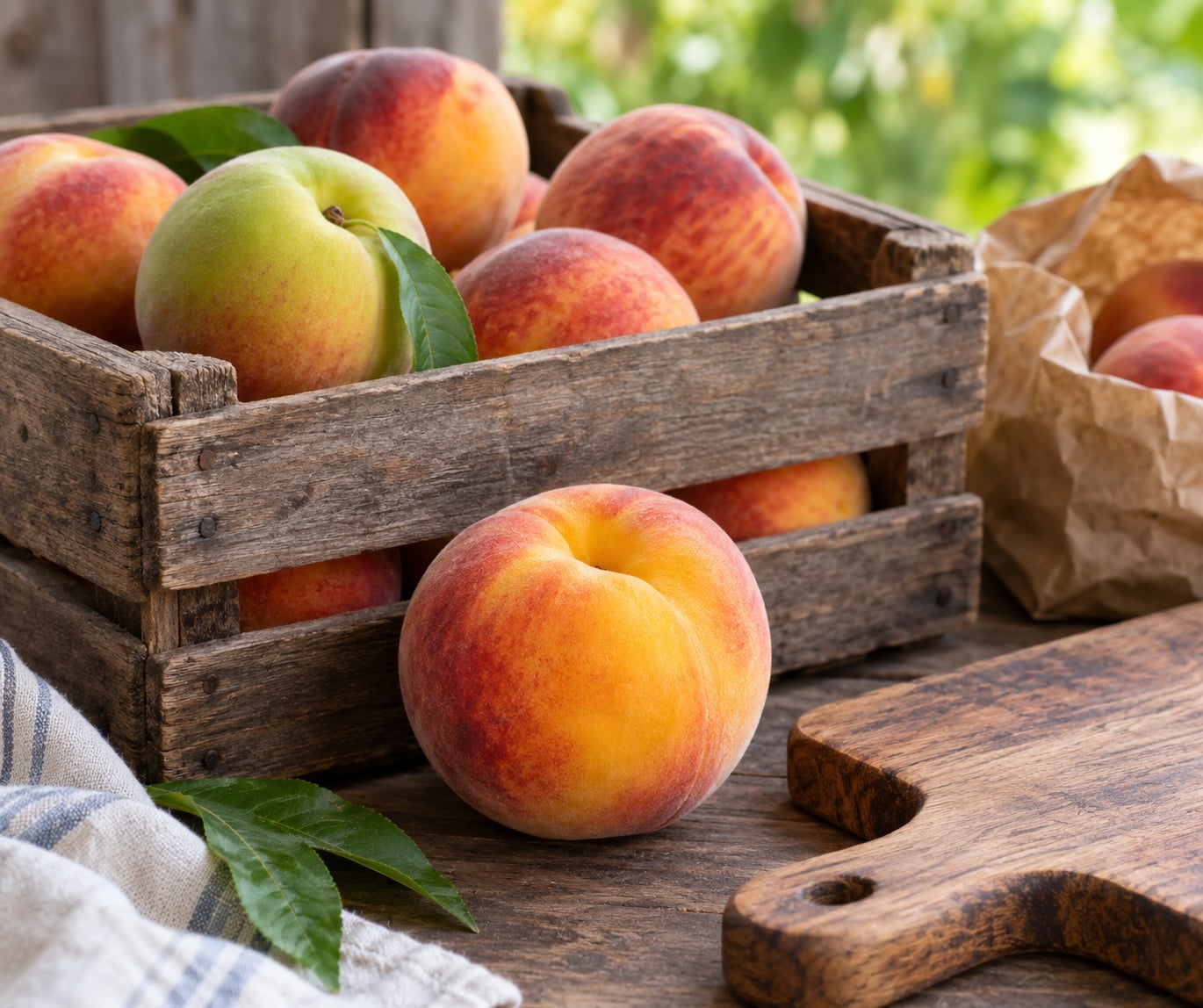
Ripe peaches give you three signals at once: a background color that has turned golden, creamy, or deep orange instead of green, a sweet scent at the stem end, and a slight give when you press gently near the stem. Color by itself proves nothing, and squeezing hard bruises the fruit before it ever reaches your kitchen.
The check takes about fifteen seconds per peach, and the order matters. Read the background color first, smell second, touch last, so you handle the fruit as little as possible. Vendors at orchards and public markets hand-pick peaches already ripe, and a shopper who squeezes every piece gets fruit that bruises in the bag on the way home.
Local, tree-ripened peaches usually need a day on the counter before they are perfect, while peaches shipped from a packing house come in hard because they had to survive the trip. That difference shapes what you should buy and how you should treat it once it’s home.
Table of Contents
- Step-by-Step: How to Pick Ripe Peaches at a Produce Stand
- 1. Know Which Peach Variety You Are Buying
- 2. Check the Background Color
- 3. Smell for a Ripe Peach Aroma
- 4. Gently Test the Texture
- 5. Choose Based on When You Will Eat It
- Common Mistakes When Choosing Peaches
- Tips for Buying, Ripening, and Storing Market Peaches
- Frequently Asked Questions
- Should peaches be red before they are ripe?
- How soft should a ripe peach feel at a produce stand?
- Why do some peaches stay green when ripe?
- How should I store peaches until they are ready to eat?
- Can bruised peaches still be used?
- Choose Your First Peach With Confidence
Step-by-Step: How to Pick Ripe Peaches at a Produce Stand
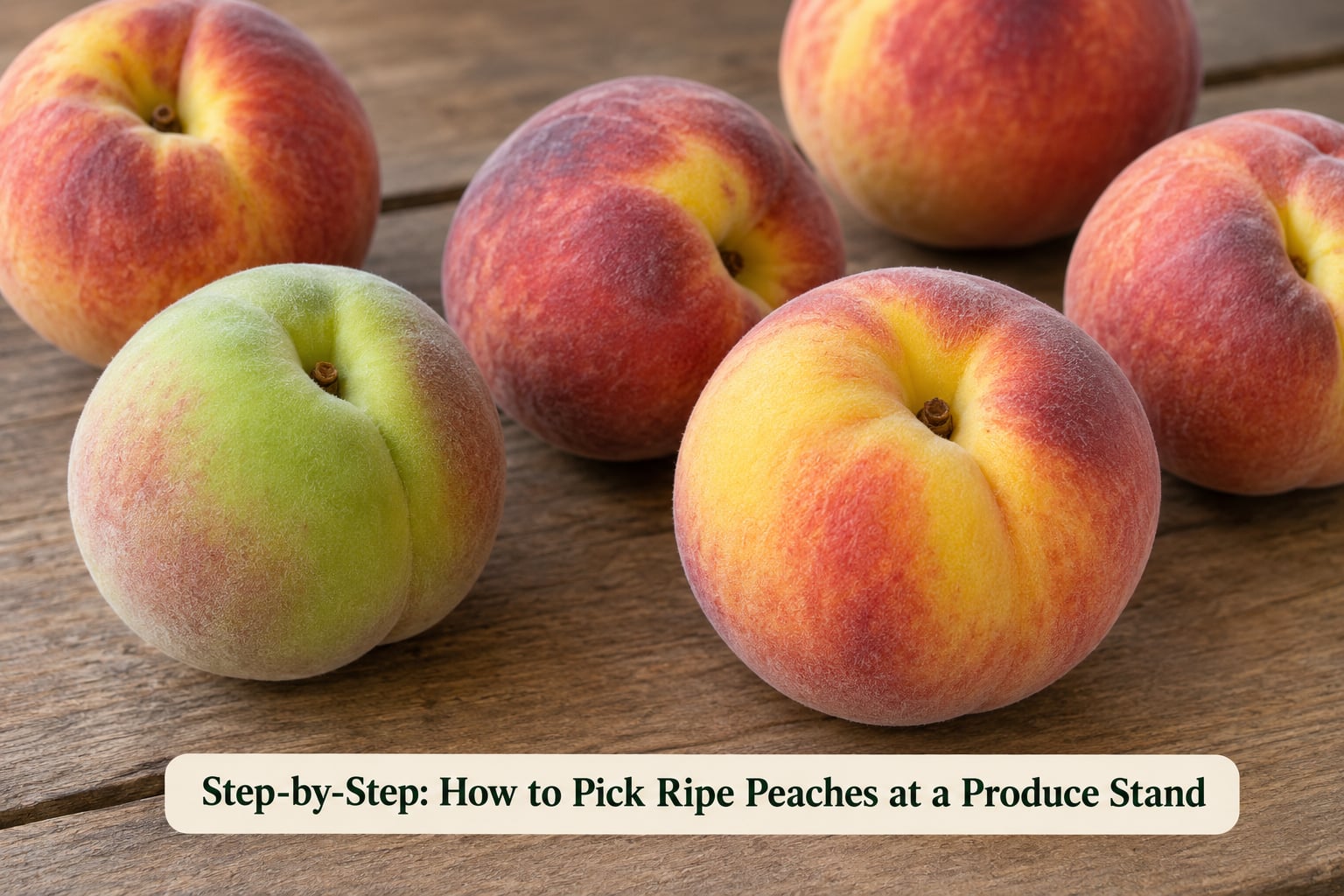
Run through these five steps in order at the stand. Each one narrows the pile, so you only touch the peaches that still make the cut.
1. Know Which Peach Variety You Are Buying
Variety decides what ripe looks like. Yellow-fleshed peaches like Redhaven and Yellow Scout finish with a golden to orange background, while white-fleshed types such as Saturn stay creamy white and are lower in acid with a softer, floral sweetness.
Freestone varieties lift the pit away cleanly, which makes them the ones to eat out of hand. Cling types hold onto the stone, and that firmer flesh holds up better for cobblers and preserves. If the vendor names the variety, ask which one is best today; most stands are happy to tell you, and the answer is usually different every week of peach season.
2. Check the Background Color
Look at the ground color underneath any red blush, especially across the shoulders and down toward the stem. That is where ripeness shows first, and it is the color to trust. Green there means the fruit is still days away, no matter how pretty the red side looks.
A pale patch where a leaf shaded the fruit is normal. An all-red peach is not automatically the ripe one, because plenty of varieties blush red long before the starch turns to sugar. This is the single most common mistake shoppers make at a stand.
3. Smell for a Ripe Peach Aroma
Put your nose near the stem cavity and inhale. A ripe peach gives off a floral, honeyed scent you can pick up from a few inches away, and it is strongest right where the stem meets the fruit.
No scent at all means no sugars yet, and that peach will taste starchy. A sour, fizzy, or fermented smell means it has gone past its window and you should put it back.
4. Gently Test the Texture
Press once with your thumb near the stem or on the shoulder, opposite the stem. Ripe flesh gives a little and feels slightly springy. The cheeks can still be firm; peaches soften from the stem end outward, so one end tells you far more than the other.
Use one finger and lift rather than poke. If the peach deforms under that touch, it is already mealy and will not hold for a day. When you plan to store peaches for several days, skip the press entirely and choose by color and aroma only.
5. Choose Based on When You Will Eat It
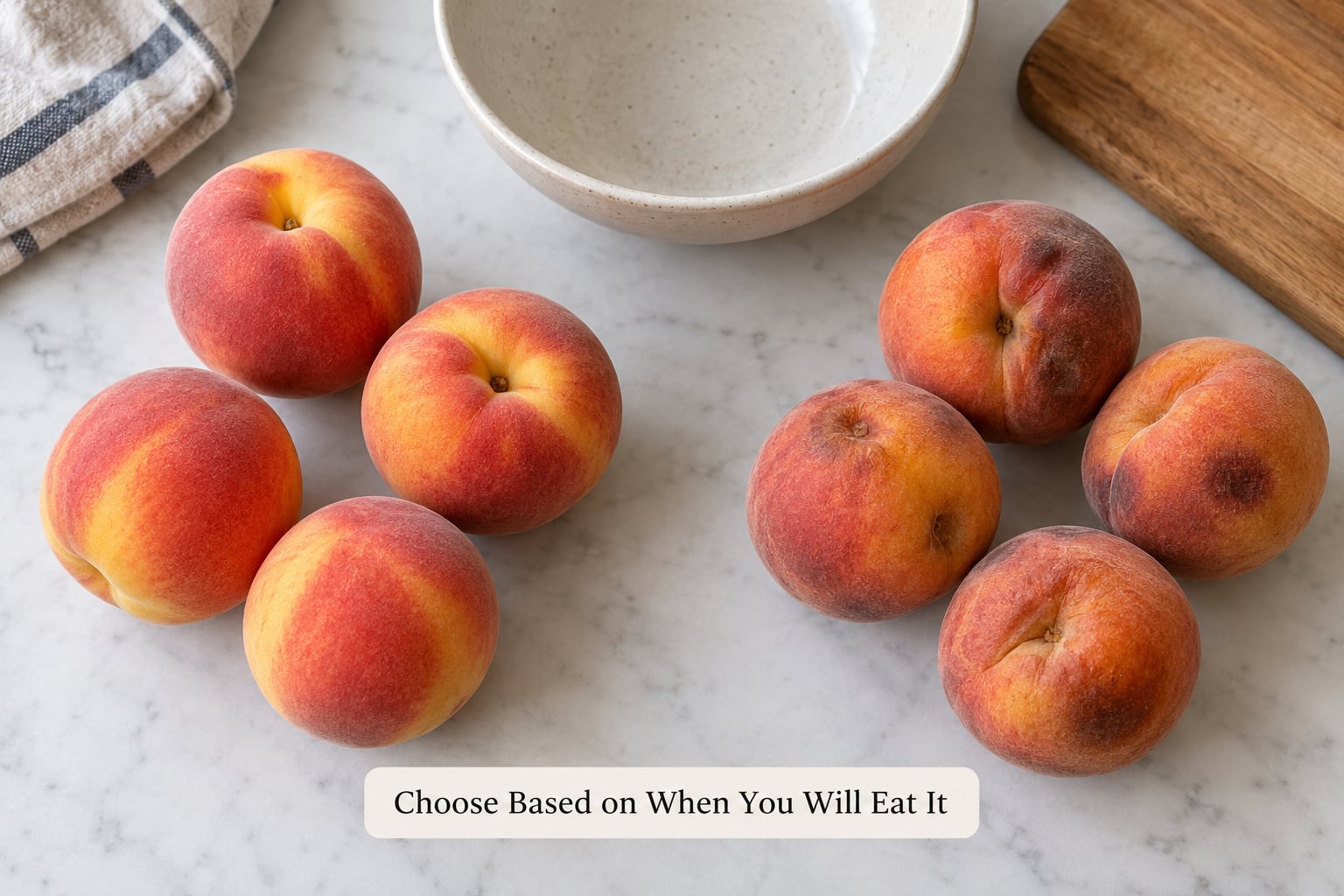
Match the peach to the date on your calendar. Eating today, pick fruit that is fragrant with a definite give at the stem. Holding two or three days, pick firm peaches with a fully turned background color and no aroma yet, then let them finish on the counter.
For canning or cobbler, buy the firmest fruit you can find. Baking softens it anyway, and peaches that are already soft when they go in the oven turn to mush before the filling sets.
Common Mistakes When Choosing Peaches
Most disappointing peaches trace back to one of a handful of habits. Here is what goes wrong and the correction.
Assuming red means ripe. Red blush is a cultivar trait, not a ripeness signal. Read the background color between the stem and the shoulders instead.
Squeezing hard to be sure. Stone fruit bruises from one firm press, and a bruised spot turns soft and spreads rot to the peaches beside it. Press with a thumb once, gently, or not at all.
Testing only the cheek. A peach can feel firm on the outside and be ready at the stem. Check the shoulder and the stem cavity, where softening happens first.
Ignoring splits, leaks, and soft spots. Fruit that is leaking juice or split along the seam will spoil its neighbours in the bag. Lift each peach you plan to buy and look at the bottom.
Buying the softest fruit for later in the week. Peaches picked at peak softness rarely last past a day or two. Buy a spread: one ripe for today, two firmer for the days ahead.
| Sign | Underripe | Perfectly ripe | Overripe or mealy |
|---|---|---|---|
| Background color | Green, or green in the creases | Golden, cream, or deep orange | Darkened, dull, sometimes bruised brown |
| Texture at the stem | Hard, no give at all | Slight give, cheeks still firm | Collapses, feels spongy |
| Aroma at the stem | Little or no scent | Floral and sweet | Faint, sour, or fermented |
| Best use | Ripen on the counter for baking | Eat fresh, slice into salads | Freeze, bake, or eat today |
One more myth worth dropping: tapping a peach and listening for a hollow sound tells you nothing. Orchardists and extension services are blunt about that one. Smell and a light press beat any tap test every time.
Tips for Buying, Ripening, and Storing Market Peaches
Ask the vendor which variety is peaking and whether there is a sample plate. Most stands keep a cut peach around for exactly that reason, and one taste tells you more about sweetness than any color check.
Choose according to the growing method you prefer, but judge the fruit the same way either way. Organic fruit tends to be firmer and carries less blush, so give it an extra day on the counter. Conventionally grown peaches are often picked closer to full ripeness and may be ready sooner.
Firm peaches ripen fastest at room temperature in a closed paper bag, and a banana added to the bag speeds things up because it gives off ethylene gas that pushes stone fruit along. Layering them in a bag also concentrates that gas around every peach.
| Method | Typical time to ripen | Notes |
|---|---|---|
| Counter, single layer | 1 to 3 days | Best for tree-ripened local peaches |
| Paper bag, closed | About 1 day | Holds moisture and ethylene near the fruit |
| Paper bag plus a banana | Several hours to a day | Fastest method that keeps the texture |
| Warm oven, 200F | 20 to 30 minutes | For baking only; softens but dulls the flavor |
| Freezer | Does not ripen | Halves and freeze firm fruit for smoothies and cobblers |
Once a peach is ripe, move it to the refrigerator and use it within two or three days. Cold stops ripening almost completely, which is why peaches stored too early in the crisper can stay hard for weeks.
Keep ripe peaches in a single layer or loosely in a paper bag, and keep them away from other fruit, which speeds them up and can push them into mealy territory. Handle each one with a light touch and carry them in something with a flat bottom rather than a jumbled bag.
Frequently Asked Questions
Should peaches be red before they are ripe?
No. The red blush on a peach is a variety trait, not a ripeness signal. Some cultivars blush deep red while still hard as a rock, and others ripen to a creamy yellow with barely any red at all. Watch the background color between the stem and the shoulders instead: when it turns from green to golden, cream, or deep orange, the fruit is moving toward ripe.
How soft should a ripe peach feel at a produce stand?
A ripe peach gives a little at the shoulder, right opposite the stem, while the cheeks still feel firm. If the whole fruit collapses under light pressure, it went past ripe and the flesh turns mealy within a day. For fruit you plan to eat tomorrow, firm with a small give is the better buy.
Why do some peaches stay green when ripe?
White-fleshed varieties such as Saturn often keep a creamy white or faintly green background even at peak ripeness, and leaf shade can leave green patches on a yellow peach too. Green in the crease near the stem is normal. A fruit that is green all over, rock hard, and smells of nothing is simply not ready.
How should I store peaches until they are ready to eat?
Leave firm peaches in a single layer on the counter, out of direct sun, until they give at the shoulder. Once they are ripe, move them to the refrigerator and eat them within two or three days. Cold slows ripening sharply, so fruit put in the crisper too early may stay hard for weeks.
Can bruised peaches still be used?
Usually yes. A peach dropped or pressed too hard gets a soft spot that darkens but stays edible, so cut around it. Skip the fruit when the bruise is leaking, smells sour or fermented, shows white or grey fuzzy mold, or when the area around the pit is brown and mushy, because rot is moving through the flesh.
Choose Your First Peach With Confidence
Match the background color to the variety the vendor named, smell the stem end for sweetness, then press once at the shoulder. Gentle give means eat it today, firm fruit with a turned background means it ripens on your counter in a day or two, and anything leaking, split, or badly bruised goes back in the pile.
If you only remember one habit, make it the spread. Buy one peach you can eat this afternoon and two firmer ones for later in the week, and your market haul stops being a gamble.