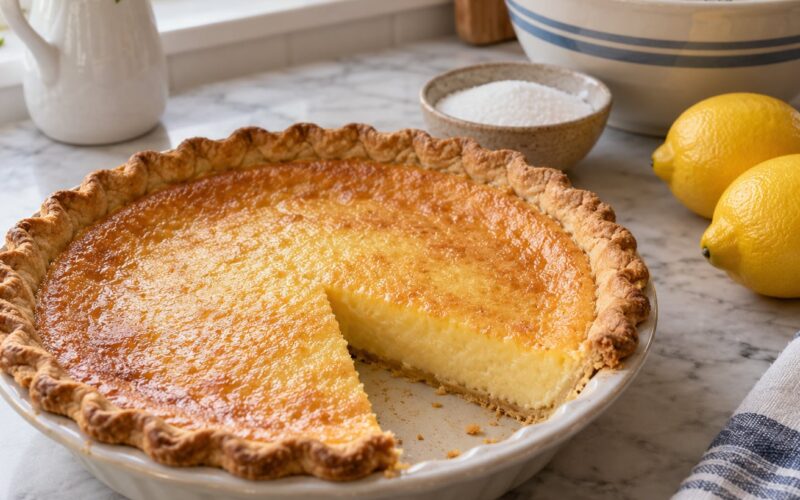
Chess pie looks like it took an afternoon, and most of that time is waiting. Learning how to make chess pie from scratch takes about 30 minutes of hands-on work plus roughly an hour in the oven, then a cooling period you should not skip. The filling is sugar, melted butter, eggs, cornmeal, milk, and a spoonful of vinegar, poured into a blind-baked crust and baked gently until the edges set while the middle still trembles.
It is a beginner-friendly bake, too. One bowl, no mixer, and forgiving in the ways that matter. The three things that decide whether your pie turns out are the crust, the temperature of your ingredients, and how long you let it cool before you cut it.
Table of Contents
- What You Need to Make Chess Pie From Scratch
- Step-by-Step
- Step 1: Prepare the Pan and Make the Crust
- Step 2: Mix the Cornmeal Custard
- Step 3: Fill the Shelled Crust
- Step 4: Bake Until Just Set
- Step 5: Cool, Slice, and Serve
- Common Mistakes
- Frequently Asked Questions
- Do I have to use cornmeal in chess pie?
- Can I make chess pie without a pre-baked crust?
- How do I know when chess pie is done baking?
- Can I make chess pie ahead of time?
- Why is my chess pie runny after baking?
- How long should chess pie cool before slicing?
What You Need to Make Chess Pie From Scratch
Nothing here is exotic. If you have a 9-inch pie plate, a whisk, and a bag of granulated sugar, you are most of the way there.
Equipment
- 9-inch pie plate, glass, ceramic, or disposable aluminum
- Rolling pin (optional, since you press the dough by hand)
- Medium mixing bowl with a whisk, fork, or spatula
- Fine-mesh sieve or strainer (optional, but it earns its space)
- Fork, for docking the raw dough
- Parchment paper and pie weights, dried beans, or a smaller pan to use as a weight
- Wide strip of foil or a pie shield
- Wire cooling rack
- Optional but useful: an instant-read thermometer and a pie server
From-scratch crust
- 1 1/2 cups all-purpose flour (190 g)
- 1/2 teaspoon fine salt
- 1/2 cup cold unsalted butter, cubed (1 stick, 113 g)
- 3 to 4 tablespoons ice water
Shortcut: one refrigerated 9-inch pie crust from the grocery store, still in its pan. Roll it out or unroll it, and keep going. You will lose a little flakiness, but nobody at the table will notice.
Custard filling
- 1/2 cup unsalted butter, melted and cooled to room temperature (113 g)
- 1 3/4 cups granulated sugar (350 g)
- 4 large eggs, at room temperature
- 1/3 cup fine cornmeal (about 45 g)
- 1/2 cup whole milk, buttermilk, or evaporated milk (120 ml)
- 1 tablespoon white vinegar, apple cider vinegar, or fresh lemon juice
- 1 teaspoon pure vanilla extract
- 1/2 teaspoon salt
- 1 teaspoon ground cinnamon (optional, for an old-fashioned fall version)
Evaporated milk gives you a filling closer to the diner-style pies, richer and more opaque than whole milk. Buttermilk adds a tang that some Southern families insist on. If 1 3/4 cups of sugar feels like a lot, start at 1 1/2 cups and add up to 1/4 cup more if you want it sweeter.
What each main ingredient actually does
The eggs are the structure. They are the whole reason the filling firms up into something you can slice, and they are why the temperature they come out of the fridge at matters so much. Cold eggs mean a filling that stays loose no matter how long you bake it.
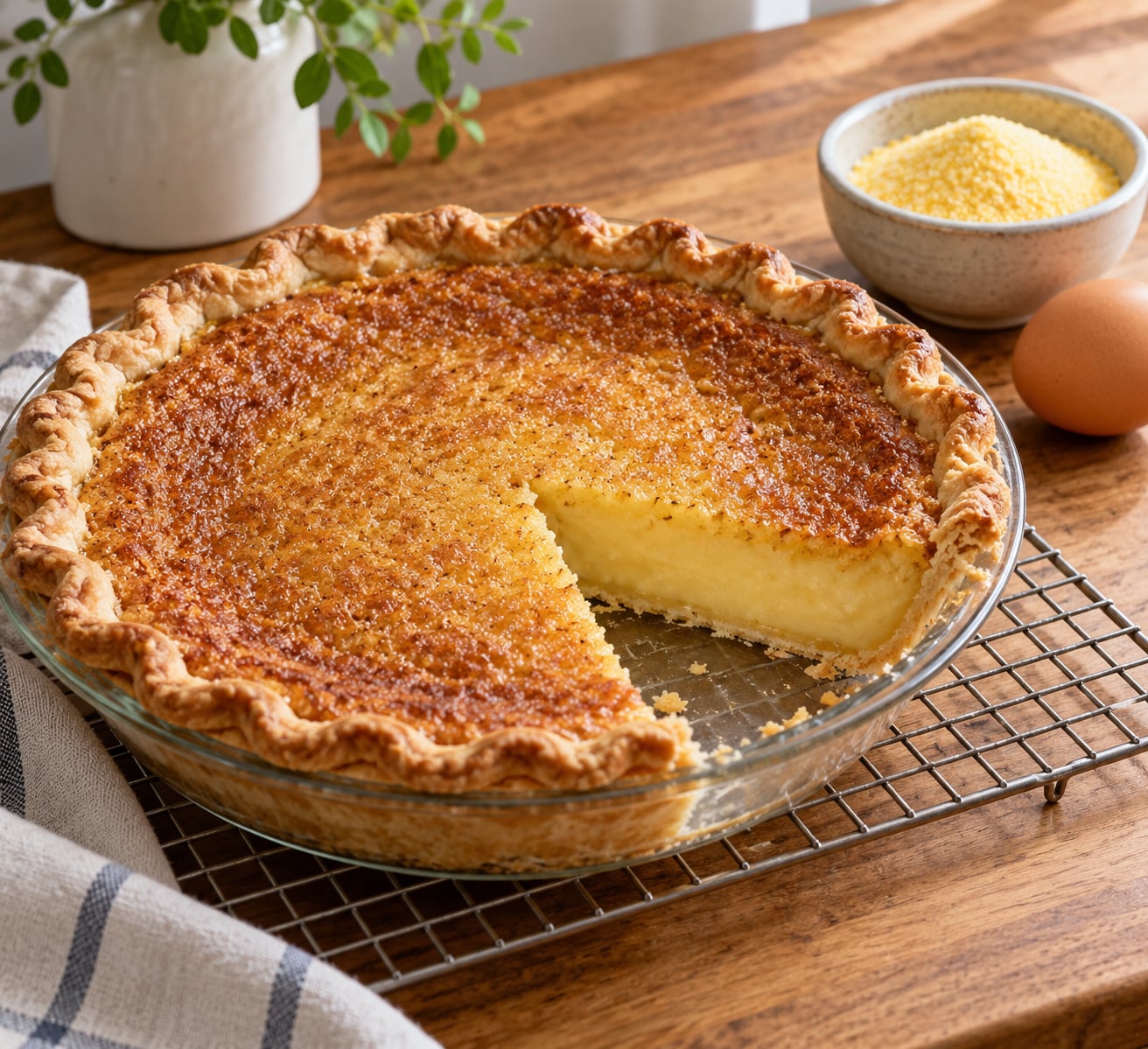
The cornmeal is the signature. It settles, rises during the bake, and forms that thin crackly layer on top that crackles under a spoon. A chess pie without cornmeal is sweet cream pie. It will taste fine, but it will not be chess pie.
The butter does two jobs. In the filling it rounds out the sweetness, and in the crust it keeps the dough tender instead of tough. The vanilla is there to warm up the cornmeal flavor, so use the real stuff if you have it.
Baking terms in plain English
- Blind bake means baking the empty crust before any wet filling goes in.
- Par-bake is a shorter version of the same idea, long enough to set the dough and dry the bottom.
- Dock means pricking the raw dough all over with a fork so steam can escape instead of blistering the surface.
- Crackly top is the thin cornmeal crust that forms on the surface during the bake.
- Set means the filling has firmed enough to hold a cut, while still trembling when you nudge the plate.
- Room temperature for eggs and milk means out of the fridge for 30 to 45 minutes before you mix.
Step-by-Step
Read the whole method once before you start, because two of these steps happen back to back and the oven does not wait. Then work in order, and do not skip the cooling at the end.
Step 1: Prepare the Pan and Make the Crust
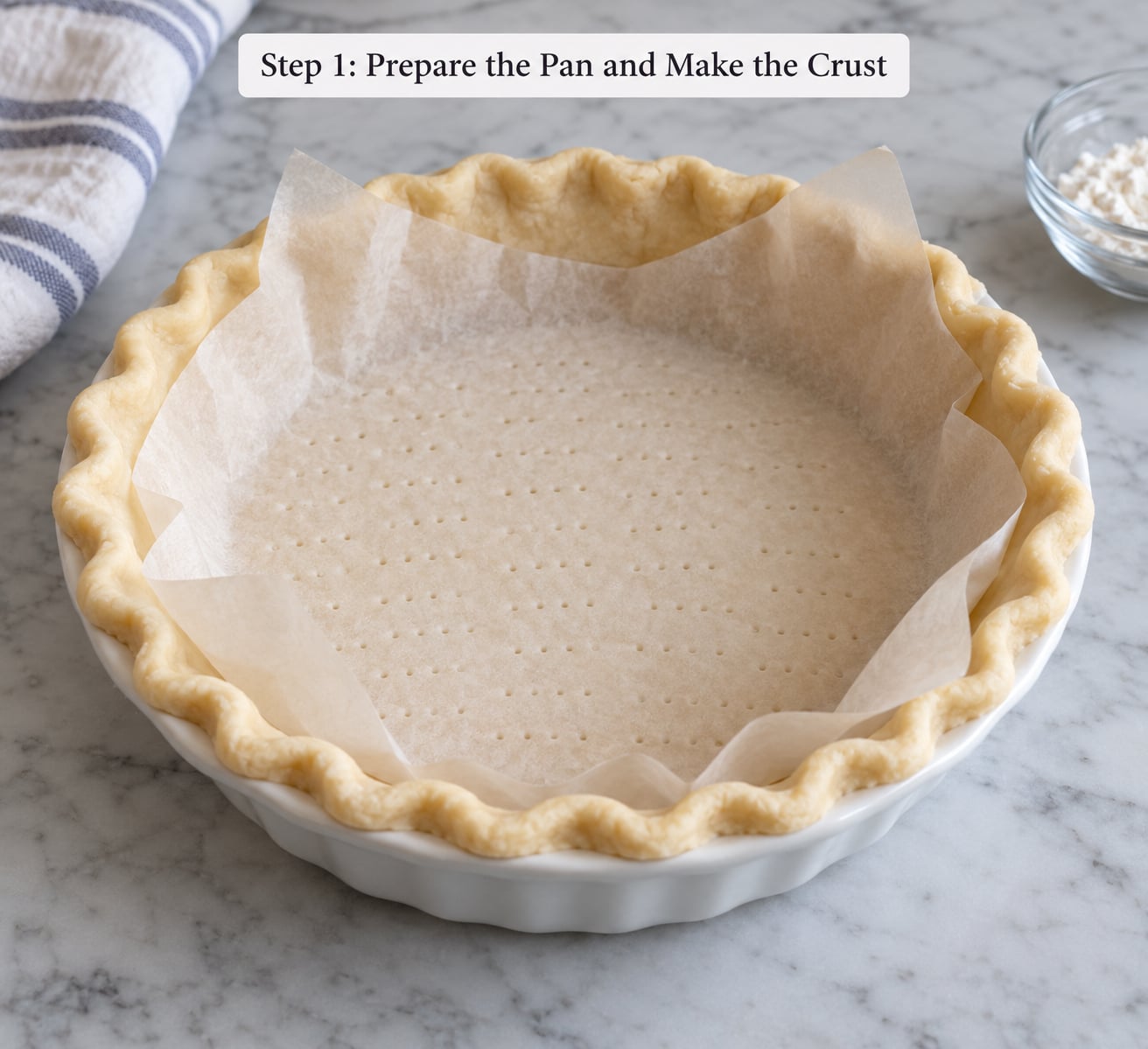
Put your pie plate in the freezer while you make the dough. A cold plate keeps the butter in the dough solid, and solid butter is the whole reason the crust holds its shape instead of slumping into the corners.
Whisk the flour and salt together in a bowl. Cut the cold butter into the flour with a pastry cutter or your fingertips and keep working until the mixture looks like coarse crumbs with a few pea-size pieces of butter left in it. Those pieces are what flake.
Drizzle in the ice water a tablespoon at a time and stir with a fork. Stop the moment the dough holds together when you squeeze a piece. Do not knead it. More water makes a crumbly mess you cannot repair, and kneading makes a tough crust.
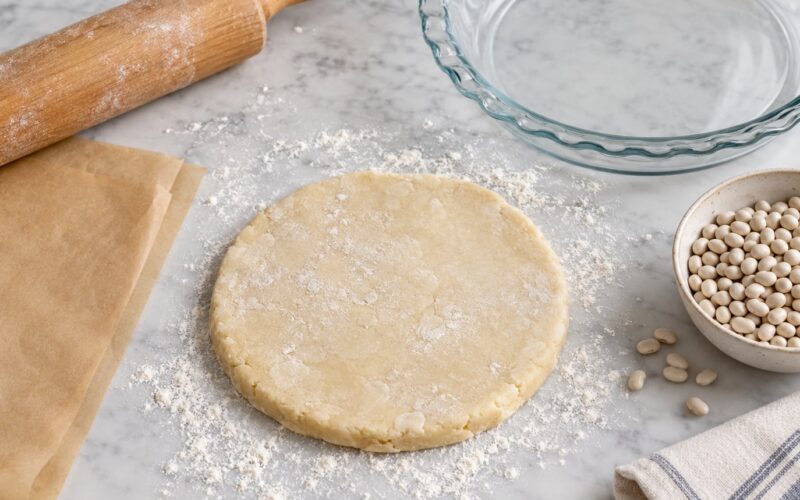
Press the dough into the chilled plate in even sections, starting at the bottom center and working outward. Aim for about a quarter inch thick on the bottom and an inch up the sides. Dock the whole thing with a fork, right down to the bottom.
Line the crust with parchment paper, fill with pie weights or dried beans, and bake at 350°F (175°C) for 15 to 20 minutes. Pull the paper and weights out, put the crust back in for 3 to 5 more minutes, and pull it when the bottom looks dry and pale gold. Keep the oven on.
Step 2: Mix the Cornmeal Custard
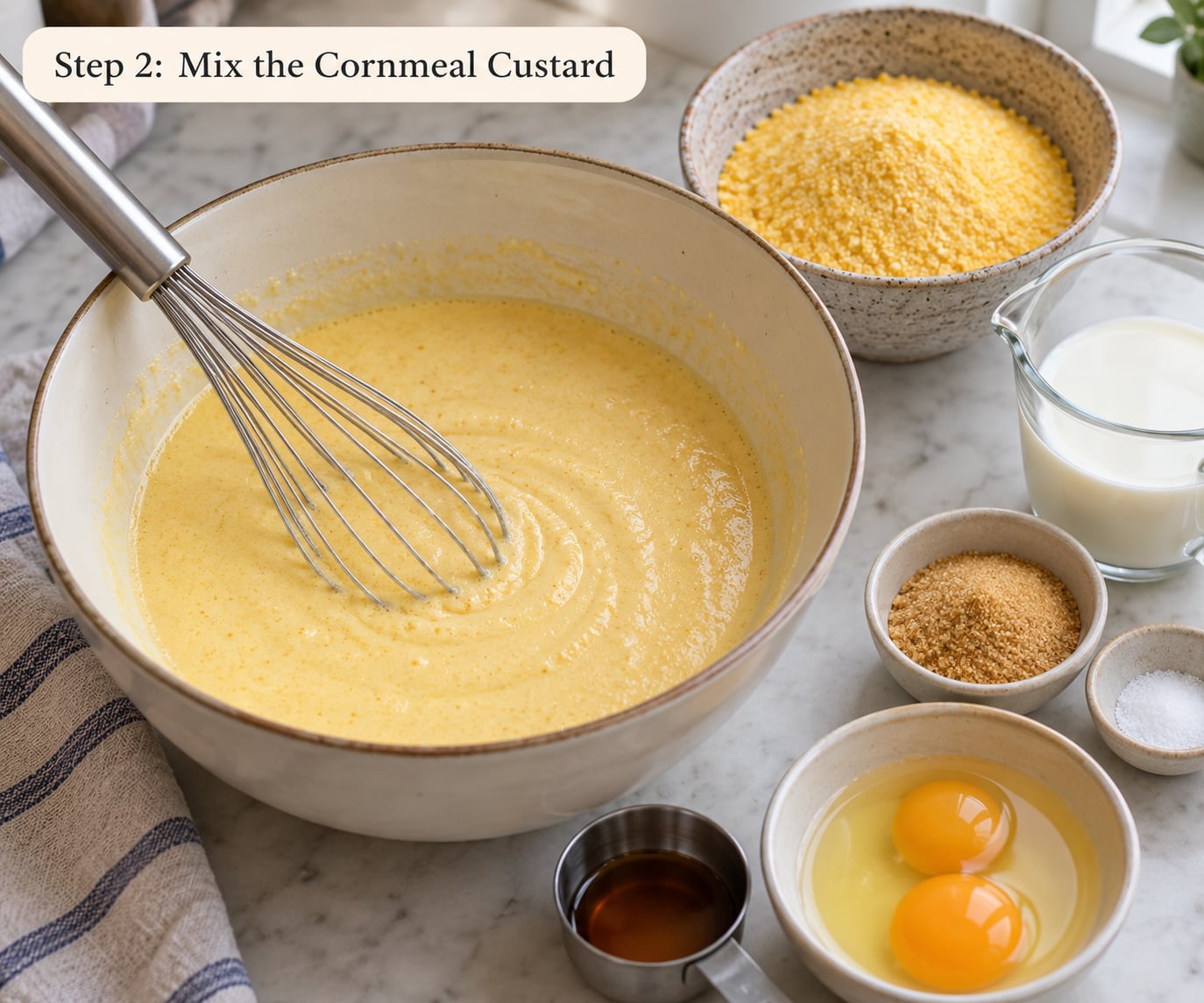
Whisk the melted butter and sugar together in the same bowl until the sugar dissolves, about a minute. Add the eggs one at a time, whisking gently for 30 seconds after each one goes in.
Pour in the milk, then the cornmeal, vinegar, salt, cinnamon if you are using it, and vanilla. Whisk until no dry streaks remain at the bottom of the bowl. It will look slightly broken or curdled, and that is fine. The eggs scramble-looking appearance before baking is normal and bakes out completely.
Then stop whisking hard. Overbeating after the eggs are in knocks the air out of them, and that is a common reason for a cracked top later. For the smoothest possible result, pour the filling through a fine-mesh sieve into a second bowl.
Step 3: Fill the Shelled Crust
Let the blind-baked crust cool on a rack for about 5 minutes. Hot pastry plus hot custard plus glass plate is a bad combination, and pouring straight onto a screaming-hot crust can partially cook the eggs where they land.
Pour the custard through the sieve into the shell, filling evenly so it does not pool on one side. Stop about a quarter inch below the rim, since chess pie rises as it bakes and a full plate will overflow.
Do not tap the plate hard on the counter to pop bubbles, and do not smooth the top with a spatula. Let it sit flat and bake.
Step 4: Bake Until Just Set
Bake at 350°F (175°C) for 40 to 50 minutes. If the crust edge starts browning before the filling is done, wrap a wide strip of foil around the rim or set a pie shield on top. Chess pie takes a long time at a low temperature, so darkening early is normal.
Here is how you know it is done. The edges are set for about two inches in from the crust, and the center still trembles when you tap the plate, but it trembles as one soft mass rather than sloshing like liquid. That is the moment to pull it.
If you use an instant-read thermometer, the center should be around 175°F to 180°F (80°C). If you wait until the center is rock solid and the top is uniformly browned, you have gone too far, and the filling will come out rubbery rather than silky.
Step 5: Cool, Slice, and Serve
Cool the pie on a wire rack at room temperature for at least 3 hours before cutting. The filling keeps setting as it cools, so a pie that looks soft coming out of the oven firms up considerably as it sits.
Cut with a thin knife dipped briefly in hot water and wiped clean between every slice. A warm blade glides through the custard instead of dragging it, and you get tidy edges on the plate.
Serve it at room temperature, which is how it is meant to taste. Chess pie is the dessert for Thanksgiving, Christmas, Pi Day, a Sunday supper, or any potluck where somebody needs to bring a dish that everybody eats.
Because the filling is an egg custard, treat it as a perishable food. Cover the pie loosely and refrigerate it within 2 hours of coming out of the oven, and eat it within 3 to 4 days. Individual slices freeze well for up to 2 months, though the crust softens a little on thawing, so thaw overnight in the refrigerator rather than on the counter.
Common Mistakes
Almost every bad chess pie traces back to one of six things. Here is what goes wrong, why, and what to do about it.
- Soggy bottom crust. Usually a skipped or rushed blind bake. The wet custard sits on raw dough and steams it instead of baking it. Give the crust the full 15 to 20 minutes with weights, and cool it 5 minutes before filling.
- Runny filling after baking. Almost always cold eggs or cold milk, or an oven running cooler than the dial says. Bring eggs, milk, and melted butter to room temperature, and check your oven with an oven thermometer once a season.
- Not enough time in the oven. The most common first-timer mistake, and the one people regret most. A correctly baked chess pie still wobbles in the middle. Trust the set edges, not the center, and pull at 40 minutes rather than 55.
- Grainy or lumpy filling. The cornmeal was dumped in dry and never fully dispersed. Whisk it into the wet ingredients rather than layering it on top, and pass the finished filling through a sieve.
- A cracked top. You overwhisked after adding the eggs, or you dropped the filling from a height. Mix gently and pour from close range.
- Browned crust before the filling is done. Put the foil ring on at the 20-minute mark rather than waiting to see it darken. The top should be golden, never dark brown.
- Way too sweet on the tongue. You left out the acid. That single tablespoon of vinegar or lemon juice is what keeps two cups of sugar from tasting flat and syrupy.
On oven temperature, because you will see three different numbers across three different recipes and none of them are wrong:
- 325°F (165°C) is the gentlest. It bakes very slowly and gives the smoothest texture, but plan on 50 to 60 minutes and use a pie shield.
- 350°F (175°C) is the sweet spot and the one this method uses. It is a reasonable balance between a set filling and a browned top.
- 375°F (190°C) then down to 350°F is the two-heat approach: a hot start to set the crust and get the crackly top going, then lower heat to finish the custard gently.
Pick one and stay with it. Changing oven temperature mid-recipe is the one maneuver that reliably gives beginners a cracked, weepy top.
A few notes that matter more than they sound. Take your eggs out of the fridge 30 to 45 minutes before mixing, which is the single biggest difference between a set filling and a soupy one. Keep the cornmeal in, because it is not there for thickness, it is there for the crackled top that everyone recognizes. And do not serve the pie hot from the oven, no matter how good it smells.
Frequently Asked Questions
Do I have to use cornmeal in chess pie?
Cornmeal is what makes it chess pie rather than sweet cream pie. It does not thicken the filling so much as it settles and rises into that thin crackly top that crackles under a spoon. A pie without it is still a pleasant custard tart, just a different dessert. If you leave it out, reduce the sugar slightly or add a tablespoon of cornstarch for body.
Can I make chess pie without a pre-baked crust?
You can fill an unbaked crust, but the bottom will most likely turn out pale and soft rather than flaky, because the wet custard steams the raw dough before it can bake. Chess pie holds heat in the pan for a long time, so the damage is mostly done. If you want to skip the blind bake for convenience, use a refrigerated store-bought crust and bake it for at least 10 minutes first.
How do I know when chess pie is done baking?
Look at the edges, not the center. The filling should be set about two inches in from the crust, while the middle still trembles as one soft piece when you tap the plate, with no liquid sloshing. It is meant to wobble, and first-time bakers often pull too late. If your edges brown before the middle sets, add a foil ring and give it more time at 350F.
Can I make chess pie ahead of time?
Yes, and it is one of the best make-ahead desserts for a holiday table. Bake it up to two days ahead, let it cool completely, then cover it loosely and refrigerate. Bring it out 30 to 60 minutes before serving so it is not ice cold from the fridge. Slices also freeze well for up to two months if you wrap them individually, though thawed crust loses a little of its flakiness.
Why is my chess pie runny after baking?
Three causes cover nearly every case: eggs and milk used straight from the fridge, not enough baking time, or an oven that runs cooler than its dial. Cold ingredients are the most common and the easiest to fix, so bring everything to room temperature for 30 to 45 minutes before mixing. If it is still loose, put it back in the oven for another 10 minutes; the filling keeps firming as it cools, too.
How long should chess pie cool before slicing?
At least 3 hours at room temperature, on a wire rack rather than the stovetop. The custard continues to set as it cools, so a pie that looks a little soft coming out of the oven is usually perfect once it has rested. Cutting it early gives you a scoop instead of a slice. If you need it faster, 45 minutes in the refrigerator after an initial hour on the rack will hold the slices together.
Start with the crust, and start it early. Chill that pie plate, mix the dough with barely enough water, and give the blind bake its full 20 minutes. Then bring your eggs and milk to room temperature before you whisk anything, and pull the pie out of the oven when the edges are set and the middle still trembles. Everything else about how to make chess pie from scratch is patience, and letting it sit for three hours before the first cut is the part people skip and later regret.