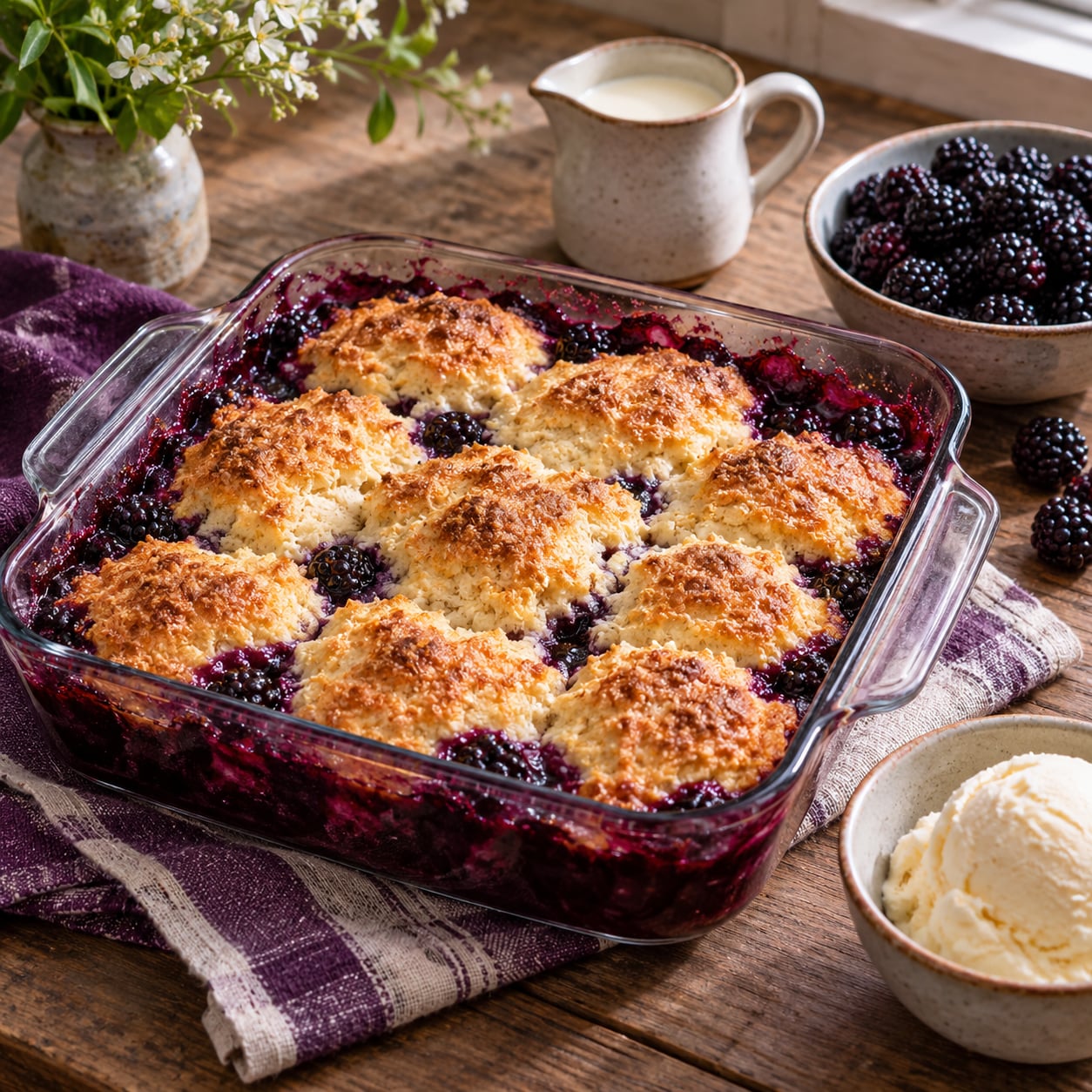
Learning how to make blackberry cobbler from scratch is mostly about two things: a fruit filling that thickens as it bakes, and a biscuit topping you handle as lightly as possible. A from-scratch cobbler goes into a 375°F oven, bakes for 35 to 45 minutes, and comes out with a golden, crumbly top and dark, bubbling fruit underneath.
Prep takes about 20 minutes and the whole thing, start to finish, runs close to an hour. A boxed mix is faster, but it leans heavily on sugar and starch, and the topping usually turns cakey rather than crumbly. Making it yourself means you control the fruit-to-topping ratio, the sweetness, and whether the berries go in fresh, frozen, or canned.
Here is the short version of the method before the details: macerate the berries with sugar, cut cold butter into a dry biscuit dough, drop the dough over the fruit, brush it, and bake until the topping is golden and the edges are bubbling. Everything else in this guide is a way to make that sequence land properly.
Table of Contents
- What You Need
- Step-by-Step: How to Make Blackberry Cobbler
- 1. Preheat the oven and prepare the baking dish
- 2. Make the blackberry filling
- 3. Mix the dry biscuit ingredients
- 4. Cut in the butter and make the dough
- 5. Roll or shape the biscuit topping
- 6. Assemble and bake the cobbler
- 7. Check the filling and cool before serving
- Common Mistakes
- Frequently Asked Questions
- Can I make blackberry cobbler ahead of time?
- How do I know when blackberry cobbler is done?
- Should I use fresh or frozen blackberries?
- What can I serve with blackberry cobbler?
- Can I make blackberry cobbler without buttermilk?
- How do I reheat blackberry cobbler without making it soggy?
- Conclusion
What You Need
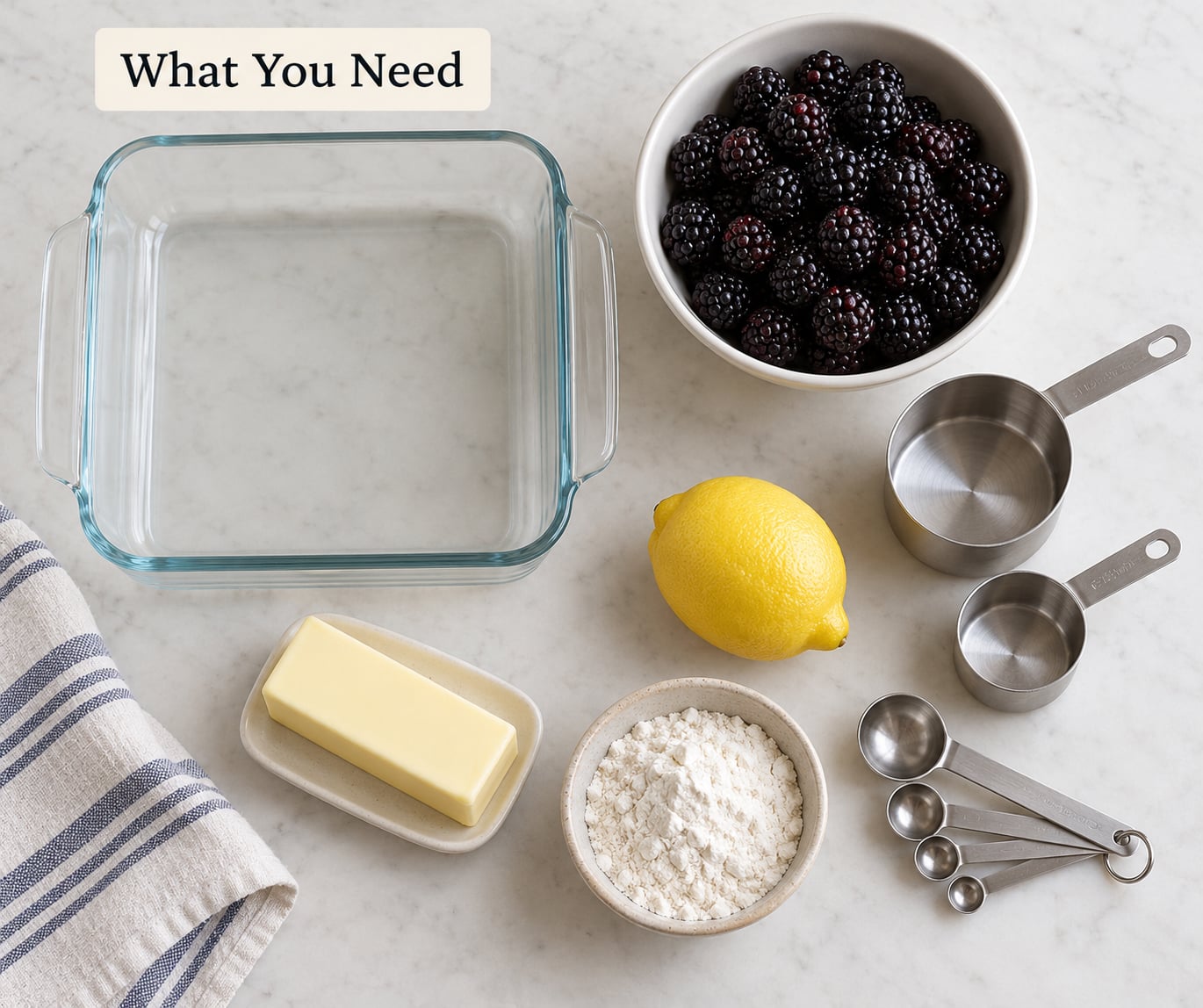
An 8-inch square glass or ceramic baking dish is the right pan. An 8×8 gives you more fruit per bite and a deeper filling layer, which is exactly what you want from a cobbler. A 9×9 works, just with a slightly thinner fruit layer, and a 9×13 makes for a shallower, more topping-heavy dish. Glass is helpful because you can look at the sides of the pan and watch for bubbling.
Beyond the pan, you want a large bowl for the fruit, a smaller bowl and a pastry brush for the topping, a rolling pin or just your hands, and a wire cooling rack. No mixer, no specialty equipment. This is a straight-by-hand recipe.
For the blackberry filling:
- 6 cups fresh blackberries, or 12 ounces frozen thawed and drained, or two 15-ounce cans drained well
- 3/4 cup granulated sugar, plus 1 tablespoon to taste
- 1 tablespoon lemon juice
- 1 teaspoon pure vanilla extract
- 1 tablespoon cornstarch
- 1 teaspoon lemon zest, optional
For the biscuit topping:
- 1 1/2 cups all-purpose flour
- 1/4 cup granulated sugar
- 1 tablespoon baking powder
- 1/2 teaspoon salt
- 6 tablespoons cold unsalted butter, cut into small cubes
- 3/4 cup buttermilk or cold whole milk
You can swap in what you have without wrecking the structure. Buttermilk, milk, or even half-and-half all work in the topping. A spoon of almond extract alongside the vanilla gives it a slightly almond-note finish, and a teaspoon of ground cinnamon or a pinch of nutmeg goes into the dry topping. Rolled oats can replace half the flour for a chewier, more rustic top, which also works well if you are avoiding gluten.
One substitution to skip: do not swap in self-rising flour without dropping the baking powder and salt. The leavening is what makes the topping rise and brown, and doubling it leaves you with a dense, cakelike layer.
Step-by-Step: How to Make Blackberry Cobbler
1. Preheat the oven and prepare the baking dish
Set the oven to 375°F and give it a full 15 minutes to come to temperature. A cobbler that goes into a cold oven spends its first 15 minutes not browning, and that is usually why the topping looks pale and the fruit leaks.
Lightly grease the 8-inch dish with butter or a little cooking spray and set it on a rimmed baking sheet or a folded towel. If the fruit boils over in the oven, the sheet saves your oven floor and your afternoon.
Keep the fruit and the biscuit dough separate until baking time. The topping goes on top of the fruit, not into the same bowl, and nothing gets pre-cooked at this stage.
2. Make the blackberry filling
Put the blackberries in the large bowl with 3/4 cup sugar, the lemon juice, vanilla, and the cornstarch. Toss with your hands until the sugar looks mostly dissolved and the fruit is glossy and wet.
Let it sit 15 to 20 minutes at room temperature. This is maceration, and the berries release their own juice into the sugar as they sit, which is where the flavor comes from rather than from the sugar itself. You want a visible pool of purple syrup at the bottom of the bowl when the timer goes off.
Taste one berry at the end of the resting period. If it is flat, add the extra tablespoon of sugar. If it is already sweet, leave it. Fresh berries in peak season usually need nothing extra, while late-season or store-bought fruit benefits from the boost.
If you are using frozen berries, thaw them in a colander set over a bowl first and discard the liquid. That liquid is thinner and carries less flavor than fresh juice, and it is the number one cause of a soupy cobbler. Canned berries need an even more thorough drain, ideally 15 minutes in a sieve while you press them gently.
3. Mix the dry biscuit ingredients
Whisk the flour, 1/4 cup sugar, baking powder, and salt together in a medium bowl. Give it a full 30 seconds of whisking, then run your fingers through it and look for any small white clumps of flour hiding at the bottom. Break them up with a whisk or a fork before the butter goes in.
This step is boring and it decides the texture. Flour that goes in lumpy stays lumpy after the butter and milk, and you end up with pockets of raw dough baked into the topping.
4. Cut in the butter and make the dough
Add the cold butter cubes to the dry ingredients and work them in with your fingertips. Rub quickly between your thumb and forefinger until the butter is broken into pieces about the size of peas, with some flat shards left in the mix. The dough should look like coarse crumbs, not sand.
Pour in the buttermilk or milk and stir with a fork just until the dough holds together when you pinch it. You will still see dry flour in the bottom of the bowl. That is correct. Stop there.
The moment the dough starts feeling smooth is the moment you have overmixed it, and overmixed topping bakes up dense and breadlike instead of flaky. A better result means leaving those dry patches alone.
5. Roll or shape the biscuit topping
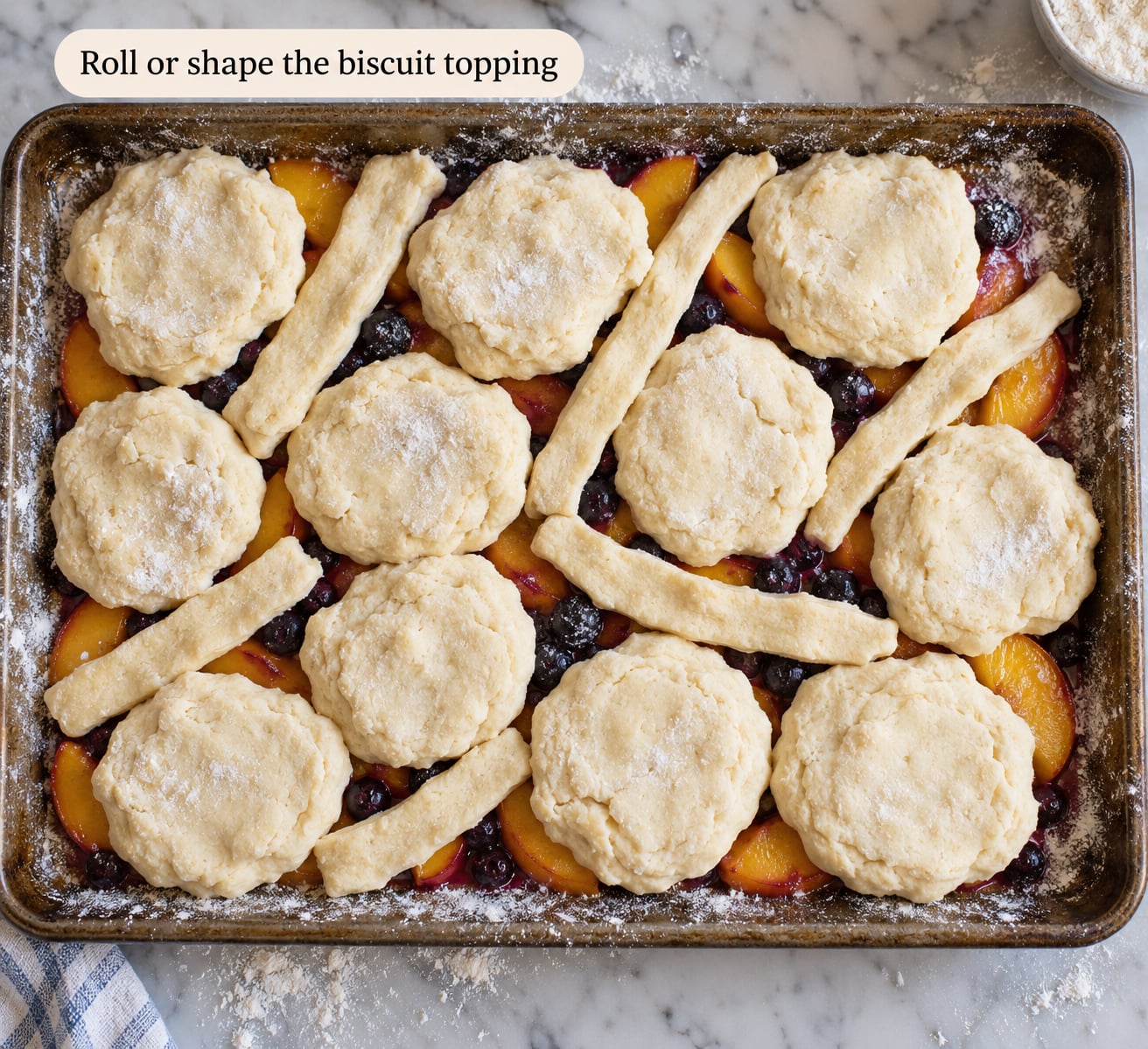
Tip the dough onto a lightly floured surface, or skip rolling and just pinch clumps straight from the bowl. For a rolled topping, pat the dough into a rough 3/4-inch-thick round, then cut it into rounds with a biscuit cutter or into rough strips with a knife. The shapes do not need to match. This is the one part of the recipe where neat is not the goal.
How to make blackberry cobbler from scratch well means leaving the pieces thick and slightly irregular, because uneven thickness is what gives you both crisp edges and soft centers in the same spoonful.
6. Assemble and bake the cobbler
Spread the blackberry mixture and all its juice into the prepared dish. Use your hands to scatter the dough pieces over the top, pressing them down lightly so they sit in a loose single layer rather than a grid with gaps.
Leave some fruit visible between the pieces. A cobbler with a sealed crust traps steam and steams the topping instead of browning it, and the fruit needs somewhere to bubble up.
Brush the dough with a little cream, melted butter, or milk so the surface browns evenly, then bake at 375°F for 35 to 45 minutes. A 9×9 pan usually finishes in the 30 to 40 minute range because the fruit layer is shallower, and a 9×13 takes closer to 45 minutes. Start checking at 30 minutes with a knife or an instant-read thermometer.
7. Check the filling and cool before serving
The topping should be golden brown across the whole surface, not just the edges, and you should see thick fruit bubbling up around the perimeter of the dish. The center should spring back only slightly when you press it lightly, and an instant-read thermometer in the center should hit 190°F.
The filling continues to thicken as it cools, so cutting into the cobbler straight out of the oven is how you end up with a puddle on the plate. Rest it on a wire rack for 15 minutes before serving. That rest also lets the juices redistribute through the fruit rather than sitting at the bottom.
A covered cobbler keeps well at room temperature for up to 2 days, and refrigerated in a covered dish for 3 to 4 days. For longer storage, bake it up to 10 minutes short of done, cool completely, wrap tightly, and freeze for up to 3 months. Thaw overnight in the fridge and finish it in a 350°F oven.
Common Mistakes
The most common problem is a watery filling. It usually traces back to undrained frozen or canned berries, to fruit that sat in sugar longer than 20 minutes, or to a filling with no cornstarch in it at all. Drain frozen fruit properly, keep the maceration short, and keep the cornstarch. If the filling is still loose after baking, spoon it into a saucepan, simmer it for two minutes, and pour it back into the dish.
Soggy, heavy biscuits come from overmixing the dough. Work the butter in with your fingertips, add the liquid with a fork, and stop while the dough still looks a little rough. A second cause is stacking the pieces too thickly, which gives you a raw, doughy center under a brown top.
Pale dough or raw dough in the middle is usually an oven issue, not a recipe issue. Check that the oven actually reached 375°F, give it time to preheat, and remember that a deeper 8×8 fruit layer needs the full 45 minutes. A thermometer is the most reliable fix, since color alone lies on a fruit cobbler.
Fruit leaking out of the dish means the oven was too hot or the dish was too full. Pan juices that boil over are the symptom, not the cause, and a rimmed baking sheet underneath catches the spill so the cobbler still bakes correctly.
An overly sweet result traces back to the sugar in both the filling and the topping plus whatever the fruit carried in. Cut the topping sugar to 2 tablespoons, use tart berries, and add lemon juice. The extra acid reads as brightness rather than sourness and makes the whole dish taste less sugary.
Frequently Asked Questions
Can I make blackberry cobbler ahead of time?
Yes, and the topping is where you can buy yourself a day. Assemble the fruit and the unbaked dough in the greased dish, cover it tightly, and refrigerate for up to 24 hours. Bake straight from the fridge, adding 5 to 10 minutes to the bake time since the dish starts cold. You can also bake the cobbler completely, cool it, cover it, and refrigerate it for 3 to 4 days.
How do I know when blackberry cobbler is done?
Look for three cues together: the topping is golden brown all the way to the center, thick fruit is bubbling at the edges of the dish, and the center springs back only slightly under a light touch. An instant-read thermometer inserted in the middle should read 190F. If the top is brown but the center still wobbles, give it five more minutes rather than pulling it early.
Should I use fresh or frozen blackberries?
Both work, with different results. Fresh berries keep their shape and give a brighter, cleaner flavor, and they only need 15 to 20 minutes of maceration. Frozen berries are cheaper and work year-round, but you must thaw them in a colander and discard the liquid or the filling will be watery. Never put frozen berries straight into the dish, and never reduce the sugar to compensate.
What can I serve with blackberry cobbler?
A scoop of vanilla ice cream is the classic answer and the one most people want. Creme fraiche or a spoonful of unwhipped heavy cream is lighter and lets the fruit flavor lead. Whipped cream dusted with a little powdered sugar works well too, and for a breakfast-brunch version, warm the cobbler and serve it with yogurt and a drizzle of honey.
Can I make blackberry cobbler without buttermilk?
Yes. Use cold whole milk, half-and-half, or even heavy cream in the same amount, 3/4 cup total. If you want the tang of buttermilk without any dairy, stir 1 teaspoon of lemon juice or vinegar into 3/4 cup of milk and let it sit for 5 minutes before adding it to the dough. It is not traditional, but the acid does the same job.
How do I reheat blackberry cobbler without making it soggy?
Skip the microwave if you can, because it steams the topping and softens the crust. Warm a serving in a 350F oven for 10 to 15 minutes, or in a skillet over medium-low heat with a lid for 5 minutes. Either way, uncover it for the last few minutes so the top dries back out, and skip the ice cream until the dish is hot, so it melts evenly instead of sliding off.
Conclusion
A good blackberry cobbler comes down to three things: thicken the fruit with cornstarch and a short maceration, keep the biscuit topping rough and barely mixed, and bake at 375°F until the top is golden and the edges are bubbling thick purple syrup.
Start now by preheating the oven and greasing that 8-inch dish. Once it is hot, the fruit and dough take about 20 minutes of your hands-on time, and the rest is the oven doing the work.