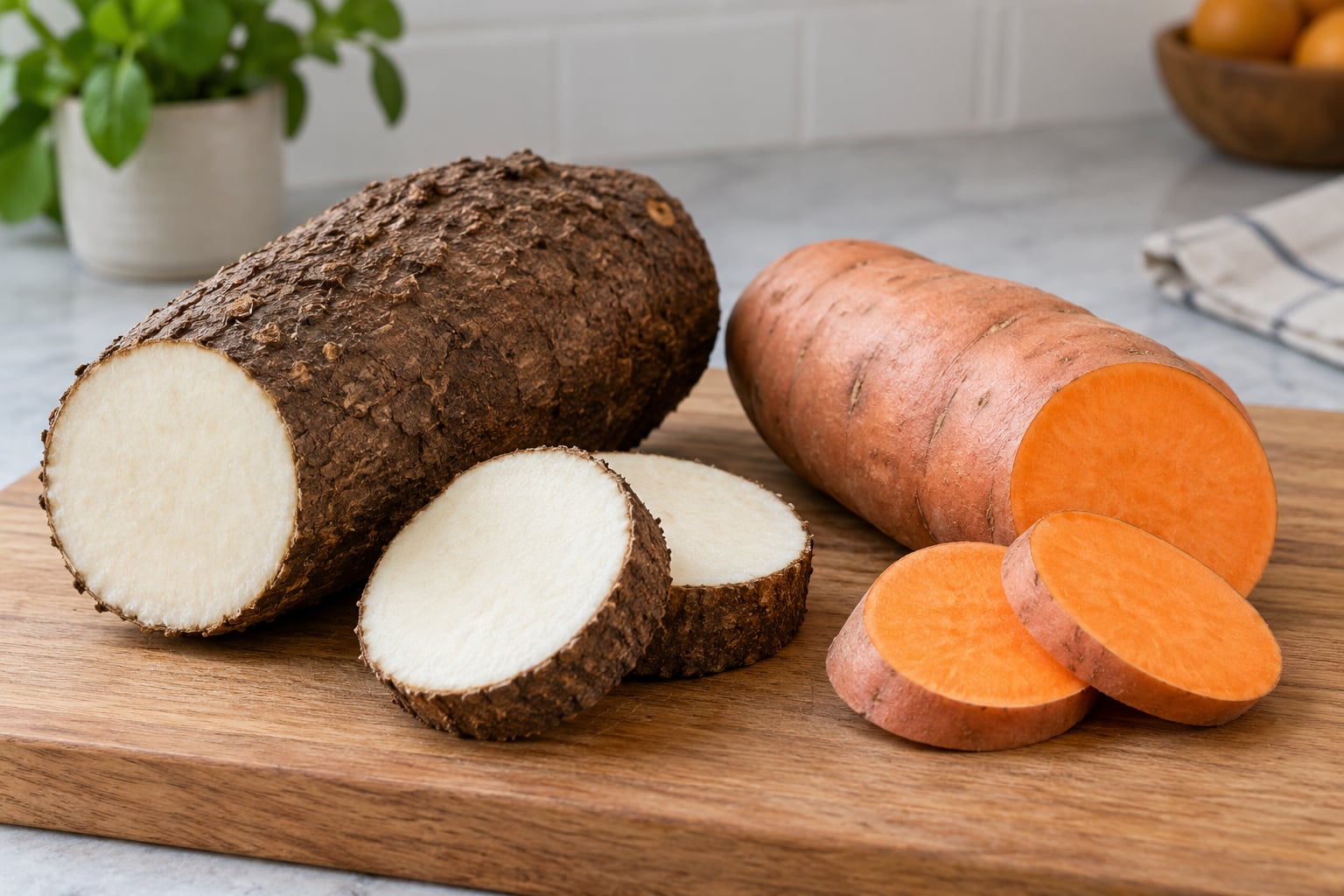
Yams and sweet potatoes are two botanically unrelated vegetables that most US shoppers call by the same name. A true yam is the tuber of a Dioscorea vine in the Dioscoreaceae family; a sweet potato is the storage root of Ipomoea batatas, a member of the morning glory family. To tell the difference between yams and sweet potatoes, start with the skin, the shape, and the color of the cut flesh.
- Sweet potato: smooth thin skin, tapered ends, orange or yellow flesh, naturally sweet and creamy when cooked.
- True yam: rough scaly skin like bark, thick cylindrical shape, off-white to deep purple flesh, starchy and mildly flavored.
- At the store: almost everything marked yam is a sweet potato. Read the label, because USDA rules require the words sweet potato to appear on any product sold under the name yam.
I grew up calling the orange thing on Thanksgiving yams and had no idea what I was actually eating until a Caribbean vendor at a public market set a real one in front of me. It looked like a rough brown log, and it tasted nothing like the candied version. That gap between the two names is what this guide clears up.
Table of Contents
- How to Tell the Difference Between Yams and Sweet Potatoes at a Glance
- Shape, Skin, and Color
- Dioscorea versus Ipomoea: what each one actually is
- Flavor and Texture
- How to Cook True Yams
- How to Cook Sweet Potatoes
- Nutrition: Which Is Healthier?
- Popular US sweet potato varieties and what each one is good for
- Yams and Sweet Potatoes at the Market
- How to tell a yam from a sweet potato in four steps
- How to read the label
- Other roots people confuse with yams
- Storage and Shelf Life
- Which Should You Choose?
- Frequently Asked Questions
- Are yams and sweet potatoes the same thing?
- Why are sweet potatoes sometimes called yams?
- Which is sweeter, a yam or a sweet potato?
- Can I substitute sweet potato for true yam in a recipe?
- How can I tell whether a yam is fresh?
- What is the best way to store yams and sweet potatoes?
- The Bottom Line
How to Tell the Difference Between Yams and Sweet Potatoes at a Glance
If you only have a few seconds in the produce aisle, scan the table below. Skin texture and flesh color are the two clues that never fail, and everything else follows from those.
| Feature | True yam | Sweet potato |
|---|---|---|
| Plant family | Dioscoreaceae, the yam family | Morning glory family (Convolvulaceae) |
| Genus and species | Dioscorea, hundreds of species | Ipomoea batatas |
| Part of the plant | A tuber, a swollen underground stem | A storage root |
| Skin | Rough, scaly, dark brown, bark-like | Smooth, thin, reddish or tan |
| Shape | Thick and cylindrical, blunt ends | Long and tapered, sometimes bulging mid-body |
| Flesh color | Off-white, yellow, reddish, or deep purple | Orange, yellow, white, or purple |
| Raw taste | Starchy, bland, sometimes slightly bitter or slimy | Sweet, lightly flavored |
| Cooked texture | Holds shape well, dry and floury like potato | Creamy and moist if soft, firm and dry if firm type |
| Where you find it | Caribbean, West African, and Latin American markets | Every mainstream US supermarket |
Shape, Skin, and Color
Dioscorea versus Ipomoea: what each one actually is
A true yam belongs to the genus Dioscorea, a sprawling tropical vine related more closely to lilies and grasses than to anything in the morning glory family. The part you eat is a tuber, which is a modified stem, and that detail matters in the kitchen because a tuber stays firm when cooked while a root tends to soften.
A sweet potato is a single species, Ipomoea batatas. It is a storage root, and the plant itself is a close cousin of the ornamental morning glory vine. Sweet potatoes come in both firm and soft types, which is why two sweet potatoes from the same bag can behave so differently in the oven.
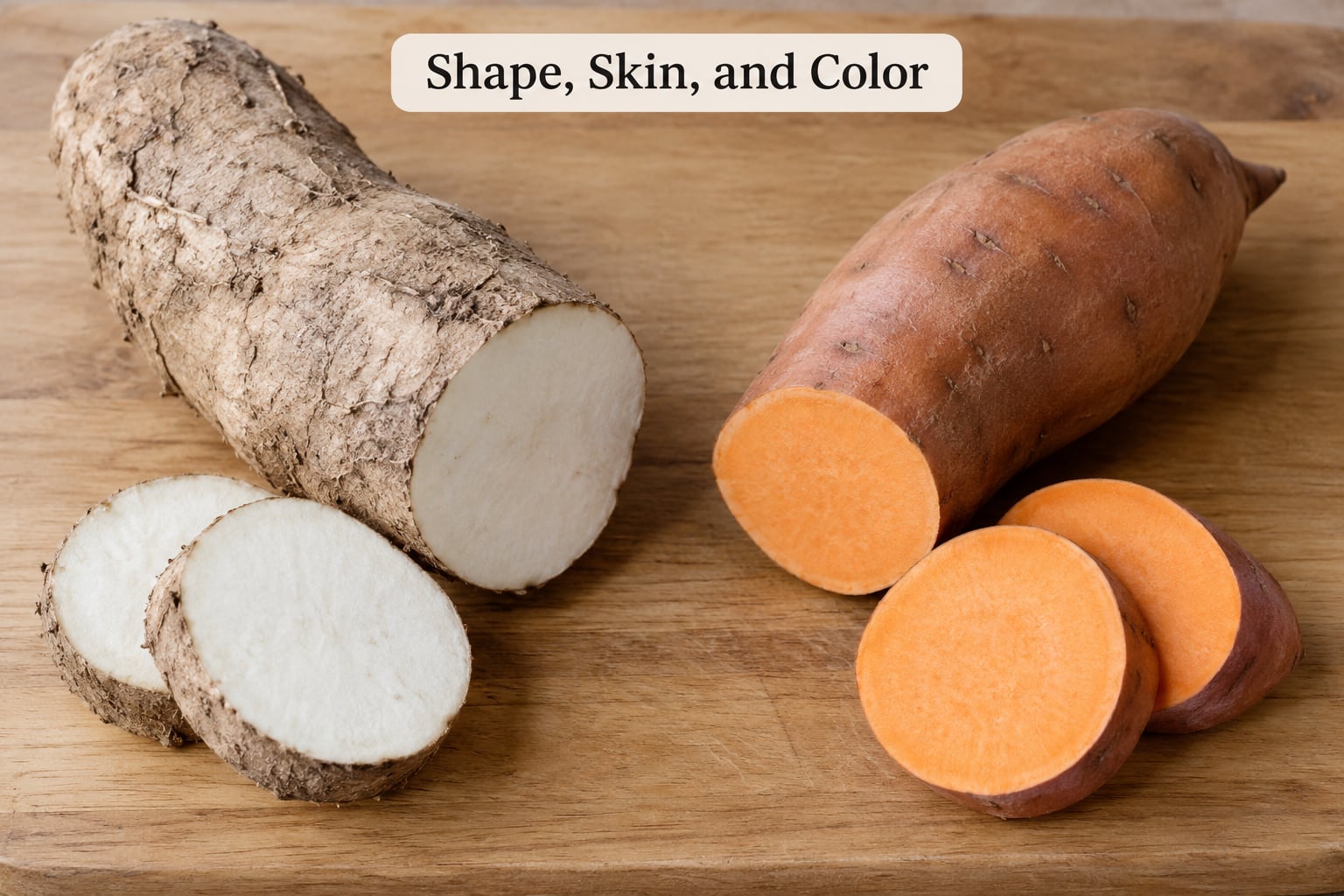
Skin is the fastest read. True yams carry rough, scaly, bark-like skin in dark brown or near black, often with a netting pattern around the surface. Sweet potatoes have skin thin and smooth enough to scratch with a fingernail, usually tan or brick red or deep purple.
Shape follows the same split. True yams grow thick and cylindrical with blunt, rounded ends, sometimes the diameter of a wrist. Sweet potatoes are typically longer and more tapered, though Jewel and Garnet varieties are short and blocky, and Murasaki is a small purple-skinned tuber-shaped one that still belongs to the sweet potato side of the family.
Flesh color needs a caveat. Purple flesh on a Murasaki sweet potato does not make it a yam, and pale creamy flesh on a Beauregard does not make it one either. Color varies by cultivar in both groups, so use it as a supporting clue, not the first test.
Flavor and Texture
Cooked side by side, the difference is immediate. A sweet potato roasted with its skin on develops caramelized, almost candy-like edges because its natural sugars brown at high heat. A true yam roasted the same way stays pale, starchy, and faintly nutty, closer to a Russet potato than anything sweet.
Raw yams have a slick, mucilaginous feel and can taste bitter or even slightly irritating. That is dioscorine, a compound in the skin and flesh of raw Dioscorea that is broken down by cooking. Yams must be cooked thoroughly. Do not taste one raw, and do not rely on a quick fry.
Texture depends on the sweet potato variety as much as on the choice between yams and sweet potatoes. Firm types such as Jewel, Garnet, and Hannah hold their shape and stay dry, which is what you want for fries, chips, or roasting. Soft types such as Beauregard have higher sugar and moisture, mash into something creamy, and turn silky in a pie or a candied glaze.
How to Cook True Yams
Because true yams are starchy rather than sweet, they take to the same methods you would use for potatoes, and they need a longer cook than most people expect.
For boiled yams, cut into thick rounds or leave whole, cover with cold salted water, and simmer 30 to 45 minutes depending on size. They should yield to a knife but still hold together.
For roasted yams, scrub hard and leave the skin on, cut into 2-inch chunks, toss with oil and salt, and roast at 425°F for 35 to 45 minutes until the edges brown and the centers are tender.
For fried yams, soak sliced pieces in water for 20 minutes to pull off excess starch, dry thoroughly, and fry at 350°F until golden. Drain and salt immediately, since they do not carry much sweetness of their own.
Simmering yams in a stew or a pot of soup is the classic West African use, where they thicken the broth with starch the way a potato does. If you cannot find fresh true yams in your area, frozen chunks or freeze-dried pieces are the most common option, and dried yam powder works for soups and fufu-type dishes.
How to Cook Sweet Potatoes
Sweet potatoes reward high heat and a little patience. Their sugars start browning around 350°F, so give them enough heat and enough time.
For baked sweet potatoes, pierce the skin several times and bake whole at 400°F for 45 to 60 minutes depending on size, or cut into halves and roast cut-side down for 35 to 45 minutes. Split a lengthwise cut opens the soft varieties into a creamy texture that works well with butter and brown sugar.
For air-fried fries, cut into even sticks, toss with oil and seasoning, and air-fry at 400°F for 16 to 20 minutes, shaking the basket twice. Firm varieties like Garnet are the best choice here because soft types brown before they crisp.
For candied sweet potatoes, slice and simmer in water for five minutes, drain, then arrange in a dish with butter, brown sugar, a splash of orange juice, and a little cinnamon, and bake until the glaze thickens and the edges caramelize.
Cubing for salads or soups works with either type. Just watch the timing, because cubed sweet potato gives up its structure faster than yam, and overcooked cubes turn mushy well before the surrounding liquid reduces.
Nutrition: Which Is Healthier?
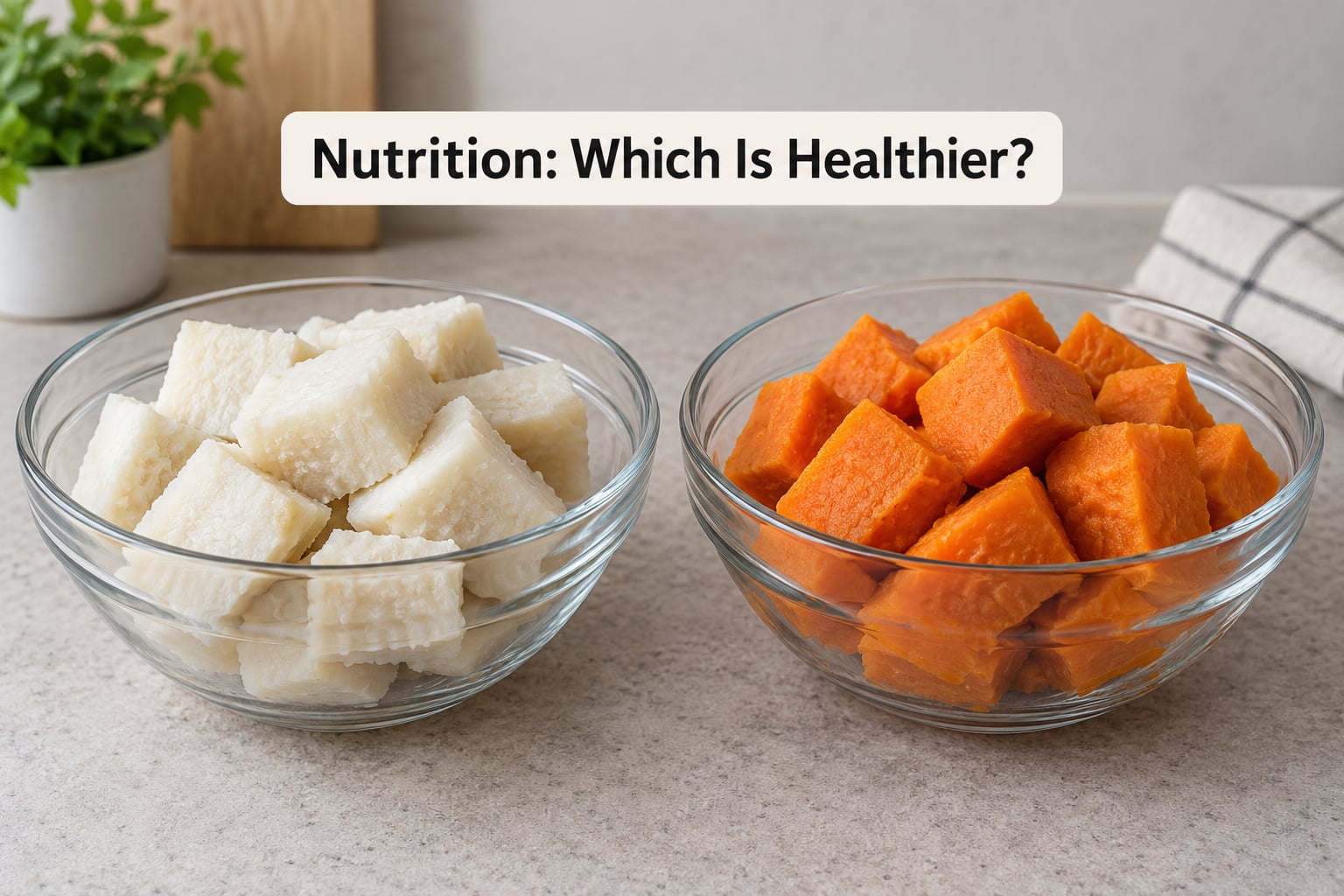
Both are nutrient-dense, and neither wins outright. Values below are approximate per 100 grams of raw flesh; cooking method, variety, and portion size move these numbers more than the choice between the two vegetables does.
| Nutrient (approx. per 100 g raw) | True yam | Sweet potato |
|---|---|---|
| Calories | 100 | 86 |
| Carbohydrates | 24 g | 20 g |
| Fiber | 3 g | 3 g |
| Natural sugars | 0.5 g | 4 g |
| Vitamin A (from beta-carotene) | Negligible | About 960 mcg RAE |
| Vitamin C | About 12 mg | About 20 mg |
| Potassium | About 350 mg | About 475 mg |
| Manganese | Present | Present |
Sweet potato leads on beta-carotene, and that is the headline nutritional difference. Orange-fleshed varieties convert beta-carotene into vitamin A efficiently, which is one reason they are frequently recommended for eye and immune health. True yams are richer in certain B vitamins and contribute more starch, which some people find easier to digest than the fiber-heavy, sugar-containing sweet potato.
Both carry plenty of potassium and fiber, and both lose some vitamin C through long cooking. If you care about vitamin C, steam or roast briefly rather than boiling for an hour.
Popular US sweet potato varieties and what each one is good for
| Variety | Skin | Flesh | Best use |
|---|---|---|---|
| Jewel | Reddish brown | Orange | Firm, excellent for fries and roasting |
| Garnet | Red | Deep orange | Firm, sweetest of the firm types |
| Beauregard | Rose | Orange | Soft, moist, mashing and pies |
| Hannah | Tan | Yellow | Firm, skin-on fries and roasting |
| Murasaki | Purple | Orange to yellow | Cakes and color contrast dishes |
Yams and Sweet Potatoes at the Market
True yams are not a routine US grocery item. They show up at Caribbean, West African, and Latin American specialty markets, and the season depends heavily on import supply rather than on a domestic growing calendar. Sweet potatoes are in season in the United States mainly from late summer through winter, and they are the only option you will reliably find.
How to tell a yam from a sweet potato in four steps
First, look at the skin. If it is rough, scaly, and dark with a netting texture, you are holding a true yam. If it is smooth and thin enough to see daylight around a scratch, it is a sweet potato.
Second, read the label or the sign. Anything sold in the United States under the name yam is required to name sweet potato somewhere on the packaging, so a bag reading yam and sweet potato is a sweet potato, plainly.
Third, check the shape. Thick and cylindrical with blunt ends means Dioscorea. Long and tapered, or short and blocky with pointed ends, means sweet potato.
Fourth, cut it if you still have doubt. Orange, yellow, white, or purple flesh inside a smooth skin is a sweet potato. Creamy white or starchy off-white flesh inside a rough brown skin is a true yam.
How to read the label
USDA naming rules mean the word sweet potato has to appear on anything labeled yam, which turns the label into a reliable tool. A produce sticker with a PLU code for a sweet potato is definitive. Plain bulk bins and chalk signs are murkier, and some sellers use yam loosely, so skin and flesh still decide it.
Other roots people confuse with yams
Yuca, which is cassava, is a completely different plant and looks more like a thick branch than a tuber. Taro has a rough brown husk and starchy, slightly muddy purple or white flesh. Cushcush is a small, pale, flattened tuber used in Caribbean cooking that can easily pass for a miniature yam. White sweet potatoes are sweet potatoes that simply lack beta-carotene, and old photos circulate labeling them as yams.
Storage and Shelf Life
Whole sweet potatoes store best in a cool, dark, dry place rather than the refrigerator, ideally somewhere around 55 to 60°F with decent airflow. Kept that way they last roughly one to three months. Refrigeration, which is fine for cut pieces, turns the starch to sugar and makes them softer and sweeter, which is why fridge-stored tubers bake up so well.
Whole true yams keep best in the same conditions and last a few weeks to a couple of months once cured. They should be stored unwashed, and moisture is what shortens their life, so skip the plastic bag and use a breathable basket or paper sack.
Cut pieces behave differently. Refrigerate cubed or sliced raw sweet potato in an airtight container for up to four days, and blanch or cook cut yam similarly, no more than three to four days. Cooked sweet potato keeps about three to four days in the fridge and about two to three months frozen. Cooked true yam keeps a little longer, since it is lower in sugar and resists browning.
Which Should You Choose?
Pick the sweet potato for baked dishes, fries, glazed sides, pies, and anything where you want sweetness and creamy texture. Roasted sweet potatoes are difficult to beat, and a soft variety such as Beauregard is the one to buy for candied preparations or mash.
Pick the true yam when you want a starchy, potato-like vegetable: boiled and served with sauce, simmered into soups and stews, fried into crisps, or ground into fufu-style flour. Yam is the better choice for satiety-focused meals and for anyone who finds sweet potato too sweet.
For salads and roasting pans, consider availability first. In most US markets the sweet potato is the only realistic option, and a recipe calling for yam almost always means sweet potato. In Caribbean, West African, or Latin American grocery aisles, the choice is genuinely yours.
Frequently Asked Questions
Are yams and sweet potatoes the same thing?
No. A true yam is the tuber of a Dioscorea vine in the Dioscoreaceae family. A sweet potato is the storage root of Ipomoea batatas in the morning glory family. They share no genus and cook differently, so a recipe calling for one is not reliably a recipe for the other.
Why are sweet potatoes sometimes called yams?
The name stuck in the 1930s, when Julian C. Miller at the Louisiana State University Agricultural Center began promoting a new soft orange-fleshed sweet potato that looked nothing like the pale varieties shoppers knew. Marketing pushed the exotic word, and the mislabel spread. USDA rules now require sweet potato to appear on any product sold as a yam.
Which is sweeter, a yam or a sweet potato?
Sweet potatoes win by a wide margin. Four grams of natural sugar per 100 grams against about half a gram in true yam is the short version, and roasting caramelizes that sugar into a crisp edge. True yams cook up mild and starchy, closer to a potato than to anything dessert-like.
Can I substitute sweet potato for true yam in a recipe?
You can, and in most home kitchens you will have to, but expect a different dish. Sweet potato brings more sugar and more moisture, so a stew or fritter recipe written for yam will cook down sweeter and softer. For soups and boileds the swap works well; for fried items and baked sides, results diverge more.
How can I tell whether a yam is fresh?
Look for firm skin with no soft spots, wrinkles, or mold around the ends. Fresh true yams should feel heavy for their size and smell clean, not musty. The scratch-and-sniff test matters because the bitter dioscorine compound concentrates in damaged or aging tissue, and any yam that smells sharp or turns slimy after cutting should be discarded.
What is the best way to store yams and sweet potatoes?
Keep both whole, unwashed, and unwrapped in a cool, dark, ventilated spot rather than the refrigerator, and expect one to three months for sweet potatoes and somewhat less for true yams. Cut pieces go in the fridge in an airtight container for no more than four days, or freeze them for long-term storage.
The Bottom Line
Start with the skin. Rough, scaly, and dark means a true yam; smooth and thin means a sweet potato. Then check the cut flesh and the shape, and read the label, which by USDA rule always tells you which sweet potato you are looking at.
What you buy comes down to the dish. Sweet potatoes for anything roasted, glazed, or baked. True yams for soups, stews, boiled plates, and fried sides, where you want starch rather than sugar.