Caramel turns grainy because a few stray sugar crystals get back into the hot, supersaturated syrup and give the whole batch a starting point to clump around. To make caramel without it crystallizing, keep the pan clean and dry, stop stirring the moment the sugar boils, swirl instead, and keep the syrup hot until you add your cream. Twenty minutes of patience, no special equipment beyond a heavy saucepan and a thermometer.
I have ruined more batches of caramel than I care to admit, and almost every time the cause was the same: something got stirred in, or something cold hit the syrup too fast. Fix those two habits and the rest is detail.
Table of Contents
- What You Need
- Step-by-Step
- 1. Prepare a clean pan and measure the sugar
- 2. Dissolve the sugar before caramelizing
- 3. Let the caramel color without disturbance
- 4. Stop the cooking at the right moment
- 5. Finish and test the texture
- Common Mistakes
- Frequently Asked Questions
- Why does my caramel crystallize and become grainy?
- Should I stir caramel while it is cooking?
- Can I rescue caramel that has started to crystallize?
- What temperature should caramel reach for a smooth texture?
- Why does caramel harden or become too soft after I add cream?
What You Need
A small batch is 1 cup (200g) of granulated white sugar plus 1/4 cup (60ml) of heavy whipping cream and a tablespoon of unsalted butter if you want a rich sauce. That is the whole recipe.
- Granulated white sugar. Measure it by weight if you can. Brown sugar, honey and coconut sugar all behave differently, and brown sugar in particular is the single most common cause of failed home caramel.
- A heavy-bottomed stainless steel saucepan, 2 to 3 inches deep and 6 to 8 inches wide. Thin non-stick pans spike in temperature and scorch the sugar before you notice.
- A candy thermometer. This is the single tool that most reliably prevents crystallization, because it removes your reliance on colour judgement alone. Dark pans lie to you.
- A wooden spoon or silicone spatula for the dissolve phase only.
- A heatproof surface, ideally a silicone mat or a marble board, for the cool-and-snap test.
The pan matters as much as the recipe. Scratched metal holds micro-crystals of sugar from the last batch, and a speck of grease, flour or oven spray gives a stray molecule somewhere to attach. If your sugar lives in a bin where you also scoop flour with the same measure, that contamination is a plausible reason your batches keep turning grainy.
Step-by-Step
This is the wet method, meaning the sugar dissolves in water first. It is more forgiving than the dry method, which never touches water at all. For a dry batch, skip the water in step 2 and pour the granulated sugar straight into the dry pan.
1. Prepare a clean pan and measure the sugar
Wash the saucepan, dry it completely, and set it on a cool burner. Any water left in the pan from washing makes uneven lumps on the heating surface. Measure your 1 cup of sugar and 1/4 cup of cream before you turn on the heat, and leave the cream at room temperature. Cold cream hitting a 340F syrup is what seizes caramel into a solid, chewy mass.
2. Dissolve the sugar before caramelizing
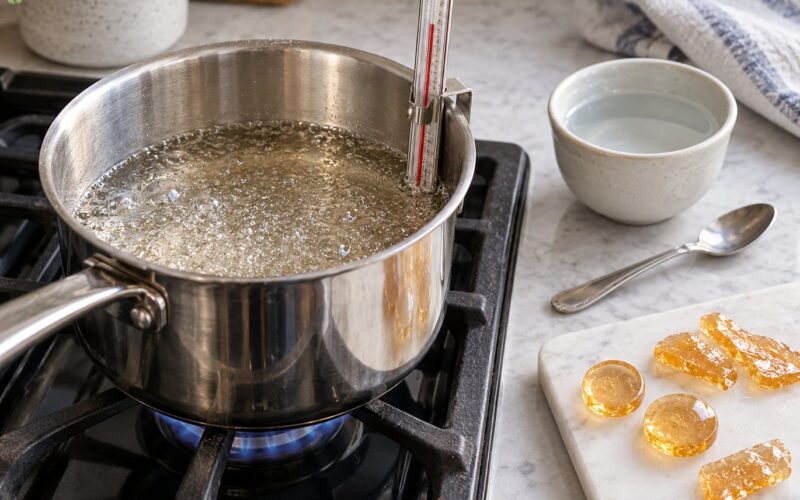
Put the sugar and the 1/4 cup water in the pan and heat over medium, stirring gently with the wooden spoon until the sugar has completely dissolved and the mixture comes to a boil. Stirring here is correct and necessary. Any lumps on the bottom or the walls get pushed back into the solution. Once you see no more grains and the syrup runs clear like water, turn the heat up to medium-high and put the spoon down for good.
This is where most people trying to make caramel without it crystallizing go wrong. Once the syrup boils, any crystal knocked off the wall dissolves back into the supersaturated solution and multiplies into a chain reaction. From this point on, the only movement allowed is lifting the pan off the burner and swirling it by the handle.
3. Let the caramel color without disturbance
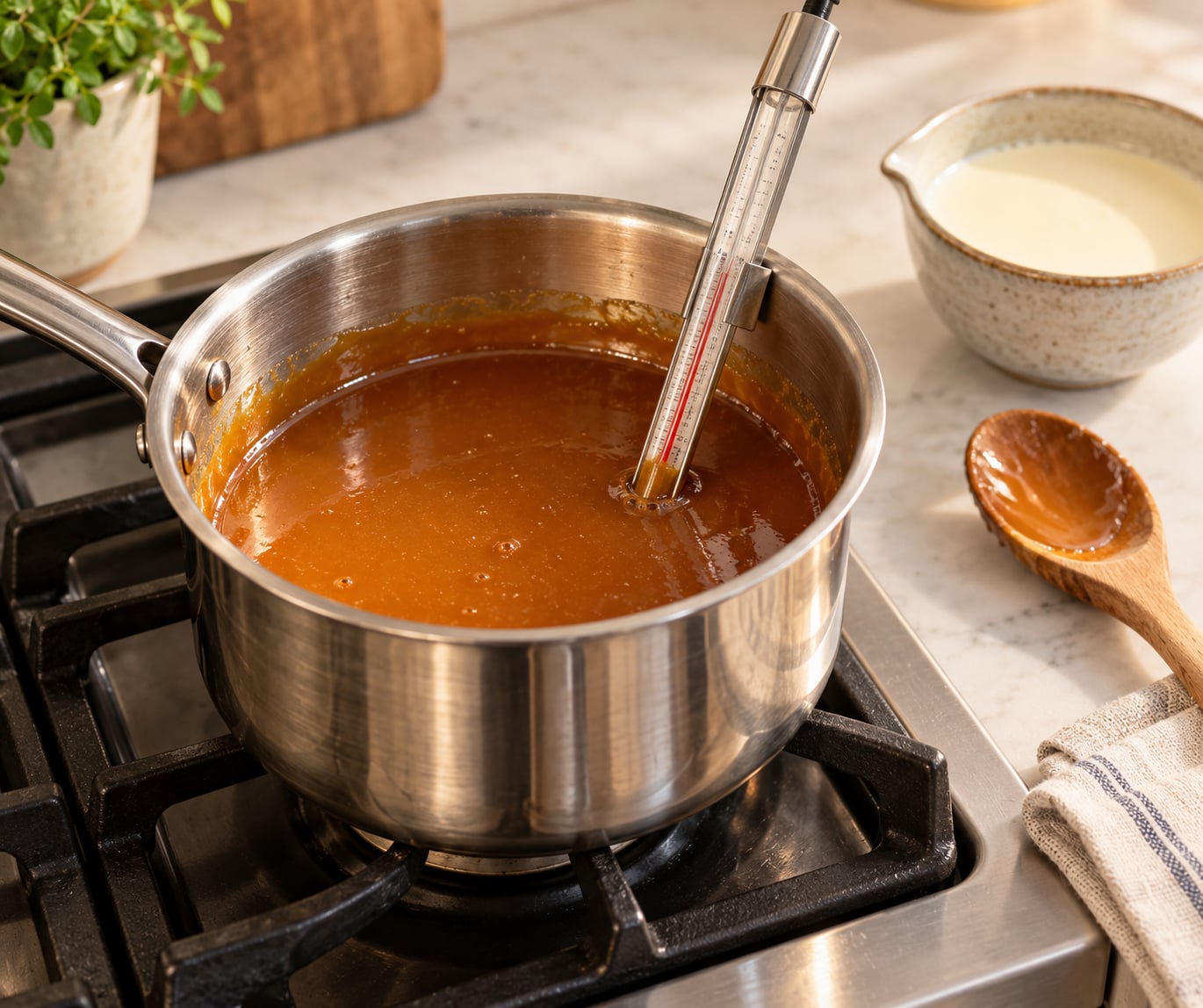
Hold the thermometer in the syrup without touching the bottom or sides. Watch the colour go from clear to pale gold at around 320F (160C), to light amber near 340F (170C), to a deep amber around 350F (177C). For a pourable sauce, pull it at 335 to 340F. Do not stir, do not scrape, and keep the burner on medium-high so the syrup stays fully molten.
Colour cues only work in a light pan against a neutral background. If you judge by eye and your kitchen is dim, stop guessing and use the number.
4. Stop the cooking at the right moment
Take the pan off the heat. Wait about 30 seconds so the boil calms down, then pour the cream in a thin stream down one side of the pan while whisking briskly with the butter. It will hiss, steam and roughly double in volume, so use a pan with headroom and keep your face back from the steam. Stir in the butter until the sauce is glossy and smooth, then return it to low heat for one to two minutes to cook out any raw cream flavour.
Never add water or a fridge-cold ingredient to caramel sitting above 340F. The temperature drop plus the fat is what makes caramel seize.
5. Finish and test the texture
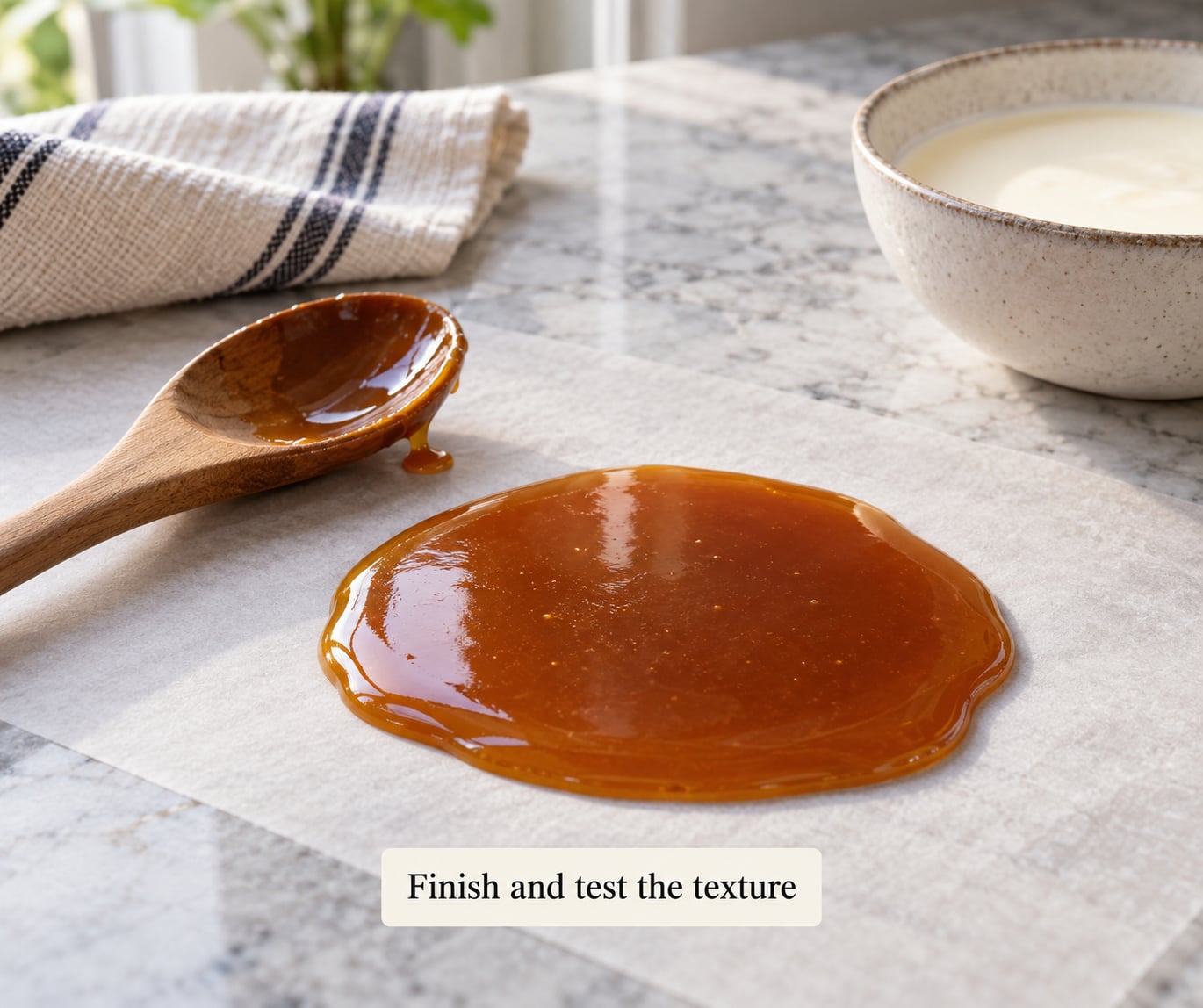
Pour a small spoonful onto your heatproof surface and let it cool completely, about 60 seconds. A good sauce snaps cleanly and is not tacky or bendable. Pour the rest into a jar or a prepared dish and let it set. If it is rock hard after cooling, warm it gently with a splash of cream. If it is still loose, return it to the heat and cook another 5 to 10 degrees.
Common Mistakes
- Stirring after the boil. The most common failure by a wide margin. Once the syrup boils, stop stirring and swirl the pan by the handle instead.
- Sugar splashed up the pan walls. Those dry crystals rejoin the syrup and seed the batch. Either wash them down with a barely damp pastry brush early on, before the syrup gets thick, or keep a clean damp brush and wipe the walls back into the liquid.
- A dirty or scratched pan. Old sugar residue and grease both act as seed sites. Use a light-coloured stainless pan and wash it well after every batch.
- Overheating. Cooking past the target temperature, or cranking the burner high to speed things up, drives off water and concentrates the syrup until it seizes. Be patient; a caramel sauce takes 15 to 20 minutes.
- Cold cream or butter. Brings the temperature down fast and fat out of emulsion. Use room temperature dairy.
- A pan that is too small. When the cream goes in, a shallow pan will overflow. Use a 6 inch or wider saucepan.
- Judging by colour in a dark kitchen. A thermometer removes the guesswork entirely.
- Scrapping the pan bottom when pouring. Crystals from the base end up in the sauce. Pour carefully and leave the last syrup behind.
Two habits are worth building beyond caramel. First, never scoop sugar with the same measure you use for flour. Second, wipe your thermometer probe before each use; the sugar film on it changes the reading.
If you make this at a market stall or in volume, hold the finished sauce at 105 to 115F in a warming unit. Caramel held too hot goes thin and starts to cook off; too cold and it thickens past drizzling. Reheat it slowly with a splash of cream and whisk until it comes back to a pourable state.
Frequently Asked Questions
Why does my caramel crystallize and become grainy?
Crystallization starts with a seed: a dust mote, a grease speck, a leftover sugar crystal in the pan, or a granule knocked off the wall while you stirred. That seed gives the dissolved sucrose something to stack onto, and because the syrup is supersaturated, the reaction spreads through the whole batch within seconds. Stale or contaminated sugar and stirring after the boil are the two biggest triggers.
Should I stir caramel while it is cooking?
Only while the sugar is dissolving in water. Stirring is helpful right up to the boil, because it breaks up lumps and pushes stray granules off the pan walls. The moment the syrup reaches a full boil, stop for good. From that point, lift the pan by the handle and swirl it instead. Any stirring after the boil knocks crystals back into the syrup and triggers graininess.
Can I rescue caramel that has started to crystallize?
Often yes, if you catch it early. Put the pan back on low heat, add a splash of hot water or warm cream, and stir gently until the crystals dissolve back into the syrup. If it has fully hardened or smells burnt, no amount of liquid will fix it and you should start over. Crystallized caramel is still perfectly safe to eat; it just looks and feels wrong.
What temperature should caramel reach for a smooth texture?
For a pourable caramel sauce, aim for 335 to 340F (168 to 171C). For soft chewy caramels, cook to 350F (177C). Colour runs a little behind temperature, so pull the pan when the syrup looks like the colour you want, then confirm with the thermometer. Holding the syrup at temperature without stirring is what keeps it smooth.
Why does caramel harden or become too soft after I add cream?
Cream changes the concentration and adds fat, so the final texture no longer matches the temperature the syrup reached on its own. Too hot and the caramel seizes into a solid, chewy mass because the temperature shock pulls fat out of emulsion. Too cool and the sauce stays loose. Use room temperature cream, whisk constantly, and cook the sauce one to two minutes after it comes together.
Measure your sugar accurately, keep the pan still once it boils, and trust the thermometer over the colour. Those three habits cover nearly every grainy batch I have seen, and knowing how to make caramel without it crystallizing is mostly the discipline to leave the pan alone for twenty minutes.