How to make peanut brittle on the stove in one pan: cook sugar, light corn syrup and butter to 300 to 305 F, the hard crack stage, then stir in peanuts, vanilla, salt and baking soda off the heat and pour the foaming mixture in a thin layer on a lined sheet pan. The whole job takes about 25 minutes, and most of that is you standing at the stove watching a thermometer.
Peanut brittle is a hard cooked-sugar candy, and the stove is the classic place to make it because the candy thermometer gives you the single measurement that decides the outcome: whether the batch snaps glassy hard, stays bendy and chewy, or scorks past saving. Color and smell lie to you. A syrup that looks right at 320 F tastes scorched.
The method below uses the standard 2:1:1 ratio of sugar to corn syrup to peanuts. It sets in 20 to 30 minutes once poured and breaks into shards with a clean pop.
Table of Contents
- What You Need
- Equipment
- Ingredients and what each one does
- Which peanuts should you use?
- Before you turn on the burner: hot sugar safety
- Step-by-Step: How to Make Peanut Brittle on the Stove
- Step 1: Prep the workspace (5 minutes)
- Step 2: Combine sugar, corn syrup and butter over medium heat
- Step 3: Cook the syrup to hard crack (300 to 305 F)
- Step 4: Take it off the heat and add peanuts, vanilla, salt, then baking soda
- Step 5: Pour it thin and spread it out
- Step 6: Let it cool completely at room temperature
- Step 7: Snap it into shards
- Step 8: Store it properly
- Candy temperature stages at a glance
- How to make peanut brittle on the stove without a thermometer
- Flavor variations and batch scaling
- Common Mistakes
- The mistakes beginners repeat most
- Frequently Asked Questions
- Do you need a candy thermometer for peanut brittle?
- How do I know when peanut brittle is ready?
- Why won’t my peanut brittle get hard?
- Why put baking soda in peanut brittle?
- Can you make peanut brittle without corn syrup?
- How long does peanut brittle keep, and can you freeze it?
- Conclusion
What You Need
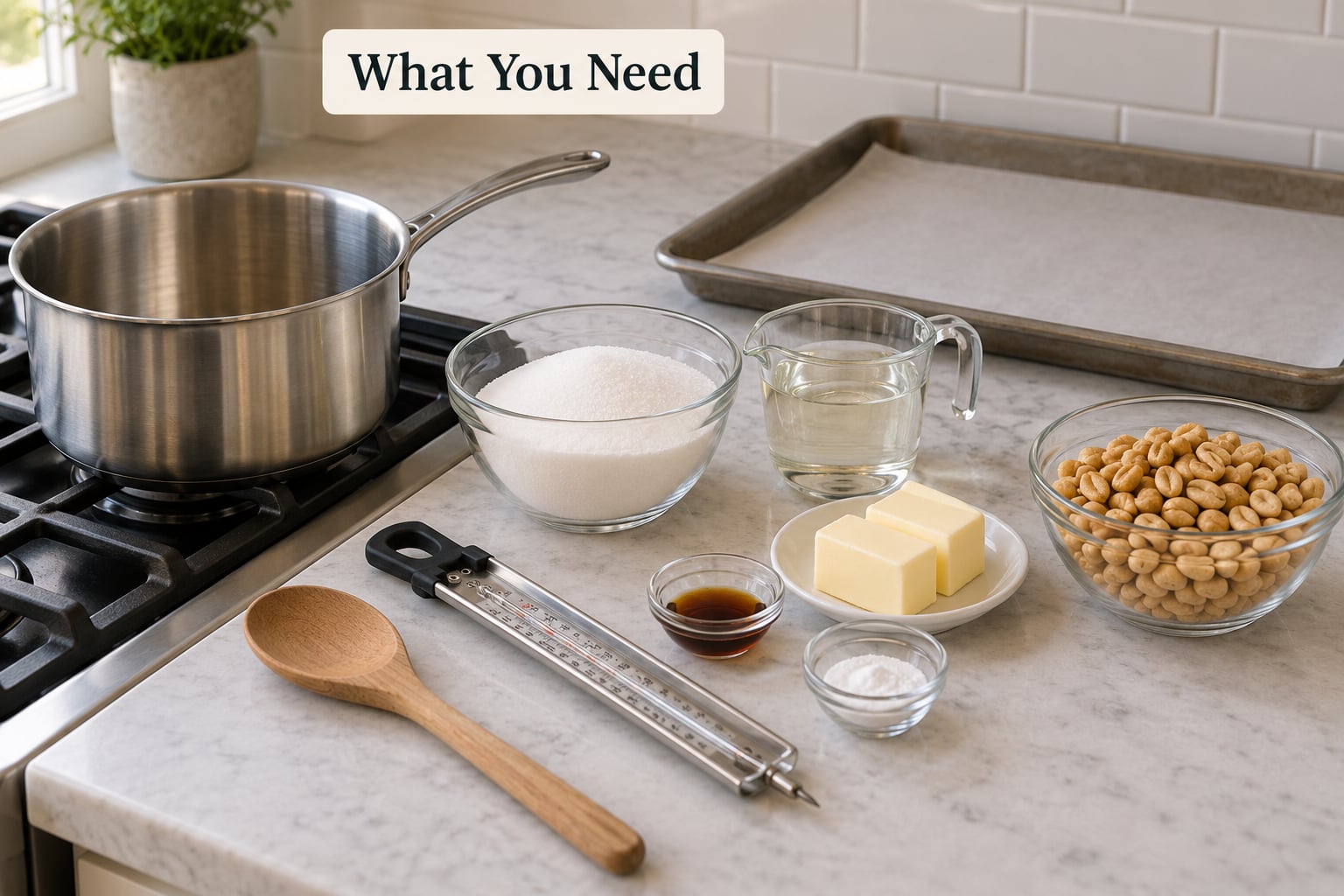
Everything gets measured and staged before the burner goes on, because the ten minutes after the sugar starts boiling are too busy to stop and search for something.
Equipment
- Heavy-bottomed 3 to 4 quart saucepan. Thin aluminum warps, scorches the syrup in a ring, and is the number one reason a first batch tastes bitter.
- Candy thermometer, clip-on or probe, with a hard crack setting.
- Wooden spoon or silicone spatula that can stand up to molten sugar.
- Rimmed baking sheet lined with parchment, or very lightly greased. Parchment is more reliable.
- Dry oven mitts, a small bowl for the peanuts, and a second sheet pan to catch drips if the first one is close to full.
Ingredients and what each one does
- 2 cups (400 g) granulated sugar. The body of the candy.
- 1 cup (240 ml) light corn syrup. Keeps the sugar from crystallizing into a grainy sand, and slows the climb so the temperature stays readable.
- 8 tablespoons (115 g) unsalted butter, cubed. Adds richness and dairy depth, and shortens the window you have to pour.
- 1 cup (140 g) peanuts.
- 1 teaspoon vanilla extract, added off the heat so it does not cook off.
- 1/2 teaspoon baking soda. Not baking powder. It reacts with the hot syrup and releases gas, which aerates the candy and gives the lighter, crisper texture instead of a glass-hard block.
- 1/4 teaspoon kosher salt, or 1/2 teaspoon fine sea salt.
Which peanuts should you use?
Dry roasted salted peanuts are the standard for a reason: they are already roasted, so they add crunch and color without extra oven time, and the salt balances the sweetness. Raw peanuts work, but roast them at 350 F for 8 to 10 minutes and cool them fully before they go near the syrup, otherwise they steam and go soft.
Spanish peanuts, skins on, are the traditional choice and give a more rustic, uneven texture. Halve any whole ones so you get a nut in every shard instead of a bare patch.
If your peanuts are already salted or you switch to salted butter, cut the added salt down or leave it out. A second layer of salt on candy that is already sweet-salty tips it.
Before you turn on the burner: hot sugar safety
Sugar at 300 F sticks to skin and burns far worse than boiling water, because it is above the temperature at which water cools a burn. Dry hands, sleeves pushed back, long hair tied, children out of the kitchen.
- Do not lean over the pan, and keep water splashes away. A few drops of cold water hitting a hot base can spit and make a sudden boil-over.
- Use dry utensils. A wet spoon dropped into the syrup crystallizes the edges immediately.
- If a sugar fire starts, slide a lid over the pan and turn off the heat. Never add water.
- Cool the pan cleanup: let the hardened sugar sit, then cover with hot soapy water. Pouring water into a hot sugar pan is the fastest way to make a dangerous mess.
Step-by-Step: How to Make Peanut Brittle on the Stove
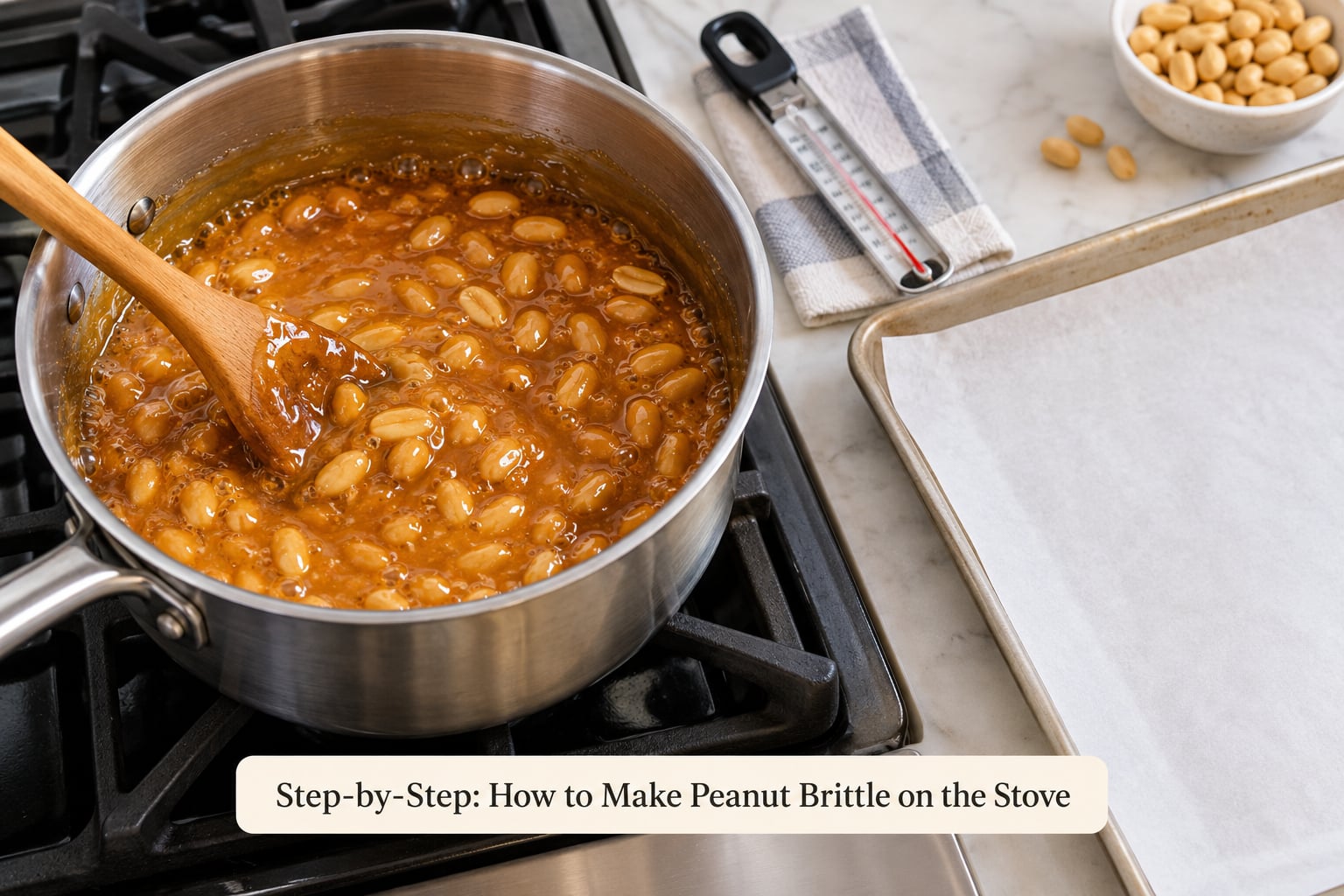
Step 1: Prep the workspace (5 minutes)
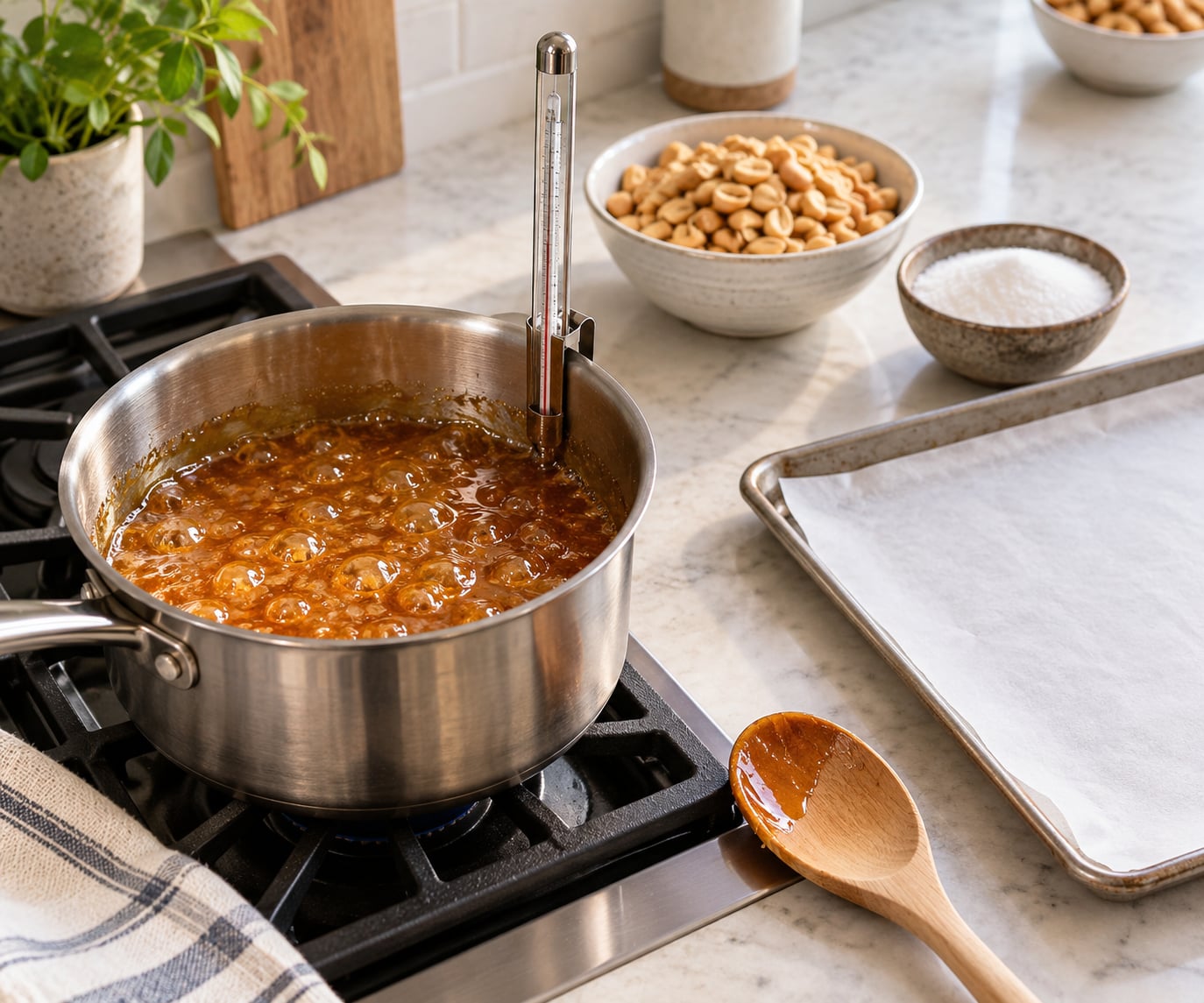
Line the baking sheet with parchment and press the corners down so it does not lift. Measure the peanuts into a bowl, cut the butter into cubes, and set every ingredient within arm’s reach of the stove. Fit the thermometer to the pan before you heat anything, and know which bulb sits in the syrup without touching the bottom.
Step 2: Combine sugar, corn syrup and butter over medium heat
Put sugar, corn syrup and butter in the saucepan and stir just until the butter melts and the mixture looks like thin sweet milk. From this point on, stop stirring. Note the time but do not trust it; pans, burners and starting temperatures all differ.
Step 3: Cook the syrup to hard crack (300 to 305 F)
Bring it to a boil, then lower the heat to medium and let it cook uncovered without touching the spoon. Expect the climb from boil to hard crack to take 8 to 12 minutes. Sugar, not time, is the clock.
Watch the bubbles as the temperature rises. Large lazy bubbles turn smaller and tighter, and around 300 F the syrup starts to pop like distant firecrackers. At that point it is done. Do not lift the pan to shake it, do not tilt it to check the color, and do not add the peanuts yet. Every disturbance at this stage is how to make peanut brittle on the stove go grainy instead of glassy.
Step 4: Take it off the heat and add peanuts, vanilla, salt, then baking soda
Pull the pan off the burner and add the peanuts, vanilla and salt. Stir with a folding motion for about ten seconds, then add the baking soda and stir fifteen seconds more. The mixture will foam up hard, roughly doubling in volume and going cloudy and matte.
That foam is your clock. You have somewhere between 30 and 90 seconds before the mixture stiffens in the pan, so have the baking sheet in front of you and move now.
Step 5: Pour it thin and spread it out
Scrape everything onto the lined sheet and spread it with a buttered spatula into an even layer about 1/8 inch thick. Thick spots cool slowly in the middle and stay soft and bendy. Leave a two inch border around the pan so nothing runs off, and do not press the peanuts back into the surface after it starts setting.
Step 6: Let it cool completely at room temperature
Give it 20 to 30 minutes, until the sheet is cool all the way to the center and the layer snaps when you lift an edge with a fingernail. Do not put it in the fridge or freezer to rush it. Rapid cooling makes condensation, and condensation makes tacky candy.
Step 7: Snap it into shards
Lift the parchment off the sheet and break the brittle with clean, dry hands or the back of a knife. It should shatter rather than bend. Bending means it was pulled under 300 F.
Step 8: Store it properly
Break it into pieces and layer them in an airtight container with parchment or wax paper between the layers. In a cool, dry cupboard it stays crisp for two to three weeks. For longer storage, freeze single sheets flat and keep them in a sealed bag for up to three months, then thaw without opening. Skip the refrigerator even if the kitchen is humid; sealed in the freezer it is fine, sealed in the fridge it is not.
Candy temperature stages at a glance
| Temperature | Stage | What it looks like | What happens if you stop here |
|---|---|---|---|
| 240 to 250 F | Syrup | Large lazy bubbles, syrup runs off the spoon in a thin thread | Will not set; stays sticky and grainy |
| 260 to 280 F | Soft ball | A drop in cold water pulls into a soft ball | Fudgy and chewy |
| 280 to 290 F | Soft crack | Drizzled threads bend before they break | Taffy-plush, not brittle |
| 300 to 305 F | Hard crack | Threads break cleanly; a drop in cold water snaps hard between the fingers | Crisp glassy brittle, the target |
| 310 to 340 F | Caramel | Deeper amber, stronger molasses flavor | Chewy toffee, not brittle |
| 350 F and up | Scorched | Smoking, acrid smell | Discard; there is no recovery |
How to make peanut brittle on the stove without a thermometer
Drop testing works, and it is accurate to within a few degrees if you do it often enough. Drop a small spoonful of syrup into a bowl of cold water, wait five seconds, then pinch it. If it bends into a U, you are still short. If it snaps hard and you can feel the break in your teeth, it is done.
Two other cues help. Past about 300 F the syrup begins making fine crackling noises on its own, and a thread dripped from a spoon should break cleanly on the cold saucer instead of sagging. Most home candy makers still buy the thermometer after the first batch, because a five dollar tool beats losing a pot of scorched sugar.
Flavor variations and batch scaling
Stir in a handful of dark chocolate or butterscotch chips right after the peanuts so they melt into the surface. Cinnamon and a pinch of cayenne with the peanuts gives a warm, slow-burn version. Sesame seeds, pumpkin seeds, pecans, cashews and macadamias all work in the same 1 cup measure, and pumpkin seeds make a clean nut-free version for a school or allergy table.
For holiday gifting, double or triple the recipe but use more pans rather than a deeper layer. Two full batches pour much more evenly into two rimmed sheets than one batch poured twice as thick. Everything stays set for the same 300 to 305 F target; only the pan count changes.
Common Mistakes
Almost every disappointing batch of peanut brittle traces back to one of six things: under-cooking, stirring too early, pouring too thick, scorched sugar, a poorly lined pan, or storing it while it is still slightly tacky.
| Symptom | What actually happened | Fix |
|---|---|---|
| Grainy or sandy texture | Sugar crystallized: stirring after the boil, a splash of water, peanuts added before the target temperature, or the pan lifted off the heat and put back on | If it is still syrup, add a tablespoon of water and reheat to 290 F, then keep cooking to 300 F. If it has already hardened grainy, there is no fix; start over |
| Sticky, or it bends instead of breaking | Pulled below 300 F, poured thicker than 1/4 inch, or stored in humid air before it cooled completely | Return the pieces to the pan, reheat slowly to 300 F, pour thin again, and cool fully. Store airtight and keep it out of a steamy kitchen |
| Bitter or burnt flavor | Sugar went past 350 F, often in a thin aluminum pan with a hot spot under the burner | No recovery. Pull it off the heat immediately, keep it out of the house, and discard. Next time use a heavy-bottomed pan and watch the thermometer |
| Stuck to the sheet pan | No parchment, or a pan that was not greased | Warm the sheet a few minutes in the oven, run a thin spatula under the edges, then flip it out. Some home candy makers simply drop the hot pan on the counter and peel the candy off |
| All the peanuts ended up in one spot | The pour was too thick to spread, so the nuts could not distribute | Spread to an even 1/8 inch right away with a buttered spatula; the batch firms within a minute |
| Hard, dense, difficult to bite | Poured thick, or the baking soda was skipped or under-mixed | Expect a lighter, crisper texture next time: stir the baking soda in fully for a full 15 seconds of foam |
The mistakes beginners repeat most
Stirring the syrup while it boils is the big one, and most people who lose a batch to graininess admit to it. The rest of the pattern: adding peanuts at 250 F because the mixture looks thick enough, checking progress by lifting and tilting the pan, pouring everything into one small quarter sheet, and skipping the thermometer because the color looked right.
One more worth naming: expecting pale candy. Brittle cooked to 300 F is a light amber, and the amber deepens as it cools. The dark, molasses-scented batches people post as failures are often perfectly good candy that was watched too anxiously.
Frequently Asked Questions
Do you need a candy thermometer for peanut brittle?
Not strictly, but it is the one tool that takes the guessing out. Color and smell can run 10 to 20 F off depending on your burner and the kitchen light, and the syrup keeps climbing for a few seconds after you turn the burner off. Without a thermometer, drop-test every 30 seconds after 280 F and stop the moment a drop snaps instead of bending. A cheap clip-on model is worth every cent.
How do I know when peanut brittle is ready?
It is ready at 300 to 305 F, the hard crack stage. A drop of syrup in cold water should snap hard between your fingers rather than bend, and a thread dripped from the spoon should break cleanly. Pour it thin, no more than 1/8 inch, because the center of a thick pour stays warm and soft long after the edges set.
Why won’t my peanut brittle get hard?
Four usual causes: you pulled it off the heat below 300 F, you poured it thicker than a quarter inch, it cooled in humid air, or it went into a container before it was completely set. Soft pieces can be reheated in the pan to 300 F and poured thin again. Also check your thermometer in a pan of boiling water, because a poor one can read 15 degrees off.
Why put baking soda in peanut brittle?
Baking soda reacts with the hot syrup and releases carbon dioxide, which aerates the candy so it snaps light and crisp instead of breaking like glass. It foams hard when it goes in, which doubles as your signal that the mixture is about to stiffen and needs pouring. Half a teaspoon is right for two cups of sugar. Baking powder will not work; it leaves a soapy note.
Can you make peanut brittle without corn syrup?
Yes. Swap the corn syrup for an equal volume of honey, keep the same 300 to 305 F target, and watch the color more carefully because honey scorches faster than syrup. A classic shortcut version uses 1 cup white sugar, half a cup brown sugar, one stick of butter and 2 cups of peanuts, cooked to the same temperature. Expect a slightly softer, more molasses-flavored result.
How long does peanut brittle keep, and can you freeze it?
Airtight in a cool, dry cupboard it stays crisp for two to three weeks. For longer storage, freeze single sheets flat in a sealed bag for up to three months and thaw without opening the bag. Avoid the refrigerator: temperature swings create condensation, and condensation makes the candy tacky within hours.
Conclusion
The first step is the one that decides the rest: measure everything, line the pan, fit the thermometer and clear the workspace before the burner is lit. Then trust the temperature and the texture cues instead of the clock. Hit 300 to 305 F, stop stirring the moment it boils, add the baking soda off the heat, and pour the foam thinner than feels right. That sequence is the whole difference between brittle that snaps and a batch you scrape out of the pan.