Resting meat is the pause after you take a cut off the heat and before you slice it. During that window the muscle fibers relax, the juice that cooking pushed to the surface moves back through the meat, and the temperature evens out, so a roast slices cleanly instead of flooding the board. A strip steak needs 5 to 10 minutes; a whole brisket needs an hour or more.
Most home cooks skip the rest because they are hungry, then wonder why the first slice is dry and the second one is cold. Both problems have the same fix, and it takes almost no work. Here is how to rest meat after cooking and why the pause is worth the delay.
Table of Contents
- How to Rest Meat After Cooking and Why It Matters
- What Does Resting Meat Actually Do?
- Is Resting Meat a Myth?
- How Long Should You Rest Meat After Cooking?
- How Long Should You Rest Steak, Pork, Beef, and Chicken?
- How to Rest Meat After Cooking Step by Step
- Should You Cover Meat While It Rests?
- How Do You Know When Meat Has Rested Long Enough?
- Resting Times by Meat Type
- How Long Is Too Long to Rest Meat?
- Why You Should Slice Meat Against the Grain
- Common Resting Mistakes
- Meat Temperature and Food Safety
- Frequently Asked Questions
- Does resting meat continue cooking after it comes off the heat?
- How long should steak rest before slicing?
- Should I cover meat while it rests?
- How do I know when chicken or ground meat is safely cooked?
- Can I rest fish after cooking, and how long should it rest?
- Does resting meat make it less safe or more likely to cool down?
- What to Do First
How to Rest Meat After Cooking and Why It Matters
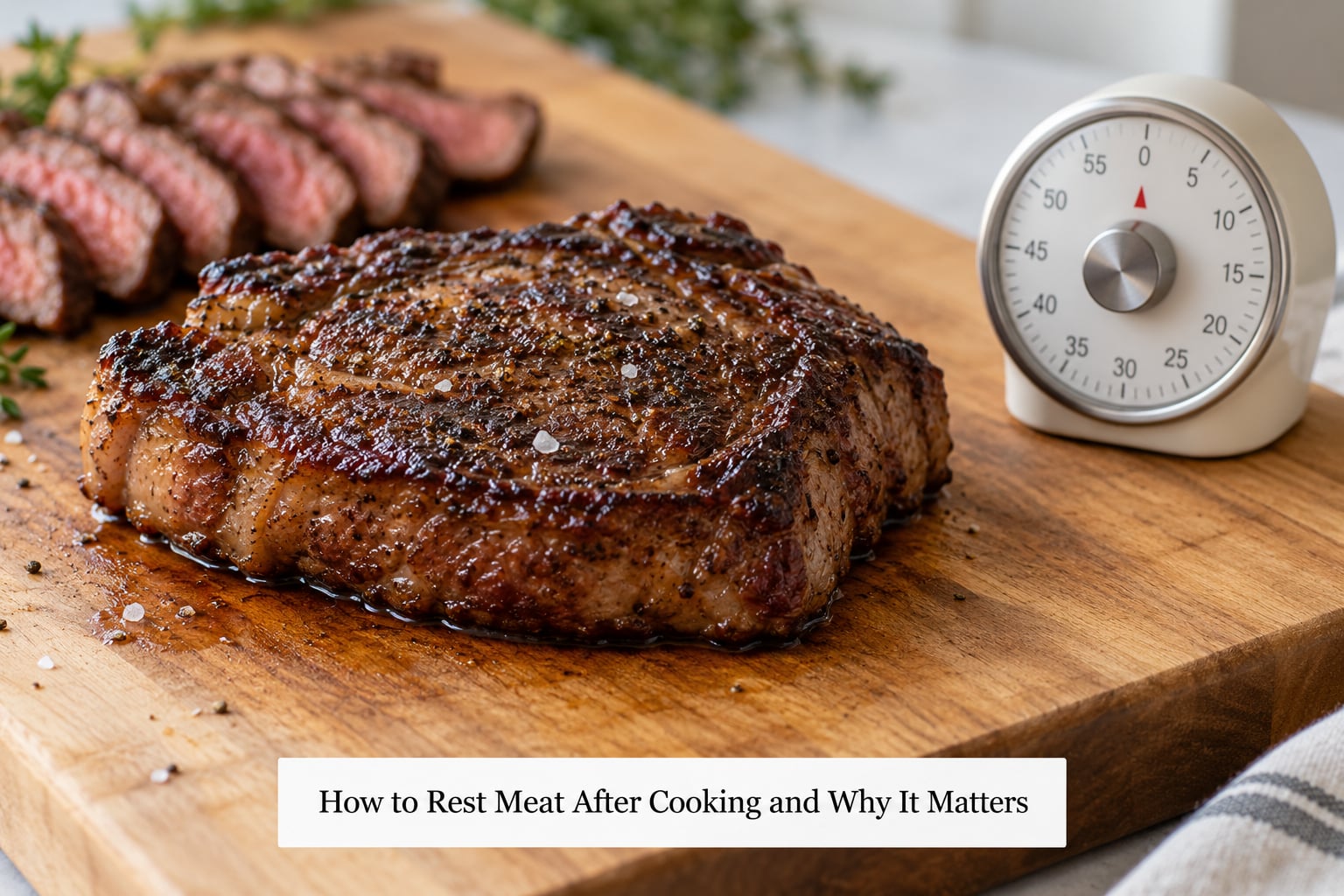
Resting is not continued cooking and it is not reheating. You remove the meat at the right moment, set it on a surface that lets heat escape, and leave it alone for a set time before cutting. The cut keeps cooking internally for a few degrees during that pause, which is a bonus, not the point.
The point is texture. Heat drives moisture out of muscle, and a cut that is cut straight out of the pan loses that moisture onto the board instead of into the first slice. Resting gives the fibers time to relax and the liquid time to migrate back inward.
A rough rule most kitchens land on: 5 to 10 minutes for steaks and chops, 15 to 30 minutes for roasts and large cuts, and up to an hour or more for brisket, pork shoulder and whole birds. Fish needs the least of all, usually 2 to 3 minutes.
What Does Resting Meat Actually Do?
Three things happen at once, and none of them add new moisture to the meat. They only decide where the moisture ends up.
Liquid moves back inside. As meat heats, gas trapped in the fluids between muscle fibers expands and pushes liquid toward the surface, which is why a steak sits in a puddle on the board. Off the heat, those gases reach equilibrium and the liquid drifts back into the fiber structure.
Muscle fibers relax. Muscle proteins contract sharply as the temperature climbs and shorten measurably around 130°F (54°C). Once the heat stops, they loosen. That is why rested meat feels tender rather than springy under the knife.
The temperature evens out. A steak straight off the grill is scorchingly hot on the outside and noticeably cooler in the middle. Resting closes that gap so every slice from the same cut tastes the same.
Is Resting Meat a Myth?
Partly, and the honest version is more useful than the boosterism. Resting cannot put moisture back into meat that already lost it, and it cannot rescue a well-done cut. Once muscle cells have shrunk, cracked and given up their water, that water is in the pan. No amount of waiting reverses it.
What the evidence does support is real for large, fatty cuts. A brisket or a pork shoulder rested for hours is reported as noticeably more tender than the same cook cut and served straight from the smoker, and big roasts slice without bleeding juice. For a thin strip steak seared hard, the difference is small enough that some cooks just eat it.
So the honest rule is: the larger and fattier the cut, the more the rest buys you. The smaller and leaner it is, the less difference it makes.
How Long Should You Rest Meat After Cooking?
Rest long enough for the fibers to relax, and no longer. For most home cooking, thickness is the best guide: a 1-inch steak needs about 5 minutes, a 2-inch steak about 10, and a 3-inch roast about 20 to 30.
Cooking method matters too. A low-and-slow roast has gentler heat and less moisture loss, so it needs less correction than a steak thrown on a screaming-hot grate. A cut pulled hot from an oven runs a little more carryover than one pulled gently.
And temperature at pull shifts things: meat pulled well below target has a longer rest available to it, since the center still has to climb. Meat pulled right at final temperature needs a shorter rest because carryover is about to overshoot.
How Long Should You Rest Steak, Pork, Beef, and Chicken?
Steak. 1-inch filet or strip: 5 to 7 minutes. Ribeye or sirloin 1.5 inches: 8 to 10 minutes. A thick 2.5- to 3-inch ribeye: 10 to 15 minutes. Reverse-seared steak follows the same clock, since the crust is already set.
Pork. Pork chop or tenderloin, 1 to 1.5 inches: 5 to 10 minutes. Bone-in pork chop: about 10 minutes. Pork loin roast: 20 to 30 minutes. Pulled pork from a shoulder can rest anywhere from 30 minutes to several hours without hurting you.
Beef. Boneless roast or tenderloin: 15 to 20 minutes. Prime rib: 20 to 30 minutes before carving. Brisket: 1 hour bare, 2 to 4 hours wrapped, and overnight rests in a cooler are common practice among pit cookers.
Chicken. Boneless breast: 5 to 10 minutes, and a short rest is one of the easier ways to keep it juicy. Whole bird: 20 to 30 minutes before carving keeps the breast from going dry ahead of the thighs.
How to Rest Meat After Cooking Step by Step
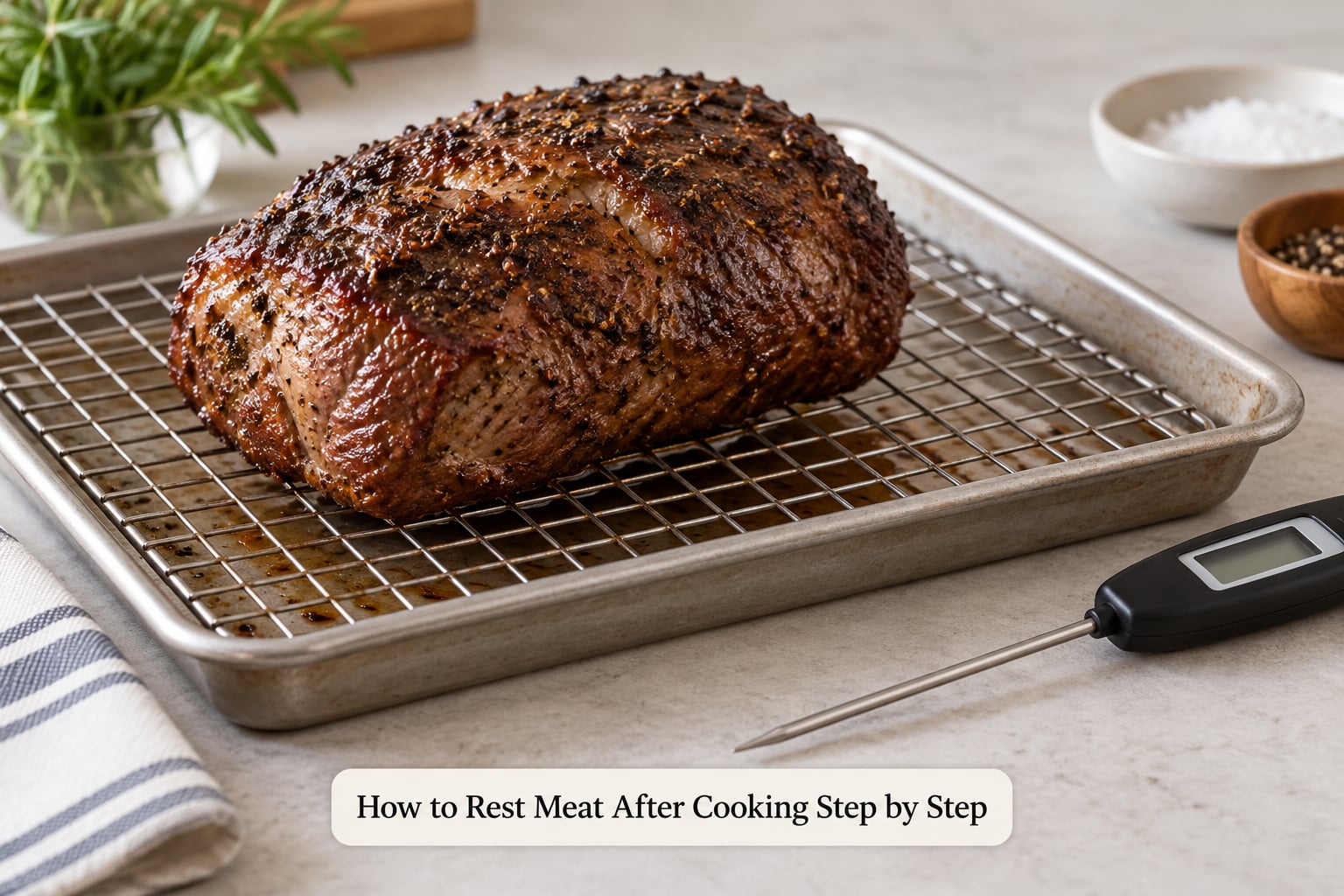
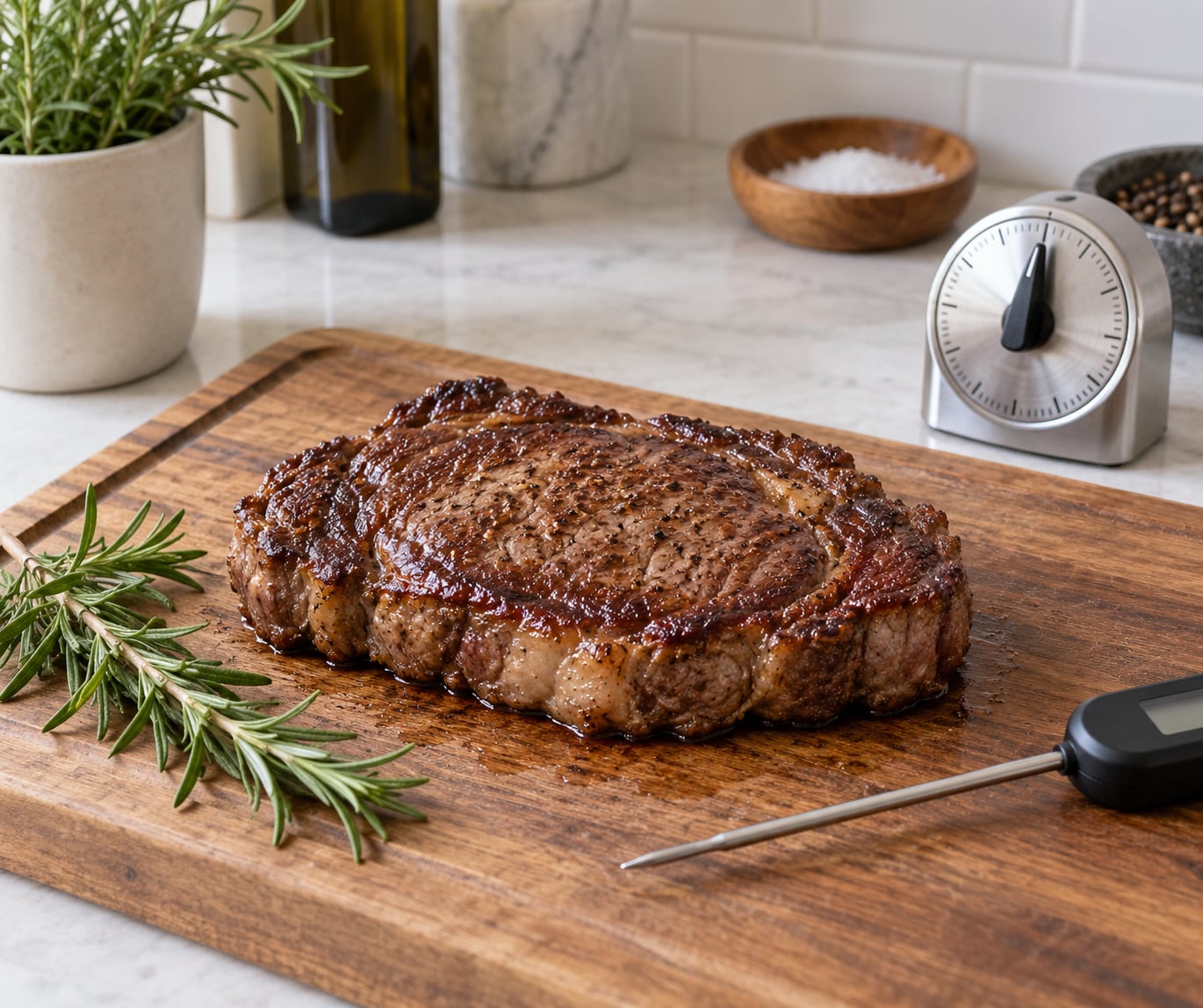
Step 1: pull early for carryover cooking. Take the cut off the heat about 5°F (3°C) below your target internal temperature. A ribeye you want at 130°F (54°C) medium rare comes off the grill at 125°F (51°C), and the center climbs on its own. Reading this with an instant-read thermometer is the difference between a planned finish and a lucky one.
Step 2: choose the surface. Put the meat on a wire rack set over a plate or shallow pan for steaks and chops. Air moves under the meat, so the bottom does not steam and go soft. A whole roast can rest straight on a cutting board; there is enough mass to hold its own heat.
Step 3: tent only if you need to. For a long rest, drape foil loosely over the meat without pressing it down. For anything under about 20 minutes, leave it open. Tight wrapping traps steam against the crust and softens it.
Step 4: time it. Set a timer for the range in the table below. This is the step people skip, and it is also the step that makes the rest reliable instead of guesswork.
Step 5: slice against the grain. Resting holds the meat together long enough to cut cleanly. Finding the grain and cutting across it shortens the fibers, so each bite chews softer.
Should You Cover Meat While It Rests?
Leave it uncovered for short rests. A steak resting 5 to 10 minutes loses very little heat, and open air keeps the seared crust crisp instead of steaming it soft.
Use a loose foil tent for anything resting longer than 20 minutes. Drape, do not seal. The foil slows heat loss while still letting steam escape.
Tight wrapping, whether foil or butcher paper, is for long holds and for cuts where the crust does not matter, like a pulled pork shoulder. Note the tradeoff: a tight wrap holds heat well and softens the surface of anything with a crust.
How Do You Know When Meat Has Rested Long Enough?
Use the timer, and treat the table as a range rather than a deadline. Thickness, starting temperature and how hot your kitchen is all shift the numbers a few minutes either way.
A leave-in probe gives you something better than a clock: watch the center reading flatten out over a few minutes. When it stops climbing, the gradient has mostly equalized and the rest has done its work.
Appearance helps too. Rested meat that is ready to carve looks glossy rather than wet, and the juices that run out are clear and thin rather than bloody. Remember that surface temperature is not doneness. A probe reading taken right after slicing measures the outside, so check the thickest part before you serve.
Resting Times by Meat Type
These are starting points, not deadlines. A thicker cut in the same row needs more time, and a cut pulled cooler has more room to climb.
| Cut | Rest time | Notes |
|---|---|---|
| Filet or strip steak, 1 inch | 5 to 7 minutes | Open, on a wire rack |
| Ribeye or sirloin, 1.5 to 2 inches | 8 to 12 minutes | Most common home steak |
| Thick-cut steak, 2.5 to 3 inches | 10 to 15 minutes | Loose tent if the kitchen is cool |
| Pork chop, 1 to 1.5 inches | 5 to 10 minutes | Keep it warm on a rack |
| Lamb chop | 5 minutes | Lean cuts lose heat fast |
| Boneless beef roast | 15 to 20 minutes | Board is fine |
| Prime rib | 20 to 30 minutes | Loose foil before carving |
| Brisket | 1 hour bare, 2 to 4 hours wrapped | Long holds stay above 140°F (60°C) |
| Pork shoulder for pulled pork | 30 minutes to several hours | Wrap loosely to hold heat |
| Chicken breast, boneless | 5 to 10 minutes | Slice after, not before |
| Whole turkey or chicken | 20 to 30 minutes | Tent loosely while carving waits |
| Fish fillet | 2 to 3 minutes | Only enough to stop the carryover |
| Burger patty | 2 to 3 minutes | Rest on the grill, off direct heat |
| Ground beef or sausage | 3 to 5 minutes | Keeps the pan juices from running out |
Thin portions need less time than the table suggests. A small chicken tenderloin or a single hamburger patty is done in a couple of minutes, and pushing that to 10 minutes is just holding it warm.
How Long Is Too Long to Rest Meat?
Past about 40 minutes, a thin steak is losing heat faster than it is gaining anything. The juices have already migrated. That is not dangerous, just dry and cool at the table, which is the complaint that shows up most often in cooking forums.
Large cuts are the exception. Brisket and pork shoulder improve for hours, and pit cookers routinely hold them wrapped overnight without a problem. What matters for those is not time but temperature.
To keep a long rest hot, pick one of these:
- Warm oven. Set it to 150 to 170°F (65 to 77°C) and put the wrapped cut in with the door cracked. This is the simplest home method and works for a prime rib or a turkey.
- Cooler or cambro. Wrap the meat in foil or butcher paper, set it in a pre-warmed cooler, and close the lid. It holds for hours, which is why almost every serious barbecue cook owns one.
- Loose foil tent on the counter. Fine for 30 to 60 minutes in a normal kitchen. Push it past a few hours and you should move it somewhere warmer.
- Food warmer. Set it low, around 140 to 150°F (60 to 65°C). Anything much hotter keeps cooking the meat and dries it out.
Why You Should Slice Meat Against the Grain
Muscle runs in bundles, and those bundles are what you chew against. Cutting across them shortens each fiber into a short segment that the teeth can handle. Cutting along them leaves long intact strands that feel chewy even when the meat is perfectly cooked.
Finding the grain takes about five seconds. Look at the cut surface and find the lines running through it, usually the clearest clue on a flat face. On a round loin or tenderloin the lines form loose arcs. On a ribeye the fibers curve around the outer edge, so follow them rather than cutting straight across the steak.
Pork chops and hams show clear lines along the long axis. Chicken breast has a grain too, running lengthwise from the top of the breast down toward the wing. Lamb and beef roasts follow the muscle, which is why a crosswise cut at the base of the shank and lengthwise cuts through the eye all behave differently.
Once you know which way the grain runs, slicing becomes the finishing move of the whole method. The meat rests, the fibers relax, and the cut across them gives you the tender, clean slice the rest was setting up.
Common Resting Mistakes
Slicing immediately. The knife goes through, and the board fills with juice that belonged in the meat. Fix: set a timer before you turn the meat, and make the rest part of the cook rather than an afterthought.
Resting far too long. An hour on a thin strip steak is a long time for very little gain. Fix: match the rest to thickness using the table above.
Wrapping too tightly. Foil pressed down and sealed steams the crust soft. Fix: drape loosely for long rests, and reserve tight wrapping for pulled meat and large cuts where the surface does not matter.
Skipping the rack. A steak left on a solid board cooks its own underside in trapped steam and goes grey. Fix: a wire rack over a pan for anything thin.
Judging doneness by color. A steak can look done and still be undercooked in the middle. Fix: an instant-read thermometer in the thickest part, every time.
Confusing rest time with storage time. Resting on the counter is fine for a defined window, but it is not a way to hold cooked meat for later. Fix: refrigerate cooked meat within two hours, and keep it at 40°F (4°C) or below.
Meat Temperature and Food Safety
Resting does not make undercooked meat safe, and it does not change the minimum internal temperatures. It only adds a few degrees of carryover cooking after the heat stops.
Mainstream USDA guidance for minimum internal temperature at the thickest part:
- 145°F (63°C) for whole cuts of beef, pork, lamb and veal, plus fish, with a 3-minute rest.
- 160°F (71°C) for all ground meats.
- 165°F (74°C) for poultry, either whole or ground.
The 145°F figure for whole cuts already includes a resting period, which is one reason it appears in the guidance. Pulling a steak at 135 to 140°F and letting it finish on the board lands in the same place.
For extended holds, keep cooked meat above 140°F (60°C). A wrapped brisket sitting in a closed cooler on a warm afternoon drops slowly but genuinely stays hot, which is the whole trick. Once it falls into the 40 to 140°F (4 to 60°C) range, the two-hour rule applies, and the same applies to the counter during any rest.
Refrigerate leftovers within two hours, in shallow containers so they cool fast. Resting drippings are worth keeping too. After a long rest they turn dark and concentrated, and a tablespoon spooned back over the carved meat is better than any sauce from a jar.
Frequently Asked Questions
Does resting meat continue cooking after it comes off the heat?
Yes, a little. Carryover cooking typically adds 5 to 10°F (3 to 6°C) to the center of a cut after it leaves the heat, and more for large roasts than for thin steaks. That is why cooks pull 5°F (3°C) early and let the rest finish the job. Set a leave-in probe in the thickest part and watch the number climb; when it stops rising, the rest is essentially complete.
How long should steak rest before slicing?
A 1-inch steak needs 5 to 7 minutes, a 1.5 to 2 inch steak 8 to 12 minutes, and a thick 2.5 to 3 inch ribeye 10 to 15 minutes. Rest it on a wire rack over a plate so the underside does not steam, and tent it loosely if you need another few minutes. Slice against the grain as soon as the timer goes off.
Should I cover meat while it rests?
Leave short rests uncovered so the crust stays crisp, and tent loosely with foil for anything resting more than 20 minutes. Drape rather than press the foil down, because sealed foil traps steam and softens the surface. Tight wrapping is fine for pulled pork, brisket and other large cuts where the texture of the crust does not matter.
How do I know when chicken or ground meat is safely cooked?
Use a thermometer in the thickest part, not color. USDA guidance puts chicken and poultry ground meat at 165°F (74°C) and all ground meats at 160°F (71°C). Take the reading before slicing, because once you cut the meat the probe can miss the warmest spot. Resting adds a few degrees, so pulling ground meat a degree or two early and letting it sit is a common approach.
Can I rest fish after cooking, and how long should it rest?
Yes, but only briefly. A fish fillet carries very little fat and no thick muscle to relax, so 2 to 3 minutes is enough to let the carryover cooking finish and the surface stop steaming. Any longer and the fillet cools and dries out. Rest it on a wire rack or a cold plate, and flake it rather than slicing it.
Does resting meat make it less safe or more likely to cool down?
Resting does not change doneness or make meat less safe, but the clock is running the whole time. Keep cooked meat above 140°F (60°C) for long holds, and if it drops into the 40 to 140°F (4 to 60°C) range, refrigerate it within two hours. That is why a closed cooler or a 150 to 170°F (65 to 77°C) oven is the usual answer to overnight rests.
What to Do First
Buy one instant-read thermometer if you do not have one. Pull your next steak 5°F (3°C) early, set it on a wire rack, and time five minutes per inch of thickness. That single habit fixes juiciness, even doneness and slicing all at once.