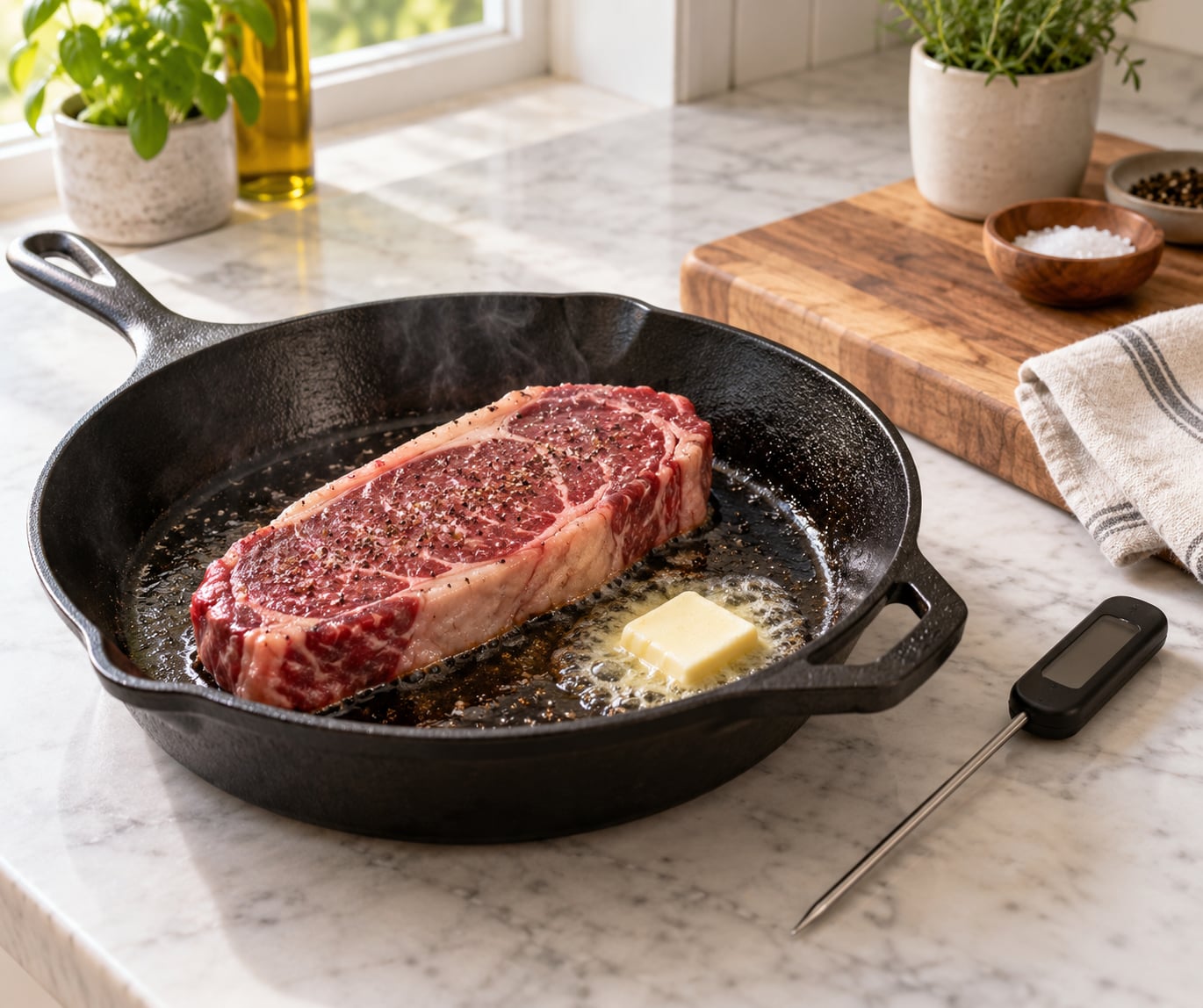
How to cook steak in cast iron comes down to four things: preheat the skillet until it just begins to smoke, dry and season the steak, sear it 3-4 minutes a side without touching it, then baste with butter and finish thicker cuts in a 425F oven until your thermometer says so. The whole thing takes about 25 minutes, start to finish, and once you own a skillet and a thermometer there is nothing else to buy.
The reason cast iron works where a nonstick pan fails is heat. A 12-inch skillet holds roughly four pounds of iron, and that much mass takes five to eight minutes on the burner to heat evenly and hold temperature when a cold steak hits it. A lighter pan drops 100 degrees the second the meat lands, and a steak needs surface heat above roughly 300F to brown through the Maillard reaction. No brown crust, no steakhouse flavor.
A note on terms before we start. A sear means browning the surface quickly with direct pan contact on high heat, which is where nearly all of the flavor comes from. Carryover cooking is the heat already inside the steak finishing the job while it rests, which is why you pull it about 5F below your target. Both matter more than any seasoning blend you can buy.
Table of Contents
- What You Need
- Step-by-Step: How to Cook Steak in Cast Iron
- Step 1: Choose, Season, and Temper the Steak
- Step 2: Preheat the Cast-Iron Skillet
- Step 3: Sear the First Side Without Moving It
- Step 4: Turn and Check the Doneness
- Step 5: Baste With Garlic Butter
- Step 6: Rest, Slice, and Serve
- Common Mistakes
- Why is my steak sticking to cast iron?
- Why is the pan smoking so much?
- The other failures, and how to fix each
- Frequently Asked Questions
- Is 400F hot enough to sear a steak?
- Should steak be cooked on high heat?
- What is the 3-3-3 steak rule?
- How do I stop my cast iron pan from smoking?
- How long should a pan sear a 2 inch steak?
- Is a seasoned cast iron skillet supposed to be sticky?
What You Need
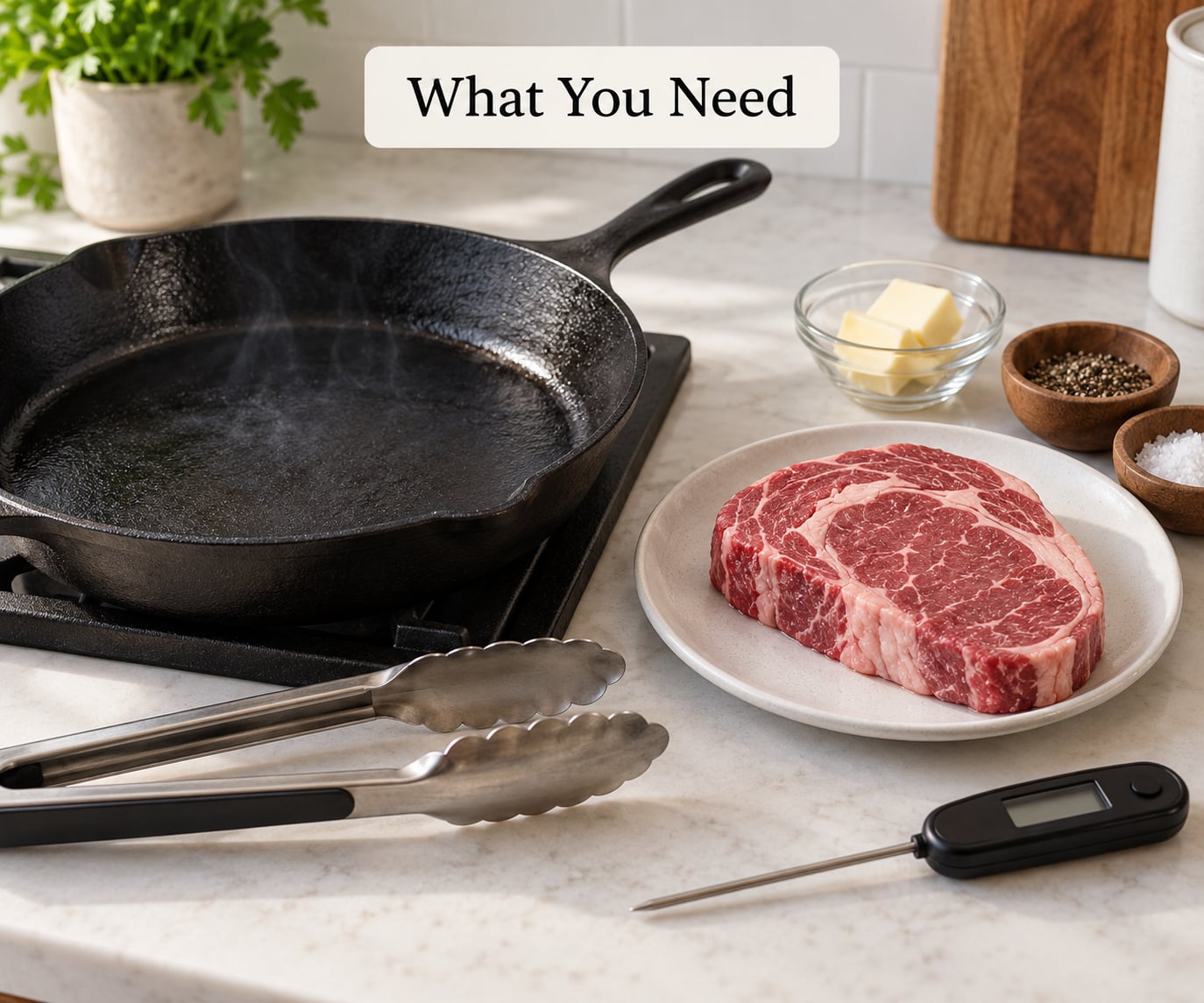
Most of the list is short, and only three items actually change your result.
The skillet. A 10.5 or 12-inch cast iron skillet, bare or enameled. If it is enameled you lose a little crust adhesion but you gain the ability to use acid for a pan sauce. Before the first sear, wipe the pan with a paper towel, run it over a burner for a minute to steam off any moisture, then rub it with a thin layer of neutral oil. Cast iron should feel faintly slick, never tacky.
The steak. A 1-inch strip, sirloin, or ribeye is the useful baseline for timing, because every recipe on the internet gives you minutes per side and those minutes only mean something once you fix a thickness. Look for even thickness and a fat cap about a quarter inch thick; that cap is flavor, and it is the part people leave in the pan by mistake.
The thermometer. A cheap instant-read thermometer with a second or third of a second response time. This is the item that turns a guess into a repeatable result, and it costs less than the difference between a good steak and a disappointing one.
Also on the counter: tongs (never a fork, which punctures the crust and lets juice escape), a sharp chef’s knife, a wooden cutting board, coarse kosher salt, freshly ground black pepper, and a neutral oil such as avocado, canola, grapeseed, or refined olive. For the baste, 3 to 4 tablespoons of unsalted butter, 2 smashed garlic cloves, and a few thyme or rosemary sprigs if you have them.
One piece of equipment worth mentioning is a separate pan for temperature. A small skillet with a little water on the back burner tells you when the oven has fully preheated, because you cannot trust a beep. Many ovens run 25 to 50 degrees cool and take a full 15 minutes after the preheat signal.
Step-by-Step: How to Cook Steak in Cast Iron
Step 1: Choose, Season, and Temper the Steak
Pat the steak dry with paper towels until the surface feels almost tacky. That step takes ten seconds and it is the single biggest difference between a gray, bland steak and a crusted one, because moisture on the surface boils before the meat can reach browning temperature. If the steak has been sitting in a bag, blot the bottom too.
Temper it for 30 to 45 minutes before cooking so the center does not stay cold while the edges overcook. Tempering is a temperature equalization trick, not a food safety shortcut, so if you would rather skip it, just cook the steak straight from the fridge and give the center extra time.
Season immediately before the steak goes in the pan, not at the start of the temper. Use about one teaspoon of coarse salt per pound of beef, a heavier hand than feels right, and the same weight in coarsely ground black pepper. The pepper does not need to be pre-toasted, though if you have a minute and a dry skillet, toasting it in the pan before the oil goes in wakes up the aromatics.
Step 2: Preheat the Cast-Iron Skillet
Set the burner to high and give the skillet a full five to eight minutes with nothing in it. Cast iron is slow precisely because of how much iron there is, and that is the trade you want. A faint shimmer of oil followed by the first wisp of smoke is the signal; a heavy plume means the oil is breaking down past its smoke point, which makes the pan bitter and can make the whole kitchen smell like a tire fire.
Add the oil once the pan is hot, then wait thirty seconds for it to shimmer and flow. Lay the steak in away from you, and let it hit the far side first. You are looking for an immediate, aggressive sizzle that lasts. If you hear a lazy spit, the pan was not ready.
One steak per pan. Two steaks in a 12-inch skillet drop the temperature enough to steam the surfaces instead of browning them, and two is the most common reason home cooks think cast iron does not work.
Step 3: Sear the First Side Without Moving It
Leave it alone. Three to four minutes for a 1-inch steak, undisturbed, is the whole technique. Every early peek or nudge cools the surface, resets the clock, and leaves you with a steak that is cooked outside and raw in a ring just inside it.
You will know it is working by sight and sound. The sizzle drops to a quieter hiss as water boils off, the edges lift slightly and turn a deep brown about a quarter inch up the side, and the whole side goes from red to a matte brown rather than a wet pink. Steak releases from cast iron when that crust has formed and not a moment before; a light touch with the tongs should let you lift an edge with no resistance. If it clings hard, it needs another 30 to 60 seconds.
One thing that catches people: steak contracts as it cooks, and the contact patch shrinks. After a minute or so, press gently on the top with the tongs or a heavy flat object so the full face stays against the pan. The result browns evenly instead of only at the rim.
Step 4: Turn and Check the Doneness
Flip once and cook the second side for one to two minutes. Then check with the thermometer, because carryover cooking means the center climbs another 3 to 8F while the steak rests.
Probe the thickest part of the steak with the tip of the instant-read, aiming sideways rather than straight down. Never touch the probe to the bone or the pan floor, either of which reads low and will have you pull the steak early.
| Thickness | Sear, per side | Oven finish at 425F |
|---|---|---|
| 3/4 inch | 2-3 min | Not needed for medium rare |
| 1 inch | 3-4 min | 4-6 min to medium rare |
| 1.5 inch | 3-4 min | 8-12 min to medium rare |
| 2 inch | 4 min | 12-18 min to medium rare |
These times assume a fully preheated oven and a skillet hot enough to sear. A gas burner gives you a better sear than an electric coil, which cycles and drops the pan temperature the moment you put the steel on it. On electric, add a minute or two and expect a slightly weaker crust no matter how long you wait.
Doneness targets below are what most people aim for, measured as the temperature you pull the steak. The rested temperature in the right column is where the center lands about five minutes later.
| Doneness | Pull at | Rested | What it feels like |
|---|---|---|---|
| Rare | 120-125F | 125-130F | Cool, soft center |
| Medium rare | 125-130F | 130-135F | Warm, slightly springy |
| Medium | 135-140F | 140-145F | Firm, no give at the edges |
| Medium well | 145-150F | 150-155F | Mostly cooked through |
| Well done | 155F and up | 160F and up | Dry unless you baste |
FoodSafety.gov puts the safe minimum internal temperature for whole cuts of beef at 145F with a three-minute rest, and that holds regardless of the doneness table above. Lower targets are about preference and texture, not safety.
Step 5: Baste With Garlic Butter
Butter goes in late. Its milk solids burn at around 350F, which a searing pan reaches within seconds, so butter added at the start of the sear turns brown and acrid before the steak has a crust.
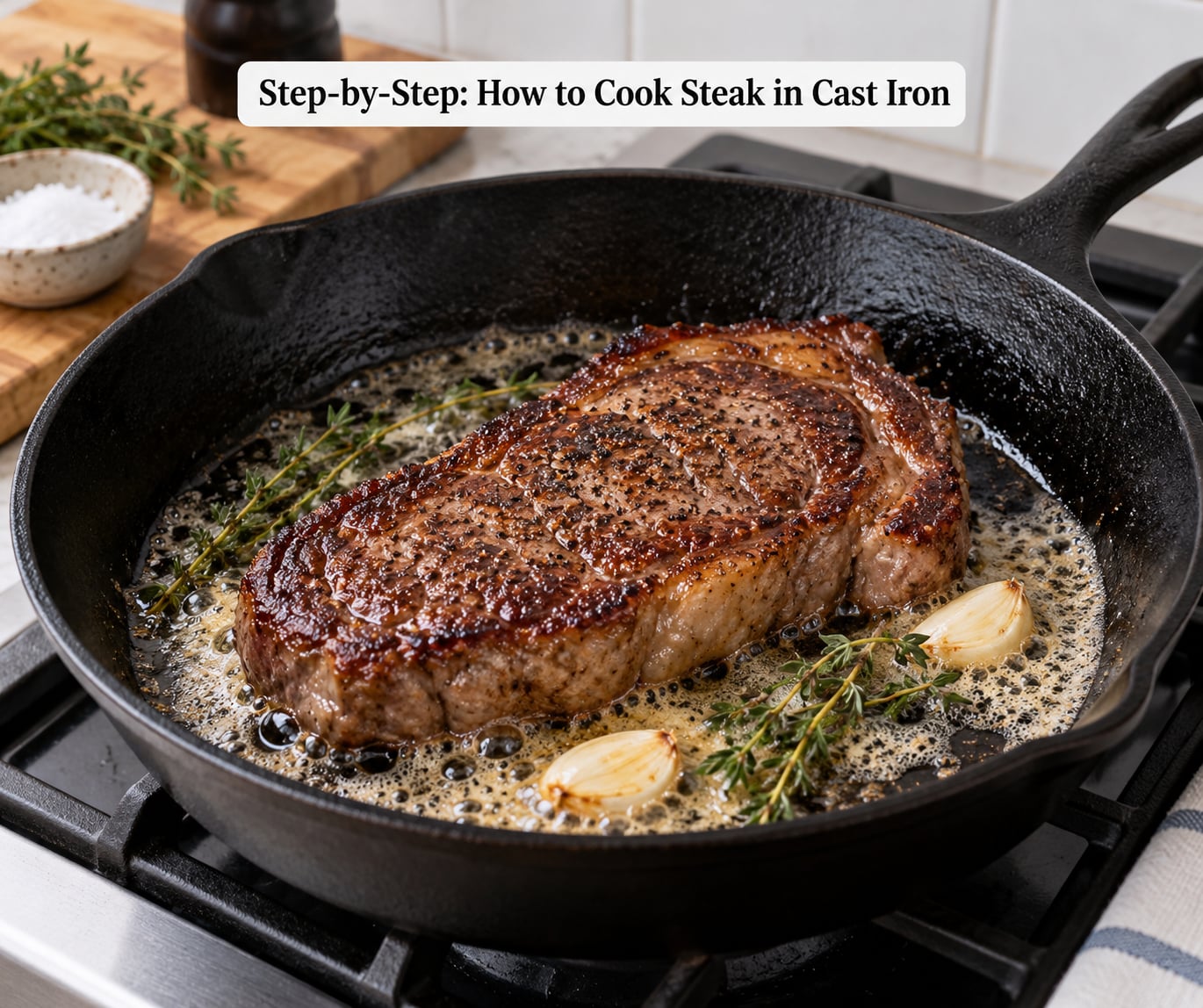
Tilt the handle away from you and slide in 3 to 4 tablespoons of butter, the garlic cloves, and the herb sprigs. As the butter foams, tilt the pan so the liquid pools at the front and spoon it repeatedly over the top of the steak for 30 to 60 seconds. Ten to fifteen deliberate bastes is plenty.
Watch it the whole time. When the butter stops foaming and the solids turn tan, stop. Garlic added in the last fifteen seconds gives you flavor without bitterness, and the browned butter in the pan afterward is the start of a pan sauce: add a splash of stock or water, scrape the fond off the bottom, and reduce.
Step 6: Rest, Slice, and Serve
Move the steak to a wire rack set on a plate, or a cutting board, and let it sit. A 1-inch steak wants 5 minutes, a 2-inch steak wants 8 to 10. Resting on a solid board traps steam underneath and softens the crust you just built, so a rack or the edge of a plate is better.
Slice against the grain. Find the direction the muscle fibers run, usually obvious on the surface or the fat cap, then cut perpendicular to it in a single confident motion. Cutting with the grain chews the fibers and makes a tender steak taste tough.
Season with a pinch of flaky salt and serve right away. A thick bone-in ribeye is worth the extra 15 minutes: sear the same way, then roast at 400F until the center reaches 125F for a medium rare result.
Common Mistakes
Why is my steak sticking to cast iron?
Nine times out of ten it is one of three things. The pan was not hot enough, the steak surface was wet, or you tried to release it before the crust formed. There is also a seasoning question worth checking: a properly seasoned cast iron should feel faintly slick and evenly dark. If it feels rough, patchy, or sticky, the polymerized oil layer is thin, and a thin layer releases a steak badly. Give the pan a re-seasoning before your next steak rather than fighting it.
Other fixes worth trying. Use a thinner steak, since more surface area means more contact points holding on. Press the steak down harder than feels polite. And after cleaning, wipe the pan dry and heat it, because any water left in the pan steams and creates a temporary layer that grips.
Why is the pan smoking so much?
Some smoke is normal and expected at these temperatures, especially with an oiled-and-seasoned pan where a little of the seasoning oil re-volatilizes. A heavy constant plume means one of three things: the oil is past its smoke point, the pan is empty and overheating before the oil went in, or the burner is set much hotter than high. Avocado oil and grapeseed hold past 480F, canola around 400F, and regular olive oil gives up around 410F, so it belongs on a moderate heat or later in the cook. Turn on the range hood before you start, not after.
The other failures, and how to fix each
Cold skillet. Five to eight minutes, high heat, empty, until the oil shimmers and smokes. This is the most common cause of a pale steak and the easiest to fix.
Moving the steak too soon. Stop. Set a timer and walk away. A steak that needs a spatula at 90 seconds was not going to form a crust anyway.
Overcrowding. One steak, or let the sides of the meat touch each other, which still leaves the flat faces in contact with iron.
A gray, blanched crust. Moisture on the surface. Pat it dry again right before the pan, and season right before the pan so the salt does not pull moisture out over ten minutes.
Uneven doneness, cooked rim and raw middle. A steak under 1 inch needs no oven time at all, and a steak over 1.5 inches should never finish entirely on the stovetop. Also try tying an uneven filet with butcher’s twine so it cooks as one piece.
Burned butter. Add it during the flip, not before the sear. Sixty seconds of basting is plenty.
Skipping the rest. Five to ten minutes, on a rack. It is the cheapest improvement in this entire method.
Frequently Asked Questions
Is 400F hot enough to sear a steak?
For cast iron, 400F is warm enough to brown but not hot enough for the deepest crust. The sweet spot for a home burner is a little above medium-high, roughly 500F at the pan surface, and you confirm it by the shimmer and first wisp of smoke from the oil rather than by a number. A 400F oven is a different thing entirely: it is the right temperature for finishing a thick steak after the sear, where the ambient heat cooks the center evenly without burning the drippings.
Should steak be cooked on high heat?
Yes for the sear, no for the finish. High heat is what gives you browning in two to four minutes per side, but that same heat scorches the fat and overcooks the edges if you leave it there. Finish anything thicker than one inch in a 425F oven, where the surrounding air does the cooking and the pan juices do not burn. Low and slow on the stovetop is the single most common way to end up with a gray steak.
What is the 3-3-3 steak rule?
It is a simple memory aid: three minutes on the stovetop for each of the first two sides, then three minutes in the oven, which is meant to land a roughly one-inch steak near medium rare. It is a fine starting point and a poor rule to obey exactly, because pan size, burner type, oven accuracy and steak thickness all move the real number. Use the three minutes to build confidence, then switch to an instant-read thermometer.
How do I stop my cast iron pan from smoking?
A little smoke is normal at searing heat. To cut the rest, preheat the pan fully before adding oil, choose an oil with a high smoke point such as avocado, canola or grapeseed, and set the burner just below the maximum your knob offers. Never walk away from a smoking empty pan. Running the range hood before you start pulls the plume instead of letting it hang in the kitchen.
How long should a pan sear a 2 inch steak?
About four minutes per side on the stovetop, and that only gets you to rare at the center. A 2-inch steak needs an oven finish of roughly 12 to 18 minutes at 425F to reach medium rare, so check the internal temperature rather than trusting the clock. Two inches is also the thickness at which searing both sides fully and then finishing really separates good technique from an overcooked steak.
Is a seasoned cast iron skillet supposed to be sticky?
No. Properly seasoned cast iron should look evenly dark and matte, feel faintly slick with no raw oil underneath, and release an egg or a steak without scraping. A tacky or sticky surface usually means the seasoning is thin, or it was built by stacking layers with too little heat between them. Rinse, dry thoroughly, and give it a thin oven-baked coat of oil, then let it cool on the burner.
Start with a 1-inch steak, a pan preheated until it smokes, and a thermometer. Pat the steak dry, season it heavily right before the pan, give it 3-4 minutes a side untouched, baste with garlic butter, and rest it five minutes before you slice. Learn to cook steak in cast iron on that one cut, and everything thicker becomes a matter of oven time you can read off the thermometer.