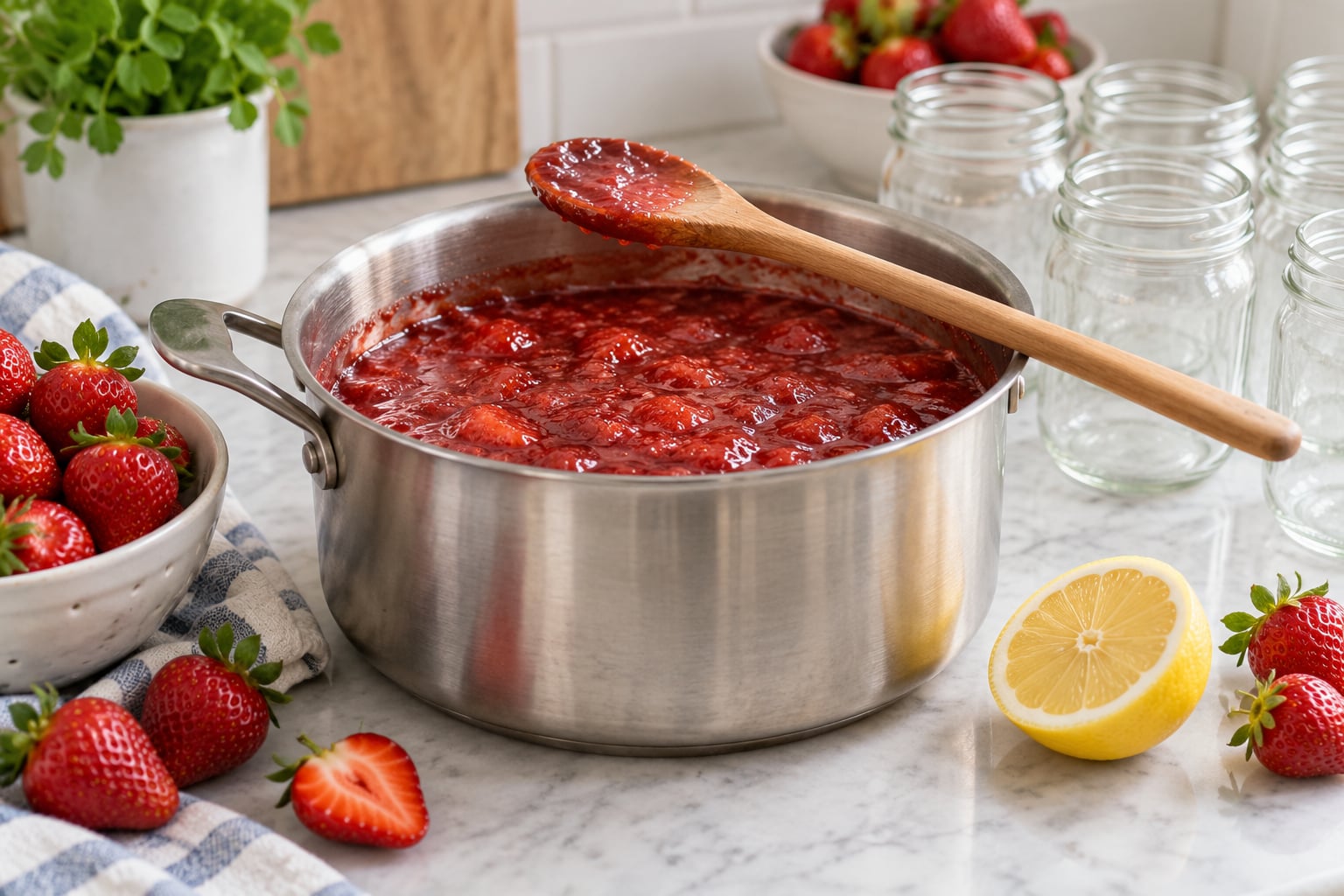
Strawberry jam that won’t set is almost always a ratio, heat, or timing problem rather than bad fruit. You likely missed one of three things: the equal-volume sugar ratio, enough lemon juice, or the full one-minute rolling boil after the pectin goes in. Get those right and the batch gels. Miss one and no amount of extra cooking will bring it back.
The whole job takes about 40 minutes start to finish, and most of that is you standing at the stove with a spoon. The only tools that genuinely matter are a wide pot, new two-piece lids, a plate you can freeze, and a food thermometer.
Table of Contents
- What You Need
- Which method should you use?
- Step-by-Step: How to Make Strawberry Jam That Sets
- Step 1: Prepare the fruit
- Step 2: Choose the right pectin and sugar
- Step 3: Cook the jam
- Step 4: Test the set
- Step 5: Fill and seal the jars
- Common Mistakes and How to Fix Them
- Frequently Asked Questions
- How can I get my strawberry jam to set?
- What causes strawberry jam not to set?
- How do you fix a jam that is too runny?
- Can I recook my jam if it didn’t set?
- Can you overcook liquid pectin?
- How long should it take for strawberry jam to set?
- Conclusion
What You Need
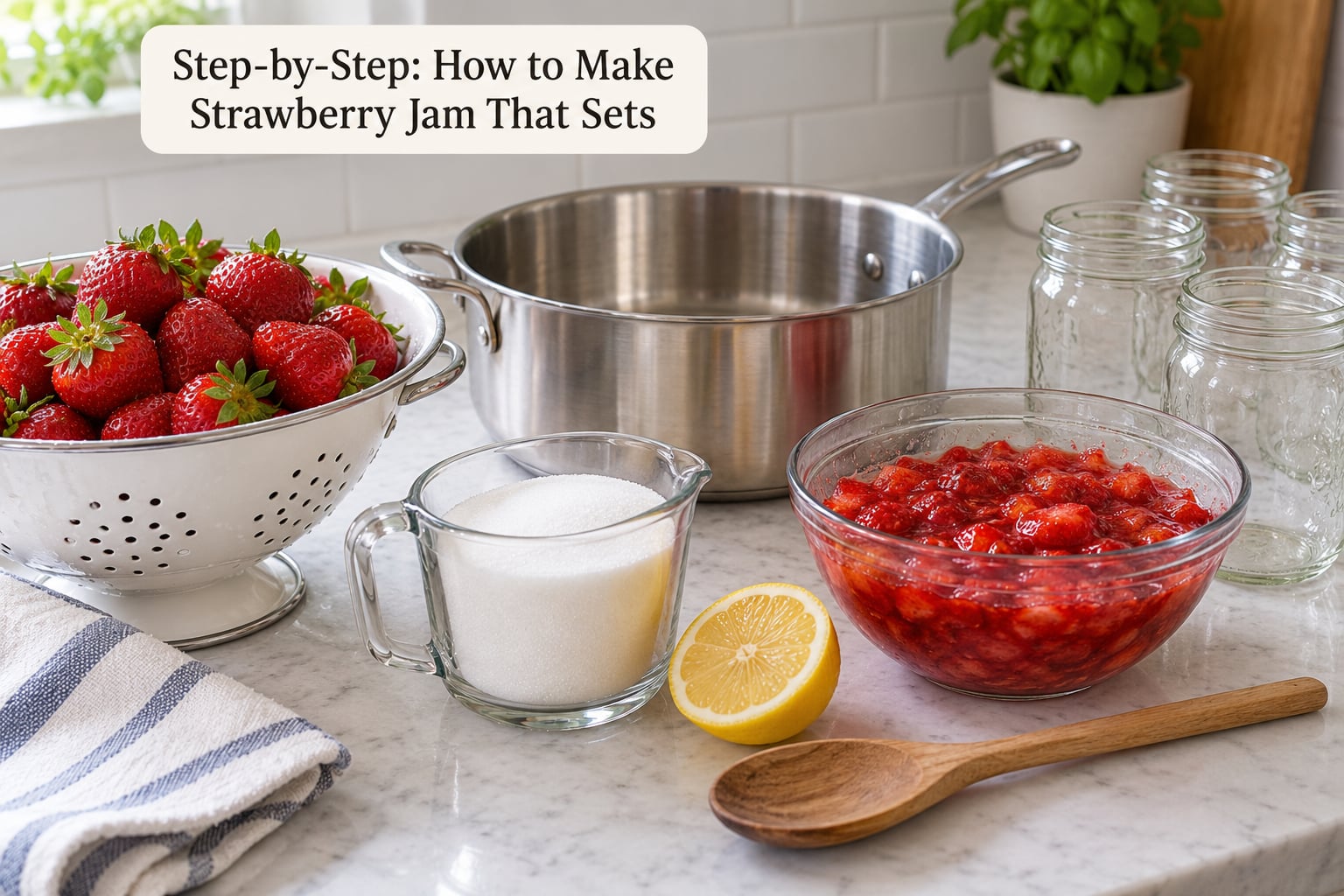
For the stovetop method, gather 4 cups of hulled and crushed strawberries, 4 cups of granulated sugar, 1/4 cup of fresh lemon juice, and a box of liquid pectin. That 4:4:1/4 ratio is the one worth memorizing, because it works even when the berries are small, seedy, or past their best.
You also need a non-reactive pot (stainless steel, copper-free, or enameled cast iron works; plain aluminum can discolor fruit and dull flavor), a wide wooden spoon or spatula that can scrape the bottom, a ladle, and clean mason jars with brand-new lids. Rings can be reused, but lids cannot; the seal comes from a fresh flat disc every time.
Half-pint (8 oz) and pint (16 oz) jars are the standard sizes. Four cups of prepared fruit fills roughly four to five half-pints with headspace to spare. A headspace measuring tool, or the metal lid ring from a jar, doubles as the ruler so you don’t have to guess.
Before you start, keep two jars of hot, ready-to-fill jam on a towel for about ten minutes so the glass doesn’t shock. Have a rack or folded towel ready for the cooling jars too.
Which method should you use?
There are three routes to a set jam, and they are not interchangeable. Pick the row that matches the equipment you own and the storage life you need.
| Method | How it sets | Total time | Storage life |
|---|---|---|---|
| Liquid pectin, stovetop | Sugar, acid, and a one-minute hard boil | About 40 minutes | Shelf stable after a water bath |
| Powdered pectin, no-cook | Sugar dissolves in raw fruit; no heat | About 20 minutes plus a 30 minute rest | Freezer or refrigerator only |
| No pectin, long cook | Evaporation plus natural pectin and acid | 45 to 60 minutes | Shelf stable after a water bath |
Step-by-Step: How to Make Strawberry Jam That Sets
Step 1: Prepare the fruit
Rinse the berries under cool running water, then hull them by pulling off the leafy cap and the pale core just under it. Toss anything soft, bruised, or showing fuzzy mold into the compost; that soft fruit carries water and little acid, and it is the fastest route to a loose jam.
Measure the fruit after hulling, then crush it. A potato masher works, and so does pulsing in a food processor, though pulse in short bursts or you will pulverize the fruit into a purée that loses all its texture. Aim for pieces about the size of a small pea, roughly half crushed and half intact.
Macerating is optional but it helps. Let the crushed fruit sit with the sugar for 10 to 15 minutes before heat goes on, and the sugar pulls juice out of the berries so you start with less free water to boil off. That short wait is the difference between a 10-minute boil and a 30-minute one.
Step 2: Choose the right pectin and sugar
Regular pectin needs the full sugar amount. This is the single most misunderstood point in home canning: you cannot cut the sugar on a recipe that uses standard pectin and expect a set, because the sugar is not just sweetness, it is part of the gel structure. Cut it and the pectin has nothing to lock onto.
If you want less sugar, you need low-sugar pectin that is formulated for it, or a no-sugar pectin, and you accept a softer set. The same rule applies in reverse: a recipe tested with one form of pectin is tested with that exact form’s behaviour, which is why swapping liquid pectin for powdered in someone else’s recipe gives an unpredictable result. Canners on r/Canning say this often enough to be folklore: the end result is rarely dangerous, but it is no longer the recipe you were given.
Lemon juice is the third leg. It supplies the acid that lets pectin molecules link up, and it also balances the sweetness of a jam that is genuinely sweet. If your strawberries are tart, you can drop the lemon to 2 tablespoons. If they are very ripe and sweet, keep the full 1/4 cup.
Step 3: Cook the jam
Scrape the crushed berries and their juice into the pot, add the sugar, the lemon juice, and the pectin, and stir over medium-high heat until the mixture comes to a boil and the sugar dissolves. Expect heavy foaming at this stage; stir the bottom frequently so nothing catches.
Skim the foam with a spoon as it rises. Foam is trapped air and fruit pulp, and leaving it in the pot means foam in the finished jam. A spoonful of butter stirred in at the end knocks it down faster than any other trick I know.
Once it boils, turn the heat up to full and start timing. Hold a hard rolling boil, the kind that you cannot stop stirring for, for exactly one full minute at a high rolling boil, or about two minutes at a medium rolling boil. Under-cooked pectin is the most common reason a jam looks reduced and still runs off the spoon.
Step 4: Test the set
Do not judge the set straight from the pot. You need a cold surface, because warm jam will run no matter how good it is.
- Frozen plate test: Put two or three plates in the freezer for at least 15 minutes. Drop a teaspoon of jam on a cold plate, wait 1 to 2 minutes, then push the edge with your fingertip. If it wrinkles, it will set.
- Wrinkle test without a freezer: Chill a saucer in the fridge for 20 minutes, spoon the jam onto it, and do the same fingertip push. Slower, but it works.
- Thermometer test: Cooked sugar-based jam is generally reliable at about 220°F (104°C), somewhere in a 210 to 220°F range depending on altitude and the recipe.
Read the plate result carefully. A gentle wrinkle is a soft set that spreads nicely on toast. A firm wrinkle that holds a sharp peak is a firm set. If the puddle spreads flat with no wrinkle at all and reabsorbs into the plate, it is still runny and needs more boiling.
Step 5: Fill and seal the jars
Ladle the jam into hot jars, leaving 1/4 inch of headspace. Headspace is the gap between the jam and the lid; too little means the jar can be too full for the seal to form, too much means the jam floats away from the glass and doesn’t set against the fruit the way you want.
Wipe each rim clean with a damp paper towel, drop on a new flat disc, and screw the band on until it is just snug. Over-tightening is the most common sealing mistake; the band needs to be able to release pressure during processing, and a stuck band just builds pressure inside.
Strawberry jam is a high-sugar food, so the tested safe method for shelf storage is a boiling water bath: put the jars in a pot of water that covers them by 1 to 2 inches, bring to a rolling boil, and process half-pints and pints for 10 minutes. Lift the jars out, set them on a folded towel, and leave them undisturbed for 12 to 24 hours before you press a lid or test for seal.
Skip the oven method. Baking the sealed jars in an oven is not the tested process and does not destroy bacteria the way boiling water does, which is a misconception that shows up repeatedly under stovetop jam recipes.
Common Mistakes and How to Fix Them
Match the symptom to the cause before you do anything else, because most failed batches need a different response depending on how far along you are.
| Symptom | Likely cause | What to do |
|---|---|---|
| Runny after 24 hours, jar sealed | Not enough pectin activation, low sugar, or not enough acid | Refrigerate and use as syrup, or freeze; recooking sealed jars is not the tested method |
| Watery layer at the top of the jar | Overripe or watery fruit, or not cooked to temperature | Stir it back in at service time, or reprocess the whole jar |
| Hard, dry, gummy jam | Overcooked, or a firm-set recipe cooked to a soft-set stop | Serve with yogurt or butter; a thin layer of hot water in the jar softens it |
| Scorched smell and color | Pan bottom unattended, or heat too high after the boil | Discard; burnt flavor does not go away |
| Lid popped or flexible | Headspace wrong, band over-tightened, jars touched while cooling | Store in the refrigerator and eat within a few weeks; do not shelf store |
| Mold on the surface | Storage above 40°F for too long, or a stuck utensil | Discard the whole jar. Do not skim and keep it. |
| Foam in the jam | Skimmed too late, or too little stirring | Dip a clean dry spoon to the top and lift off what is floating |
Two habits prevent most of that. First, don’t judge a jam until it has cooled completely; a warm jar is still fluid even when the batch is perfect, and a cold fridge test hours later proves nothing about a jam that was properly set and then warmed. Give it a full night before you call it a failure.
Second, don’t halve or double the recipe casually. Evaporation depends on the surface area of your pot, so a doubled batch in the same pot boils down slowly and concentrates unevenly, and a halved batch cools so fast it never reaches a full boil. Pectin ratios do not scale linearly. If you want four jars instead of eight, cook two full batches.
Spices, alcohol, and very ripe fruit can also hold a set back, which is why savory or boozy jam recipes carry their own tested quantities rather than the standard 4:4:1/4. Canners on r/Canning report the spice effect often enough that I treat it as real.
And if a batch really did fail, you have not wasted it. Reframe it: thin jam becomes a pouring syrup for pancakes, a drizzle over cheesecake, a glaze for meat, or a drink sweetener. That is the honest outcome of a failed batch, not a reason to bin the fruit.
Frequently Asked Questions
How can I get my strawberry jam to set?
Match sugar to fruit by volume (about 4 cups fruit to 4 cups sugar), add 1/4 cup of lemon juice, and boil the pectin in for a full one-minute hard rolling boil. Then test on a plate chilled in the freezer before you fill the jars. The set forms in the pot, not in the jar, so the plate test is your only real proof.
What causes strawberry jam not to set?
The usual culprits are under-cooked pectin, a boil that was too gentle, too little sugar or too little lemon juice, and fruit that was overripe or watery. Swapping liquid pectin for powdered in a recipe tested with the other form is a frequent surprise, as is adding spices or alcohol. Runny jam that looks reduced is almost always a heat problem, not a fruit problem.
How do you fix a jam that is too runny?
If the jam has not been canned yet, return it to the pot, add a small amount of pectin the package allows, bring it back to a full boil, and retest on a cold plate. If it is already sealed and shelf stored, do not reprocess; refrigerate it and use it as syrup, or freeze it. Sealed jars have a vacuum and reprocessing them is not a tested method.
Can I recook my jam if it didn’t set?
Only if the jars have not been processed or sealed. Unprocessed jam goes back on the stove with a little extra pectin and another boil. Sealed, shelf-stored jars should go straight into the refrigerator to be eaten within a few weeks, or into the freezer. Boiling water bath canning is for sealing jars, not for correcting texture.
Can you overcook liquid pectin?
Yes, and this surprises people. Pectin that boils too long or gets too hot breaks down, so a jam that boils for 30 minutes can end up looser than one that boiled for one minute. Very high heat for a long stretch has the same effect. Bring it to a boil, hold one minute, and get it off the heat and into the jars.
How long should it take for strawberry jam to set?
A batch that is done at the right temperature sets as it cools, usually within a few hours and certainly overnight. Jar it hot and leave it undisturbed for 12 to 24 hours before testing. If it is still liquid after a full night in the refrigerator, the set did not happen in the pot and waiting longer will not change that.
Conclusion
If you are making a batch this week, do three things and you will not have to troubleshoot anything: weigh nothing and measure 4 cups crushed fruit to 4 cups sugar with 1/4 cup lemon, boil the pectin in for a full one-minute hard rolling boil, and do not fill a jar until the frozen plate test wrinkles. Skip any one of those and the jam sets in the jar as syrup no matter how long it cooks. If a batch already failed, refrigerate it, keep it as syrup, and change one variable on the next round.