A CSA box is worth the money when the share size matches the number of people you feed, the produce arrives in enough variety to keep meals interesting, and the price per pound undercuts what you would spend at the grocery store. Most disappointing shares fail on one of those three things, not on the farming.
Community Supported Agriculture means you pay a flat seasonal fee upfront, then collect a pre-packed box of whatever is ripe that week from a pickup site or your doorstep. The farmer uses your payment to cover seed, soil and labor before the harvest exists, and a bad week gets shared by everybody. That risk model is the whole deal, and it is also why you cannot judge a share on the photo alone.
This guide walks through what to gather before you compare anything, six steps for vetting a farm, and the mistakes that make a good share look overpriced. Updated for 2026, with cost ranges that vary by region.
Table of Contents
- What You Need Before You Compare Anything
- Step-by-Step: How to Find a CSA Box Worth the Money
- 1. Set Your Household’s Produce Needs
- 2. Compare Share Size, Price, and Flexibility
- 3. Check the Farm’s Growing Practices and Share Quality
- 4. Estimate the Food’s Real Usable Value
- 5. Read Reviews and Ask Specific Questions
- 6. Start With a Trial or Flexible Option
- Common Mistakes That Make a CSA Box Feel Overpriced
- Frequently Asked Questions
- How do I know if a CSA share is worth the price?
- What size CSA box should a family choose?
- Is a more expensive CSA always better?
- What should I do if a CSA share contains too much food I will not eat?
- How much produce should I expect from a weekly CSA?
- Can I judge a CSA by its photos and customer reviews?
- Conclusion
What You Need Before You Compare Anything
You need four numbers and one habit. Collect all four and any comparison takes about ten minutes instead of an afternoon of tab-hopping.
- Household size and eaters per week. Count people, not mouths-at-the-table. One person who cooks seven nights a week eats very differently from a family of four that eats out twice a week.
- Your weekly produce budget at the store. Look at a receipt from a normal week, not a holiday one. That number becomes the baseline your CSA share has to beat.
- Cooking and storage habits. Do you have a freezer, a pressure cooker, a dehydrator, or a CSA tote that fits on the bottom shelf of your fridge? Surplus only helps if you have somewhere to put it.
- Pickup access. A share you cannot collect on schedule is a share you pay for and never eat. Note the pickup site’s hours and how far you will drive for it.
The habit is waste tracking. For four weeks, keep a note on your phone of everything from the box you actually ate. One member on a market forum described needing a year and a half to fully reorient meal planning around the share; four weeks of honest notes gets you most of the way there before you have committed a season’s money.
Step-by-Step: How to Find a CSA Box Worth the Money
1. Set Your Household’s Produce Needs
Start by estimating servings per week rather than pounds. A rough guide: one adult who cooks most nights uses about eight to twelve pounds of produce a week, a two-person household about fifteen to twenty pounds, and a family of four closer to twenty-five. A mini share usually lands somewhere between five and eight pounds, a half share near ten to fourteen, and a full share around eighteen to twenty-five. Those ranges overlap a lot, which is exactly why share names alone tell you nothing.
Next, be honest about cooking. A share sized for someone who roasts a chicken on Sunday and batch-cooks will overwhelm someone who boils pasta four nights a week. If you are in the second group, a mini share or an every-other-week plan will feed you without a compost bowl full of kale.
Then add in the things your household simply will not eat. If nobody will eat fennel or eggplant, a standard share will hand you three weeks of both. Farms that let you swap items, or that send a crop preview before harvest week, solve this better than any amount of determination will.
2. Compare Share Size, Price, and Flexibility
Compare the total season cost, not the weekly number, because weekly prices hide the real commitment. Multiply the weekly share price by the number of weeks, then add delivery fees and any add-on shares you plan to buy. A forty-dollar weekly share over eighteen weeks is roughly seven hundred twenty dollars plus delivery, paid before a single tomato exists.
| Share type | Typical weekly price | Produce weight | Best fit |
|---|---|---|---|
| Mini or quarter share | twenty to thirty-five dollars | five to eight pounds | one to two light-cooking adults |
| Half share | thirty to fifty dollars | ten to fourteen pounds | two adults, or one cook who preserves |
| Full share | forty-five to seventy-five dollars | eighteen to twenty-five pounds | families of three or more |
| Every-other-week share | about half the full weekly rate | varies by pickup cycle | single households on a tight budget |
| Split share | full price shared two ways | half a box each | two households alternating pickup |
Flexibility matters more than most people weigh. Ask about vacation holds, whether a missed pickup can be picked up the next day or donated to a food shelf, whether unused shares roll over, and whether there is an installment or sliding-scale option. A farm that answers those four questions plainly is usually a farm that has thought about real households.
Home delivery is the line item that quietly inflates a share. Members on regional subreddits and city forums report paying ten to sixteen dollars more per week for doorstep drop-off than for pickup at a neighborhood site. On a fifty-dollar share, that delivery fee can be a fifth of the total bill.
3. Check the Farm’s Growing Practices and Share Quality
Certification labels tell you what a farm is allowed to do, not automatically how gently it grows. Learn the four labels you will actually meet:
- USDA Certified Organic. Inspected annually by a certifier, no synthetic pesticides or fertilizers. It does not mean pesticide-free; some approved crop protectants come from natural sources.
- Certified Naturally Grown. A farmer-run alternative with similar input rules and independent inspection, at lower cost. Many small farms that cannot afford organic certification use this one.
- Regenerative or no-till. Focuses on soil health through cover crops, reduced tillage and rotation. There is no single federal standard, so ask what they actually do on the ground.
- Conventional. Not a red flag by itself. Ask whether they spray, what they spray and whether it hits the crops you eat raw.
Beyond labels, look at crop variety and communication. A farm growing twenty crops gives you a different box every week. A farm growing six gives you three weeks of zucchini in July, which is the single most common complaint in member forums. Farms that publish a weekly newsletter, a crop preview, or a photo of an actual box tell you far more than farms posting stock rotation imagery of tomatoes.
Ask how they handle weather. Hail and flooding hit everyone the same week, and the fair policies look like this: an email the day after the storm explaining what was lost, a credit on the next share, or a clear cancellation clause. Silence after a bad week is the tell.
4. Estimate the Food’s Real Usable Value
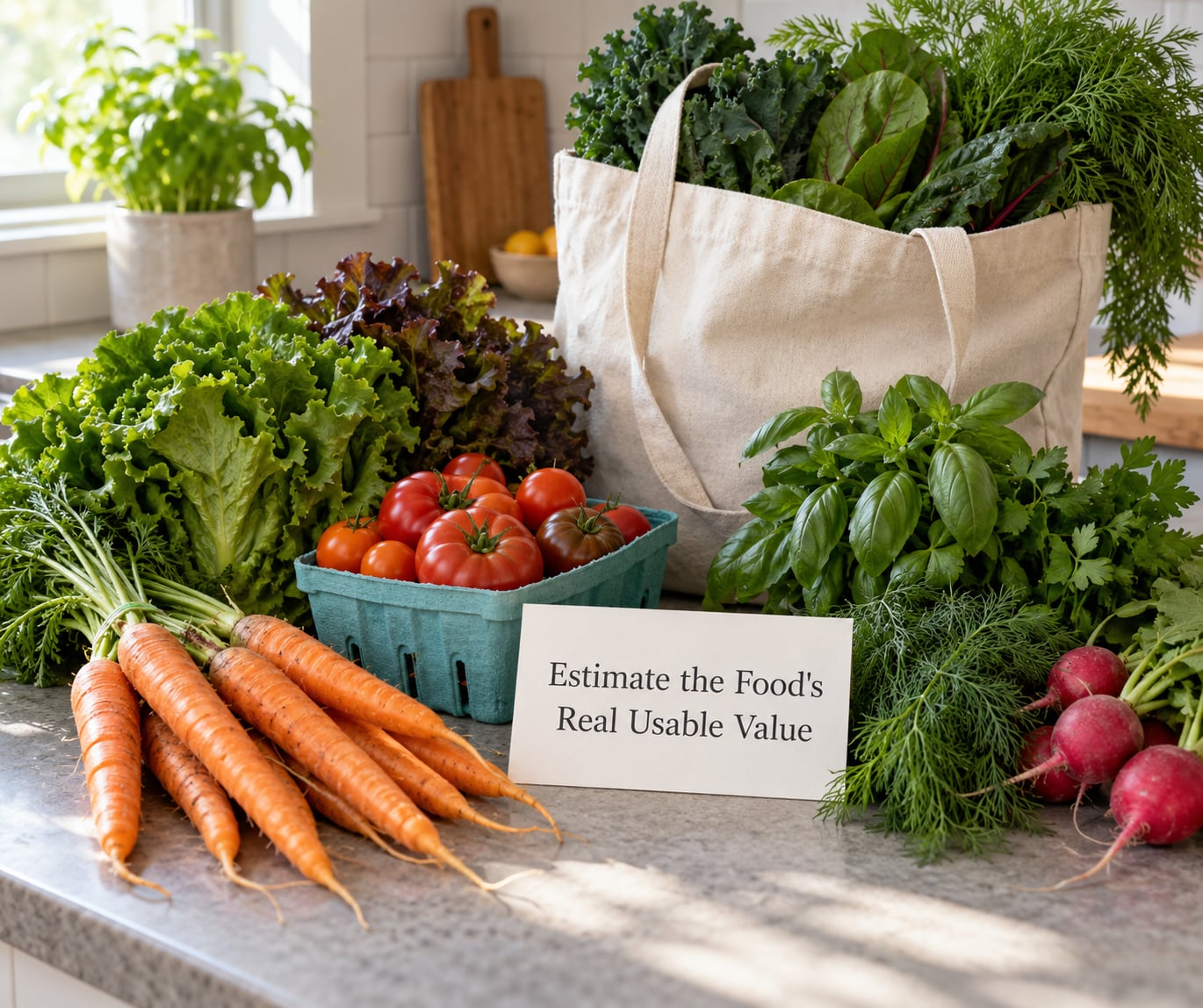
Here is the arithmetic nobody in this space writes down. Take the weekly share price, divide by the pounds in the box, and you have cost per pound. A forty-dollar half share carrying twelve pounds works out to roughly three dollars and thirty cents a pound. Compare that to the produce you already buy.
A grocery store basket of lettuce, tomatoes, onions, peppers, herbs and potatoes for a family of four typically runs forty to seventy dollars, and certified organic versions of the same items run higher. A farmers market tempts you to compare item by item, and often the single-item prices there are higher than the grocery store, but you only buy what you want. A CSA’s retail-equivalent value is real, and so is the pile of rutabaga you never touch.
The number worth tracking is edible value per pound. If a share is fourteen pounds and you eat ten, your real cost per pound is higher than the sticker math suggests. That is why four weeks of waste tracking, before you sign up, is the cheapest research you will do all year.
Seasonal items skew the math twice. Early-season greens are scarce and worth a premium; late-summer zucchini and cucumbers are cheap everywhere. Farms that publish “what’s in the box this week” archives let you see the real curve of what you will receive, and that archive is the single most useful page on a CSA website.
5. Read Reviews and Ask Specific Questions
Reviews tell you more when you read them as patterns rather than stories. One person ranting about a bad week is weather. Nine people in different years describing oversized shares is a sizing problem. Scan for mentions of share volume, missing items, communication speed and how the farm handled a crop failure, then call the farm and ask.
Questions worth asking on the phone or in the signup email:
- What does a typical share weigh, and what did members actually report in the last four weeks?
- Can I skip a week or place a vacation hold, and how late can I do it?
- What happens to my money if a crop fails?
- Do you offer choices, swaps or a crop preview before the box is packed?
- Is the share size fixed, or do large families get more?
- Do you accept SNAP or Bridge cards, and is there a sliding scale or work-trade option?
- Do you send recipes or prep guidance, and do you include storage windows?
Warning signs are easier to spot than you would think. Vague crop lists with no specifics, no email address and no named person, cash-only payment, no stated policy for missed pickups, or a signup page with no season dates and no update to last year’s crop notes. A farm that cannot tell you how it handles August is telling you something.
6. Start With a Trial or Flexible Option
The single best way to reduce risk is to buy less time. Trial or sample shares exist at a meaningful number of farms and cost a fraction of a full season. A half share, an every-other-week plan or a split arrangement with a neighbor all let you test a farm’s communication and sizing without a long commitment.
Set your renewal criteria before the season ends, not during. My own rule: did we eat at least eighty percent of the last four boxes, did the farm communicate during any bad week, and would the share still be cheaper than my grocery baseline at current prices. If two of the three fail, skip the renewal and try a different farm or go back to shopping at the market.
Common Mistakes That Make a CSA Box Feel Overpriced
Most complaints I read about CSAs are not about farming. They are about fit, and the fix is usually available before you pay.
- Buying a full share for a two-person household. Correction: ask the farm for last season’s actual box weight, then step down a size. Half shares are cheaper per pound anyway.
- Treating every item as equally useful. Correction: before the season, list three vegetables you would never buy. A farm with a choice option or a swap policy beats one without, full stop.
- Ignoring pickup rules. Correction: read the missed-pickup policy before paying. If the answer is that uncollected boxes are donated with no credit, factor in whether your schedule is reliable.
- Overlooking crop variety. Correction: ask how many crops the farm plants and see the previous season’s weekly archive. Eight crops means repetition is coming.
- Accepting the delivery fee without math. Correction: multiply the per-week delivery charge by your season length and compare it with the produce you would buy at a market you can drive to once.
- Comparing price while ignoring freshness and convenience. Correction: value the week of prep time and the fact that your produce was harvested days rather than a week or two ago. Just be clear-eyed that convenience is part of what you are buying, and it is a fair thing to pay for if you would have shopped anyway.
One more trap: peak-season duplication. Three weeks of the same zucchini is a preservation problem, not a farm failure. Budget ninety minutes once in July for batch cooking, freezer portions or a jar of pickles. Members who set aside time for it report the surplus stops being waste; members who skip that step are the ones who cancel.
Frequently Asked Questions
How do I know if a CSA share is worth the price?
Divide the weekly price by the pounds in the share, then compare that per-pound figure to what you spend on the same vegetables at the grocery store or your market. Then adjust for what you actually eat. If edible pounds land within ten percent of your grocery baseline, the share is saving you money and buying convenience and freshness with the difference.
What size CSA box should a family choose?
For a family of four that cooks most nights, a full share of roughly eighteen to twenty-five pounds a week is standard. Families of one or two who cook often do well on a half share of ten to fourteen pounds. Light-cooking households and single adults usually want a mini share or an every-other-week plan, and splitting a share with a neighbor halves the cost and the risk.
Is a more expensive CSA always better?
No. Price usually tracks labor, certification fees, delivery and farm size rather than produce quality. An expensive farm that publishes crop previews, absorbs delivery costs and ships loose greens on Wednesday may serve you better than a cheaper one that fills boxes the night before a long drive. Judge communication and packing, not the invoice.
What should I do if a CSA share contains too much food I will not eat?
Freeze, preserve or give it away before it turns. Blanch and freeze surplus greens, turn extra tomatoes or peppers into sauce or jam, and offer a bag to neighbors or a nearby food shelf. Long term, pick farms with a choice or swap policy, choose an every-other-week plan, or split your share so half the volume leaves your kitchen.
How much produce should I expect from a weekly CSA?
A mini share runs five to eight pounds, a half share ten to fourteen pounds, and a full share eighteen to twenty-five pounds. Very early and very late weeks are lighter because there is less in the field. Ask the farm for last season’s actual box weights, since published share sizes are often estimates rather than measurements.
Can I judge a CSA by its photos and customer reviews?
Partly. Photos show presentation but not volume, and stock photos of perfect tomatoes tell you nothing about an August share. Reviews are more useful when you read them as patterns: repeated mentions of oversized boxes, missing items or slow communication matter, one complaint does not. Confirm what you read with two questions sent to the farm before you pay.
Conclusion
Start with a list, not a farm. Write down the vegetables your household actually ate over the last month, convert that to pounds and servings, and compare it to the share sizes on offer. Then pick the program whose quantity, quality and pickup policies line up with what you wrote down, and buy the smallest version of it you can find. That single step is how you find a CSA box worth the money.