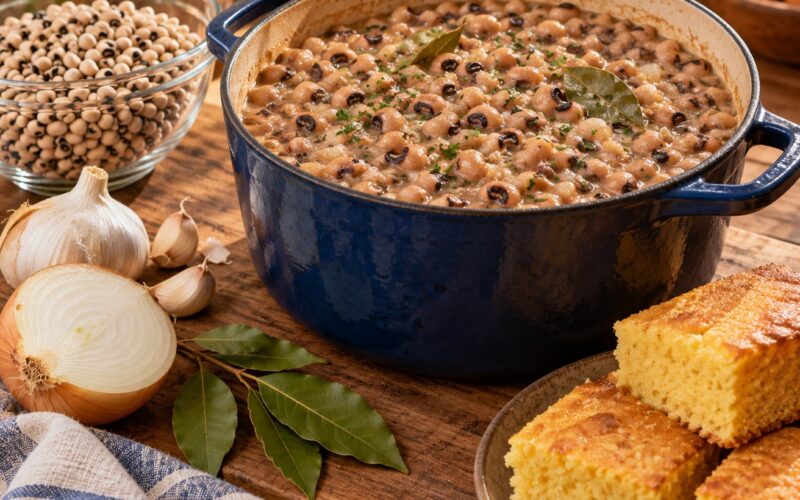
Learning how to make hoppin john is mostly about controlling liquid and heat, nothing more. This one-pot method gives you six servings of tender black-eyed peas over fluffy rice in about an hour and fifteen minutes, once the beans have soaked.
Hoppin’ John is a traditional Southern dish built on black-eyed peas, rice, and savory pork, and the whole thing comes down to three things: tender beans, a well-seasoned pot, and enough cooking liquid to spoon over the rice. If you have to make hoppin john tonight, skip the overnight soak. The quick-soak method below cuts bean cooking time roughly in half and gets a pot on the table in a little over an hour.
Table of Contents
- What You Need for Hoppin’ John
- What to Use Instead of a Ham Hock
- How to Make Hoppin’ John, Step by Step
- Step 1: Soak and Rinse the Black-Eyed Peas
- Step 2: Build the Flavor Base
- Step 3: Simmer the Black-Eyed Peas Until Tender
- Step 4: Add the Rice and Finish the Hoppin’ John
- Step 5: Rest, Taste, and Serve
- Common Hoppin’ John Mistakes and How to Fix Them
- The beans turn to mush
- The pot tastes salty
- The liquid is thin and watery
- The pot tastes bland
- The rice is sticky or glued to the pot
- Canned black-eyed peas instead of dried
- Frequently Asked Questions
- Do I have to soak the black-eyed peas for hoppin john?
- Can I make hoppin john without sausage or meat?
- How long does hoppin john take from start to finish?
- What rice works best for traditional hoppin john?
- Can I make hoppin john in a slow cooker?
- How should I store leftover hoppin john?
- Where to Start With Your Pot
What You Need for Hoppin’ John
Prep takes 15 minutes. Hands-on cooking takes about 25 minutes, and the beans simmer 60 to 90 minutes more. That is 1 hour 15 minutes to 1 hour 45 minutes total, plus soaking time if you plan ahead.
- 1 pound dried black-eyed peas (about 2 cups), sorted and rinsed
- 1 smoked ham hock (about 1 pound), or 8 ounces diced smoked ham
- 1 tablespoon bacon fat or cooking oil
- 1 medium yellow onion, diced
- 1 green bell pepper, diced
- 2 celery stalks, diced
- 3 garlic cloves, minced
- 1 bay leaf and 1 teaspoon dried thyme
- 1 teaspoon cayenne pepper or red pepper flakes, plus more to taste
- 4 cups low-sodium chicken broth, plus extra water or broth as needed
- 1 tablespoon white vinegar, added at the end
- 1 1/2 cups long-grain white rice (Carolina Gold is the classic pick), cooked separately
Onion, celery, and green bell pepper together are the Southern holy trinity. Dice them the same size so they soften at the same rate as the beans finish.
What to Use Instead of a Ham Hock
The ham hock gives you smoke, collagen, and broth in one piece, but it is not the only good choice. Bacon adds a quicker smoky note, andouille brings more spice, and smoked paprika plus a little oil gets you a vegetarian pot that still tastes like it took hours.
- Smoked ham hock: deep smoke and gelatin-rich broth, the traditional choice. It is very salty, so start with less added salt.
- Diced smoked ham: the same smoke with no bone, ready in about an hour, though you get less body in the cooking liquid.
- Thick-cut bacon: fast smoke that renders right into the pot, in a smaller batch with less broth flavor.
- Andouille or smoked sausage: spicy, smoky, and regional, but it can crowd out the black-eyed peas.
- Smoked paprika, no meat: the vegetarian substitute for smoke. Add a teaspoon of liquid smoke if you want more depth.
For the pot itself, a Dutch oven or heavy pot with a tight lid works best. You want a simmer that barely bubbles, and a lid keeps the liquid in instead of letting it reduce away.
How to Make Hoppin’ John, Step by Step
Step 1: Soak and Rinse the Black-Eyed Peas
How long you soak depends on how much planning you have. Pick the line that matches your schedule and nothing breaks.
- Long soak (8 to 12 hours, or overnight): cover the peas with 6 cups of cool water plus 1 tablespoon salt. They roughly double in size. Beans simmer in about 60 minutes afterward.
- Long soak (24 to 48 hours): the peas get softer and cook faster, but you need to change the water once or twice and skim the grey scum off the top.
- Quick soak (1 hour): bring the peas and 6 cups of water to a boil, boil 2 minutes, cover, and let them sit for an hour. Then drain and rinse. Add about 20 minutes to the simmer.
- No soak: perfectly workable. You just plan on 90 to 120 minutes of gentle simmering and start checking the liquid early.
Drain the peas in a colander and rinse them under cold water. That rinse removes the soaking liquid and any of that chalky taste that comes from the pot water.
Step 2: Build the Flavor Base
Set the Dutch oven over medium heat with the bacon fat or oil. Add the ham hock and let it sizzle for 2 to 3 minutes so the surface browns, then turn it a few times until the edges look lightly caramelized. Browning the meat is where most of the smoky depth comes from, and it takes patience worth spending.
Add the onion, celery, and bell pepper. Cook 6 to 8 minutes, stirring every couple of minutes, until the vegetables look soft and translucent and the bottom of the pot has a light golden color. Add the garlic, bay leaf, thyme, and cayenne and stir for 30 seconds.
Step 3: Simmer the Black-Eyed Peas Until Tender
Stir in the rinsed peas and pour in the chicken broth. The liquid should cover the peas by about an inch, and if it does not reach, add water from the pot you boiled the peas in. Bring it to a boil, then turn the heat down until you see one bubble every second or two.
Cover and simmer for 60 to 90 minutes, stirring occasionally so nothing catches on the bottom. Old beans and hard water both stretch this range, so trust the beans rather than the clock.
The doneness test: press one pea between your thumb and finger. It should give easily and feel creamy inside while the skin still holds its shape. When the skins start to slip off and the liquid turns cloudy and thick, you have gone too far. Pull the pot off the heat at that first sign.
Step 4: Add the Rice and Finish the Hoppin’ John
There are two schools here. Purists hold that the rice belongs in the pot with the beans so the starch and broth season every grain, while plenty of cooks stir the rice in at the very end or serve it underneath. Both work, and the difference is mostly about texture.
Rice in the pot: once the beans are tender, stir in 1 1/2 cups of rinsed long-grain rice, add 3 cups of broth or water, bring back to a boil, then cover and simmer 18 to 20 minutes on the lowest heat. Rest 10 minutes before serving. Keep an eye on it, because rice added at this stage drinks the broth fast and can scorch if the pot runs dry.
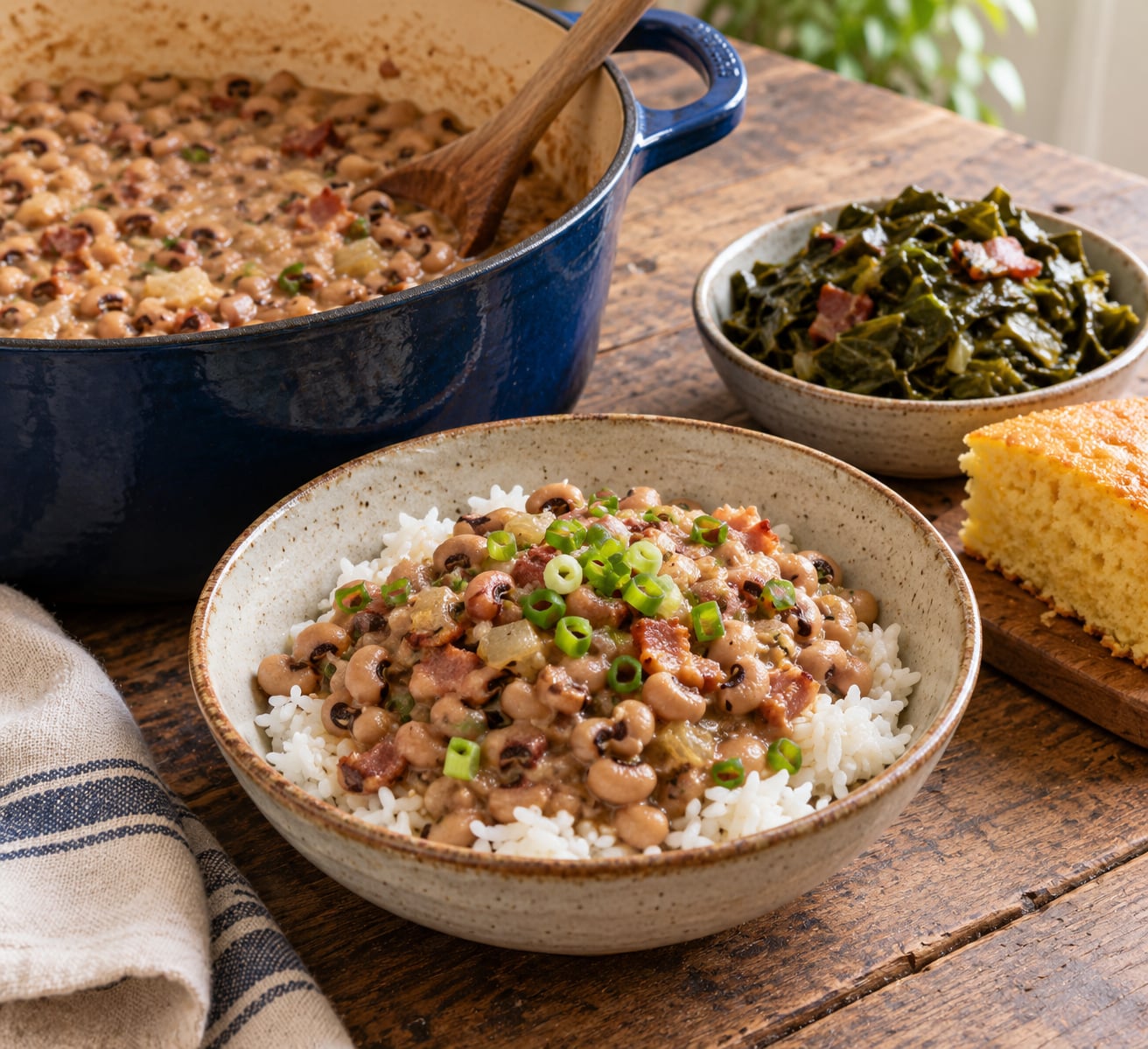
Rice on the side: cook 1 1/2 cups of rice in 3 cups salted water while the beans simmer. Ladle the beans and their thick cooking liquid over the top. This is my usual route, since it keeps every grain separate and lets you control the sauce-to-rice ratio at the table.
Step 5: Rest, Taste, and Serve
Turn off the heat and let the pot sit, covered, for 10 minutes. The beans keep cooking in the residual heat, and the liquid thickens just enough to coat a spoon.
Taste before serving. Add the white vinegar now, a teaspoon at a time. Vinegar sharpens the pot without making it taste sour, which is why the classic recipes finish with it. Then add salt in small increments, because the ham hock may have salted the broth on its own and the only way to know is to taste.
Spoon over rice and top with sliced scallions. For serving alongside, fried cornbread and a pot of collard greens make the traditional plate, and a sharp cabbage slaw or roasted sweet potatoes balance the starch.
Divide the rest into an airtight container and refrigerate within two hours. It keeps three to four days in the fridge and freezes up to three months; when reheating, add a splash of broth and warm it over low heat rather than in a microwave, so the beans stay creamy instead of drying out.
Common Hoppin’ John Mistakes and How to Fix Them
The beans turn to mush
Over-simming is the usual culprit, and there is no bringing a mushy bean back. Pull the pot off the heat the moment the skins start to loosen, and serve the beans with rice rather than stirring rice into the pot. Serving the dish the next day, reheated with a little broth, is another good move, since the extra day actually suits the peas.
The pot tastes salty
A salty pot is easy to end up with once a smoked ham hock is in there, and adding water does not fix it if you have already seasoned the rice. Next time, skip added salt entirely, use low-sodium broth, and taste at the 50-minute mark. If this pot is over-salted, dilute it with unsalted broth and bulk the dish up with more beans and rice.
The liquid is thin and watery
Take the lid off and simmer uncovered for 10 to 15 minutes, stirring now and then. The starch in the bean broth thickens as it reduces. Watch it, though, because that same starch turns past a thick pot into glue if you walk away.
The pot tastes bland
Usually the aromatics went in too late or the pot was never salted. Add a splash more broth, another clove of minced garlic, a pinch of cayenne, and a teaspoon of the vinegar. A spoonful of the reserved bacon fat or ham hock juice stirred back in at the end fixes a thin pot faster than more simmering.
The rice is sticky or glued to the pot
Stir the rice once, early, when the liquid still looks loose, and keep the heat at its lowest setting. If you cooked the rice in the pot and it caught, the fix is serving it with a splash more broth and calling it one-pot rice, because scraping the bottom is not worth it.
Canned black-eyed peas instead of dried
You can absolutely use canned peas, and the whole pot takes about 30 minutes. Drain two 15-ounce cans well, skip the soaking and the long simmer, and swap the ham hock for diced smoked ham or 4 slices of bacon rendered in the pot.
- Pour 2 cups of broth into the pot with the browned aromatics and meat.
- Add the drained peas and bring to a simmer.
- Simmer 20 minutes uncovered so the liquid thickens.
- Season at the end with salt, cayenne, and the vinegar.
Frozen peas work the same way. Thaw them in the pot and shorten the simmer to about 15 minutes.
Frequently Asked Questions
Do I have to soak the black-eyed peas for hoppin john?
No. Unsoaked black-eyed peas cook fine, they just need a longer, gentler simmer, usually 90 to 120 minutes instead of 60 to 90. Soaking softens the skins and shortens the cook, but it is a planning tool, not a requirement. If you have an hour, use the quick soak. If you have overnight, do the long soak. If you have neither, start the beans without soaking and taste one every 15 minutes after the 90-minute mark.
Can I make hoppin john without sausage or meat?
Yes, and you still get the smoky character. Skip the ham hock and cook the onion, celery, and pepper in olive oil instead of bacon fat, then add two teaspoons of smoked paprika and a small splash of liquid smoke with the beans. Use vegetable broth, hold the salt until the beans are tender, and keep the white vinegar finish. The pot lands in the same place in about 60 minutes.
How long does hoppin john take from start to finish?
Plan on one hour and fifteen minutes to one hour and forty-five minutes for the standard version, plus soaking time you can skip. That figure covers 15 minutes of prep, 25 minutes of hands-on cooking, and 60 to 90 minutes of simmering. A long soak the night before does not add to the same day; a quick soak adds about an hour, and no soak at all adds nothing but a longer simmer. Using canned black-eyed peas brings the total down to roughly 30 minutes.
What rice works best for traditional hoppin john?
Long-grain white rice is the classic choice, and Carolina Gold is the traditional Southern variety because it stays separate and fluffy. Most cooks rinse the rice first, cook it in salted water, and ladle the beans and their broth over the top. You can also cook the rice in the pot with the beans at the end, which some purists insist is the only authentic way, but be careful with the heat so it does not catch.
Can I make hoppin john in a slow cooker?
You can, and it suits a long soak well since the beans get the time anyway. Skip the browning step or do it in a skillet first for more flavor, then put the aromatics, beans, ham hock, broth, bay leaf, and cayenne in the slow cooker. Cook on high for 2 hours or low for 6 to 8 hours, then transfer the beans and liquid to a saucepan, remove the meat, and reduce uncovered for 15 minutes before seasoning and serving over rice.
How should I store leftover hoppin john?
Cool it within two hours and refrigerate it airtight, where it keeps three to four days. Freeze it in a sealed container for up to three months, and leave a little room at the top for expansion. Reheat on the stovetop with a splash of broth so the beans stay creamy, or microwave in short bursts with a damp piece of paper towel over the bowl. Thawed beans soften a little, so expect to add broth and heat longer than you would fresh.
Where to Start With Your Pot
If this is your first time, soak the beans overnight and use a smoked ham hock, then start tasting at the 50-minute mark so you catch the seasoning before it gets salty. Brown the meat and the aromatics properly, and most of the rest takes care of itself.
Once you have it down, the shortcut worth learning is the canned version. It takes half an hour, it uses the same method, and once you can cook that, hoppin john stops being a holiday project and becomes a Tuesday dinner in 2026.