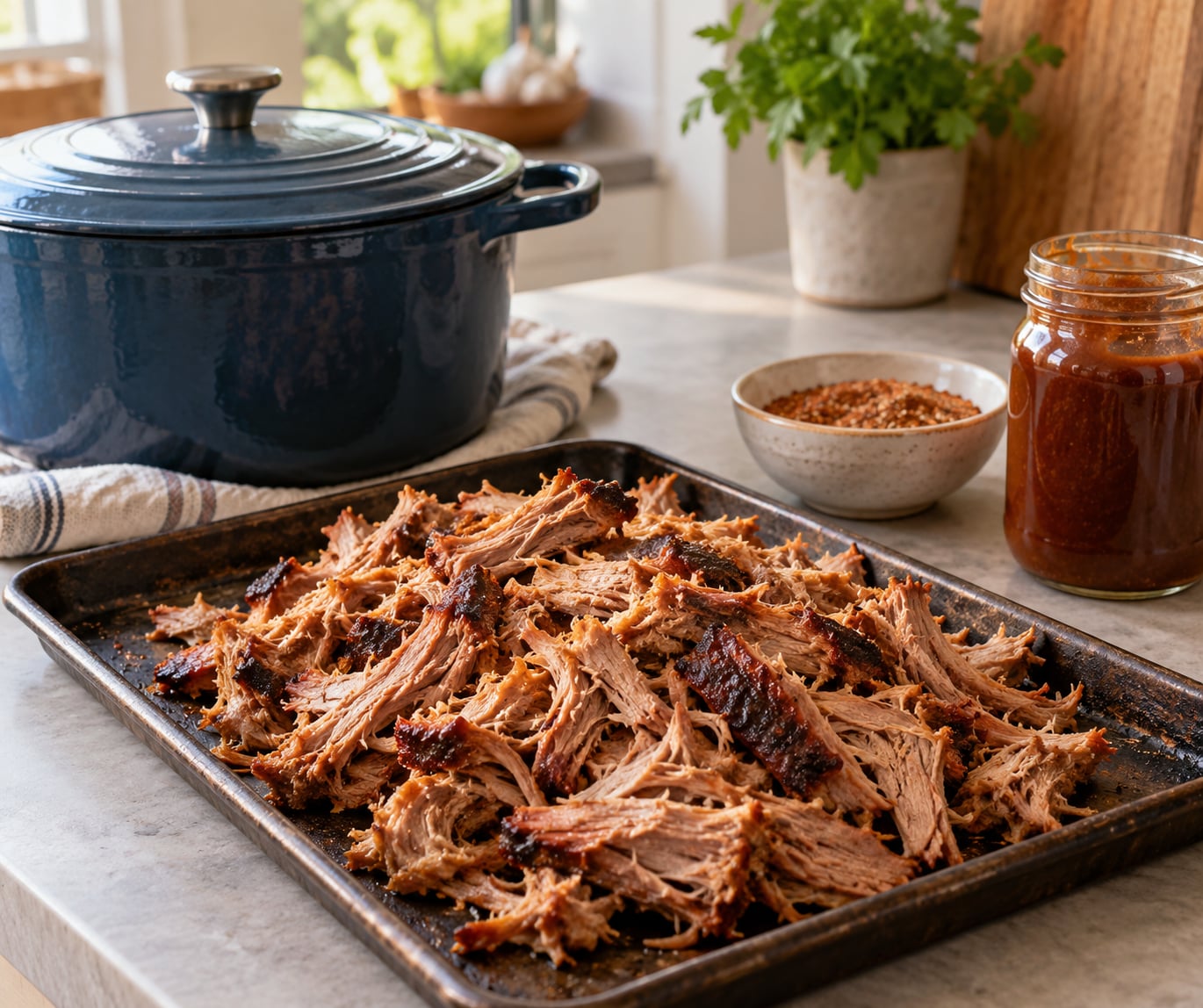
Oven pulled pork is made by slow-roasting a seasoned pork shoulder (also called pork butt or Boston butt) at 250-300°F until the center reaches 195-205°F, then pulling it apart with two forks and tossing it with barbecue sauce.
Yes, a home oven slow-cooks pork shoulder the same way a smoker does. The shoulder is a collagen-rich cut, so hours of gentle heat turn that collagen into gelatin, which is the only reason the meat shreds instead of slicing.
The honest part: oven pulled pork is not smoked barbecue. It is a different dish that happens to land in the same place, and it is the best option if you have no smoker, no grill, or an apartment where smoke would be a problem. Cook to temperature, not to the clock, and it works every time. Updated for October 2026.
Table of Contents
- What You Need: Pork, Pan, and Seasoning
- The pork
- The vessel and tools
- The dry rub
- The liquid and the sauce
- How much per pound
- How to Make Pulled Pork in the Oven, Step by Step
- 1. Choose and Prepare the Pork Shoulder
- 2. Season the Pork and Start the Oven
- 3. Roast Until the Pork Is Tender Without Drying It Out
- 4. Rest, Shred, and Finish the Pulled Pork
- Three Oven Methods, Side by Side
- Common Mistakes and How to Fix Them
- The pork came out dry
- The pork is still tough
- The pork is wet and mushy
- There is no bark
- It cooked unevenly
- Leftovers turn to mush
- Food Safety for Oven Pulled Pork
- Frequently Asked Questions
- What temperature do you cook pulled pork at in the oven?
- How long does pulled pork take at 300 degrees?
- Do you have to pull pork at exactly 195F?
- How long can I leave dry rub on pork in the refrigerator?
- Can I cook pulled pork from frozen in the oven?
- How do I reheat pulled pork without drying it out?
What You Need: Pork, Pan, and Seasoning
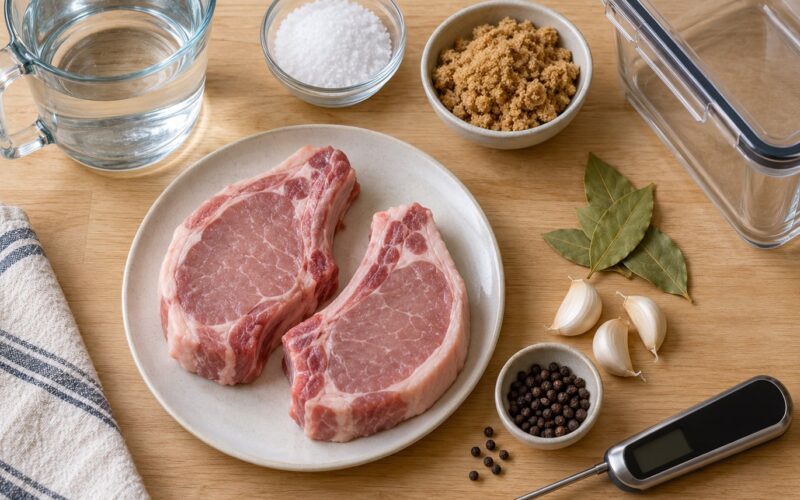
You need very little. A pork shoulder, a covered vessel, an instant-read thermometer, and a pantry dry rub cover the whole recipe.
The pork
Pork shoulder, pork butt, and Boston butt are three names for the same cut. Pick a 4-6 lb piece, bone-in or boneless. Bone-in holds shape better and gives you a serving piece to present; boneless is easier to cut and cooks slightly faster.
The vessel and tools
A 4-6 quart Dutch oven is the best vessel, because it heats the meat from the sides as well as the bottom. A heavy-duty foil packet set inside a roasting pan works almost as well, and a deep baking dish is fine in a pinch. You also want an instant-read thermometer (this is the one tool you should not skip), two forks, a cutting board, and heavy-duty foil.
The dry rub
Mix 2 tablespoons brown sugar, 1 tablespoon smoked paprika, 1 teaspoon garlic powder, 1 teaspoon onion powder, 1 teaspoon salt, and 1/2 teaspoon black pepper. Add 1/2 teaspoon cayenne for heat, or 1 teaspoon cumin for earthiness. A dry rub is not a marinade, so you do not need to soak the pork first.
The liquid and the sauce
You need 1/2 cup of chicken broth, apple juice, or cola to keep the pan from going dry, plus 1 cup of barbecue sauce for the finish. Broth gives depth, apple juice gives sweetness, and cola adds caramelized molasses notes. Any of the three works.
How much per pound
Per pound of pork, use 1 tablespoon of dry rub, 1/4 cup liquid, and 1/4 cup sauce. A 4 lb piece feeds about six hungry people; plan on 1/2 to 3/4 lb per person.
How to Make Pulled Pork in the Oven, Step by Step
This is the method I use. It takes most of a Saturday, but nearly all of it is oven time, and the result shreds clean every time instead of sometimes.
1. Choose and Prepare the Pork Shoulder
Take the pork out of the fridge 30 minutes before cooking so it is not refrigerator-cold. If it is still in netting or a plastic sleeve, cut it off. Pat the surface completely dry with paper towels and trim the thickest slab of hard fat off the top, leaving a thin layer, because that top fat is what turns into bark.
2. Season the Pork and Start the Oven
Heat the oven to 300°F. Rub the dry rub all over the pork, working it into the crevices, and set the shoulder fat-side-up in the vessel. Pour the liquid around the meat, not over it, so the rub stays dry enough to crust. Cover tightly with the Dutch oven lid or two layers of foil crimped tight to the rim, and put it in the oven on a lower rack.
3. Roast Until the Pork Is Tender Without Drying It Out
This is the whole method in one rule: leave it alone. Cooking time cannot be converted from weight with any accuracy, so temperature is the only real signal.
| Pork shoulder weight | At 250°F | At 275°F | At 300°F |
|---|---|---|---|
| 4 lb | 4 to 5 hours | 3.5 to 4.5 hours | 3 to 4 hours |
| 6 lb | 5.5 to 6.5 hours | 4.5 to 5.5 hours | 3.5 to 4.5 hours |
| 8 lb | 7 to 8 hours | 5.5 to 6.5 hours | 4.5 to 5.5 hours |
| 10 lb | 8.5 to 10 hours | 7 to 8 hours | 5.5 to 6.5 hours |
| 12 lb | 10 to 12 hours | 8 to 9.5 hours | 6.5 to 8 hours |
A rough rule of thumb is 40 to 60 minutes per pound at 250°F, but treat that as a floor, never a deadline. Check the temperature after the minimum time on the table, then every 30 minutes.
For a faster cook, blast the covered pan at 450°F for 2 to 2.5 hours, or sear at 425°F for 45 minutes and then drop to 325°F covered for about 3 hours. Both work. They just trade some collagen conversion for speed, so shred with more care.
Around the 3-hour mark, check the liquid. If the pan is dry, add 1/2 cup hot broth and put it back. When the pork hits about 190°F, pull the cover off, raise the heat to 375°F, and give it 30 to 60 minutes more so the surface dries into bark. Watch it during this phase, because this is where pork turns from good to dry.
4. Rest, Shred, and Finish the Pulled Pork
Rest the pork 30 to 45 minutes in the covered pan. Resting lets the juices redistribute, and shredding hot meat dumps most of them on the cutting board.
Pull the meat onto a board and shred with two forks, working along the grain with short strokes. Pull some bark off and fold it back in at the end so you get crunchy bits with the tender meat.
Toss the shredded pork with about half the barbecue sauce, taste it, and add more. Save the rest of the sauce for serving and for reheating later.
Three Oven Methods, Side by Side
Every recipe publisher picks one vessel and assumes it is correct. It is not the only option, and the right pick depends on your equipment and your afternoon.
| Method | Oven temp | Time for a 6 lb piece | Bark | Best for |
|---|---|---|---|---|
| Dutch oven, covered | 300°F | 3.5 to 4.5 hours | Good, if you uncover at the end | The most consistent result; heats from all sides |
| Foil-covered roasting pan | 300°F | 4 to 5 hours | Good, easy to crisp | No Dutch oven at home |
| Uncovered roaster | 425°F then 325°F | 3 hours | Best | You want crust and you want it fast |
| High-heat blast, foil-sealed | 450°F | 2 to 2.5 hours | Moderate | A weeknight, with more shredding patience |
One warning on the uncovered method: a Dutch oven with the lid off dries faster than it braises. Cover through the long middle stretch, then uncover for the last stretch.
Common Mistakes and How to Fix Them
Almost every bad batch traces back to the same handful of things. Here is how to spot them and what to change.
The pork came out dry
The lid came off too early or stayed off too late, or the piece was small. Fix: keep it covered until 190°F, and only uncover for 30 to 60 minutes at 375°F. If you already have dry pork, toss it with a splash of the reserved pan juice and warm it through.
The pork is still tough
It did not get hot enough, or it did not get long enough. Fix: put it back in the covered pot at 300°F for another 45 minutes and probe again. Most of the time it shreds on the second pass.
The pork is wet and mushy
Too much liquid, or all the sauce went in at the start. Fix: keep the liquid to 1/2 cup and drain any excess before shredding, then let the shredded meat sit uncovered on a sheet pan in a warm oven for 10 minutes to tighten up.
There is no bark
You opened the oven too often, or the rub was wet. Fix: leave the door closed between checks, and finish uncovered at 375°F. If a covered cook left you with no crust, 30 minutes uncovered at 375°F brings it back.
It cooked unevenly
A large bone-in piece has hot and cold spots. Fix: cut a 7 to 8 lb shoulder into two or three chunks. They cook faster and more evenly, which is often the difference between shreddable and chewy.
Leftovers turn to mush
Mixing sauce into the pork ahead of time is the cause. Store the pork and the sauce in separate containers, and reheat the pork covered with a splash of broth for 15 minutes, then add sauce at the last second.
Food Safety for Oven Pulled Pork
The USDA safe minimum internal temperature for whole cuts of pork is 145°F (63°C) with a 3-minute rest. Pulled pork is pulled at 195 to 205°F, so you are nowhere near that floor, and the extra heat is not overcooking. It is what breaks collagen into gelatin.
Past roughly 205°F, though, you are past the useful part. Muscle fibers start losing structure and the meat turns stringy, which is the dry, chalky failure people describe as overcooked.
For leftovers, refrigerate within 2 hours of serving, use it within 3 to 4 days, and reheat to 165°F. Keep it covered while reheating.
One more thing. A long oven cook means the oven is on for many hours, so do not leave it running while you are away overnight unless you have a working smoke alarm and know what to do if it goes off. An overnight cook at 250°F is easy; an unattended one is not.
Frequently Asked Questions
What temperature do you cook pulled pork at in the oven?
Cook a pork shoulder at 250-300F in the oven, covered, and pull it when the center hits 195-205F. The USDA safe minimum for whole cuts of pork is 145F, but that only means safe to eat. Shredding texture comes from collagen breaking down into gelatin, which happens in the 190-205F range. Past 205F the muscle fibers break down further and the meat turns dry and stringy.
How long does pulled pork take at 300 degrees?
A 4 lb piece takes about 3 to 4 hours at 300F, a 6 lb piece about 3.5 to 4.5 hours, and an 8 lb piece about 4.5 to 5.5 hours. Treat those as minimums before you start checking, not deadlines. Weight, bone-in versus boneless, and how full your oven is all shift the real number, so the thermometer decides when you pull, not the clock.
Do you have to pull pork at exactly 195F?
No. 195F is the most commonly quoted target, but 190 to 205F all work. Probe the thickest part of the shoulder with an instant-read thermometer, then push a fork or knife into the meat and twist. If there is almost no resistance, the collagen has converted and you are done. If it still fights back, give it another 20 to 30 minutes and check again.
How long can I leave dry rub on pork in the refrigerator?
Up to 24 to 48 hours is fine, uncovered, in the refrigerator. Salt in the rub pulls a little moisture into the meat, which seasons it deeper than a same-day rub does. Beyond a couple of days the surface can go slightly wet and less likely to form bark, so pat the pork dry again before it goes in the oven.
Can I cook pulled pork from frozen in the oven?
Yes, and it works well. Set it in the vessel with the liquid and rub, then cook at 300F covered exactly as you would a thawed piece. A frozen shoulder needs roughly 45 to 60 extra minutes, so start checking the internal temperature earlier than the cook-time table suggests and pull at 195-205F like usual.
How do I reheat pulled pork without drying it out?
Reheat it covered, with a splash of broth, apple juice, or water, either in the oven at 300F for about 15 minutes or in a covered skillet over low heat. Steam, not a hot dry pan, is what keeps it moist. Add your barbecue sauce after it is warm, since sauce reheated with the meat reheated twice tends to go past sweet and sticky.
Start with a 4 to 6 lb shoulder at 300°F, covered, and stop opening the oven. Check the temperature instead, uncover at 190°F for bark, rest 30 minutes, and shred with a fork.