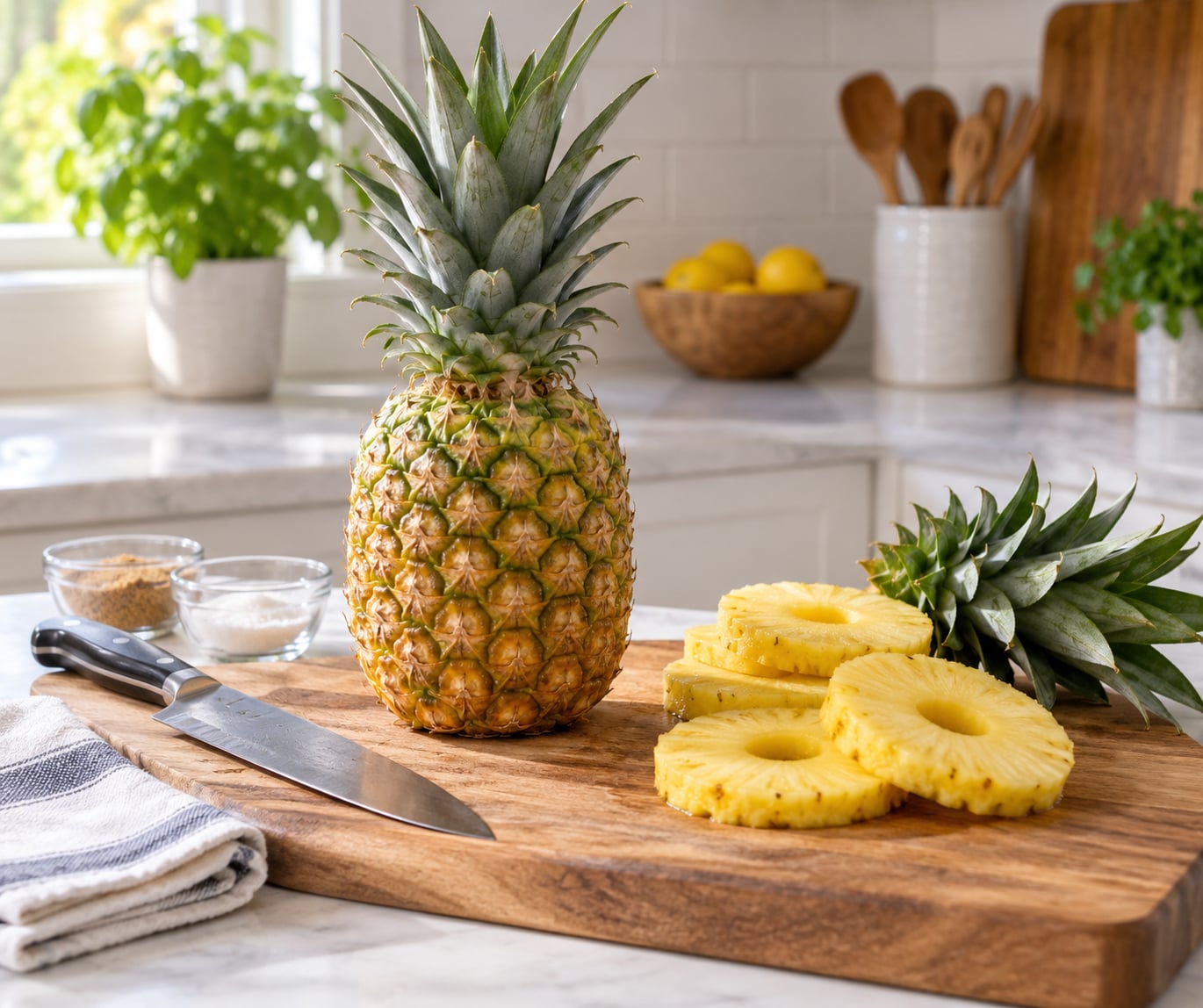
To cut a pineapple without wasting it, shave the skin off in one thin slice that follows the curve of the fruit, pop the eyes out with shallow diagonal cuts along their natural rows, then slice the flesh away from the core instead of coring straight through it. Most of the fruit you paid for ends up on the board. The standard peel-and-chunk method can throw away a quarter to nearly half of the edible flesh.
It takes about 10 minutes once you know the sequence, and the fruit rolls everywhere until you stop it. Stand it upright, cut down toward the board, and keep the blade angled toward the peel instead of the good yellow flesh.
Last updated October 2026.
Table of Contents
- What You Need
- Step-by-Step: How to Cut a Pineapple Without Wasting It
- Step 1: Wash the Pineapple and Stand It Safely
- Step 2: Cut Off the Crown and the Base
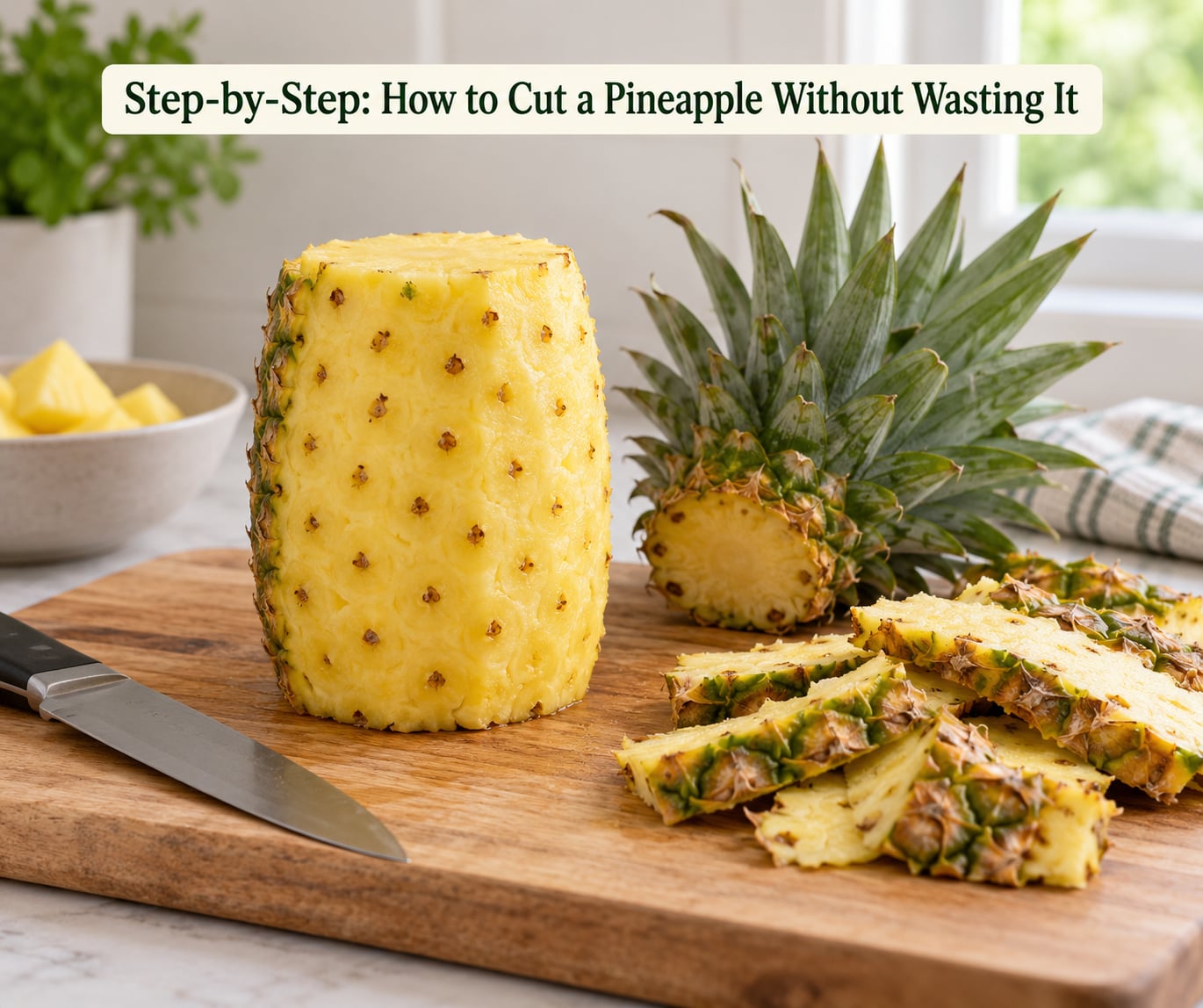
- Step 3: Shave Off the Skin in One Thin Slice
- Step 4: Take Out the Eyes With Shallow Diagonal Cuts
- Step 5: Cut Around the Core Without Losing the Flesh
- Step 6: Cut the Flesh and Save the Usable Scraps
- How to Store Cut Pineapple
- How to Avoid the Mistakes That Waste a Pineapple
- Frequently Asked Questions
- Can you eat the core of a pineapple?
- What should I do with the pineapple crown?
- How do you know when a pineapple is ripe enough to cut?
- How do I stop my hands from getting sticky while cutting a pineapple?
- How long can cut pineapple stay in the refrigerator?
- Is it better to cut a pineapple vertically or horizontally?
- Conclusion
What You Need
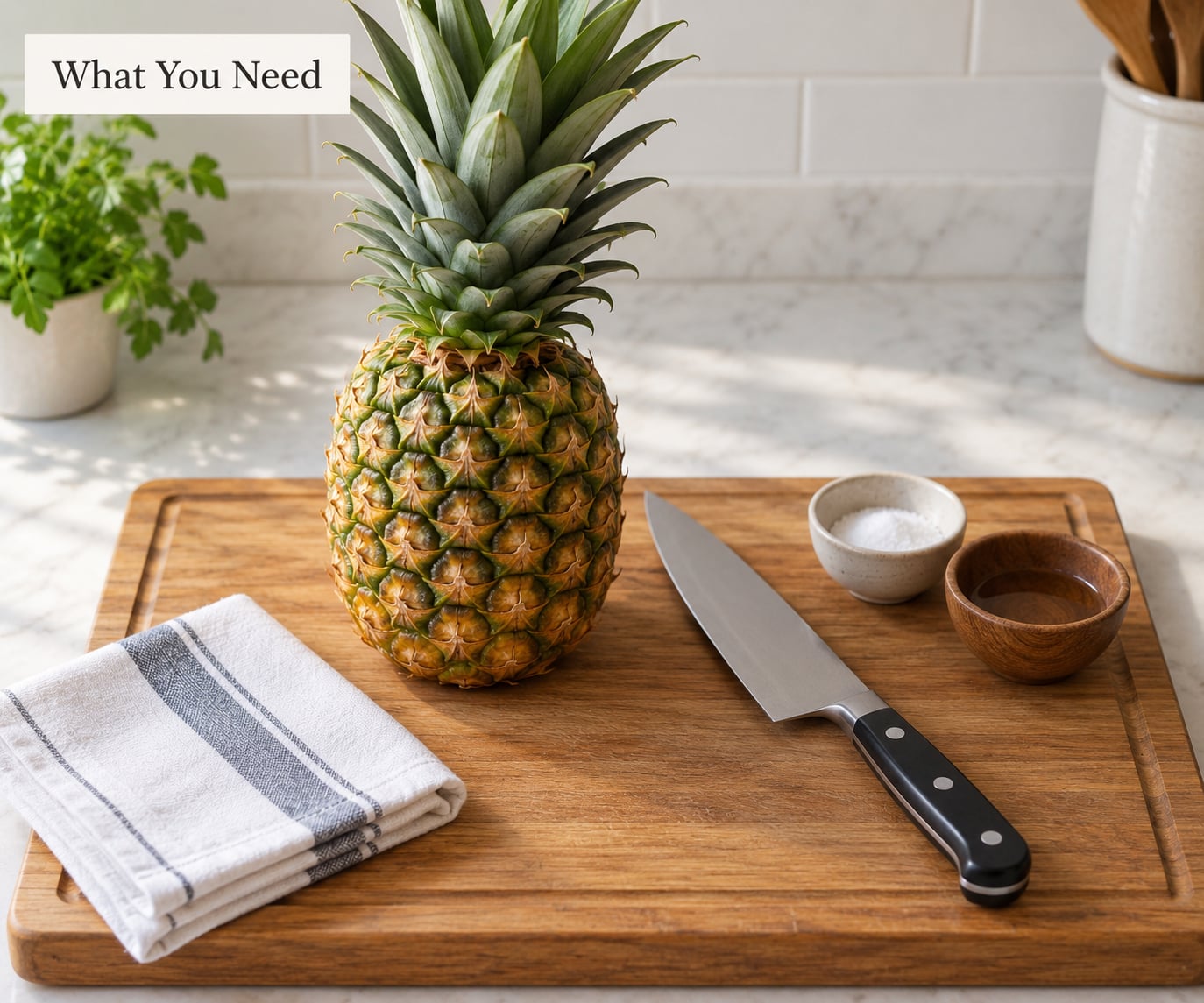
A sharp chef’s knife does nearly all of the work. A dull blade crushes the flesh and forces you to saw, which is exactly how good fruit ends up in the trash.
- A sharp chef’s knife for the crown, the base and the skin.
- A short serrated knife or paring knife for the shallow diagonal eye cuts. The serrations grip a wet, slippery surface better than a straight edge.
- A large cutting board, ideally with a damp towel underneath so it does not move when you push against it.
- A clean kitchen towel or tongs to grip the fruit, since the rind is wet and combative.
- Airtight containers for the cut fruit, and a jar or bag for the crown and rind if you plan to use them.
A pineapple corer or a biscuit cutter works, but neither is required. A corer saves time on the core and costs you the outer ring of flesh where the blade has to travel; a biscuit cutter makes clean rings from a fruit you have already skinned.
Step-by-Step: How to Cut a Pineapple Without Wasting It
Step 1: Wash the Pineapple and Stand It Safely
Rinse the outside under cool running water and scrub it with your hands, even though you will never eat the rind. Pineapples carry dirt and bacteria on the skin, and rinsing keeps that from moving to your board and your knife.
Pat the fruit dry. Wet skin is slippery skin, and a wet pineapple on a wet board is how people end up in the emergency room.
Put the damp towel under your cutting board, then stand the pineapple upright on its base. This is the whole trick to the method: vertical fruit is stable fruit. It is done when the base sits flat and does not rock or shift when you press the top with your palm.
Step 2: Cut Off the Crown and the Base
Slice off the leafy crown about an inch below the leaves, cutting straight down and keeping a little flesh with it. Then cut a thin slice off the base so the fruit will sit flat. You should still have roughly half the fruit in front of you.
Save the crown if you plan to grill it, blend it into a drink or use it as a garnish. Trim off the punky brown end first, since that part is bitter.
Step 3: Shave Off the Skin in One Thin Slice
Hold the fruit steady with your non-knife hand on the flat top where you cut the crown. Slice down the side, angling the blade so the sharp edge rides just under the skin and the belly of the blade follows the curve of the fruit.
Turn the fruit a quarter turn and repeat. Four or five passes remove the entire rind, and because you are shaving rather than carving off wedges, a usable layer of yellow flesh stays behind on every side.
It is done when no green or brown skin patches remain and the surface feels uniformly dimpled, the way the skin always looks under the eyes.
Step 4: Take Out the Eyes With Shallow Diagonal Cuts
This is the step people overcut. The eyes look like little brown dots, but each one is a fibrous tuft with a shallow plume of flesh running diagonally beneath it. You only need to remove that plume, not a wedge of the fruit underneath.
- Rest the blade at about a 45-degree angle to the surface.
- Slice into the fruit just above one row of eyes, taking a slice about a quarter-inch deep.
- Make the matching cut just below the same row, so the two cuts meet and lift out a narrow diagonal strip carrying the eyes.
- Turn the fruit and repeat around the curve, moving down each row as you go.
Follow the natural diagonal lines the eyes form rather than cutting straight across them. Work around the curved sides in smaller, shallower cuts, since the fruit narrows there and a deep cut removes flesh you wanted.
It is done when you run a fingertip over the surface and find nothing raised or tough. Any leftover eye reads as a gritty spot in the mouth.
Step 5: Cut Around the Core Without Losing the Flesh
The pale core is edible. It is not poisonous and it holds plenty of sweet flesh, so cutting it out in one thick cylinder throws away more fruit than most people realize.
Two approaches work. For rings or thick wedges, stand the fruit on its base and cut straight down on both sides of the core, removing the two outer pieces first, then cutting thin rounds from the sides. You keep the core standing until the very end, which is what protects the inner flesh.
For maximum yield, lay the fruit on its side and run the knife down one flat face of the core, shaving off a slab. Turn it and take the matching slab from the other side. The core ends up as a narrow wedge rather than a wide cylinder, and only that wedge goes to the compost or the juicer.
You will know the core is clear when the knife meets resistance and the blade tip is running against fibrous material rather than wet flesh. Peel the stringy bits off the core afterward with your fingers or a paring knife.
Step 6: Cut the Flesh and Save the Usable Scraps
From here the fruit is finished and the choice is about shape. Rings for an upside-down cake, wedges for grilling, cubes for a fruit salad, spears for skewers, thin slices for a smoothie bowl. Each takes about a minute.
Keep the small end pieces and any ragged chunks from the top and bottom. They are the best part for blending, juicing or grilling, because nobody wants a misshapen piece on a skewer.
The core itself is worth keeping for a few hours. Blend it with water and strain it for juice, simmer it in water for a light tea, or run it through the food processor with the rind for a grate-free kimchi or relish.
How to Store Cut Pineapple
Cut pineapple belongs in an airtight container in the refrigerator, not on a plate. Exposed to air it dries out, browns at the edges and gets stringy within a day or two. A sealed box keeps the moisture in and the texture firm.
- Refrigerated in an airtight container: about 3 to 4 days at or below 40°F. Eat it in that window and it stays close to fresh-cut.
- Refrigerated in a bowl or wrapped loosely: 1 to 2 days before the edges brown.
- Frozen: 2 to 3 months at 0°F. Cut it into chunks or slices first, spread on a tray to freeze solid, then move it to a bag. Frozen pineapple softens when thawed, which makes it ideal for smoothies and baked goods but wrong for a fruit salad.
- Whole, uncut: leave it at room temperature for up to two days, or refrigerate it for about a week.
If you cut the fruit and want it to taste sweeter the next day, a pinch of coarse salt on the pieces draws a little juice out of them. Twelve hours in the fridge does the rest.
How to Avoid the Mistakes That Waste a Pineapple
- Cutting the fruit while it lies on its side. It rolls, and rolling fruit plus a sharp knife is a bad combination. Stand it upright, or cut it in half first and work on a flat face.
- Taking deep wedges to be safe. The eyes run diagonally, so a shallow slice above and below the row clears them. Cutting straight down over each eye is what carves out a cone of good flesh.
- Coring straight down the middle. That cylinder carries a ring of sweet flesh with it. Shave the two faces of the core and the yield jumps noticeably.
- Peeling in vertical strips. Four separate peelings mean four chances to take flesh with the skin. One thin shaved slice per side does the whole job.
- Leaving eyes behind. A missed eye is a gritty spot that ruins a bowl of fruit. Take a lighter second pass rather than a heavy first one.
- Storing cut fruit loosely. Airtight or not, air gets to it. Cut fruit left out at room temperature for more than two hours should be tossed.
One more habit saves fruit at the market: buy the whole pineapple, not the tub. Pre-cut pieces are machined fast, and the machines leave a wide trimmed band of usable flesh behind every eye.
Frequently Asked Questions
Can you eat the core of a pineapple?
Yes, the core is edible and worth keeping. It is fibrous and firmer than the flesh, so it is too woody to eat raw in slices, but it carries real sweetness and juice. Blend it with liquid and strain it, simmer it in water for a light tea, or chop it finely and cook it into a relish or kimchi. It is not poisonous, and peeling a thick cylinder out of the middle just throws away good fruit.
What should I do with the pineapple crown?
Keep it for a day or two if you want to use it. Trim off the brown, spiky end, then grill or roast the rest until the outer layer caramelizes and the inside softens. The skin stiffens and gets a little sweet over high heat. You can also blend it into a tropical drink, use it as a garnish for a platter, or drop the whole crown into cold water for an infused water. Compost it only once it has gone brown and woody.
How do you know when a pineapple is ripe enough to cut?
Smell it first. A ripe pineapple gives off a sweet, tropical aroma at the base, and the eyes on the skin usually flatten slightly. The leaves are a decent test too: a gentle tug at the crown should snap a leaf free, though older fruit will have lost its leaves anyway. Weigh the fruit in your hand, since a heavy one for its size is usually juicier. Skin color varies by variety, so go with aroma and weight over color.
How do I stop my hands from getting sticky while cutting a pineapple?
The juice is what makes your hands sticky, and it arrives fast once the fruit is open. Dry your hands and your knife handle before you start, then wipe the blade on a towel between steps rather than letting juice build up. Hold the fruit with a clean kitchen towel or tongs instead of bare fingers. Washing with warm water and a little dish soap afterwards removes the residue fastest, since warm water opens the pores.
How long can cut pineapple stay in the refrigerator?
Three to four days in an airtight container at or below 40°F. That is the window where the texture still resembles fresh-cut pineapple. Left exposed to air on a plate it lasts one to two days before the edges brown and the flesh turns stringy. For longer storage, cut the fruit into chunks, freeze them flat on a tray until solid, then bag them, which keeps them good for two to three months for smoothies and baking.
Is it better to cut a pineapple vertically or horizontally?
Cut it vertically, meaning you stand the fruit on its base and cut straight down toward the board. The fruit is stable in that position and the knife travels through the flesh instead of across it. Laying it on its side and cutting through horizontally works only after you halve the fruit, so the piece stays put. Standing the fruit also lets you shave the two faces of the core, which keeps more usable flesh than coring straight through.
Conclusion
Start by standing the fruit securely on its base so it cannot roll, then shave the skin off in one thin slice per side. Take the eyes out with shallow cuts angled along their rows, and shave the two faces of the core instead of cutting a cylinder out of the middle. That sequence alone keeps most of the fruit you paid for on your board.