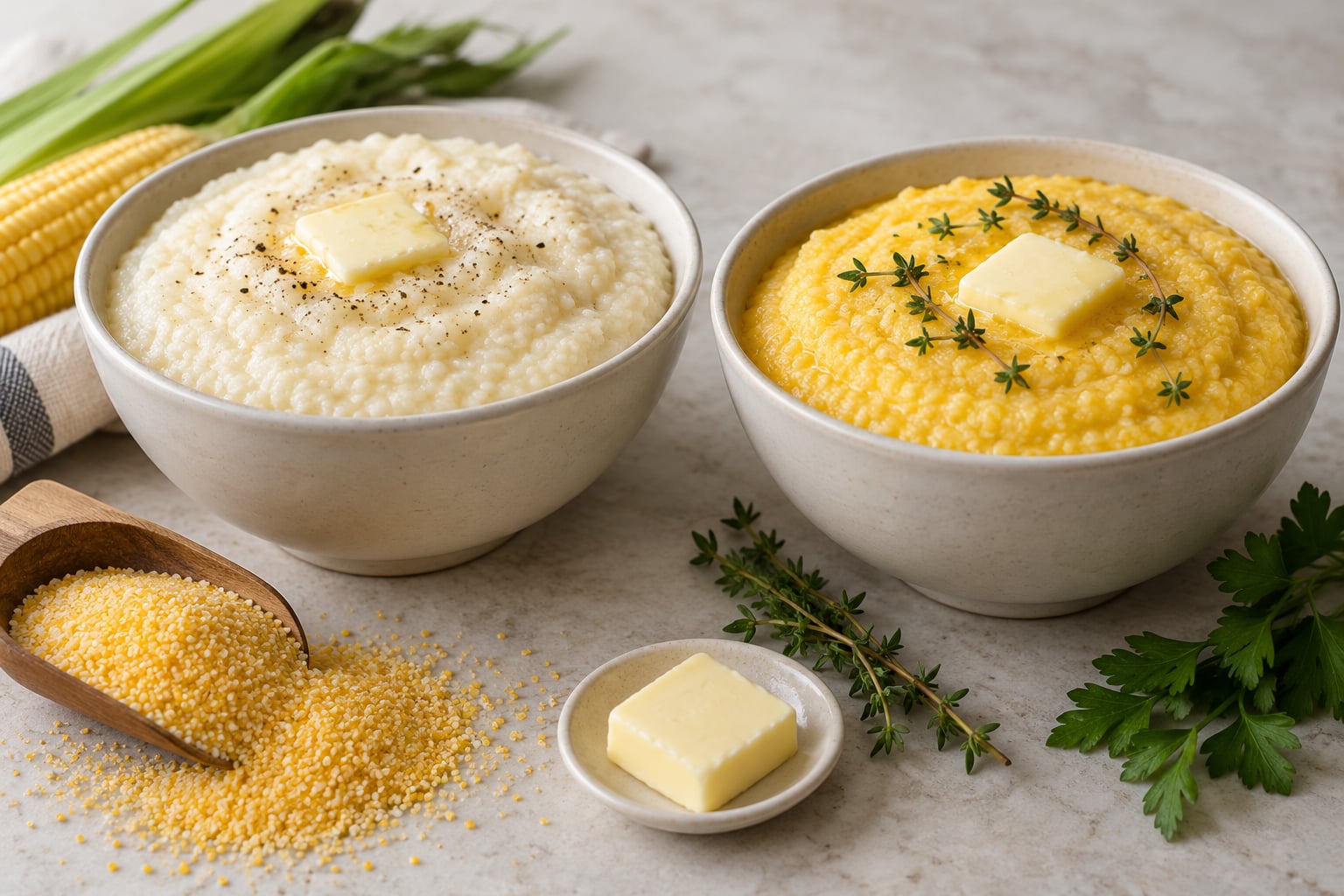
Short answer: both are corn porridges, and the difference comes from the corn, the grind, and how long you cook it. Grits are usually milled from dent corn or nixtamalized hominy and turn creamy and spoonable. Polenta is dry-milled from harder flint corn and holds its shape, so it can be served soft, spread into a firm loaf, sliced, or fried.
Quick answer: what is the difference between grits and polenta is the corn variety, the processing, and the finished texture. Grits are the Southern cousin milled from dent corn or alkali-treated hominy; polenta is the Italian cornmeal milled from harder flint corn. One is built to go creamy in a bowl, the other is built to hold a shape on a plate.
Here is the part that makes people scratch their heads at our market stall: if you pick up two plain yellow bags from two different shelves, they may well be the same ground yellow corn with two different names on them. That is not a scandal, it is just how the retail shelf works, and I would rather tell you that up front than have you find out halfway through a shrimp and grits dinner.
So this guide covers two different things at once: what the traditional versions actually are, and what you are realistically holding in your hand when you shop. Both matter, because the tradition is where the flavor comes from and the label is where your dinner gets decided.
Last updated: October 2026
Table of Contents
- What Is the Difference Between Grits and Polenta at a Glance?
- What Are Grits and Polenta Made From?
- Grits come from field corn, and sometimes from hominy
- Polenta comes from harder flint corn
- Cornmeal, grits and polenta are three different grinds
- How Do Grits and Polenta Taste and Feel?
- How Do You Cook Grits and Polenta?
- The difference between grits and polenta shows up in the pot
- Cooking grits without the glue
- Cooking polenta creamy and firm
- How to make polenta taste like grits
- Where Are Grits and Polenta Traditionally Served?
- Which Should You Choose?
- Frequently Asked Questions
- Are grits and polenta the same thing?
- Which is healthier, grits or polenta?
- Which is creamier, grits or polenta?
- Can I use polenta instead of grits?
- Can I use grits instead of polenta?
- How do I tell whether a product is grits or polenta?
- Conclusion
What Is the Difference Between Grits and Polenta at a Glance?
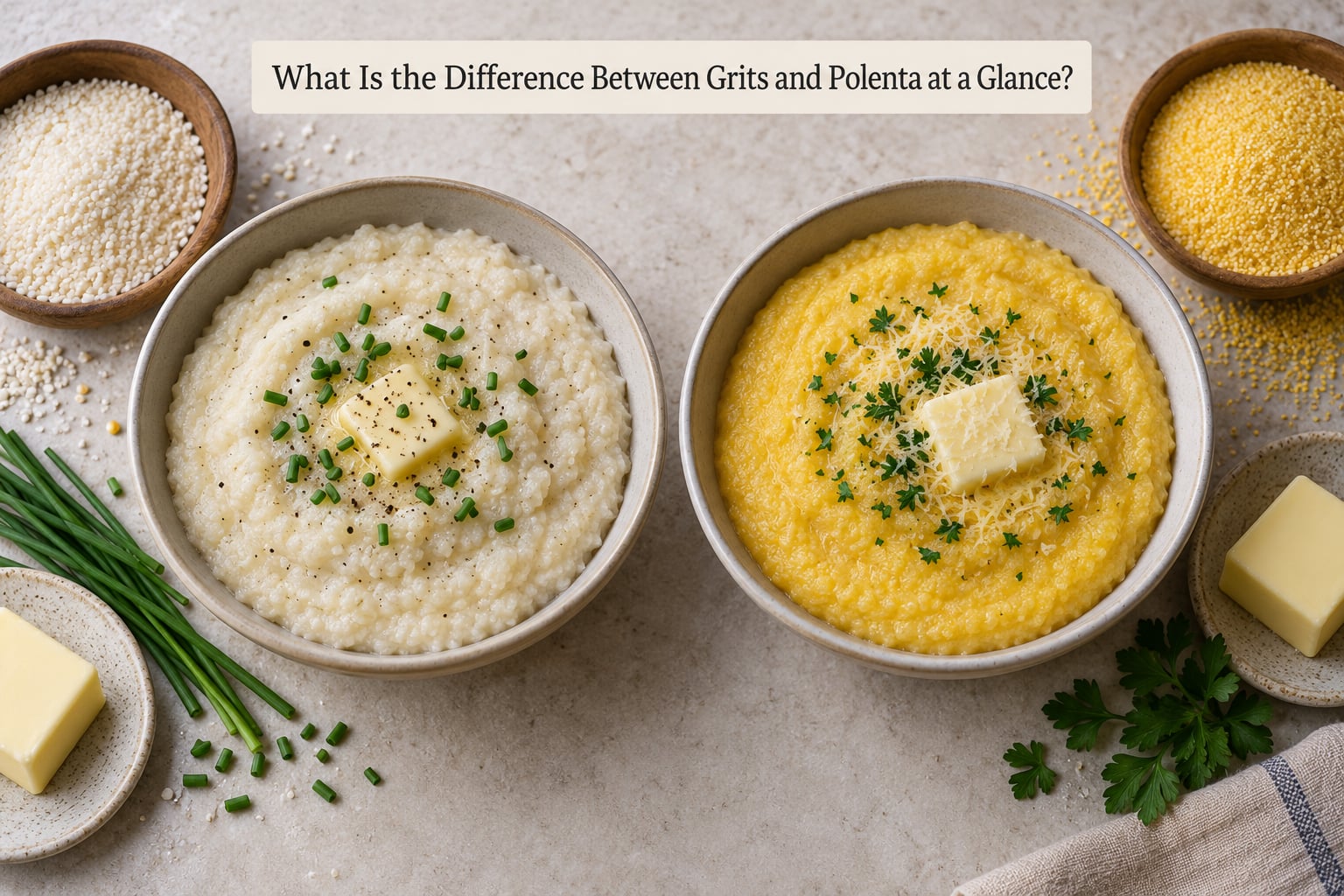
Here is the short version side by side. Read it as a map of the differences, not a scoreboard.
| What to compare | Grits | Polenta |
|---|---|---|
| Origin | American South, rooted in Southeastern corn porridge traditions | Northern Italy, from a word that once meant any ground-grain porridge |
| Main ingredient | Dent corn or nixtamalized hominy (whole kernels) | Flint corn, including heritage varieties such as otto file |
| Processing | Field corn dried, often alkali-treated, then stone-ground dry | Dried and dry-milled, usually without an alkaline soak |
| Grind | Coarse to medium; the fine end of the range is close to cornmeal | Finer than grits, but not as fine as breading cornmeal |
| Texture when cooked | Creamy and soft, or toothy if made from coarse stone-ground grits | Silky when soft, firm and sliceable when cooked further |
| Flavor | Mild, buttery, corn-forward; nuttier when made from hominy | Sweeter and more distinctly corn, with a stronger aroma |
| Color | White for hominy grits, pale yellow or deep yellow for field corn grits | Golden yellow, sometimes near-white with white cornmeal |
| Cooking method | Whisk into boiling liquid, drop the heat, simmer, stir now and then | Whisk slowly into salted boiling liquid, stir often, cook down or spread out |
| Typical simmer | About 20 to 30 minutes for fine grits, 45 to 60 for stone-ground or hominy grits | About 25 to 40 minutes on the stovetop, plus resting time |
| Liquid ratio | Roughly 4 to 5 parts liquid to 1 part grits for a creamy bowl | Roughly 3 to 4 parts liquid to 1 part polenta, less for a firm set |
| Stirring | Frequent at the start, occasional after it thickens | Frequent throughout, especially in the last third of the cook |
| Best used for | Breakfast bowls, cheesy grits, shrimp and grits, fried leftover grit cakes | Soft polenta under braised meats, grilled slabs, tubes and logs, creamy vegetable sides |
One row deserves a flag. Color is the attribute shoppers trust most and it tells you almost nothing, because both foods come in white and yellow versions.
What Are Grits and Polenta Made From?
Starting with the kernel is the only reliable way to tell them apart, so it is worth knowing three things: which corn, which treatment, which grind.
Grits come from field corn, and sometimes from hominy
Grits in the traditional sense come from dent corn, also called field corn. Dent corn has a softer, floury starch, which is exactly why it breaks down into a smooth, creamy porridge instead of staying bouncy. Most Southern grits are simply that corn, dried and stone-ground into granules coarse enough to keep a little bite.
Hominy is the same idea with one extra step. Whole kernels are soaked in an alkaline solution, usually a lime or calcium treatment, and left until the hull loosens. That process is called nixtamalization, and it does two useful things at once: it softens the kernel so it cooks quickly and it makes the niacin in the corn far more available to your body. Hominy can be eaten as kernels, or ground down into what the bag calls hominy grits. Those are the biggest, most distinct granules on the grits shelf, and they cook to a texture somewhere between couscous and very soft rice.
Worth knowing: in the South, grits means both the ingredient and the finished dish, which is part of why the word feels slippery. It can mean the dry grain in the bag, the creamy bowl on the table, or both.
Polenta comes from harder flint corn
Polenta starts from flint corn, which has a harder, glassier starch. Some mills use heritage Italian flint corn such as otto file, a variety that came to the United States from the Amalfi coast in the early 1900s. Hard starch is why polenta holds together: cooked slowly with enough stirring, it firms up into something you can spread on a tray, chill, and slice.
The word itself is older than the dish. Polenta was a broad term for a porridge of ground grain cooked in water, and in Roman times it described no corn at all, since maize had not reached Europe. Over centuries it narrowed into the cornmeal dish we mean today.
Now the honest part. A great deal of polenta sold today, including a lot of polenta in this country, is just dry-milled yellow cornmeal, and a great deal of grits is just dry-milled yellow cornmeal too. Cooking forum users have been pointing this out for years, and they are right: coarse untreated yellow corn gets ground fine and called grits, ground slightly finer and called polenta, ground fine and called cornmeal. When the bag says only yellow cornmeal, the honest answer is that the traditional difference is gone and you are working with the ingredient, not the regional dish.
Cornmeal, grits and polenta are three different grinds
- Cornmeal is the fine grind used for cornbread, tortillas, dredging and frying. It has almost no bite.
- Grits are the coarser grind, meant to be simmered. The particle size is what gives you a toothsome bite.
- Polenta sits between the two: finer than most grits, coarser than breading cornmeal, and milled to a consistency that becomes creamy or firm depending on the cook.
When a package says stone-ground, it means the mill used a stone rather than steel rollers. It matters more than most labels admit, because steel mills run hot enough to knock off some of the germ, and that germ is where a lot of the flavor lives.
How Do Grits and Polenta Taste and Feel?
Taste follows the processing, so the same comparisons that explain the ingredients also explain the flavor.
Grits land mild and round in the bowl. Stone-ground grits have a deeper, toastier corn taste, and hominy grits are the nuttiest of the lot because the alkaline soak does something subtle to the kernel’s aroma. Finished Southern-style, grits are usually leaned on by the toppings: butter, cheese, cream, black pepper, scallions, shrimp. The base flavor rarely needs to shout.
Polenta tastes sweeter and more overtly corn, sometimes described as corn-sweet rather than savory. Cooked soft and finished with olive oil, Parmesan and mushrooms, the corn flavor comes through more than it does in a heavily buttered bowl of grits. Cook it further and the flavor concentrates as the moisture cooks away.
Texture is where the two really part ways. Fine grits go creamy and loose, almost like a thick porridge, while coarse stone-ground grits keep a distinct grain between the teeth. Polenta moves along a line from soft and spoonable to firm enough to hold a clean slice; somewhere in the middle is where the risotto-style and the classic Northern Italian soft polenta sit.
Neither one is the better food. They were built for different jobs, and a bowl of polenta next to a plate of Southern grits at the same table is not a competition, it is a very long lunch.
How Do You Cook Grits and Polenta?
The difference between grits and polenta shows up in the pot
Three variables decide the outcome: how much liquid, how hot, and how often you stir. Everything else is seasoning.
- Liquid. Grits drink more. Start near 4 to 5 parts liquid per part grits for a creamy bowl, and hold back a splash to loosen at the end.
- Heat. Bring liquid to a full boil before the grain goes in, then drop to a low simmer. Boiling grits after the first minute is how you get gluey, gummy porridge.
- Stirring. Stir constantly for the first minute or two to break up clumps, then every few minutes. For polenta, keep stirring longer and more often.
- Time. Fine or quick grits finish fast; stone-ground and hominy grits need a real simmer. Polenta wants a slow, patient stir and then a rest off the heat.
Cooking grits without the glue
Whisk the grits into boiling salted liquid a little at a time. Once they thicken to the consistency of thick cream, drop the heat to low and simmer, stirring every few minutes so nothing catches on the bottom. Add milk or cream in place of some of the water for a richer bowl, and stir in butter and cheese off the heat so they do not split.
Quick grits are done in a few minutes. Instant grits need only hot liquid and a stir. Stone-ground or hominy grits want 45 to 60 minutes at a bare simmer, and they are worth the time because the texture they give you is the whole point.
Cooking polenta creamy and firm
Salt the water and bring it to a boil. Pour the polenta in a thin steady stream while whisking hard, then keep the heat low and stir often for 25 to 40 minutes. It will move from loose to soft to firm as the water cooks off, and you decide where to stop.
For soft polenta, stop while it is still flowing and loose enough to slump off the spoon. For a firm set that you want to slice or grill, cook it down further, spread it about an inch thick on a tray, let it cool, then chill before cutting. Resting the finished pot for a few minutes before serving takes the edge off polenta’s sometimes gluey reputation more than any amount of stirring will.
How to make polenta taste like grits
If you want polenta to land closer to a bowl of grits, add more butter and a heavier hand with black pepper, finish it with a splash of cream, and pull it off the heat a little earlier than you think. Coarsely ground grits also scatter more slowly, which is why grits bowls look loose and polenta bowls look glossy.
Where Are Grits and Polenta Traditionally Served?
Grits are strongly tied to the American South. Shrimp and grits is the famous one, but the everyday version matters more: a bowl of cheesy grits with eggs on a Saturday morning, grits as the base of a breakfast hash, or grits alongside fried fish. Leftover grits get a second life in the skillet as grit cakes, a habit cast-iron cooks keep alive and most cookbooks skip.
Polenta comes from Northern Italian cooking, where it is rarely the star. It shows up as a soft, spoonable bed under a rich ragù or a braise, as a risotto-style side, as grilled or fried slabs alongside roasted vegetables, and as tubes or logs that hold their shape on the plate. In that kitchen it is a canvas for whatever sauce or vegetables are in front of you.
Both traditions are real and neither is a costume. If you have ever had grits with butter and black pepper at six in the morning, you already know the food is not nostalgia, it is just breakfast.
Which Should You Choose?
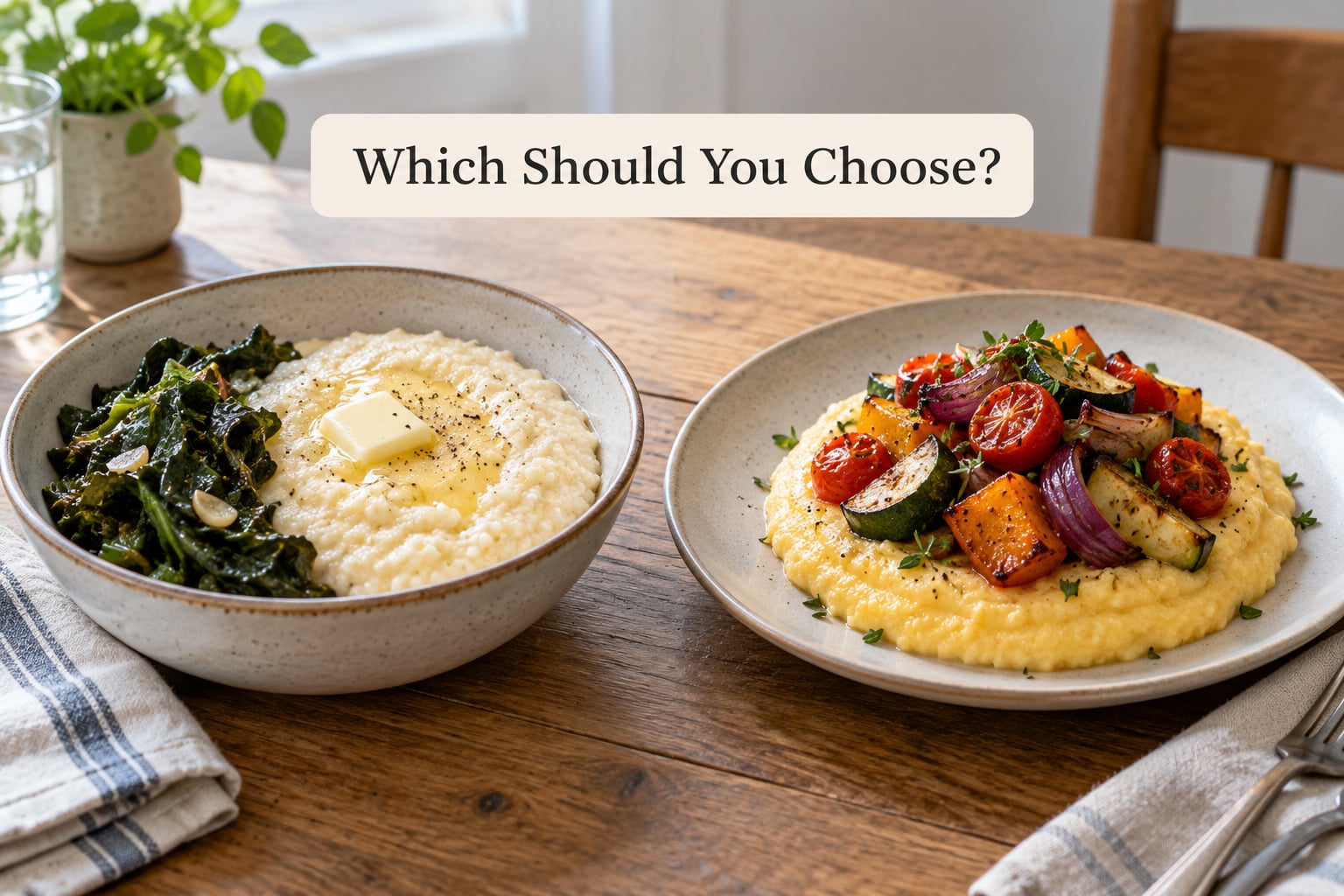
Choose grits for a creamy Southern-style breakfast, a hearty side that soaks up eggs and gravy, shrimp and grits, or a batch you plan to turn into fried grit cakes the next morning.
Choose polenta for a smooth puree, a firm sliceable base for grilling or frying, or a vegetable-forward meal where the sauce is doing the talking.
You can swap one for the other, but not without adjusting. Polenta standing in for grits wants roughly a quarter to a third less liquid, a slightly shorter cook, and more frequent stirring to keep it from catching. Grits standing in for polenta wants more liquid, a longer simmer, and an expectation that it will be looser and grainier than the recipe pictured.
Neither one is a real replacement when texture is the point of the dish. A sliceable polenta loaf made from grits will not hold, and a creamy shrimp and grits made from fine polenta will lose the bite that made the dish worth cooking.
For leftovers, both keep about three to four days covered in the refrigerator. Polenta reheats more gracefully than grits, which need an extra splash of liquid and a low heat to come back creamy instead of pasty.
Frequently Asked Questions
Are grits and polenta the same thing?
Not exactly, though plenty of bags blur the line. Traditional grits are milled from dent corn or alkali-treated hominy, while traditional polenta is dry-milled from harder flint corn. What is the difference between grits and polenta in practice is texture: grits go creamy and loose, polenta holds a shape. Store-bought coarse yellow corn is frequently sold under both names.
Which is healthier, grits or polenta?
Both are plain corn and neither is a health food in the way the word gets used casually. The one real difference is nixtamalization: grits made from hominy are alkali-treated, which loosens the hull and makes the corn’s niacin much more available to the body. Polenta is usually dry-milled with no such step. Enrichment and what you stir in matter more day to day.
Which is creamier, grits or polenta?
Grits, by tradition. Fine grits break down into a loose, creamy porridge, and stone-ground grits stay creamier in the bowl than soft polenta, which tends toward glossy and cohesive. Polenta is creamier than most people expect only if you stop cooking it early and add butter and cream off the heat. Texture depends as much on the grind as on the name.
Can I use polenta instead of grits?
Yes, for soups, casseroles and creamy bowls where texture is not the whole point. Use about a quarter to a third less liquid than the grits recipe calls for, add the polenta slowly while the liquid boils, stir more often than you would for grits, and pull the pan off the heat a minute early. The result will be smoother and less toothsome.
Can I use grits instead of polenta?
Yes, for a looser, grainier version of the same dish. Give it more liquid than the polenta recipe calls for and let it simmer longer, since grits usually need 20 to 30 minutes and stone-ground grits closer to an hour. Do not expect a firm sliceable loaf from grits, and expect a thicker, more rustic texture than the recipe pictured.
How do I tell whether a product is grits or polenta?
Read the ingredient line, not the front of the bag. If it says only yellow cornmeal or degerminated corn, you are holding dry-milled corn and the name on the front tells you more about marketing than contents. If it names the grind, stone-ground or hominy grits, you are looking at the coarser grits family. Real polenta is usually milled finer and sold as polenta cornmeal.
Conclusion
What is the difference between grits and polenta, in one line: grits come from dent corn or nixtamalized hominy and turn creamy and loose, while polenta is dry-milled from harder flint corn and holds a shape. Start there: grits for Southern-style comfort food and breakfast, polenta for a smooth puree or a firm sliceable base, then adjust the liquid and the toppings to suit the meal.