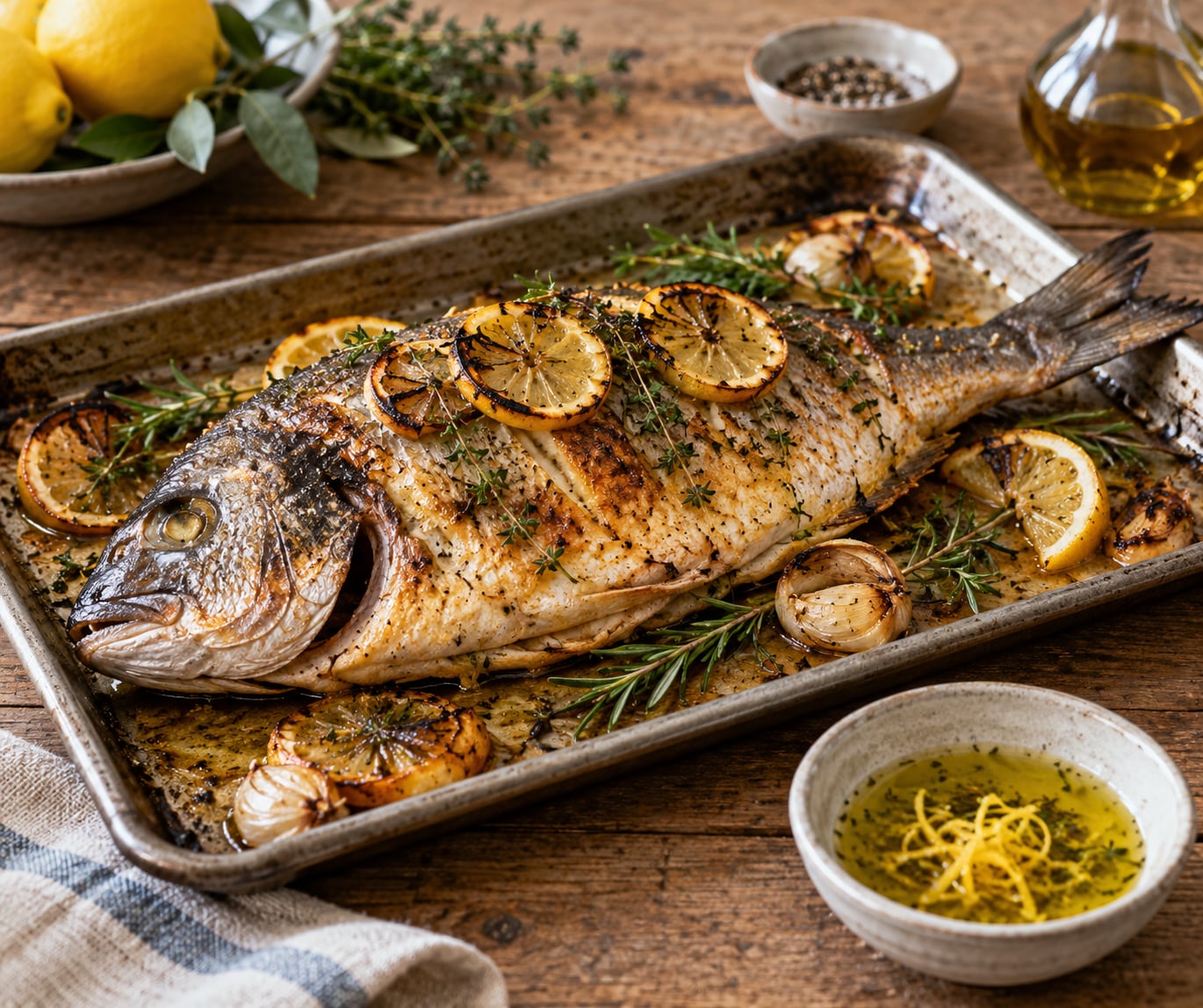
Baking a whole fish with lemon takes about 25 to 45 minutes in a hot oven, depending on weight. Score the skin, rub it with lemon zest, salt, pepper and olive oil, tuck lemon slices into the cavity, and roast at 400°F (200°C) until the thickest part behind the head reaches 145°F (63°C) and flakes with a fork.
It is the most impressive dinner you can make with almost no work, and the technique has a wide margin for error. A fish undercooked by a couple of minutes can go back in for two more. A fish overcooked by five is ruined, which is why the thermometer matters more than any timer.
Whole fish is also the best value at the market counter. You pay for one fish and get two fillets worth of meat, bones that go on the stockpot afterward, and a dinner that looks like it came out of a restaurant kitchen. Our regular customers at the market ask about this one constantly, mostly for the same reason: nobody wants to gut a whole snapper on a weeknight.
Good news is that your fishmonger will do the hard part for a couple of dollars, or will at least talk you through it. Ask them to scale and gut the fish and leave the head on. Then the cooking is 15 minutes of prep and the rest is oven time.
Table of Contents
- What You Need
- Step-by-Step: How to Bake Whole Fish with Lemon
- 1. Prepare the Fish
- 2. Score the Skin and Make Lemon-Salt Seasoning
- 3. Add Lemon and Roast
- 4. Check Doneness and Rest
- Common Mistakes
- Frequently Asked Questions
- What is the best whole fish to bake for a first time cook?
- What temperature should I bake a whole fish with lemon at?
- How long do I leave the fish in the oven?
- Is it better to bake fish covered or uncovered with foil?
- How do I know when a whole fish is cooked through?
- What is it called when you use lemon to cook fish?
- Conclusion
What You Need
Start with the fish. A 1 to 1.5 pound whole snapper, sea bass, sea bream or trout works well and fits a home oven without crowding. Anything up to about 2.5 pounds still fits on a large rimmed baking sheet, but watch the time carefully past 2 pounds because the tail end cooks faster than the head.
Ask for the fish scaled and gutted. If you want the head and tail for presentation, buy it that way. If you would rather not deal with a head on the platter, have the shop remove it and trim the tail fin, which is the other fiddly bit.
Fresh lemon matters here more than in most recipes. Bottled juice loses the aromatic oils that sit in the zest, and those oils are half of what you are baking with. Two lemons per fish is the usual amount: one for slices and zest, one to finish with. Thin-skinned Meyer lemons give a softer, sweeter result, and they are worth using if your market carries them.
Then add olive oil, coarse or kosher salt, black pepper and whatever herbs you have. Parsley, dill, thyme and oregano all work, and a few garlic cloves sliced thin into the cavity do no harm at all.
For equipment, a rimmed baking sheet lined with parchment is all you need. An oven-safe cast iron skillet or a small roasting pan also works and traps more moisture, at the cost of crisper skin. A fish spatula or two wide spatulas help for turning, though most whole fish do not need turning. A thin probe thermometer is the one tool I would buy before anything else on this list.
Here is how each part of the lemon earns its place:
- Slices go in the cavity and under the fish. They steam the flesh from the inside and stop the belly from drying out.
- Zest mixed into the oil or salt carries the aromatic oils. This is the part bottled juice cannot give you.
- Juice added late, or basted on during cooking, keeps the top of the fish moist and seasons the finished sauce.
- Lemon salt is coarse salt with the zest packed into it. Good on the skin, where you want crunch.
- Preserved lemon is the salty shortcut. Thinly sliced and tucked in with herbs, it gives the same depth with less work.
Step-by-Step: How to Bake Whole Fish with Lemon
Preheat the oven to 400°F (200°C) before you start prepping. A cold oven is the most common reason fish steams instead of roasting, and steaming is what gives you pale skin and a watery tray.
1. Prepare the Fish
Rinse the fish under cold running water and pat it completely dry inside and out. Dry really matters here. Any surface moisture turns to steam in the hot oven, and steam is the enemy of browning.
If it still has scales, scale it with the back of a knife or a fish scaler, working from tail to head. Then rinse again and dry again. If your fishmonger gutted it through the belly, check that the cavity is clean, because bits of organ left behind taste bitter.
Trim off the pectoral and dorsal fins if they stand up awkwardly, and snip the tail fin if it is spiky, which it usually is. Then lay the fish skin side down on a lined tray or in a pan.
A useful thing to do at this stage is weigh the fish. Scales vary wildly between fish, and the weight is a far better guide to cooking time than the recipe you found online. Write it down. It takes five seconds and saves you from guessing.
2. Score the Skin and Make Lemon-Salt Seasoning
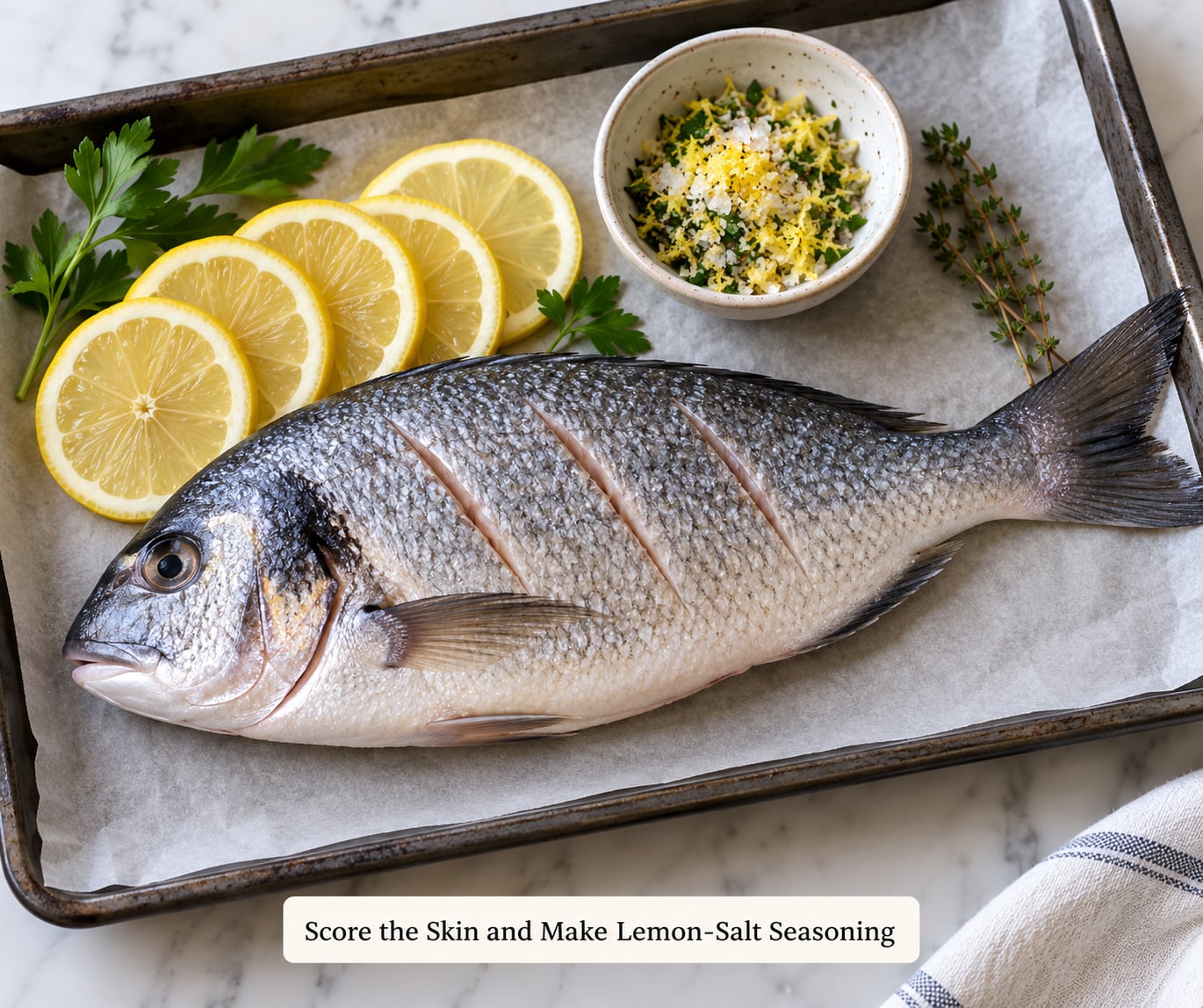
Make three or four shallow diagonal cuts across the skin on each side, cutting only through the skin and barely into the flesh. Run from behind the head toward the tail. Do not cut deep; the scoring is there to let heat and seasoning in, not to open the fish up.
Then mix two tablespoons of olive oil with the zest of one lemon, a teaspoon of kosher salt, three or four grinds of pepper and a tablespoon of whatever herb you chopped. If you have flaky salt, use it on the skin for crunch and the finer salt inside the cavity.
Rub the mixture over the outside of the fish and into the cuts. Season the cavity as well, with a little more salt than feels right, and put two or three lemon slices inside with a few herb sprigs.
If you are using garlic, slice the cloves paper thin and tuck them in with the lemon. Thick slices will still be raw in the middle when the fish is done.
3. Add Lemon and Roast
Lay two or three lemon slices on top of the fish and a couple more around it in the tray. Those slices in the tray catch the drippings and stop the parchment from smoking, which is a small but real problem with fish baked at 400°F.
Put the tray in the oven. Here is roughly how long to bake a whole fish at 400°F (200°C), and how long at 350°F (175°C) if you want a gentler roast:
| Fish weight | At 400°F (200°C) | At 350°F (175°C) | Notes |
|---|---|---|---|
| 1 lb (450 g) | 20 to 25 minutes | 28 to 32 minutes | Start checking at 20 minutes |
| 1.5 lb (700 g) | 25 to 30 minutes | 33 to 38 minutes | The most common size |
| 2 lb (900 g) | 30 to 35 minutes | 38 to 45 minutes | Check at the thickest point near the head |
| 2.5 lb (1.1 kg) | 35 to 40 minutes | 45 to 50 minutes | Cover the top with foil if it browns fast |
| 3.5 lb (1.6 kg) | 45 to 50 minutes | 55 to 65 minutes | Needs a roasting pan, not a sheet |
These are windows, not instructions. Fish varies by species and by how cold it was when it went in, so treat the table as a starting point and the thermometer as the decision.
Do not open the oven door more than once during the cook. Every opening drops the temperature, and on a short bake that is enough to push you several minutes past where you wanted to be.
Should you cover it with foil? It depends on what you want. Foil holds moisture in and gives you softer, silkier flesh, which suits sea bass and bream. Uncovered gives you crisper skin and better browning, which suits snapper and trout. Foil for the first two thirds, then pull it off for the last stretch, gets you both.
Do not flip the fish. You can baste once, halfway through, with the juices from the bottom of the tray. More than that is fiddly and mostly unnecessary.
4. Check Doneness and Rest
Start checking when the table says, not before. Put an instant-read thermometer into the thickest flesh, right behind the head and above the backbone, avoiding the bone itself. You are looking for 145°F (63°C).
You can back that up with two visual tests. The flesh should turn from translucent to opaque and separate into flakes when you lift it with a fork. If the flakes are still sticking tightly to the bone, give it a few more minutes.
Then take the fish out and rest it for five minutes. The heat keeps moving outward during that time, and the juices settle back into the flesh instead of running out onto the board. Resting a baked whole fish is the single cheapest way to make it taste better.
Finish it with a squeeze of fresh lemon juice and a handful of chopped parsley or dill. For a sauce, pour the tray juices into a small pan, add a knob of cold butter and swirl it off the heat until it emulsifies. Spoon it over the fish at the table.
Common Mistakes
The fish came out dry and rubbery. This is the big one, and it is almost always one of three things: too long in the oven, too high a temperature, or too little fat. Pulling the fish at 135°F (57°C) and letting it carry over to 145°F during the rest gives you a margin that butter and bravado cannot. Some cooks also lower the oven to 375°F (190°C) for fish over 2 pounds, which is a reasonable compromise.
It cooked unevenly. A very thick fish will have a done tail and a raw shoulder. Two fixes help. Score the skin as described, which lets heat reach the flesh evenly, and tent the skin with a small piece of foil if the shoulder is browning before the tail is opaque. Baste once at the halfway mark rather than rotating the fish.
The skin stuck to the tray. That is moisture again, or a tray that was too hot. Dry the fish thoroughly, line with parchment rather than relying on oil alone, and use a rimmed sheet with a lip so the juices pool instead of scorching under the fish.
The lemon flavor tastes flat or bitter. Bitter usually means the slices sat on the skin through the whole bake and scorched. Put lemon in the cavity and in the tray, and add the fresh juice at the very end. If the flavor is only weak, the zest was probably measured by volume and ended up too sparse. Grate it over the oil and count the spoonfuls.
The garlic butter burned before the fish was done. Butter burns at a lower temperature than fish needs. Mix a little olive oil in with it, push it under the skin rather than on top of it, or skip it and add a plain butter sauce at the table.
You cannot tell if it is done without cutting into it. Do not cut it. Press the thickest part with a finger: raw fish is springy, cooked fish gives slightly. Combine that with the flake test and a thermometer, and you will stop guessing.
Nobody wants the head on the table. Have the fishmonger remove it before you cook, or serve it family style with the head facing away from the guest who wants it. A whole fish is meant to be a bit of an event.
Finally, leftover storage. Refrigerate cooked fish within two hours, use it within three to four days in a sealed container, and freeze it for up to two to three months. Reheat gently in the oven rather than in a hot pan, or the flesh goes chalky.
Frequently Asked Questions
What is the best whole fish to bake for a first time cook?
A whole snapper or sea bass around 1 to 1.5 pounds is the easiest place to start. Both have firm, mild flesh, thick enough parts that overcooking is easy to avoid and thin enough skin that no special equipment helps. Sea trout and sardines cook even faster and suit a very hot oven. Avoid very oily fish like mackerel for a first attempt, since the fat tends to drip and scorch in a hot tray.
What temperature should I bake a whole fish with lemon at?
400°F (200°C) is the standard for roasting a whole fish. It browns the skin, cooks a 1.5 pound fish in about 25 to 30 minutes and lets the lemon slices caramelize without burning. Drop to 350°F (175°C) if the fish is over 2 pounds or if your oven runs hot, and add 8 to 10 minutes. Home ovens vary enough that the thermometer matters more than the dial.
How long do I leave the fish in the oven?
Bake a 1.5 pound whole fish at 400°F (200°C) for 25 to 30 minutes, then start checking. The rule of thumb is about 10 minutes per half pound, but a 1 pound fish needs closer to 20 to 25 minutes and a 2.5 pound fish needs 35 to 40. Weighing the fish and using the thermometer is far more reliable than any recipe timing. Pull it the moment the thickest flesh hits 145°F (63°C).
Is it better to bake fish covered or uncovered with foil?
Cover it with foil for softer, more moist flesh and uncovered for crisp, browned skin. The best compromise is to cover for the first two thirds of the cooking time, then remove the foil so the skin dries and crisps for the last stretch. Whatever you choose, put a few lemon slices in the tray and baste once at the halfway mark to keep the top of the fish from drying out.
How do I know when a whole fish is cooked through?
Check the thickest part behind the head, above the backbone. Insert an instant-read thermometer and look for 145°F (63°C), making sure the probe is not touching bone. Visually, the flesh turns from translucent to opaque and separates into clean flakes when lifted with a fork. If the flakes cling tightly, it needs a few more minutes. Never cut the fish open to test it.
What is it called when you use lemon to cook fish?
Baking fish wrapped with citrus and aromatics in a sealed parcel is called cooking it en papillote. Curing raw fish in lemon juice without heat is ceviche, slow cooking fish submerged in fat is confit, and encasing it in a salt crust to trap moisture is salt-baking. Your basic oven method is a plain roast, which is the everyday version of all of them.
Conclusion
The whole method comes down to five things. Prep the oven to 400°F (200°C), dry the fish and score the skin, rub on the lemon zest and salt mix with olive oil, load the cavity with lemon slices and roast until 145°F (63°C), then rest it five minutes before serving.
Your first action is simple: ask your fishmonger for a scaled and gutted whole snapper or sea bass in the 1 to 1.5 pound range. Weigh it in front of you, and from there the table above does the rest.