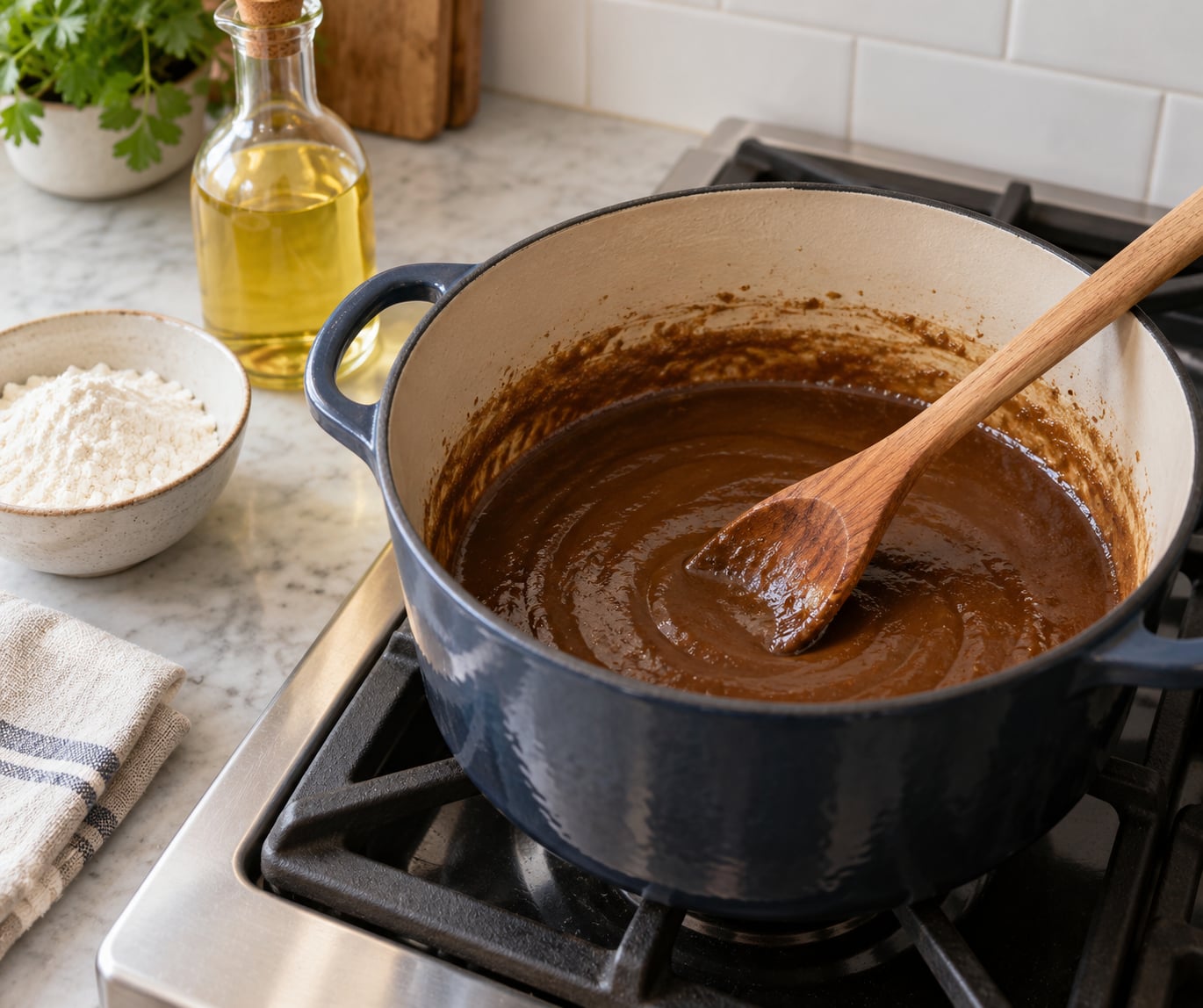
A roux for gumbo is equal parts fat and flour, cooked together over medium-low heat with constant stirring until the flour browns to a rich, dark chocolate color. That 1:1 ratio is the entire formula, and the only two real decisions left are which oil you pour into the pan and how far you let the color go. I cook gumbo most cold weekends, and this is the method that has never given me trouble.
The part people get wrong is rarely the recipe. It is the heat, the stirring, and stopping at the right shade instead of chasing a number on the clock.
Table of Contents
- What You Need
- Which oil should you use for gumbo roux?
- Step-by-Step
- Step 1: Melt the Fat Evenly
- Step 2: Whisk in the Flour
- Step 3: Cook the Roux to the Right Color
- Step 4: Add the Holy Trinity, Then the Broth
- Common Mistakes
- Frequently Asked Questions
- What is the ratio of flour to fat for a gumbo roux?
- How dark should a gumbo roux be?
- Can you use vegetable oil for a roux?
- Why is my gumbo roux not getting darker?
- How do you make a dry roux in the oven?
- How long does roux last in the fridge?
- Conclusion
What You Need
Two ingredients, one tool, and a decision about color. Measure everything before you turn on the burner, because a roux goes from sandy to glossy to dark fast enough that you will not want to break stride halfway through to hunt for the measuring cup.
The ratio is 1:1 by volume. One cup of fat to one cup of all-purpose flour, every time. For a chicken gumbo built around one bird, most cooks I know use 3/4 cup of each. For a seafood gumbo or a pot meant to feed ten to twelve, go to a full cup of each, or 1.5 cups of each when the crowd is bigger. Scaling is just cup counts: the ratio never changes.
- Fat: canola, vegetable, peanut, or avocado oil. Lard and bacon drippings are the traditional Cajun choice, but they smoke at a much lower temperature, so they need low heat and patience.
- Flour: plain all-purpose flour, about 1 cup or 120 grams per cup of oil, spooned and leveled rather than scooped.
- Pot: a heavy pot or Dutch oven. A wide surface browns faster, which matters more than anything else when you are chasing a dark roux in under half an hour.
- Spoon: a long wooden spoon with a slanted edge, or a whisk. The slanted edge scrapes the bottom clean, which is where the fond that tells you the color stage lives.
- Also nearby: the holy trinity diced and ready, a ladle of cool broth, and a long oven mitt. Hot oil splatters, and it does not care how excited you are.
Which oil should you use for gumbo roux?
Pick a refined, neutral oil with a high smoke point when you are cooking past peanut-butter color. Butter and extra virgin olive oil break down long before the flour gets dark, and both smoke at temperatures that will also darken and burn the flour itself.
| Fat | Approximate smoke point | Verdict for a dark gumbo roux |
|---|---|---|
| Canola oil | 400-450 F | The default. Clean flavor, holds up to a dark roux |
| Vegetable or soybean oil | 400-450 F | Fine, and a pantry staple in most kitchens |
| Peanut oil | 450-480 F | Good, with a faint peanut note underneath the nuttiness |
| Avocado oil | 480-520 F | Highest smoke point on the list and the least flavor |
| Refined olive oil | around 470 F | Works, since the olive flavor is stripped out |
| Extra virgin olive oil | 375-405 F | Skip it for a dark roux. It greens and turns acrid on the way there |
| Butter | around 350 F | Only for a pale roux in something like a cheese sauce |
| Lard or bacon drippings | around 190 F | Traditional and delicious, but cook low and stir constantly |
Flour is simpler than fat. All-purpose is the standard and I would not stray from it for a first pot. Bread flour is a touch higher in protein and works fine, and whole wheat or pizza flour will brown faster and taste nuttier, so pull them a few minutes earlier than the chart says.
Step-by-Step
Step 1: Melt the Fat Evenly
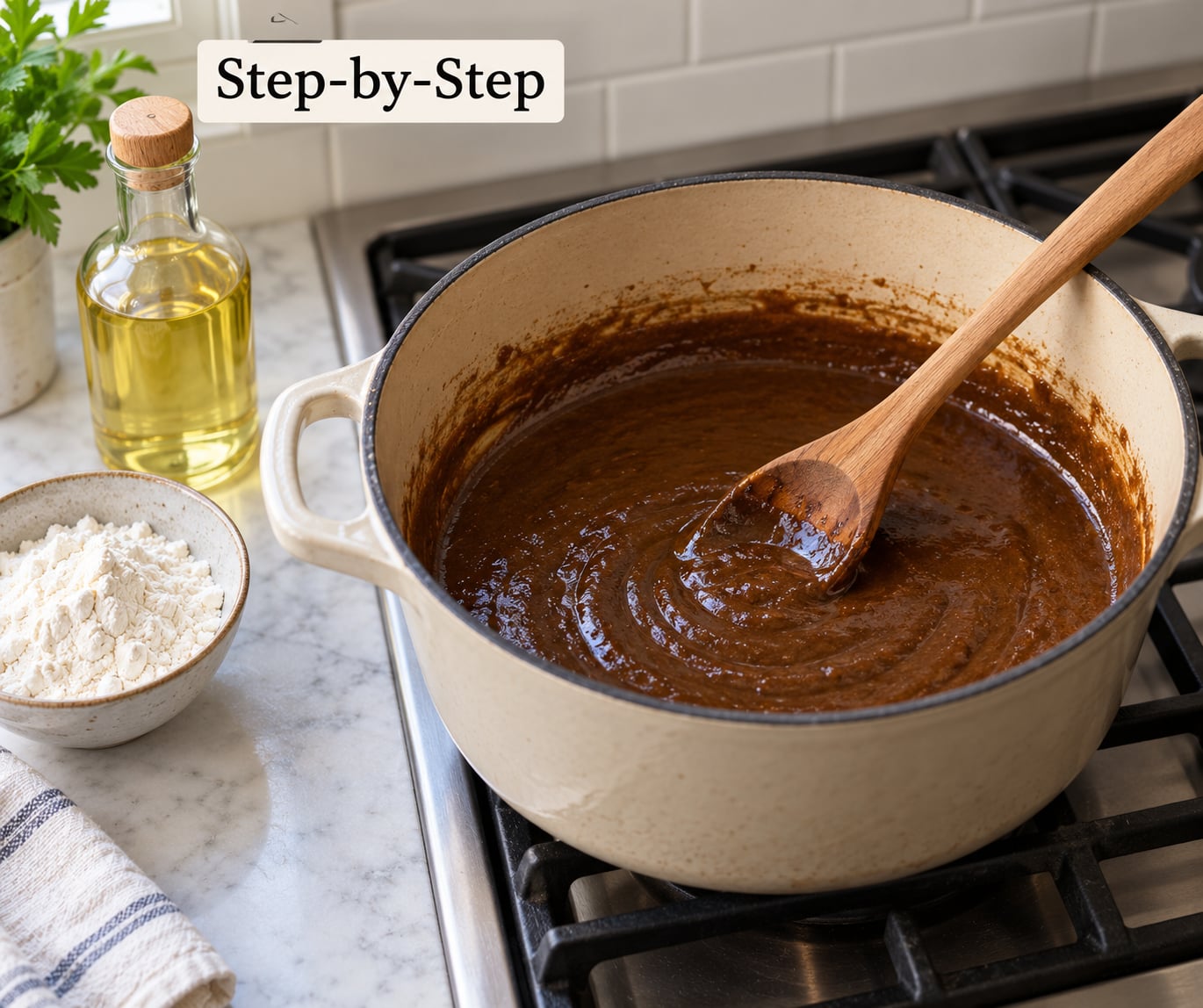
Pour the measured oil into the pot and set it over medium-low heat. Give it a slow swirl until it flows across the bottom in a thin, glossy film with no ripples left. That takes about three to five minutes.
If the oil starts to shimmer or you catch a whiff of smoke before the flour goes in, turn the heat down a notch. Smoked oil tastes smoked in the finished gumbo, and once the flour is in, smoke means burning.
Step 2: Whisk in the Flour
Add the flour a small handful at a time, whisking constantly so no dry pockets survive. The mixture will grab and stiffen into a tacky paste first, then loosen into something close to thick gravy. Both stages are normal, and neither one means you used too much oil.
Keep scraping along the bottom of the pot as you stir. That fond layer is the part that browns fastest, and letting it catch is how a batch goes from deep brown to black while the top still looks fine.
Step 3: Cook the Roux to the Right Color
Now judge by sight and smell, not by the clock. The color chart below is a guide, and the times assume medium-low heat on a normal burner. A heavier pot, a wider pan, or a gas flame with more output will move faster.
| Color stage | What it looks and smells like | Time at medium-low | Good for |
|---|---|---|---|
| Blonde | Pale cream, still smells like raw flour | 5-10 minutes | Thickening only, light broths |
| Peanut butter | Tan, first nutty aroma | 15-20 minutes | Shrimp etouffee, white stews |
| Cocoa brown | Milk-chocolate brown, deeply nutty | 25-35 minutes | Chicken and andouille gumbo, gumbo z’herbes |
| Dark chocolate | Very dark brown, close to espresso | 45-60 minutes or more | Seafood gumbo, andouille-heavy pots |
If you got here searching how to make a roux for gumbo and want the short answer on color: dark enough that it reads as chocolate rather than tan. Most New Orleans cooks cook it past the point where you would willingly eat a spoonful on its own, and the flavor comes from that depth rather than from the flour alone.
Plenty of cooks blame their cast iron and their burner whenever a roux stalls at cocoa color and refuses to go further, and they are usually right. Others will tell you a good roux never needs more than 10 to 15 minutes at a hotter setting. Neither claim is wrong; the burner, the pan, and how long you are comfortable standing next to it decide the answer for your kitchen.
If you overshoot slightly, whisk in a tablespoon or two of fresh oil and flour and keep stirring. That pulls the color back a shade, which is the only way to lighten a batch. If you see true black specks, smell smoke, or catch a burnt edge, stop: a burned roux cannot be saved, and no amount of broth fixes the bitterness. Tip it out, wipe the pot, and start again.
Step 4: Add the Holy Trinity, Then the Broth
Dump the diced onion, celery, and bell pepper straight into the pan the moment you hit your target color, plus a couple of minced garlic cloves if you like. It stops the browning dead and starts a new phase, softening the aromatics in the fat for two or three minutes while the flavor builds.
Then add cool broth a cup at a time, stirring hard between each addition. Hot roux and cold liquid do not emulsify; they split, and you get a greasy layer on top instead of a thickened pot. Once the mixture thins enough to run off the spoon in a slow sheet, turn the heat up and let it simmer, adding more broth until the consistency looks the way you want it.
Do not walk away during the dark stage. One phone call is enough time to go from dark chocolate to charcoal.
There is a hands-off alternative if your stirring arm gives out. For a dry roux, skip the fat: stir the flour with a pinch of salt, spread it thin on a sheet pan or in a cast iron skillet, and bake at 350 F for about two hours, stirring every 20 minutes or so. Color develops without the fat, so you have to add the oil later, and it never reaches the depth a stovetop roux gets. It is a genuine shortcut, and it is not the same dish.
Common Mistakes
Almost every bad gumbo I have eaten started with a roux problem, and the symptoms show up in the bowl rather than in the pan. Here is what each one looks like and what fixes it.
| Symptom | What went wrong | Fix |
|---|---|---|
| Gumbo is greasy and split | Roux was too hot when the broth hit it, or the broth went in too fast | Let the roux sit a minute, then add cool broth one cup at a time while whisking hard |
| Gumbo is too thin | Not enough roux, or a very dark batch loosened the pot | Make a slurry of 1 tablespoon oil and 1 tablespoon flour, cook it, and stir it in |
| Gumbo is gluey | Too much roux for the liquid | Add hot broth a ladle at a time. Heat will not thin it on its own |
| Roux is lumpy | Flour dumped in all at once on high heat | Add flour gradually next time and whisk without stopping |
| Roux browns unevenly, dark specks | Heat too high or stirring too slow | Lower the heat, scrape the bottom on every pass, and treat any black speck as burning |
| Roux will not darken | Pan too wide, heat too low, or not enough time in the pot | Turn the heat up a notch and keep stirring. More volume always takes longer |
| Roux tastes bitter or ashy | It burned | Discard it and start over. There is no recovery |
Two habits prevent most of that list. Scrape the bottom of the pot on every few passes, and never trust a timer over your nose. A properly cooked roux smells like toasted nuts and baking chocolate; the moment it turns acrid, you already know.
On storage, cooked roux keeps in an airtight container in the fridge for about a week, and up to two if you are quick about it. For longer, spoon it into a silicone ice cube tray, freeze solid, and move the cubes to a bag or box where they keep for three to four months. Two cubes are roughly a quarter cup of roux, which is about right for a small pot. An uncooked flour-and-oil mix in a jar keeps much longer than the cooked stuff, though it needs the same vigorous browning to taste like anything.
Frequently Asked Questions
What is the ratio of flour to fat for a gumbo roux?
One to one by volume. Measure 1 cup of neutral oil and 1 cup of all-purpose flour, cook them together, and the result thickens about a chicken or seafood gumbo pot. For a chicken gumbo built around one bird, most cooks use 3/4 cup of each. For a pot feeding ten to twelve, a full cup of each or more.
How dark should a gumbo roux be?
Darker than most home cooks expect. Aim for a rich, dark chocolate brown, well past peanut butter and close to espresso, which takes roughly 45-60 minutes at medium-low heat. A peanut-butter-colored roux is fine for shrimp etouffee, while chicken and andouille gumbo sits in the cocoa stage and seafood gumbo wants the darkest shade you can reach without burning.
Can you use vegetable oil for a roux?
Yes. Plain vegetable oil has a smoke point around 400 to 450 F, which is high enough for a dark gumbo roux and it carries no flavor of its own. The same goes for canola and peanut oil. Avoid extra virgin olive oil and butter for a dark roux, since both smoke low and turn acrid before the flour reaches chocolate color.
Why is my gumbo roux not getting darker?
Four usual reasons: the pan is too wide, the heat is too low, the volume is too large, or you are stopping early. A wide pot spreads the roux thin and the surface never gets hot enough to brown the flour. Turn the heat up a notch, keep the stirring constant, and give a big batch the full 45 to 60 minutes that color actually needs.
How do you make a dry roux in the oven?
Skip the fat entirely. Toss plain all-purpose flour with a pinch of salt, spread it about a quarter inch thick on a sheet pan or in a cast iron skillet, and bake at 350 F for roughly two hours. Stir or rotate it every 20 minutes so it colors evenly. Add the oil later at cooking time, since the flour browns without it and never develops quite the same depth.
How long does roux last in the fridge?
About a week in an airtight container, two at the outside if it went in still hot and got covered quickly. Cool it first so you are not trapping steam, then refrigerate. For longer keeping, freeze cooked roux in ice cube trays, two cubes to a quarter cup, and it will hold three to four months in a sealed bag.
Conclusion
Measure the flour and the fat before the heat goes on, keep the stirring going the whole time, and cook only as far as the dish in front of you calls for. Chicken and andouille stops at cocoa brown, seafood wants dark chocolate, and anything past black specks is a batch you throw out.
Honestly, there is not much more to how to make a roux for gumbo than that. Nothing about the method has changed in 2026, and Louisiana cooks would say it should not. Get the color right and the rest of the gumbo mostly takes care of itself.