Yes. If you have ever wanted to know how to cook butternut squash without peeling it, the answer is that the tan skin is completely edible once the squash is cooked, and it turns soft enough to chew or to slip off with a spoon. Roast the whole unpeeled squash at 400F (200C) for 45 to 60 minutes, let it cool 20 to 30 minutes, then halve it and scoop out the seeds. You skip the hardest prep job in the kitchen and you do not lose the fiber and vitamin A sitting right under that skin.
The reason people peel in the first place is that a raw butternut squash has a thick, unforgiving rind that no vegetable peeler handles well. That job goes away entirely when the squash goes into the oven whole. Home cooks on the Well Trained Mind forum describe never peeling at all, halving the squash, rubbing it with oil, and roasting it face down until the skin gives way.
What follows covers three oven methods, then the stovetop, air fryer and microwave routes, plus what to do when the skin stays tough. Cooking time scales with weight, so a 2-pound squash and a 4-pound squash are not the same job.
Table of Contents
- What You Need
- Step-by-Step: How to Cook Butternut Squash Without Peeling It
- How to Roast Butternut Squash Without Peeling It
- How to Cook It on the Stovetop or in the Microwave
- Common Mistakes
- Tips for Serving and Storage
- Frequently Asked Questions
- Can you really eat butternut squash without peeling it?
- Is the skin of butternut squash safe to eat?
- Do I need to pierce butternut squash before roasting it?
- Why is my butternut squash skin still tough after cooking?
- Can butternut squash be cooked in the microwave without peeling?
- How long does cooked butternut squash keep in the refrigerator?
What You Need
For the whole-roast method you need very little: a baking sheet, a fork, and an oven set to 400F (200C). A sheet of parchment is optional. Recipes disagree about it, and both sides have a real argument, so pick based on what you want rather than what a recipe tells you.
- A rimmed baking sheet — for the whole or halved squash. A rim catches the caramelized juices that run off late in the roast.
- A fork — for puncturing the skin before a whole squash goes in the oven.
- A heavy chef’s knife and a stable cutting board — for halving it after cooking. The cooked shell cuts like a soft eggplant, but brace the board with a damp towel first.
- Olive oil or melted butter — for the cut faces. Butter browns faster and tastes nuttier; oil is cheaper and more neutral.
- Salt, pepper, and a finishing seasoning — maple and sage, cumin and cayenne, harissa, or brown sugar and cinnamon.
- A peeler, only if you want one — plenty of cooks roast skin-on and then peel the cooked squash by hand because the skin is thin and looser than the raw one was.
Choose a squash that feels heavy for its size with a matte, even tan skin and no soft spots or green patches. Skin-on cooking works best on fully cured squash with a deep color. A pale, greenish, hard-as-a-rock squash was picked early, and its skin tends to stay leathery no matter how long it roasts. You can tell a well-cured squash from the way it sounds when you set it down, solid and hollow rather than dense.
Step-by-Step: How to Cook Butternut Squash Without Peeling It
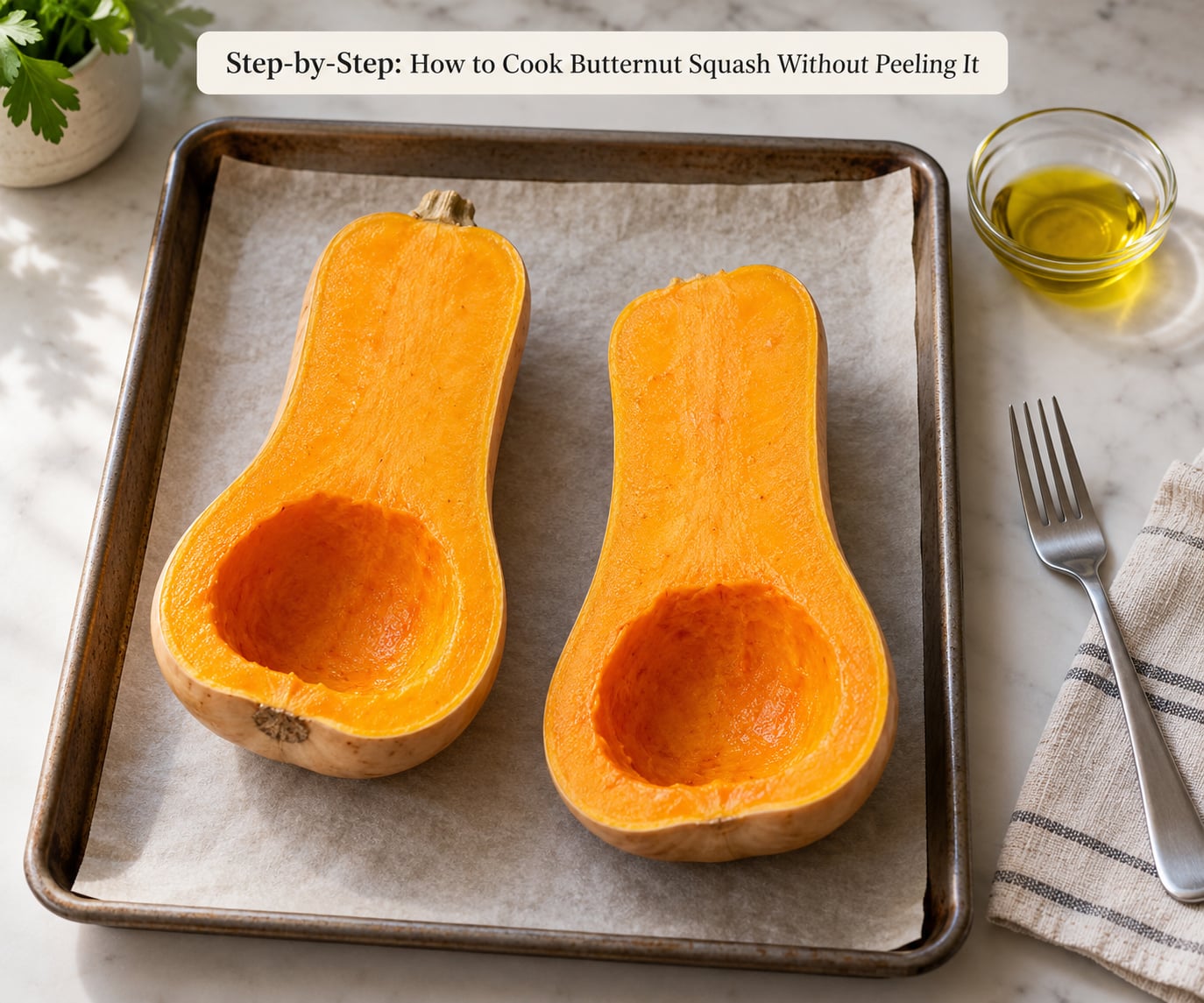
How to Roast Butternut Squash Without Peeling It
This is the one method with no prep knife work at all. You wash, you poke, you bake. Total time is roughly 60 to 90 minutes including the cool-down, and most of it belongs to the oven.
- Wash the squash and scrub the skin. A firm brush or the rough side of a sponge gets into the creases around the stem and base, where field dirt hides.
- Poke 8 to 10 holes in the skin with a fork. Work around the body of the squash rather than clustering the punctures. Steam builds inside a sealed squash as the flesh heats, and the vent holes keep it from bursting across your oven. This step is the reason the whole-roast method is safe rather than dramatic.
- Set it on a baking sheet and roast at 400F (200C) for 45 to 60 minutes. Smaller squash lands near the 45-minute mark and larger ones run closer to an hour or beyond.
- Test it. A knife should slide into the thickest part of the neck with no resistance, and the skin should look collapsed and slightly deflated rather than taut and shiny. If the knife meets any pushback, give it another 10 minutes.
- Cool 20 to 30 minutes before cutting. The flesh holds a surprising amount of heat and steam, and a freshly roasted squash will slump the moment you split it.
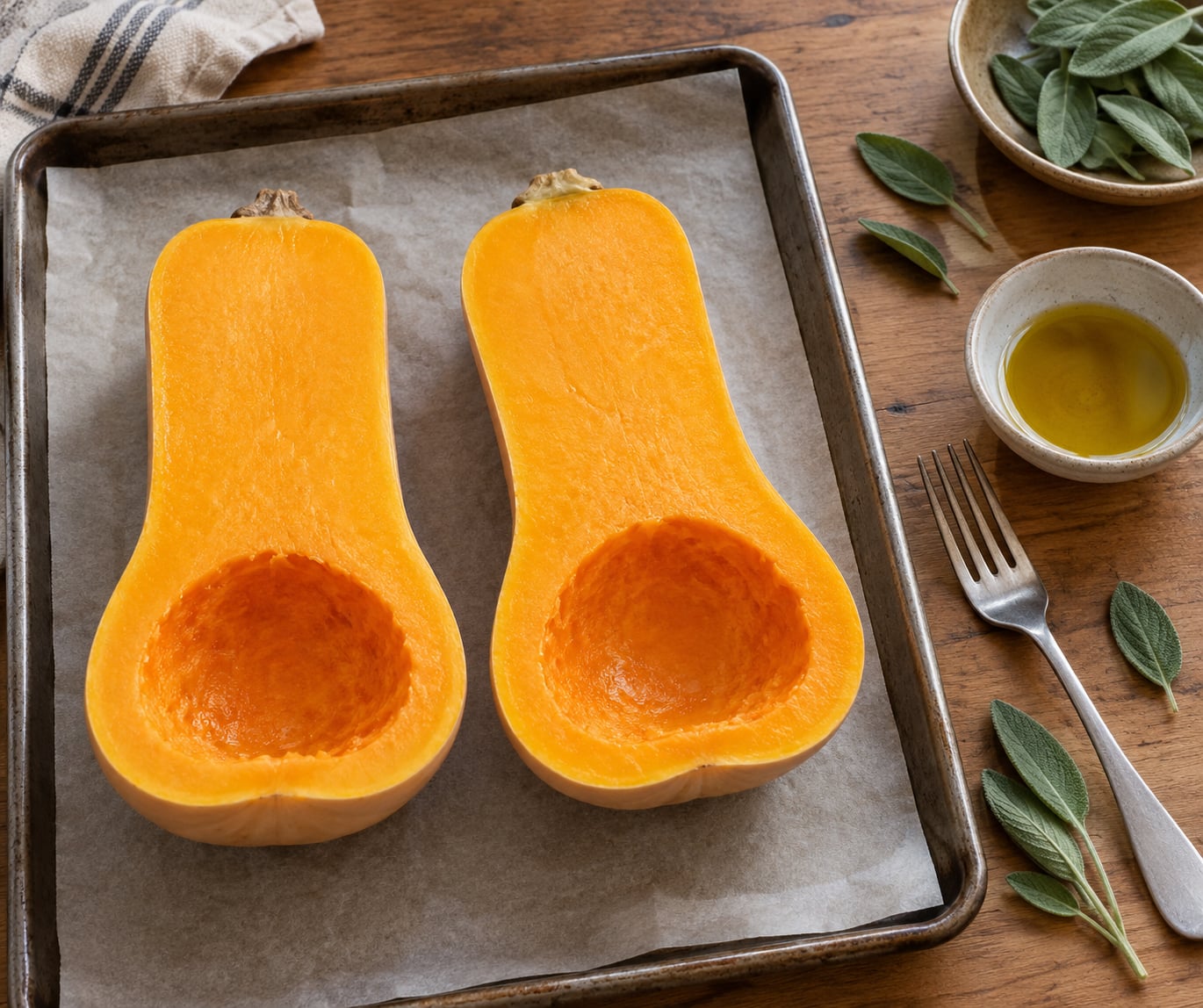
- Halve it lengthwise and scoop out the seeds. Pull the stringy pulp out with a spoon and save the seeds if you want to roast them. The cooked skin peels off in one soft strip if your knife slips under it, or you can scoop the flesh straight out and eat the skin along with it.
Recipes split on whether to roast the halves cut-side down or cut-side up, and both work. Cut-side down traps steam against the flesh, which keeps the inside moist and creamy while the skin softens. Cut-side up exposes the flat face to dry heat, so it browns and caramelizes at the edges and the interior turns drier and more concentrated. Cut-side down for soup and mash, cut-side up for a caramelized side dish. The Well Trained Mind poster who ranks on this query roasts face down by habit and gets a tender result every time.
The halved method is the same idea with 15 minutes of knife work in front of it. Halve the raw squash lengthwise, scoop the seeds, brush the cut faces with oil, season, and roast cut-side down at 400F (200C) for 40 to 45 minutes. Two-pound halves are closer to 40 minutes, three-pound halves closer to 50.
Cubes cook fastest and brown best. Cut the raw squash into 1.5 to 2 inch chunks, skin on, toss with oil and salt, and roast at 400F (200C) for 25 to 30 minutes until the edges go deep gold. Give the pieces room. Two layers are fine if the pans go in and out separately; a single crowded layer steams instead of roasting.
How to Cook It on the Stovetop or in the Microwave
An air fryer behaves like a small, very hot oven. Toss unpeeled cubes in oil and salt, air fry at 400F (200C) for 20 to 25 minutes, shaking the basket twice, until the edges crisp. Skin-on halves need longer, closer to 30 to 35 minutes, laid cut-side down.
For a covered simmer, halve and seed the squash, put it cut-side down in a pot with an inch of water, cover, and simmer gently for 25 to 30 minutes until a knife enters the neck without resistance. The flesh turns silky and the skin peels away cleanly after cooling. Do not boil uncovered and do not stir it, since the flesh breaks apart as soon as it is disturbed.
In the microwave, halve and seed the squash, place it cut-side down in a microwave-safe dish with a couple of tablespoons of water, cover loosely, and cook on high for 6 to 8 minutes per half. Check and repeat in 2-minute increments until a fork goes through without resistance. Microwave squash steams rather than roasts, so the skin softens without browning and stays thicker and more papery than oven-cooked skin. It works for soup and mash, where the texture ends up blended anyway, and it is not the best choice if you want a browned skin you can bite into.
You can also steam whole unpeeled halves cut-side up over boiling water for 25 to 30 minutes, then serve. Same softening of the skin, no browning.
Common Mistakes
Skipping the fork punctures. This is the one that actually causes problems. An unvented whole squash can split in the oven and spray sticky juice across the rack and the door. Eight to ten punctures takes fifteen seconds.
Running the oven hot. Above about 425F (220C) the sugars in the flesh burn before the flesh softens, and you get a blackened outside wrapped around a raw middle. 400F (200C) gives the skin time to relax at roughly the same rate the starches turn tender.
Crowding the pan. Pieces touching each other create a humid pocket and steam rather than roast. Leave a finger’s width between cubes, use two pans, and rotate the top pan halfway through.
Using parchment when you want browning. Parchment works fine for the whole and halved methods, where you want gentle, even cooking. On cubes it blocks direct heat, so the caramelized edges people roast squash for never quite happen. Oil the bare pan instead and roast without parchment for the deepest browning.
Cutting awkwardly through the raw skin. The rind is denser than the flesh and will roll a knife sideways if you push. Set the squash neck down, press the knife into the narrow end first, and cut toward the base. Once it has roasted, the same cut goes through like a soft shell.
Reading firmness as undercooking. A cooked squash still feels dense and starchy in the middle. Probe the neck, not the bulb, and press a thumbnail into the flesh near the stem end. If the knife went in without resistance and the skin has collapsed, it is done.
Expecting every winter squash to behave the same way. Butternut is unusually forgiving with its skin. Acorn and delicata are also skin-on friendly. Spaghetti squash has a thin skin and cooks in minutes. Pumpkin is technically edible skin-on too, but its stem and fibrous exterior make it harder to handle and less reliable in a whole roast.
Tips for Serving and Storage
Cooked skin is thin and slightly crisp at the edges, softer against the flesh, with most of the squash’s sweetness concentrated in it. If you like the flavor but not the bite, peel the cooked squash by hand with a paring knife instead of a peeler. That is the answer to the common question of whether you can peel butternut squash with a peeler: you can, but a knife on cooked squash is easier than a peeler on raw squash, which is why cooking first is the shortcut.
Roasted skin-on squash goes straight into soups, curries and stews where it dissolves into the pot. It also works as a grain bowl base, a salad add-in, and a mash alongside butter and brown sugar. Seasoning choices change the direction fast: maple and sage for a holiday side, cumin and cayenne for a warm bowl, harissa for heat, brown sugar and cinnamon for a dessert-leaning roast.
Refrigerate cooked squash in an airtight container for 3 to 4 days, and get it into the fridge within two hours of cooking. For longer storage, freeze it in single portions on a tray first, then move the pieces to a bag or container, where they keep for 2 to 3 months. Thaw overnight in the refrigerator or drop the frozen pieces straight into a soup pot.
Raw squash keeps best in a cool, dry, well-ventilated spot rather than the refrigerator, and an uncut squash held under about 50F (10C) keeps for a month or two. If it develops soft spots, mold, or a fermented smell, throw it out. Squash left in a warm spot can go off quietly, which is a separate worry from how it cooks.
Nothing has to be thrown away. Roast the seeds at 375F (190C) for 12 to 15 minutes with a little oil and salt for a snack, and compost the stringy pulp.
Frequently Asked Questions
Can you really eat butternut squash without peeling it?
Yes. Once cooked, butternut squash skin is edible and most cooks eat it. At 400F (200C) for 45 to 60 minutes the skin softens until it either chews easily or peels off in one strip with a knife. Home cooks in cooking forums describe never peeling at all, halving the squash and roasting it face down. If you prefer the texture without the skin, simply peel the cooked squash after roasting, which is far easier than peeling it raw.
Is the skin of butternut squash safe to eat?
For most people, yes. The skin carries a share of the squash’s fiber and vitamin A, which is why cooks eat it whole. Skin-on is a poor choice for anyone sensitive to fiber in their gut, since the extra roughage can cause discomfort, and it is a poor choice for a squash that was picked immature, where the skin stays leathery and can taste bitter. Peel those, or roast them longer and taste before serving.
Do I need to pierce butternut squash before roasting it?
Yes, if you are roasting it whole. Make 8 to 10 fork punctures around the skin before the squash goes into the oven. The flesh releases steam as it heats, and without vent holes that pressure builds inside a sealed squash and can split it across the oven. Halves and cubes are already cut open, so they do not need puncturing. Skipping this step is the one mistake that turns a hands-off roast into a cleanup job.
Why is my butternut squash skin still tough after cooking?
Usually the squash was under-roasted, it was too large for the time you gave it, or the oven ran hotter than the dial suggested. Test with a knife in the thickest part of the neck; any resistance means more time. Cooking time scales with weight, so add 10 to 15 minutes for every extra pound over 3 pounds. An under-cured squash with pale or greenish skin also resists softening, and there the answer is to peel it after cooking.
Can butternut squash be cooked in the microwave without peeling?
Yes. Halve and seed the squash, set it cut-side down in a microwave-safe dish with a few tablespoons of water, cover loosely, and cook on high for 6 to 8 minutes per half, checking in 2-minute increments until a fork passes through. The skin softens but never browns, so it stays thicker and more papery than oven-roasted skin. Microwave squash is best for soup and mash, where the flesh gets blended and the skin disappears into it.
How long does cooked butternut squash keep in the refrigerator?
Cooked squash keeps for 3 to 4 days in the refrigerator, stored in an airtight container and refrigerated within two hours of cooking. Cut squash dries out faster than a whole roasted half, so press parchment or a piece of plastic wrap directly onto the cut surface if you are storing it for a few days. For storage beyond that, freeze it in single portions and use it within 2 to 3 months, thawed overnight in the refrigerator.
Start by washing the squash, poking 8 to 10 holes in the skin, and roasting it whole at 400F (200C) for 45 to 60 minutes. That is how to cook butternut squash without peeling it in the shortest, least messy way there is, and once the knife slides into the neck you can eat the skin, peel it off in one piece, or scoop the flesh out and let it go in the pot. That is the whole decision, and you make it after the oven, not before.