If you have ever brought home a cantaloupe that looked perfect and tasted like plain cucumber, you are not alone. Learning how to tell if a cantaloupe is ripe comes down to four things: a sweet floral smell at the blossom end, a rind that has gone from green to beige or tan, fully raised netting, and a weight that feels heavy for its size. Smell comes first. Everything else confirms it.
At our market stalls, shoppers reach for the color first and the nose second, and that order is backwards. A melon picked early will still fade from green to tan on your counter without ever developing sugar or scent, so the look lies far more often than the aroma does.
Here is the routine I would use on any pile of melons, in the order that saves you the most disappointment.
Table of Contents
- What You Need
- Step-by-Step: How to Tell If a Cantaloupe Is Ripe
- 1. Check the blossom end for softness
- 2. How to tell if a cantaloupe is ripe: smell the blossom end
- 3. Test the weight and the skin
- 4. Look for the color shift, but do not stop there
- 5. Cut it open and confirm
- Common Mistakes
- Frequently Asked Questions
- Do cantaloupes ripen on the counter?
- How to properly ripen a cantaloupe?
- What does a cantaloupe look like when it’s ready to be cut?
- Can a cantaloupe be too ripe to eat?
- What if I pick my cantaloupe too early?
- How do I cut and store a ripe cantaloupe?
- Conclusion
What You Need
Nothing but your hands and your nose. That is genuinely the whole shopping kit, and it is why this test works at a market stall, a grocery produce section, or a home garden with a vine running up a fence.
After you get the melon home, add three things: a sharp knife, a cutting board, and cool running water with a little dish soap. The soap matters. Melon rinds can carry Salmonella from the soil and from handling, and your knife transfers that surface contamination straight into the flesh the moment it cuts through.
Step-by-Step: How to Tell If a Cantaloupe Is Ripe
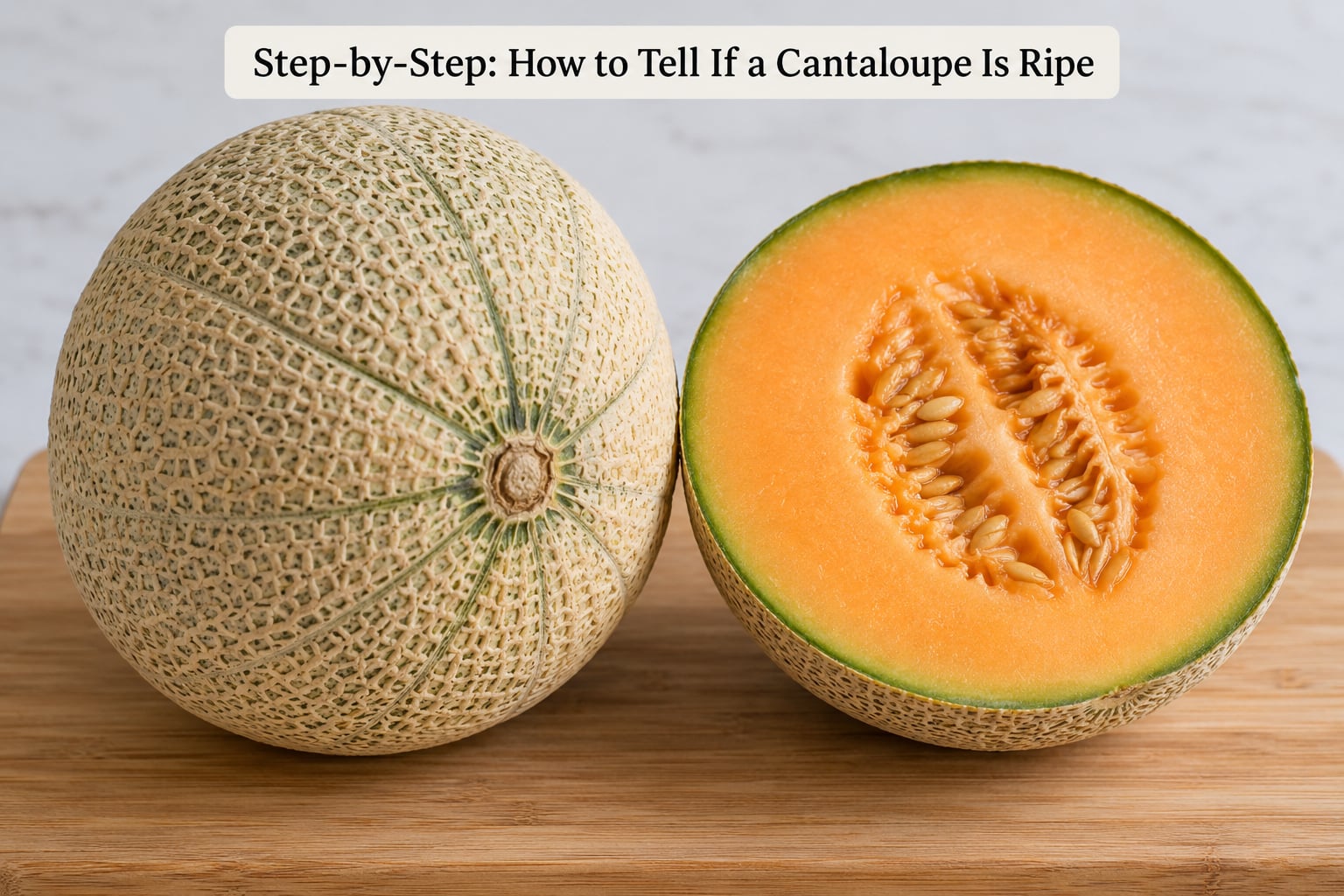
Run the checks in this order and stop as soon as one fails. Here is the quick reference I keep in mind, and then each step in detail.
- Rind color. Ripe: beige, tan, or sandy gold between the netting. Nearly ripe: yellowish-green in patches. Not ripe: green all over, even under the net.
- Netting. Ripe: raised, rough, well developed across the whole melon. Nearly ripe: netting starting to lift in places. Not ripe: flat, smooth, barely visible lines.
- Aroma at the blossom end. Ripe: sweet, floral, musky. Nearly ripe: faint, and only when the rind is warm. Not ripe: nothing at all.
- Weight for size. Ripe: heavy, solid in the hand. Nearly ripe: average. Not ripe: light, almost hollow sounding.
- Stem end. Ripe: smooth, slightly sunken scar with no stem attached. Nearly ripe: scar forming, stem still attached. Not ripe: green stem still firm on the vine scar.
- Blossom end feel. Ripe: slight give when pressed with a thumb. Nearly ripe: firm with a hint of give. Not ripe: hard, no give at all.
1. Check the blossom end for softness
The blossom end is the side opposite the stem, the scar where the flower used to be. On a ripe melon it is slightly concave, a touch softer than the rest of the rind, and it gives a little when you press it with your thumb.
Hard as a pumpkin means underripe. Very soft, dented, leaking, or showing fuzzy dark patches means the melon is going past its window, and the flesh inside is likely already breaking down.
2. How to tell if a cantaloupe is ripe: smell the blossom end
Get your nose right down to that scar. A ripe cantaloupe gives off a sweet, floral, slightly musky aroma strong enough that you can smell it from about a foot away once the rind is at room temperature. Cold melons are muted, so if you are shopping from a refrigerated case, look for one that has been sitting out, or pocket it and check it in the car.
No smell at all means no sugar has developed yet. A sharp, sour, or fermented smell means it is past ripe, and shoppers describe that odor in all sorts of unflattering ways, which is a fair signal to put the melon back. Sweet is what you want; strong is not the same as sweet.
3. Test the weight and the skin
A ripe melon is heavy for its size. Pick up two of the same variety, one in each hand, and the ripe one sits lower in your palm. A melon that feels light for its diameter usually has thin flesh and a watery interior, no matter how good it looks.
Run your fingers over the netting. It should feel raised, rough, and web-like, similar to the surface of a peanut shell. Avoid melons with hard, glassy-smooth spots, wrinkled skin, or any tackiness on the surface. That tackiness is the surface becoming slimy as the flesh underneath collapses.
4. Look for the color shift, but do not stop there
Color tells you something, and what it tells you is narrower than most shoppers think. The green fades toward beige, tan, or sandy gold as the melon matures, mostly in the spaces between the netting. Some varieties, including Charentais types sold as rockmelon or spanspek, go deep cream or almost yellow.
Because color varies by variety and by growing conditions, treat a still-green melon as underripe rather than spoiled, and treat a tan melon with no aroma as underripe too. Color is the tiebreaker, never the lead signal.
5. Cut it open and confirm
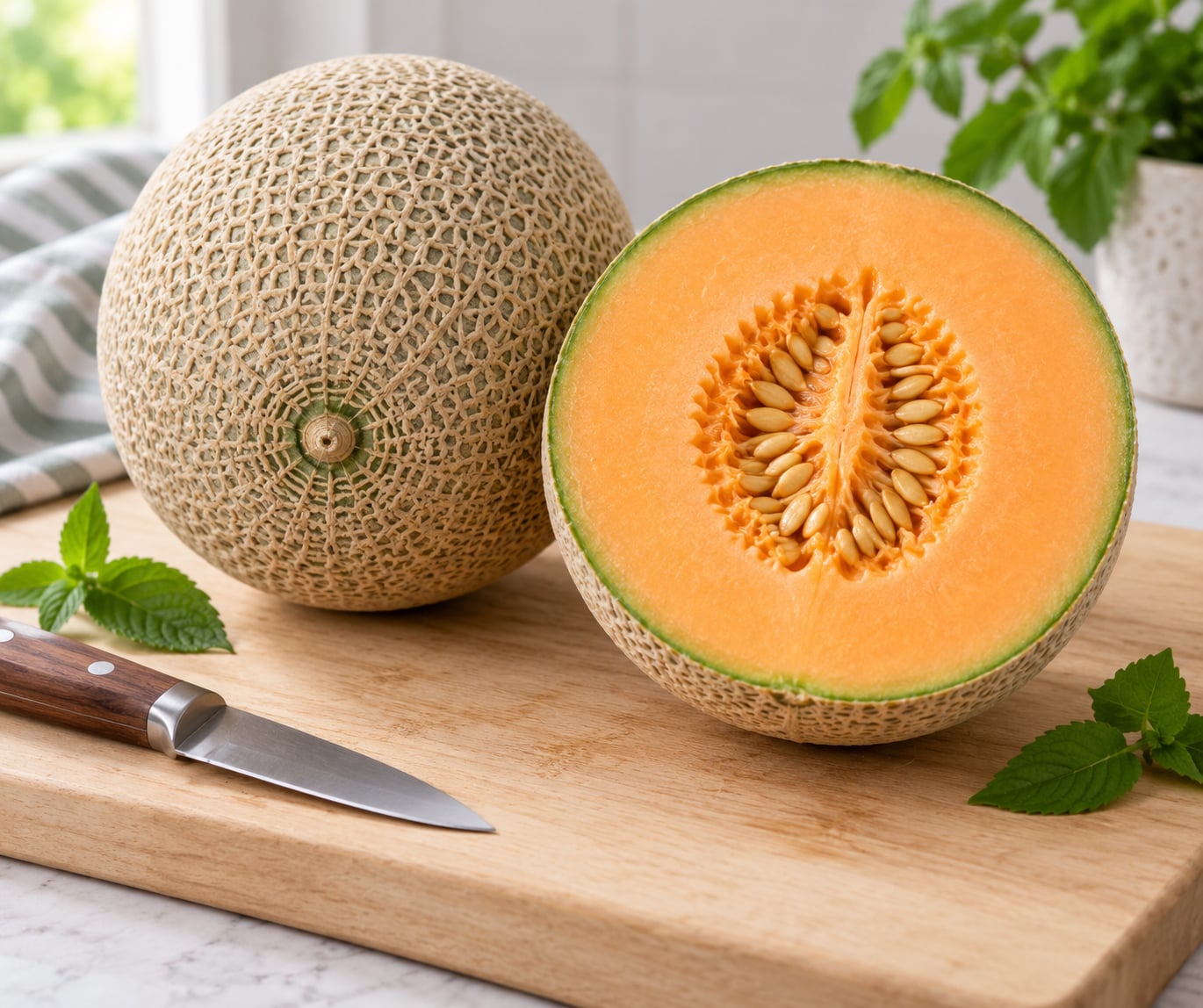
Wash the rind with soap and cool running water and dry it before you cut. On a ripe melon, the flesh is an even, deep orange all the way to the thin green line just under the skin, and the seeds sit loose in their cavities. Press the flesh with your finger: it should dimple slightly and spring back.
Watery or pale flesh, seeds firmly locked in place, or a sour smell from the cut surface all point to an underripe melon. Fuzzy black or white mold, a slimy surface, and any fermented or alcohol-like odor mean discard it, no matter how good the rind looked.
Common Mistakes
Judging by color alone. This is the most common mistake and the most expensive one. Melons shipped long distances are picked at full size but before peak sugar, and they will happily turn beige in your kitchen while staying bland. Smell first, always.
Knocking or thumping on the rind. You will see this test repeated constantly, and it tells you almost nothing useful. The dull thud people describe as perfect is equally common in underripe fruit, because the flesh structure is the same either way. Give up the knocking and use the nose.
Waiting for the stem to turn brown. Gardeners ask this constantly, and the honest answer is that stem color is unreliable on its own. A green stem can still release from a fully ripe melon, and a dry brown stem can sit on a fruit that picked too early.
Squeezing the whole melon hard. A thumb press at the blossom end is a light test. Pressing the side leaves bruises that turn soft and dark within a day, and you have damaged the melon for a ten-second check.
Two habits do more for you than any of the above. Wash the rind before cutting, every time. And once cut, refrigerate the melon in an airtight container and eat it within about three to four days; an uncut whole melon keeps roughly a week in the fridge, and room temperature is best for a melon you are still hoping to ripen. Scrape the seeds out, wrap the halves, and you have a ten-minute breakfast that beats most cereal.
Frequently Asked Questions
Do cantaloupes ripen on the counter?
Only a little, and not in the way most people hope. Cantaloupe is a climacteric fruit, so it keeps producing ethylene after harvest, which means a partly mature melon will soften on the counter over two to four days. It will not meaningfully sweeten, because the sugar peak happens on the vine before commercial melons are picked. Expect softer flesh and a little more aroma, not real sweetness.
How to properly ripen a cantaloupe?
Leave it whole at room temperature out of direct sun, ideally next to other ripe fruit like bananas or apples, whose ethylene output speeds up softening. Check the blossom end every day for aroma and give. Once it smells sweet, chill it. If the rind starts to feel soft, wrinkled, or tacky before that point, the melon is going over rather than ripening, so use it quickly.
What does a cantaloupe look like when it’s ready to be cut?
The rind has shifted from green to beige, tan, or sandy gold in the spaces between the netting. The net pattern itself is raised and rough across the whole melon rather than flat lines. The blossom end is slightly concave with a little give, and the stem end shows a smooth, slightly sunken scar with no stem attached. Color alone is not enough, so confirm with a smell.
Can a cantaloupe be too ripe to eat?
Yes, and it goes past eating quality well before it becomes unsafe. Overripe flesh turns mushy, watery, or grainy, loses its aroma, and often shows a fermented or sour smell. Small sunken spots and softened areas mean the fruit is degrading. Mold, sliminess, leaking liquid, or an alcohol-like odor are clear discard signals, and you should not taste-test a melon that shows them.
What if I pick my cantaloupe too early?
An early-picked melon will soften and its rind may color up, but it will not develop real sugar, so expect a watery, bland melon. Leaving it on the counter for several days does not fix this. In a home garden, wait for full slip: the fruit detaches from the vine with almost no force and leaves a smooth concave scar. Waiting a few extra days before harvest avoids the problem entirely.
How do I cut and store a ripe cantaloupe?
Wash the whole rind with soap and cool running water and dry it before cutting, since the surface can carry bacteria that the knife carries into the flesh. Cut it in half, scoop out the seeds with a spoon, and slice the flesh away from the rind. Refrigerate cut melon in an airtight container and eat within three to four days. A whole uncut melon keeps about a week refrigerated.
Conclusion
Start at the blossom end: press it for a little give, then put your nose right on it. A sweet, floral aroma plus a heavy weight, raised netting, and a beige-to-tan rind is a melon worth taking home.
One cue on its own will mislead you sooner or later, which is why the whole method works better as a set of five than as a single trick. If you remember nothing else from how to tell if a cantaloupe is ripe, remember this: pick up two melons, compare them, and trust the one that smells.