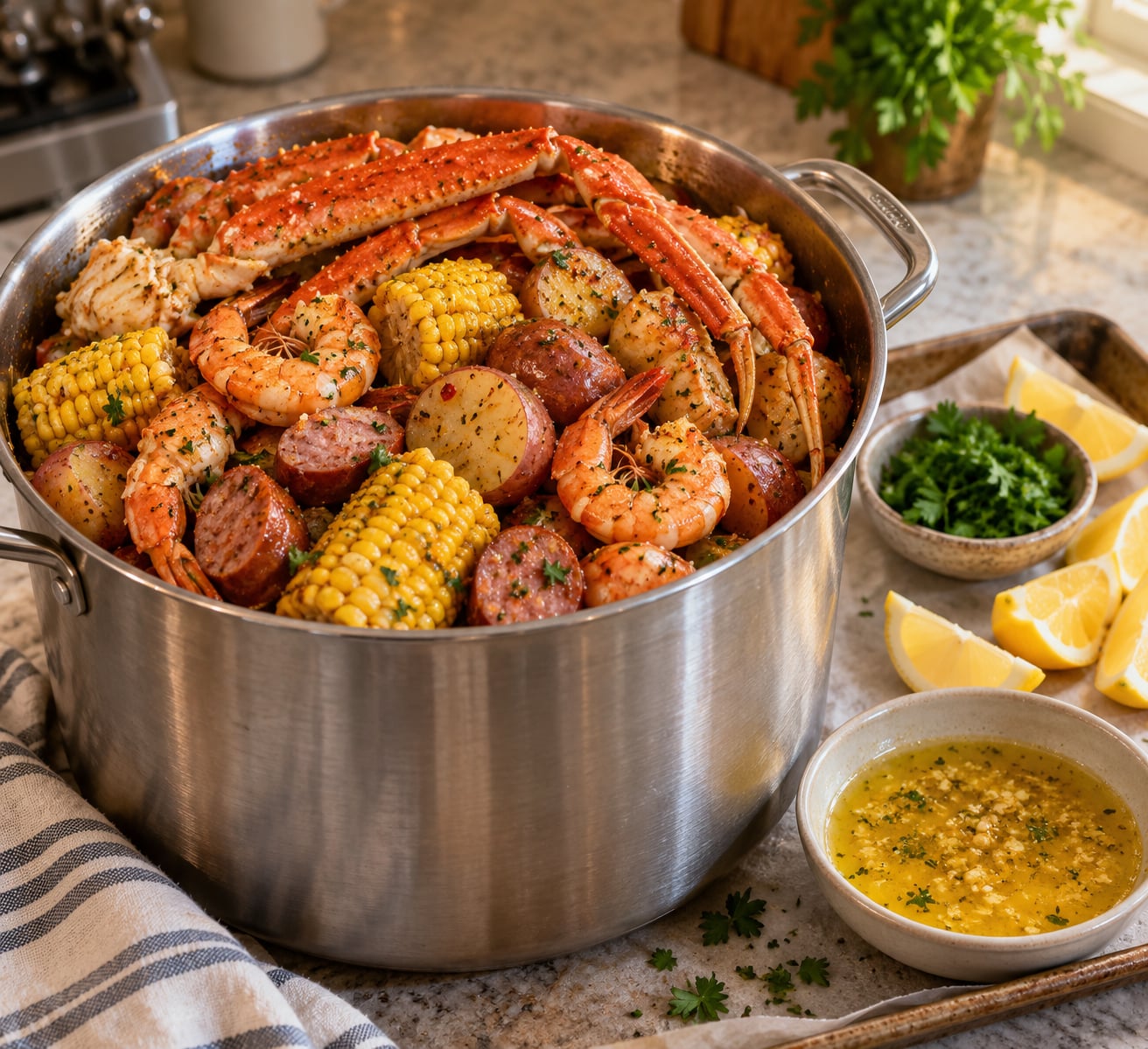
A seafood boil is a one-pot meal: seasoned shellfish, smoked sausage, corn and potatoes cooked in a heavily spiced broth, then served with a garlic butter sauce for dunking. To learn how to make a seafood boil at home, layer everything by cooking time in one large pot. Potatoes and sausage go in first, corn next, and the shellfish goes in last for just a few minutes.
Budget about 45 minutes start to finish, with 25 of those minutes unattended while the pot simmers. It is a messy, communal meal rather than an elegant weeknight dinner, so give yourself counter space and a colander within reach. All doneness guidance here follows current USDA recommendations, checked for 2026.
Table of Contents
- What You Need
- Equipment
- Seafood
- Sausage
- Vegetables and aromatics
- Liquid
- For the seafood boil sauce
- Step-by-Step: How to Make a Seafood Boil at Home
- 1. Choose and Prepare the Ingredients
- 2. Make the Seafood Boil Seasoning
- 3. Boil the Potatoes First
- 4. Add Sausage and Corn
- 5. Add the Seafood Last
- 6. Season, Drain, and Serve
- Cook-Time Layering Table
- Common Mistakes
- Rubbery shrimp
- Adding everything at once
- Under-seasoned broth
- Seafood sitting in the broth
- Clams and mussels that never open
- The pot boils over
- Skipping the sauce
- Food Safety and Storage
- Frequently Asked Questions
- How long should I boil shrimp in a seafood boil?
- Can I make a seafood boil at home with frozen shrimp?
- What seafood can I use instead of crab legs?
- How do I keep seafood from getting rubbery?
- Can I make a seafood boil without sausage?
- How should I store cooked seafood boil?
- Conclusion
What You Need
Nothing exotic, and almost everything is interchangeable. Cooks on this site have tested a lot of variations, and the honest summary is that a seafood boil has no fixed ingredient list.
Equipment
- A large pot, 8 to 10 quarts. Twelve quarts is better if you are cooking for six or more. Anything smaller will boil over the second the shellfish goes in.
- A colander or slotted spoon for draining, plus a sheet pan lined with parchment or freezer paper for serving.
- A large spoon or spider for stirring the bottom layer without crushing the shells.
- A separate small saucepan for the garlic butter sauce. Making it alongside the boil keeps the sauce emulsified and glossy instead of grainy.
- Tongs, a lemon, and a cutting board for the messy final pour.
Seafood
- Shell-on shrimp, 1 to 2 pounds. Jumbos or large white shrimp work best. Peeled shrimp loses its texture advantage, but it is fine if that is what you have.
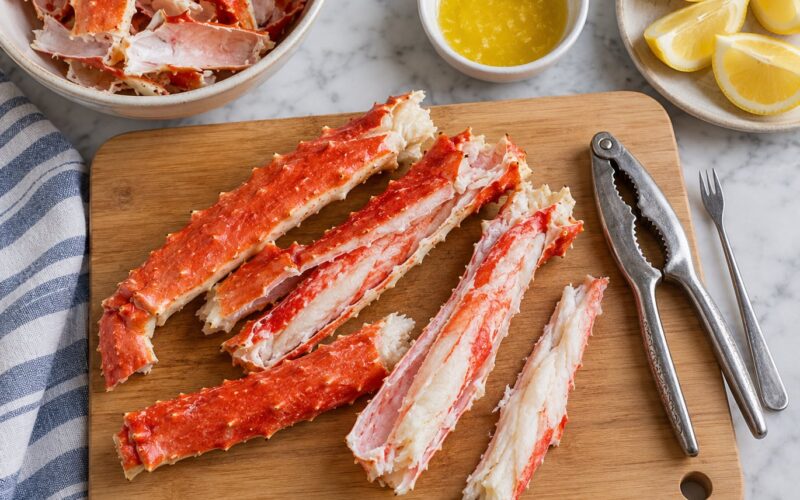
- Crab legs, 1 to 2 pounds. Snow or king crab clusters. Pre-cooked crab clusters only need reheating.
- Optional: lobster tails, clams, mussels, crawfish, or scallops. Pick two or three kinds at most or the boil turns into a scramble.
Sausage
Andouille is the classic choice, with smoked kielbasa and Italian sausage as easy swaps. Buy it fully cooked where you can, because raw sausage adds 10 to 12 extra minutes and there is no reason to wait on it.
Vegetables and aromatics
- Baby red potatoes or small new potatoes, halved. Waxy skins hold up to the heat.
- Corn on the cob, cut into halves or thirds.
- Onions, quartered or in thick wedges. Lemon halves, bay leaves, and a whole head of garlic, split lengthwise.
- Old Bay seasoning, a Cajun or Creole blend, or Zatarain’s crab boil seasoning. Old Bay is briny, Cajun blends are hotter and more peppery.
Liquid
Water works. A mix of water and beer or white wine adds body, and there is no rule against it. If you plan to drink what is left, use water.
For the seafood boil sauce
- 1 stick unsalted butter
- 6 to 8 cloves garlic, minced
- 2 tablespoons Old Bay or Cajun seasoning
- Juice of one lemon, plus a splash of the reserved boil broth
- Chopped parsley, hot sauce, and a pinch of paprika or cayenne
Substitutions are easy. Skip the beer, use vegetable broth, swap sausage for extra corn, or leave the sausage out entirely. A cup of cooked shrimp added in the last two minutes works for anyone avoiding shellfish.
Step-by-Step: How to Make a Seafood Boil at Home
The whole method rests on one idea: ingredients go in stages, longest cook time first. Nothing else you do matters as much.
1. Choose and Prepare the Ingredients
Thaw frozen seafood in the refrigerator overnight, in the original package or a bowl of cold water. Never thaw on the counter. Wash the corn and potatoes under cold running water, then scrub the potatoes and cut them in half so they cook through in the same window as everything else.
Slice the sausage into 2-inch pieces with a knife rather than tearing it open. Rougher pieces release more surface area for the broth to season. Break crab clusters into individual sections if they are large enough to crowd the pot, and give clams and mussels a hard scrub so they open cleanly.
2. Make the Seafood Boil Seasoning
Mix the seasoning blend with the aromatics in a dry bowl: the Old Bay or Cajun blend, the halved onions, garlic, bay leaves, and a heavy pinch of any extra spice you like. This is a dry rub for the pot, not a sauce, so it can look like far too much. Season the broth generously, because every item drinks from it.
Do not add extra salt beyond what the seasoning blend already contains. The broth reduces as it boils, and the seasoning concentrates with it.
3. Boil the Potatoes First
Fill the pot with about 8 to 10 quarts of water or beer and bring it to a rolling boil. Add the potato halves and boil 10 to 12 minutes, then test one with a fork or paring knife. It should slide in with no resistance. If it is still firm, give it three more minutes.
Do not move on until the potatoes are nearly tender. They are the longest-cooking item in the pot, and once the shrimp goes in, nothing else gets more time.
4. Add Sausage and Corn
Add the sausage pieces and stir once, then let the pot return to a boil. Add the corn and boil another 6 to 8 minutes. Frozen corn segments need closer to 8 minutes, fresh or blanched corn closer to 6, because they start hotter and softer.
At this point the pot is bubbling hard with a lot of crowded food. Stir the bottom every couple of minutes with the spider, or the potatoes will scorch against the metal and the whole broth will taste burnt.
5. Add the Seafood Last
This is where the timing matters. Add the clams and mussels first if you are using them and give them 5 to 7 minutes, until the shells pop open. Add raw lobster tails next for about 5 to 7 minutes. Add crab legs, shrimp and pre-cooked shellfish in the final 3 to 5 minutes.
Shrimp are done when the flesh turns opaque and curls into a loose C. Pull them the moment that happens, and remember that carryover heat keeps cooking them in the sauce. Pre-cooked or frozen shrimp need only 1 to 2 minutes in the pot. Watch the pot rather than the clock.
6. Season, Drain, and Serve
Lift the food out with the spider and spread it on the parchment-lined sheet pan. Ladle a cup of the broth over the top, then pour the garlic butter sauce over everything while it is still steaming. Scatter chopped parsley, squeeze lemon over the pan, and set out hot sauce and bread.
Serve it family-style straight off the tray. Shell, dip, and eat with your hands. That is the whole point.
Cook-Time Layering Table
| Ingredient | Cook time | When to add |
|---|---|---|
| Baby red potatoes, halved | 12 to 15 minutes | First, into the boiling broth |
| Andouille or kielbasa, cut | 12 to 15 minutes | With the potatoes, or after 10 minutes |
| Corn on the cob | 8 to 10 minutes | After the potatoes have cooked 6 to 8 minutes |
| Clams and mussels | 5 to 7 minutes | After the corn, before shrimp |
| Raw lobster tail | 5 to 7 minutes | With the clams |
| Crab legs | 3 to 5 minutes | Last few minutes |
| Raw shell-on shrimp | 2 to 4 minutes | Absolutely last, to an opaque C |
| Pre-cooked or frozen shrimp | 1 to 2 minutes | Last, just to warm through |
Common Mistakes
Almost every disappointing seafood boil traces back to one of these. Here is what went wrong and the fix.
Rubbery shrimp
Shrimp left in a simmering pot past the point of opacity turn bouncy and smell of iodine. Add them last, in the final 2 to 4 minutes, and pull them the instant they curl.
Adding everything at once
Potatoes and shrimp cannot share a cooking time. This is the single most common failure, and it always produces either mushy corn or raw shrimp.
Under-seasoned broth
Cooks new to this dish under-season because they taste the liquid before the potatoes go in. Season harder than looks right, then taste the broth near the end and adjust.
Seafood sitting in the broth
Crab legs left boiling for 20 minutes get watery and fall apart. Drain everything promptly so the shells do not continue cooking in hot liquid.
Clams and mussels that never open
Discard every shell that stays closed after cooking. Shells that open before cooking were already dead, and closed ones have not cooked evenly. This is a safety rule, not a preference.
The pot boils over
A crowded pot of shellfish and corn foams up fast. Fill the pot no more than two-thirds full, set the heat slightly lower once the boil returns, and keep the lid off.
Skipping the sauce
Boiled shellfish with no dip is a missed meal. Melt the butter with the garlic in a separate pan and pour it over while everything is hot.
Food Safety and Storage
Shellfish cooks quickly and reaches safe doneness faster than most people expect. Heat the cooking liquid to a full rolling boil, add the seafood, and let the pot return to a boil. Cook until the flesh is firm, fully opaque and pearly, reaching 145°F internally. Shrimp curl into a C; mussels and clams open their shells.
Thaw frozen seafood in the refrigerator overnight or under cold running water. Take the plastic packaging off before thawing, because sealed plastic over frozen seafood creates an ideal environment for botulism spores. Do not thaw on the counter at any point.
Keep raw seafood separate from ready-to-eat food. Use one cutting board for shellfish and a different one for lemons and herbs, then wash hands, boards and utensils with hot soapy water before serving.
Refrigerate leftovers within two hours in a sealed container, and use them within two days. Keep the sauce separate so the shellfish does not go soggy, and store the broth separately too. It makes a strong base for chowder or a dip for cold shrimp, though it is usually very salty, so season to taste after adding other ingredients.
Reheat gently in a skillet over medium-low heat for two or three minutes, adding a splash of broth if things look dry. Microwaving is fine in short bursts, but it dries shrimp out faster than a pan.
Frequently Asked Questions
How long should I boil shrimp in a seafood boil?
Raw shell-on shrimp need 2 to 4 minutes in a boiling pot, added after the potatoes, sausage and corn. They are done when the flesh turns opaque and curls into a loose C, which should bring them to 145°F internally. Pre-cooked or frozen shrimp only need 1 to 2 minutes to warm through. Pull them out the moment they curl, because they keep cooking in the sauce.
Can I make a seafood boil at home with frozen shrimp?
Yes, and frozen shrimp is often what most home cooks use. Thaw it in the refrigerator overnight or under cold running water, remove the packaging first, and add it for only 1 to 2 minutes at the very end of the cook. Pre-cooked frozen crab clusters work the same way. Fully raw frozen shrimp can be used straight from thawed with 3 to 5 minutes of cooking.
What seafood can I use instead of crab legs?
Lobster tails, clams, mussels, crawfish, scallops and extra shrimp all take the place of crab legs. Clams and mussels go in for 5 to 7 minutes and need to open before serving. Crawfish cook in about 5 minutes once the water returns to a boil. Pre-cooked imitation crab can be added in the final minute purely for the flavor of the broth.
How do I keep seafood from getting rubbery?
Cook time and a hot pot are the two levers. Add seafood only after the pot is back at a full rolling boil, layer it by cook time with shrimp last, and watch the food instead of the clock. Shrimp need 2 to 4 minutes and crab legs 3 to 5. Pull everything out promptly, because residual heat in the pile and the sauce keeps cooking it.
Can I make a seafood boil without sausage?
Absolutely. Skip it and fill the space with more corn, extra potatoes, or a second vegetable such as okra or mushrooms. If you want the smoky depth sausage brings without the meat, add smoked paprika or a little liquid smoke to the broth. Vegetarian versions also work with vegetable broth in place of beer.
How should I store cooked seafood boil?
Cool the shellfish quickly and refrigerate within two hours in a sealed container, keeping the garlic butter sauce in its own container so nothing turns soggy. Eat within two days. Store the broth separately too, since it makes a strong chowder base, though it is salty enough that you may want to dilute it. Reheat in a skillet over medium-low heat for two or three minutes.
Conclusion
Start by seasoning your broth and boiling the potatoes until a fork slides through with no resistance. Add sausage and corn next, then the shellfish in order of cook time, with shrimp and pre-cooked crab going in for the last two to five minutes.
Everything else on the table is a choice you can adjust later. Getting that sequence right is what turns a pile of boiled food into a seafood boil worth making again.