A quarter cow is one of the four shares a butcher cuts from a beef carcass, usually sold as a mixed box of steaks, roasts, stew meat and ground beef — roughly 100 to 160 pounds of packaged meat you freeze at home. Whether a quarter cow is worth it depends far more on your freezer space and how often your household eats beef than on the sticker price.
I have picked up more than a few of these boxes over the years, and the thing that surprises people is not the weight. It’s the ground beef. A quarter that looks like a lot of steak on the cut list regularly arrives with 40 to 50 percent of its usable weight in ground beef, and that changes how you should plan your cooking.
Table of Contents
- What Is a Quarter Cow and Is It Worth It?
- Hind quarter and fore quarter, or a straight spine split
- What Parts of the Cow Are Included?
- How Much Beef Does a Quarter Cow Yield?
- Live weight, hanging weight, and packaged weight explained
- How Much Does a Quarter Cow Cost?
- What a quarter cow really costs per pound of meat
- How Do You Buy a Quarter Cow?
- 1. Find a supplier and check inspection
- 2. Pick a share size and confirm the minimum
- 3. Send cutting instructions
- 4. Understand the deposit and balance schedule
- 5. Plan the pickup date honestly
- Is a Quarter Cow Worth It for Your Household?
- Usable yield against what you will actually eat
- Effective cost per pound against your grocery spend
- Freezer capacity
- Cooking frequency and ground beef volume
- Cash flow
- Who should skip a quarter cow
- Who it suits
- Quarter Cow vs. Buying Beef at the Grocery Store
- How to Store and Safely Prepare Quarter-Cow Beef
- How much freezer space to plan for
- Label, date, and rotate
- Guard against a freezer failure
- Thawing and cooking temperatures
- Frequently Asked Questions
- What is a fair price for a quarter cow?
- How much meat will I get from a 1/4 cow?
- How long does a 1/4 cow last for 2 people?
- How many cubic feet is a 1/4 cow?
- Should I buy a quarter cow?
- How long does 1/4 cow last in the freezer?
- Conclusion
What Is a Quarter Cow and Is It Worth It?
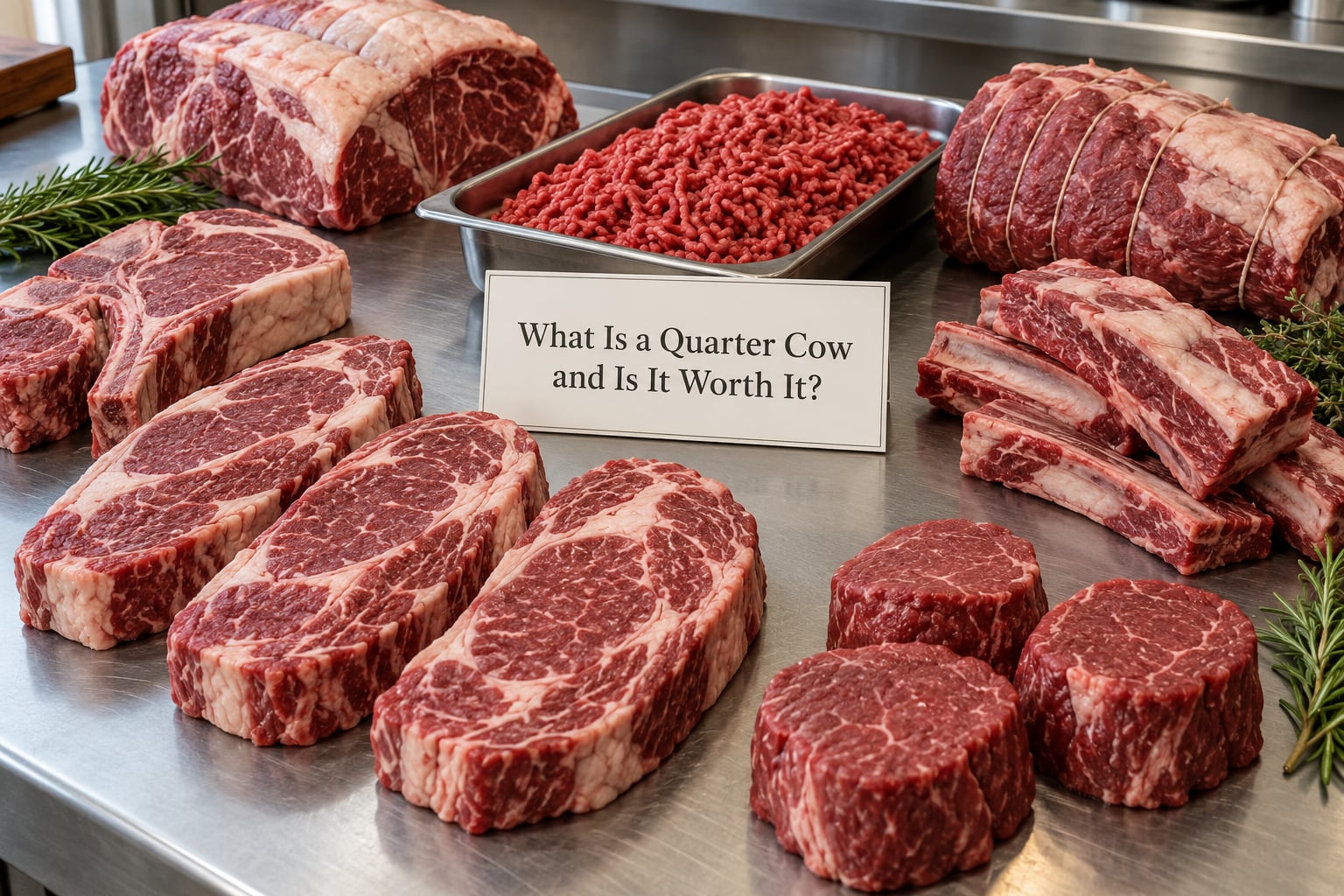
Here is the straight answer before the details. A quarter cow is one half of one side of beef, cut off the carcass after slaughter and chilled. Most sellers then cut it to your instructions, vacuum-seal it, and freeze or refrigerate it for pickup.
A quarter cow is worth it when you have about 5 to 7 cubic feet of usable freezer space, a household of three or more that eats red meat several times a week, and cash available up front. It is not worth it for one or two people, for anyone without a freezer, or for a family that mostly eats chicken and pasta.
Two different split methods are in use, and knowing which one you got tells you a lot about what is in the box.
Hind quarter and fore quarter, or a straight spine split
The older method runs a cut through the backbone and between the last rib and the first loin, producing a hind quarter (rear leg, rump, sirloin, round) and a fore quarter (rib, short loin, chuck, brisket, plate, flank). The hind quarter is the more valuable one because of the steaks inside it, so many sellers price the two differently or sell only the hind.
The second method splits the carcass straight down the spine into two matching halves, and each half is then called a quarter. On a split carcass you get a more even mix of cuts, and neither share carries a heavy steak premium.
Because your box depends on which method the plant uses, always ask for the cut list before you pay. What you actually receive is set by the processor, not by the word quarter.
What Parts of the Cow Are Included?
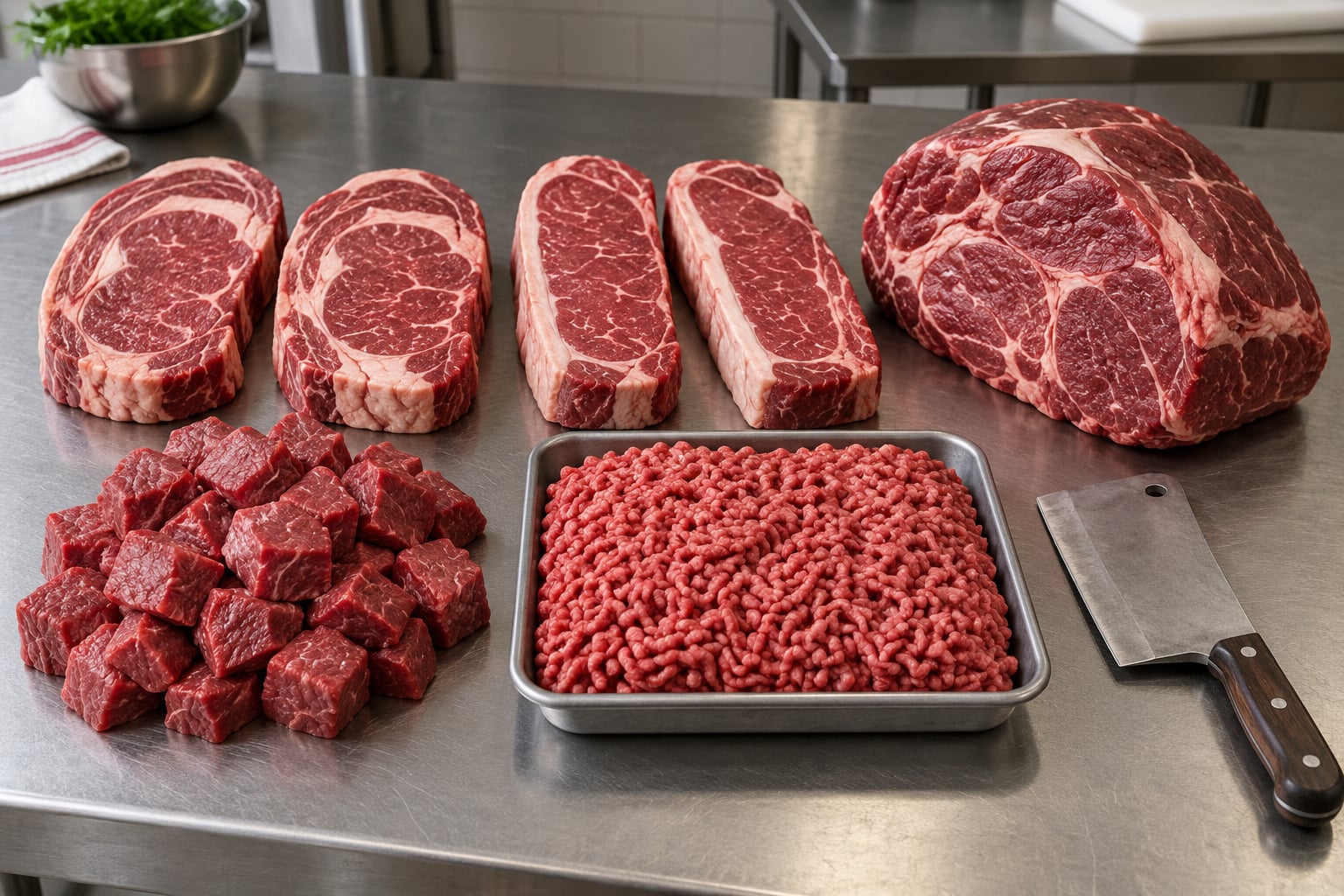
The exact mix varies by processor, package size and how much the animal was trimmed, but a typical quarter box looks roughly like this.
| Cut | Approximate packaged weight | Best cooking method |
|---|---|---|
| Steaks (ribeye, New York strip, sirloin, flank, skirt, flat iron) | 25 to 40 lb | Grill, pan-sear, or thinly slice flank and skirt against the grain |
| Roasts (chuck roast, tri-tip, rump roast, brisket) | 15 to 25 lb | Slow roast, braise, or smoke |
| Stew meat and cube steak | 10 to 20 lb | Stew, braise; cube steak is often tenderized for quick frying |
| Ground beef, plus sausage if offered | 40 to 60 lb | Burger, meatloaf, chili, sausage, bologna |
| Organ meats (liver, heart, tongue, kidney), optional | 2 to 5 lb | Sear liver quickly, slow-braise heart, freeze immediately if you will not cook it soon |
That ground beef line is the part buyers on forums complain about most, and the complaint is fair. If you pictured thirty ribeyes and received a box that is half ground beef, the value math changes completely. Plan the cooking around the ground beef first.
Some sellers also mix in lower-value areas such as the shank, plate and flank into the ground beef, which is why the percentage can exceed 50 percent. Ask whether your ground beef is a fine grind or a coarse grind, and ask if the trim is left in or removed.
Bone-in versus boneless is another difference worth asking about. Boneless roasts add convenience and add weight per package, and some plants price them differently. You do not get more meat for it — you just get less work at the counter.
How Much Beef Does a Quarter Cow Yield?
The weight question is confusing because three different numbers get used, and only one of them ends up in your freezer. The chain runs from live weight to hanging weight to packaged weight, and each step loses something.
Live weight, hanging weight, and packaged weight explained
Live weight is the animal standing on the scale at the farm. Hanging weight, also called carcass weight or dressed weight, is the cooled carcass hanging in the cooler — roughly 60 to 65 percent of live weight, because hide, gut, bone and the parts you do not eat come off. Packaged weight, also called take-home or cut-and-wrapped weight, is what you carry out of the shop, typically 50 to 55 percent of the hanging weight after bones, trim and fat are removed.
So a 1,400-pound live animal gives you roughly 840 to 910 pounds hanging, and about 420 to 500 pounds packaged. One quarter of that lands somewhere between 105 and 125 pounds in your freezer.
| Live weight of the animal | Estimated hanging weight (60-65%) | Estimated packaged weight (50-55% of hanging) | Packaged weight per quarter |
|---|---|---|---|
| 1,000 lb | 600 to 650 lb | 300 to 360 lb | 75 to 90 lb |
| 1,200 lb | 720 to 780 lb | 360 to 430 lb | 90 to 108 lb |
| 1,400 lb | 840 to 910 lb | 420 to 500 lb | 105 to 125 lb |
| 1,600 lb | 960 to 1,040 lb | 480 to 570 lb | 120 to 143 lb |
Those numbers are why a quarter of a small animal is a bad deal. Fixed costs — the slaughter fee, the transport, the cooler, the cutting and wrapping labor — get divided across fewer pounds. Several people in beef-buying forums recommend pushing to a half for exactly that reason, and the arithmetic backs them up.
Published figures from sellers cluster in the same range: 100 to 130 pounds packaged is the most commonly quoted average, with individual orders reported from about 90 to 160 pounds. A 190-pound hanging quarter typically comes out around 95 to 105 pounds packaged.
How Much Does a Quarter Cow Cost?
Quoting methods differ enough that you must compare two quotes the same way or you will be comparing apples to oranges. One method bundles everything into an all-in hanging weight rate. The other separates the beef price from a per-pound processing fee.
Under the all-in method, sellers quote a single rate per pound of hanging weight and add delivery. Under the split method, you pay a beef price per pound plus a processing fee per pound of carcass, which usually includes cutting, wrapping, freezing and often a kill fee.
What a quarter cow really costs per pound of meat
The number that matters is the effective cost: total dollars divided by packaged pounds. Several buyers have posted totals in the 600 to 1,300 range for a single quarter depending on region, feed type and processing fees, and the spread is entirely explained by which model was used.
One published example listed 110 or more pounds of packaged beef at about 1,300 dollars all in, roughly 11.80 dollars a pound of finished meat. Another buyer reported getting about 50 pounds usable from a quarter at an effective 11.49 dollars a pound against a 3.50 a pound hanging rate — which is what happens when processing and fees, not the animal, drive the price.
| Cost component | How it is usually billed | Typical US range observed |
|---|---|---|
| All-in hanging weight rate | One price per pound of cooled carcass, beef and processing bundled | About 5 to 8 dollars per pound |
| Separate beef price | Per pound of hanging weight, quoted by the seller | About 3 to 6 dollars per pound |
| Processing or cut-and-wrap fee | Flat per pound of carcass, sometimes a minimum charge | About 0.75 to 2 dollars per pound |
| Delivery | Flat fee, often waived above a minimum order | Runs about 50 to 150 dollars |
| Deposit | Paid up front, balance due when processing finishes | Commonly 200 to 400 dollars |
| Extra fees to ask about | Bone-in packaging, sausage making, vacuum sealing, small-order surcharge | Line-item charges |
These are typical US ranges, and they move. Beef prices rose sharply over the past few years and then eased unevenly, so treat any figure you find as a snapshot and ask your seller what today’s rate is.
Delivery and the deposit are where budgeters get surprised. A deposit of 300 to 400 dollars can be due months before pickup, and the balance comes due when processing is done rather than at a date you pick. Read the payment terms before you send money, not after.
How Do You Buy a Quarter Cow?
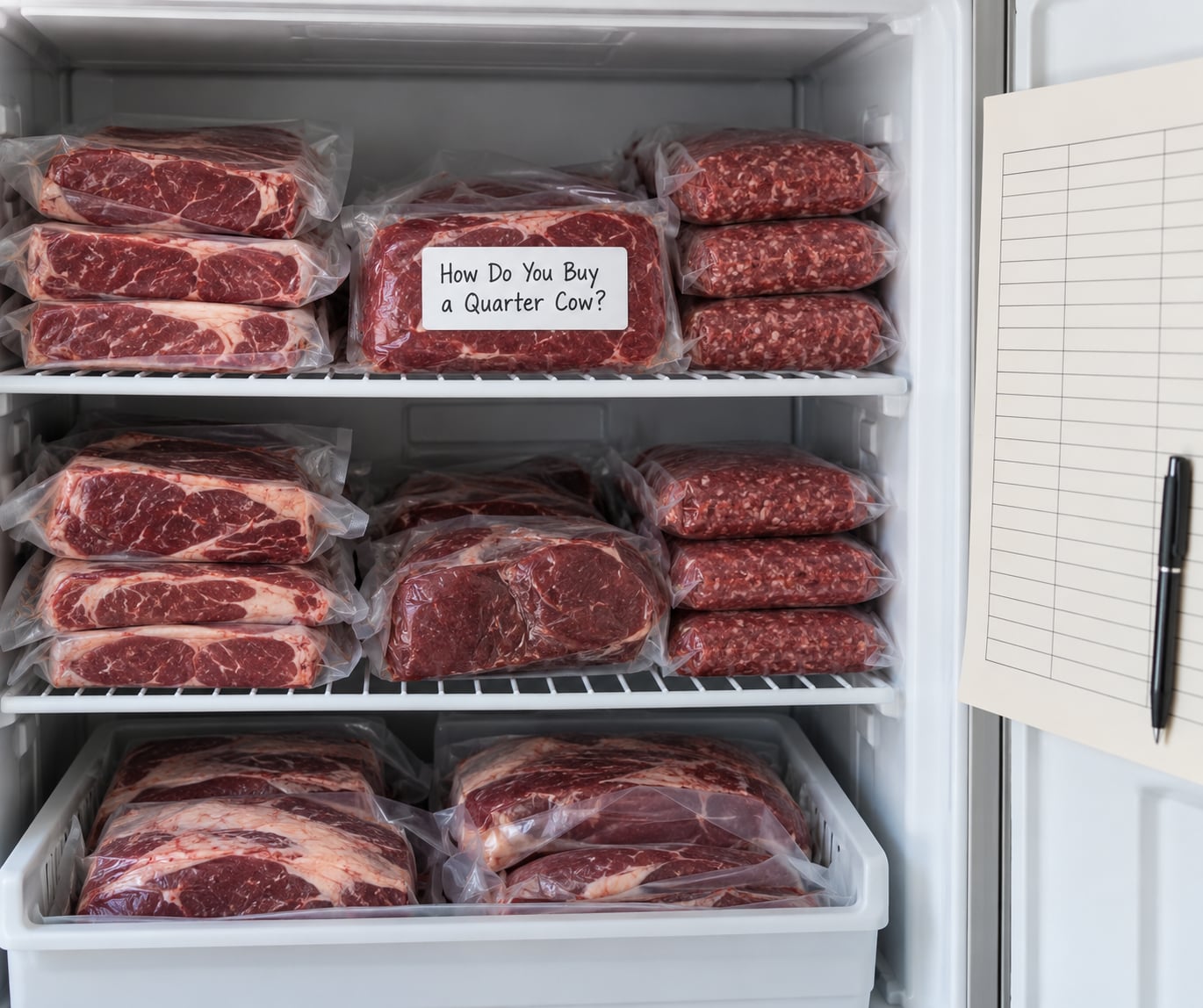
Ordering bulk beef is a five-step process, and every step has a question worth asking before you commit.
1. Find a supplier and check inspection
Look for a local ranch, a meat market or a cooperative slaughterhouse that sells shares. Ask whether the meat is USDA inspected or state inspected — state-inspected meat cannot legally be sold across state lines, which is not a dealbreaker, just something to know before you order from a distance.
2. Pick a share size and confirm the minimum
Most sellers have a minimum of a half cow, or a full cow split four ways. A single quarter is the smallest share most operations will sell. If the minimum is a half, plan to combine with neighbors, and agree in writing who pays for what before the deposit goes out.
3. Send cutting instructions
Ask for the sheet the butcher actually uses. Buyers commonly request steaks cut 1 to 1.5 inches thick, flank and skirt sliced against the grain, stew meat already cubed, cube steak tenderized, and thin-sliced roast meat where it makes sense. Specify the number of packages per cut — a few large packages are easier to store than a dozen small ones, and some plants will only cut a roast down so far.
4. Understand the deposit and balance schedule
Typical structure is a deposit at order, then the balance when processing is complete, then pickup. Ask what happens if the animal does not hit the weight estimate, since the beef price is charged on actual hanging weight, and decide in advance whether you pay the difference or take a smaller share.
5. Plan the pickup date honestly
The gap between deposit and collection can run from a few weeks to a couple of months depending on the schedule at the plant. Ask for a range rather than a date, and make sure your freezer is running and organized before the day arrives, not the day after.
If your freezer cannot hold the whole share, one honest option is to have the box split with a neighbor or family member. Write down the split by weight, agree who pays which portion of the processing and delivery fees, and confirm the butcher will cut and bag the two orders separately. Half the beef with a friend is a very different risk from a full quarter alone.
Is a Quarter Cow Worth It for Your Household?
Run these five checks before you order, and the answer writes itself.
Usable yield against what you will actually eat
Take the packaged weight your seller quotes, subtract anything you will not use, and compare it to the beef your family eats in a month. If the answer is three months of beef for a household that cooks steak twice a year, the freezer wins on paper and loses in practice.
Effective cost per pound against your grocery spend
Multiply the beef price by hanging pounds, add the processing fee, delivery and any extras, then divide by packaged pounds. Compare that figure to what you actually pay per pound at the supermarket for the same cuts. Bulk beef wins most often on roasts, ground beef and stew meat, and much less often on premium steak, where the retail discount is smallest.
Freezer capacity
You need about 5 to 7 usable cubic feet for a typical quarter. If that means clearing out half of what you currently store frozen, or stacking packages in a freezer that already runs warm, the purchase is going to end badly.
Cooking frequency and ground beef volume
Ground beef is 40 to 60 percent of the box. If your household does not have a rotation of burgers, meatloaf, chili, bologna and sausage in the plan, that portion goes stale in the freezer and the value disappears.
Cash flow
The whole amount is due before the first steak hits the pan, with a deposit weeks earlier. If that timing is a stretch, a sale at the grocery store is cheaper than a share at a higher cost of borrowing.
Who should skip a quarter cow
One or two people in a household, a renter with no dedicated freezer space, anyone buying with borrowed money, and anyone who does not cook from scratch at least a few times a week. The honest read from beef-buying forums is blunt about this — a quarter of beef for a couple is a freezer full of work, not a bargain.
Who it suits
A household of three or more that eats beef several times a week, has a working chest freezer with room, cooks roasts and ground beef regularly, and will front the cash. Add a preference for knowing where the beef came from, and the case gets stronger. Buyers who raise or hunt often say the traceability is worth part of the premium on its own.
Quarter Cow vs. Buying Beef at the Grocery Store
Bulk share beef and retail beef are not competing products so much as different answers to different questions. This table is the comparison at a glance.
| Criterion | Quarter cow share | Supermarket or butcher shop |
|---|---|---|
| Cost per pound of packaged meat | Often lower on roasts, ground beef and stew meat after fees; narrow or negative on premium steak | Retail pricing, higher per pound, but you buy exactly what you want |
| Upfront cash | Full amount plus a deposit months before pickup | Paid per trip |
| Convenience | Pickup day involves hauling, organizing and dating several hundred pounds | Aisle and cooler, same day |
| Cut selection | Whatever the butcher’s cut list gives, plus your written instructions | Any cut, any thickness, any size |
| Storage burden | 5 to 7 cubic feet of freezer and a rotation plan | None |
| Flexibility | Low — the money and the meat are committed on day one | High — change your mind next week |
| Traceability | Known farm, known breed, known feed, sometimes dry-aged before freezing | Packaged and anonymous |
| Best for | Families of three or more cooking beef weekly | Singles, couples, small freezers, variety cooks |
One more thing the comparison brings out: the minimum-order problem. A quarter of a small cow can cost more per packaged pound than a quarter of a large one, so if you have a choice between a small animal offered at a low hanging rate and a larger one at a modest higher rate, do the division before you pick.
If you do the math and the saving is thin, the sensible answer is to buy a half cow with two neighbors, or to keep buying retail for a season and wait for a better-seasoned price. Neither is a failure of planning.
How to Store and Safely Prepare Quarter-Cow Beef
Storage is where most quarter-cow stories go wrong, and most of that is avoidable.
How much freezer space to plan for
Published sizing advice ranges from 25 to 40 pounds per cubic foot, which is not really a contradiction. Vacuum-sealed packages stacked tightly run closer to 35 to 40 pounds per cubic foot, while loose or irregularly shaped packages waste air and sit nearer 25 to 30. Use 30 to 35 pounds per cubic foot as your planning figure and leave the rest as headroom for airflow.
| Packaged meat | Usable freezer space to plan | Note |
|---|---|---|
| 75 to 90 lb | About 3 cubic feet | A quarter of a small animal |
| 100 to 130 lb | About 4 to 5 cubic feet | Most common quarter box |
| 140 to 160 lb | About 5 to 7 cubic feet | Quarter of a large animal |
| 200 to 250 lb | About 7 to 9 cubic feet | Half cow share |
| 400 to 500 lb | About 14 to 18 cubic feet | Whole cow share |
Rated freezer capacity assumes the unit is full and the door opens rarely. Leave working room, or the packages you need will freeze into a single block.
Label, date, and rotate
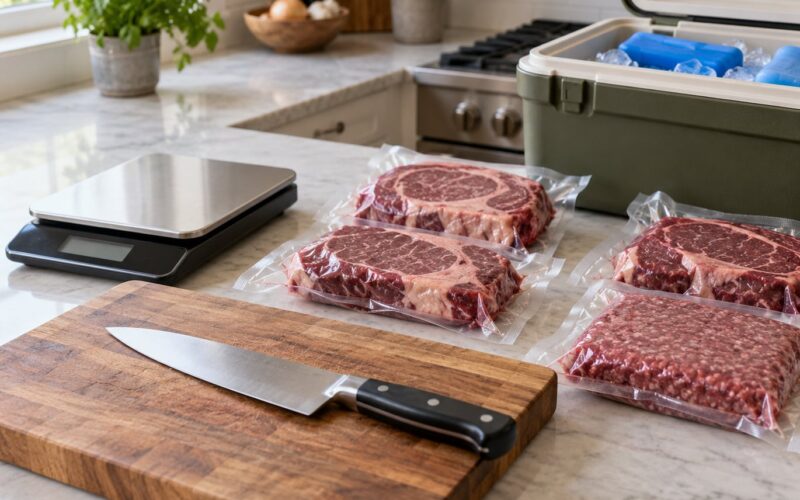
Write the cut and the date on every package with a permanent marker, then group them by type and cook from the front of the shelf first — first in, first out. Vacuum-sealed raw beef keeps its best quality frozen for about 12 months, and ground beef is worth using first because it loses more from freezer burn than whole roasts do.
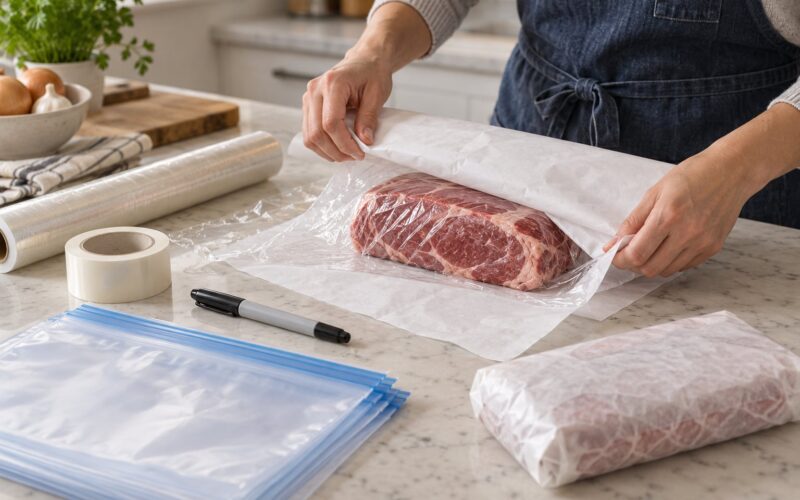
If you did not order vacuum sealing, double-wrap and expect to use thin steaks and ground beef sooner. Freezer burn does not make meat unsafe, but it degrades texture and flavor and it is the reason many boxes get wasted.
Guard against a freezer failure
One buyer in a beef-buying forum lost an entire freezer of beef to a blown circuit breaker. The cheap protections are a plug-in freezer alarm that beeps on a power loss, a dedicated circuit rather than an extension cord, and a written list of who to call if the freezer fails while you are away.
Thawing and cooking temperatures
Thaw in the refrigerator, on the counter in cold water, or in the microwave — never on a warm counter. Plan a whole frozen roast takes days in the fridge, so move it out early.
Follow the USDA minimum internal temperatures: 145°F for whole cuts such as steaks, roasts and chops, 160°F for ground beef, and 165°F for any poultry in the box. Rest whole cuts for several minutes after cooking so the juices settle.
Raw beef keeps 3 to 5 days in the refrigerator, which is not enough to thaw a full quarter slowly. Once a package is cut into portions you plan to cook within a few days, that is a much easier situation to manage than one sealed roast.
Frequently Asked Questions
What is a fair price for a quarter cow?
Most US sellers quote either an all-in rate of roughly 5 to 8 dollars per pound of hanging weight, or a beef price of 3 to 6 dollars plus a processing fee of about 0.75 to 2 dollars per pound. Delivery commonly runs 50 to 150 dollars. The only fair comparison is the total divided by your packaged pounds, which usually lands between 8 and 12 dollars per finished pound. Ask for today’s rate rather than relying on a published number.
How much meat will I get from a 1/4 cow?
Most buyers take home 100 to 130 pounds of cut, wrapped and frozen meat, with individual orders reported from about 90 to 160 pounds. The range depends on the animal size and how aggressively the plant trimmed it. A 190-pound hanging quarter typically yields around 95 to 105 pounds packaged, and about 40 to 50 percent of that weight arrives as ground beef.
How long does a 1/4 cow last for 2 people?
For two people eating beef once or twice a week, a 100-pound box takes roughly a year to a year and a half, and you will be relying on the freezer the whole time. For a family of four cooking beef several times weekly, the same box usually runs eight to twelve months. Households of five or six can move through it in four to six months. Measure your real monthly beef spend before ordering.
How many cubic feet is a 1/4 cow?
Plan for about 5 to 7 usable cubic feet for a typical quarter box of 100 to 160 pounds. Published estimates vary from 25 to 40 pounds per cubic foot depending on how tightly the vacuum-sealed packages stack, so use 30 to 35 pounds per cubic foot as a working figure. Leave headroom above that for airflow, and remember rated capacity assumes a full, unopened freezer.
Should I buy a quarter cow?
Buy one if you have 5 to 7 cubic feet of freezer space, three or more people eating beef weekly, and cash to pay in full before pickup. Skip it if you are one or two people, have no dedicated freezer, or cannot get through a large ground beef portion. The strongest reason to buy is usually traceability to a known farm; the strongest reason to skip is storage, not cost.
How long does 1/4 cow last in the freezer?
Vacuum-sealed raw beef holds its best quality for about 12 months frozen. Unsealed or loosely wrapped packages degrade sooner, and ground beef loses texture from freezer burn faster than intact roasts do. Cook ground beef first, date every package with a permanent marker, and rotate first in, first out so nothing sits past a year.
Conclusion
A quarter cow is one of the four shares of a beef carcass, and it pays off for a household of three or more that eats beef weekly, has 5 to 7 cubic feet of freezer space, and can pay in full before pickup. Everyone else should keep shopping retail.
Your first move is a single division. Ask a seller for today’s all-in total and the expected packaged pounds, divide one by the other, and compare that number against the per-pound price you already pay for the same cuts. If the saving is thin, wait. If it is real and your freezer has room, order it — and start planning the ground beef meals before you pay the deposit.