Learning how to buy fish at a seafood counter comes down to three things: check freshness with your nose first, ask where it came from and when it landed, then get it home cold the same day you plan to cook it. The whole inspection takes about five minutes per fish, and most counters expect you to ask questions.
That is the part almost nobody tells you. People freeze-panic at the counter, reach for a bag of frozen fillets, and go home, and the whole conversation with a fishmonger who does this eight hours a day never happens. A good counter will let you pick the fish up, smell it, press the flesh, and ask what came in that morning. That is the whole job.
I have bought fish the clueless way and the confident way, and the confident version costs nothing extra. Here is what to bring, what to look at, what to say, and what to do with the bag once you get home.
Table of Contents
- What You Need
- Step-by-Step: How to Buy Fish at a Seafood Counter
- How to Tell If Fish Is Fresh at a Seafood Counter
- How to Choose the Right Cut
- How to Compare Price and Value
- What to Ask the Seafood Counter
- How to Store Fish After You Buy It
- Common Mistakes
- Frequently Asked Questions
- Is fresh fish better than frozen fish?
- How can I tell if fish is fresh at a seafood counter?
- Should I choose skin-on or skinless fish fillets?
- What is the best way to transport fish home?
- How long can fresh fish stay in the refrigerator?
- How do I know whether a fish is responsibly sourced?
- Conclusion
What You Need
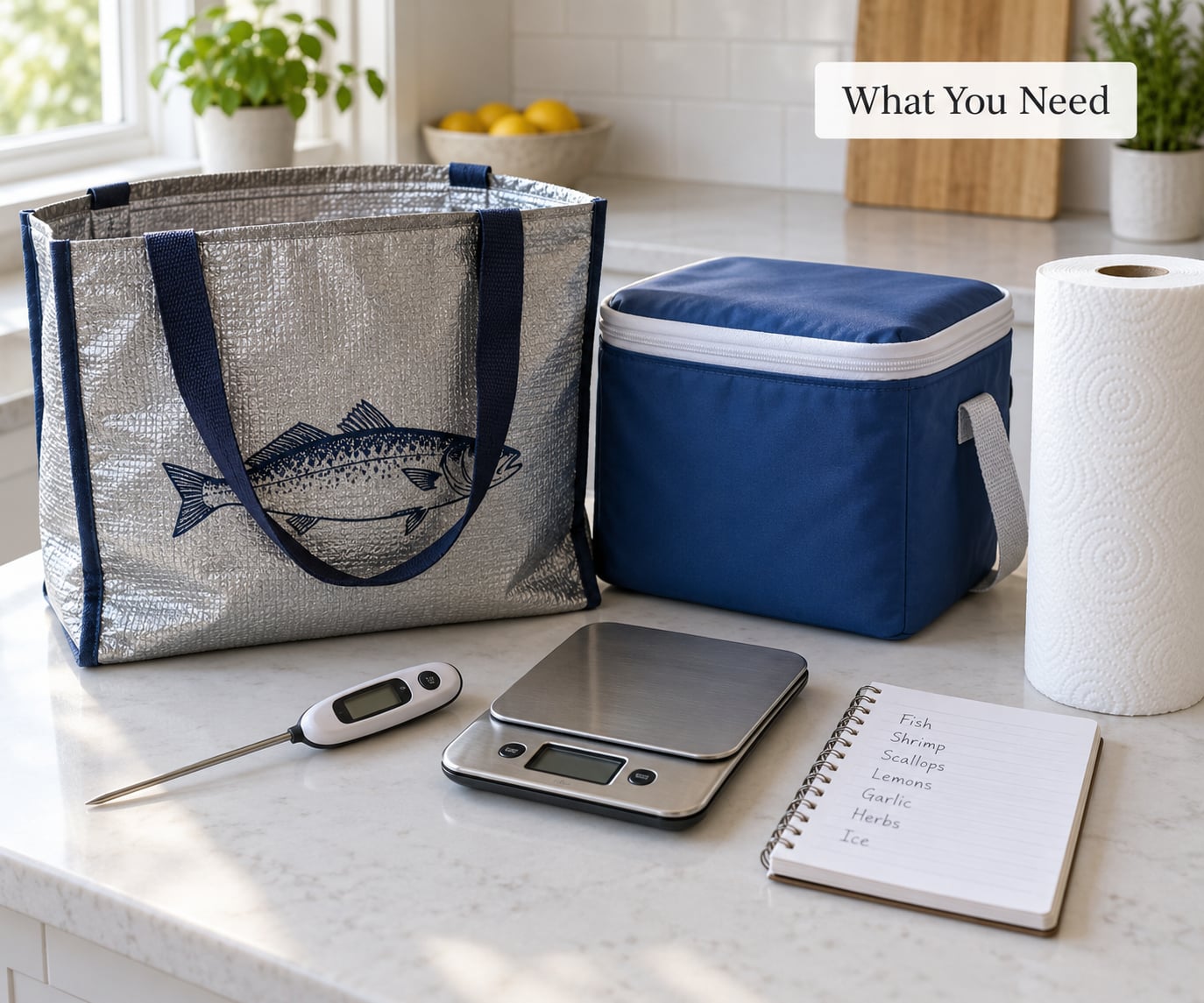
You need very little, and most of it you already own. The point of the setup is not gear, it is being able to keep the fish cold for the trip home and being able to check that it never warmed up.
- An insulated bag or small cooler. A soft grocery bag will not do. A cooler bag with two gel packs frozen solid keeps fish at or below 40°F for the drive. Ask the counter for a bag of crushed ice to lay the fish in, and double-bag it for the walk to the car.
- A kitchen thermometer. Not to check the fish, but to check your fridge. Your refrigerator needs to be at 40°F or below, and the coldest shelf is usually the back wall on the bottom, not the door.
- Paper towels. You will pat the fish dry before it goes in the fridge, and paper towels do that without wasting the protective slime coat.
- A shopping list with your meal and guest count on it. It sounds trivial, but most overbuying at the counter starts with no plan. See the portion guidance further down.
Bring questions, not opinions. Nobody minds a shopper asking about the landing date. Nobody minds a shopper bringing a photo of what they plan to cook.
Step-by-Step: How to Buy Fish at a Seafood Counter
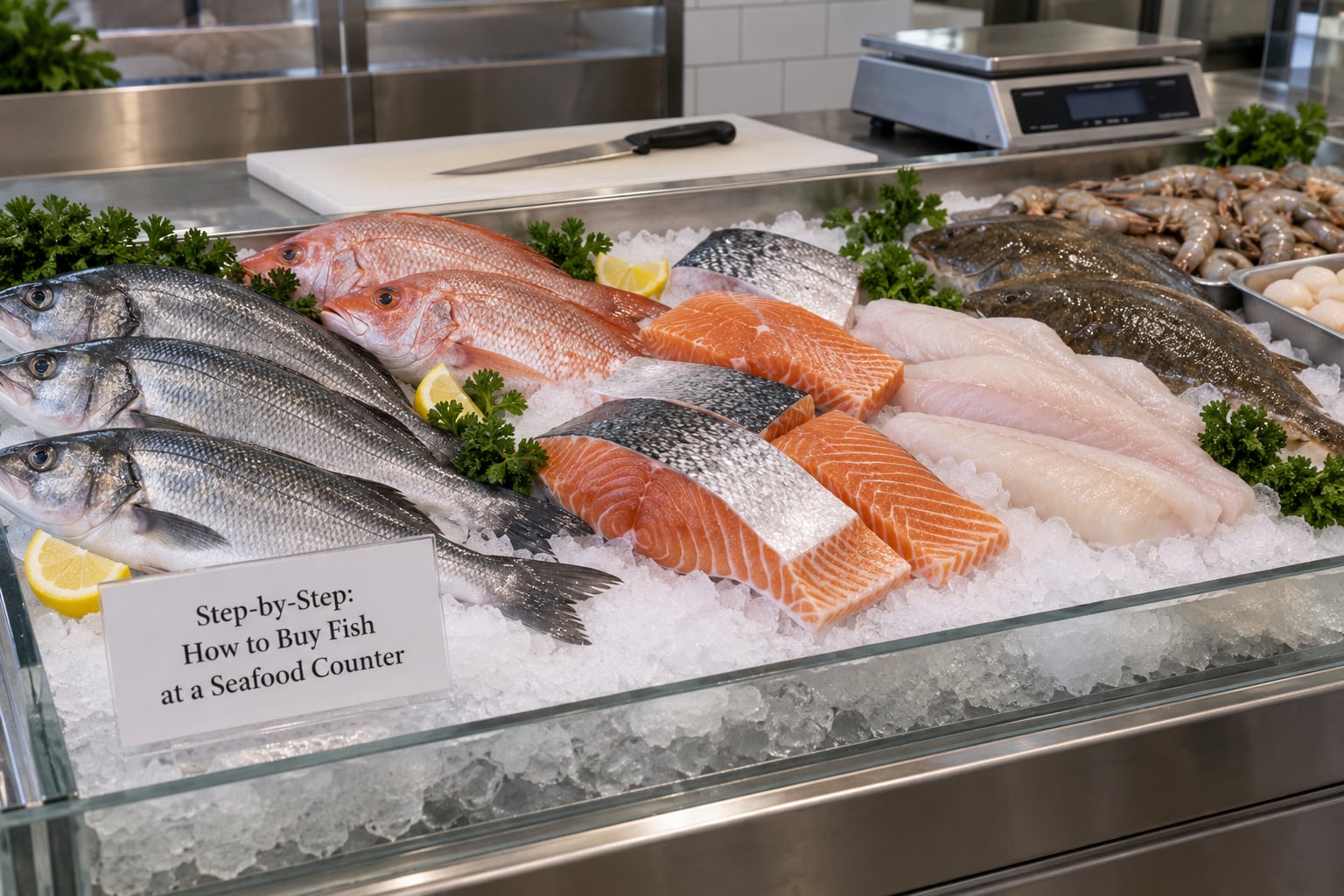
The order matters. Smell before you look, look before you ask, and ask before you choose a cut. Skip straight to the fillets and you are choosing on price, which is exactly how people end up disappointed.
How to Tell If Fish Is Fresh at a Seafood Counter
Fresh fish smells like clean air, cold seawater, or nothing much at all. Any sharp, sour, soapy or ammonia smell is a walk-away, and that rule beats every visual cue. People confuse the smell of a fish counter with the smell of old fish, but a well-run case is rinsed down and iced regularly, so the counter itself should not reek.
Fresh fish, cut open, has the same clean scent all the way to the bone. If a mackerel smells clean and oily at the surface and turns fishy in the cavity, the inside has been sitting, and that is the part you would eat.
Then use your eyes and hands:
- Eyes. Clear and bright, bulging, not sunken into the head. Milky or clouded eyes on a whole fish mean the eye has started to break down.
- Gills. Lift the gill cover. Bright red or deep pink means fresh. Brown, grey, or muddy means time has passed.
- Flesh. Press the fillet with your thumb. It should spring back and leave no dent. A dent that stays is a protein breakdown sign. The bloodline along a salmon fillet should be red, not brownish.
- Skin and scales. Wet and shiny, with scales still attached. A few missing scales are cosmetic, a patch of bare skin is not.
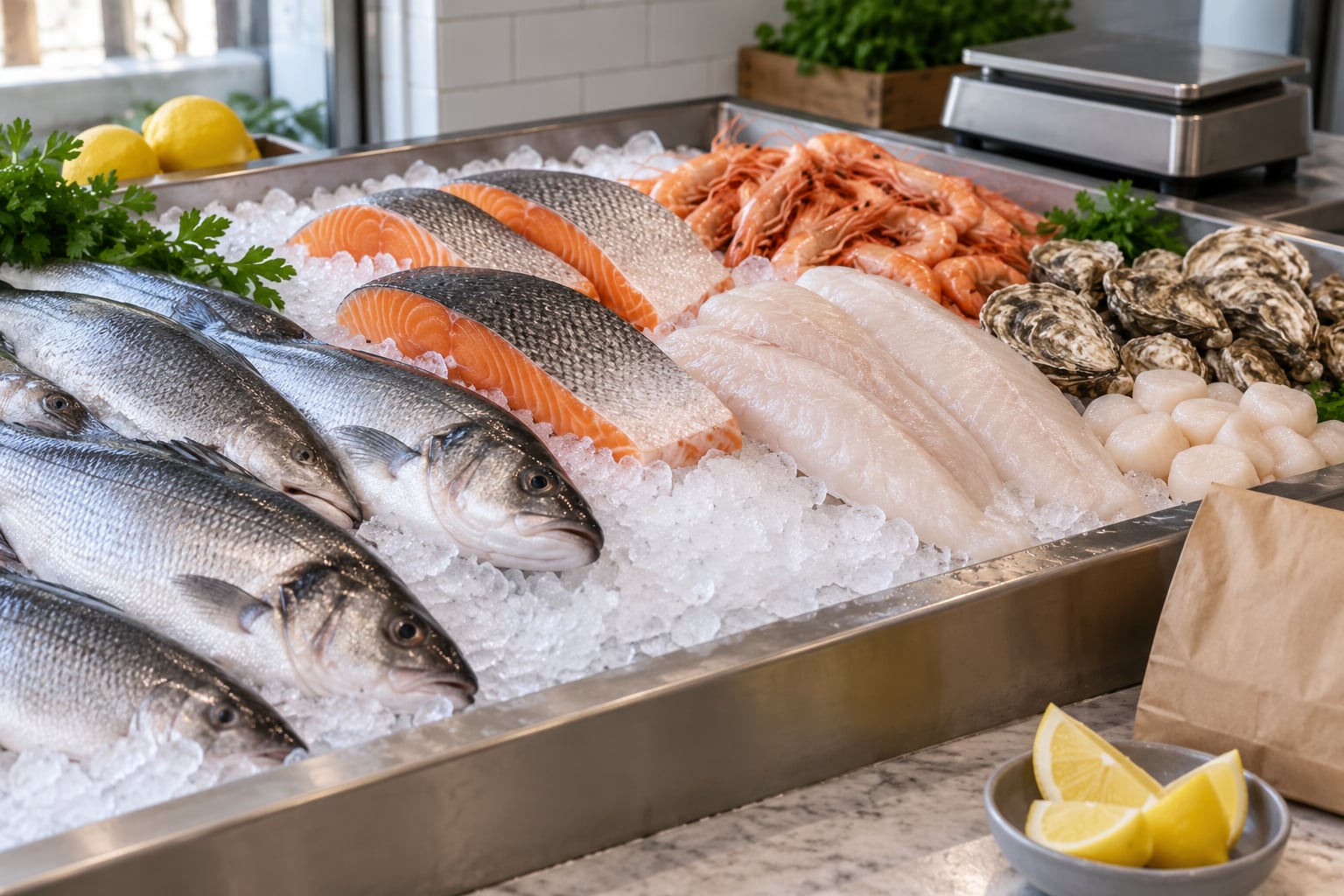
- The ice. Fresh granular ice, replenished regularly, with no pooled pink or grey meltwater in the tray. Meltwater is diluted blood and mucus, and it tells you the case is behind on cleaning.
A note on what appearance can and cannot tell you. Every sign above is a quality signal, not a safety test. Only temperature history guarantees safety, and that is the counter’s job, not yours. Your job is to refuse anything that looks and smells tired, and to get it cold fast.
| What you check | Buy it when you see | Walk away when you see |
|---|---|---|
| Smell | Clean ocean air, or nearly no smell | Sharp, sour, soapy or ammonia odor |
| Eyes | Clear, bright, bulging | Milky, clouded or sunken |
| Gills | Bright red or deep pink | Brown, grey or muddy |
| Flesh | Firm, springs back after a press | Soft, dented, dull, dry edges |
| Bloodline | Red | Brown or grey |
| Skin and scales | Wet and shiny, scales attached | Dull, dried edges, bare patches |
| The case | Bright granular ice, clean tray | Pooled meltwater, residue on steel |
How to Choose the Right Cut
Whole fish, head and gutted, fillets, steaks, and portions are the same fish at different stages of someone else’s work. Buy the least-processed form you are comfortable cutting, because you get the freshness cues and you often get more usable meat for the money.
Whole fish gives you the full inspection: eyes, gills, skin, and belly cavity all visible. It is the honest option and the cheapest per pound, and most fishmongers will clean and portion it for you at no charge. The catch is bones and the learning curve.
H&G, headed and gutted, is the most common whole-fish form. The head is off, the cavity is cleaned, and the fish is ready to cook. You can still check the gills, the skin, and the color of the flesh, and there is far less waste at the table.
Fillets are the boneless side of the fish, sold skin-on or skinless. Skin-on keeps more moisture during cooking and costs less, and you can ask whether a fishmonger will deburr or pin-bone it before you leave. Fillets lose their window faster than whole fish, so buy them for tonight or tomorrow’s meal.
Steaks are thick cross-sections, usually from a large firm fish like swordfish, halibut, or tuna. They are the most forgiving cut because there is no deburring to do, and they are the one form where a thicker piece is worth a little more.
Portions are pre-cut servings. They are the most convenient and the least telling, since you cannot see eyes, gills, or a whole body. Convenient is a fine reason to buy them, just not the only one.
On yield, a 2-pound whole salmon gives you roughly 1 to 1.25 pounds of usable flesh, while a 2-pound whole lean white fish such as cod or pollock lands closer to a pound of fillet. That gap is the reason a whole fish can look expensive per pound and still be the cheaper plate. A good fishmonger will tell you the expected yield before you buy, and you should let them.
How to Compare Price and Value
Judge value on the edible meat you take home, not the number on the sticker. Three things move that number: yield, trim, and how long the fish has been sitting.
First, do the per-pound math against yield. A whole fish at one price per pound and a fillet at another are not comparable until you apply the yield ratio above. Second, look at trim. A skinless, pin-boned fillet has had more work done to it, and some of that work shows up in the price, though not always fairly. Third, and most importantly, a fresher fish is worth more per pound than an older one at half the price, because you cannot smell through packaging and old fish does not cook back into good fish.
Origin is part of value too, and it is often the cheapest signal you can find. A fish landed nearby on ice traveled less time than one shipped across an ocean, and less time means less quality lost before it reached the case.
Do not wash fish before storing it. Rinsing strips the protective slime layer and spreads bacteria over the surface. Pat dry with paper towel, and if grit bothers you, leave that to the cooking method. Shellfish are the exception worth knowing: clams and mussels benefit from a soak in clean salted water to purge grit, and that happens after purchase, not before.
What to Ask the Seafood Counter
Counters are busy, so short questions get better answers than speeches. Six cover almost everything, and the person behind the counter usually answers faster than you expect.
- Where was this caught or farmed, and on what boat or farm? A name answers instantly. A pause is information too.
- When did it come in, and what is today’s best pick? A good answer names a landing date and volunteers an honest alternative, such as salmon being better than whatever the cod did that morning.
- Was this ever frozen? Fish frozen at sea within hours of the catch is often fresher than counter fish on its fifth day on display. That is a feature, not a defect.
- Has anything been added to it? Some fillets hold added water or phosphates to keep them plump. The clerk should be able to say yes or no plainly.
- How long can I keep this, and should I freeze it? This gets you a real answer instead of a guess from the packaging.
- Will you scale, gut, debone or portion this for me? Nearly every counter says yes. Skipping this step is leaving free help on the counter.
If the clerk gives vague answers about origin or date twice, move on. You are not being difficult, and there is always another case or another freezer.
How to Store Fish After You Buy It
The purchase is halfway. Fish loses quality faster than any other meat, so the goal is to keep it cold and fast, then eat or freeze it.
Ask for ice at the counter, lay the fish in it inside a sealed bag, and go straight to the car. The practical target is to have fish refrigerated within about 30 minutes of purchase. A bag of ice in a cooler keeps it at or below 40°F during the trip, which is the temperature seafood should live at the whole time. On a long drive, add a second bag of ice rather than leaving it in a warm car.
At home, put the fish in a shallow dish on a bed of ice or ice packs, cover it, and set it on the coldest shelf, usually the lower back of the fridge, not the door. Keep the fridge at 40°F or below. Plan to cook it within one to two days, and treat the second day as the limit rather than a target.
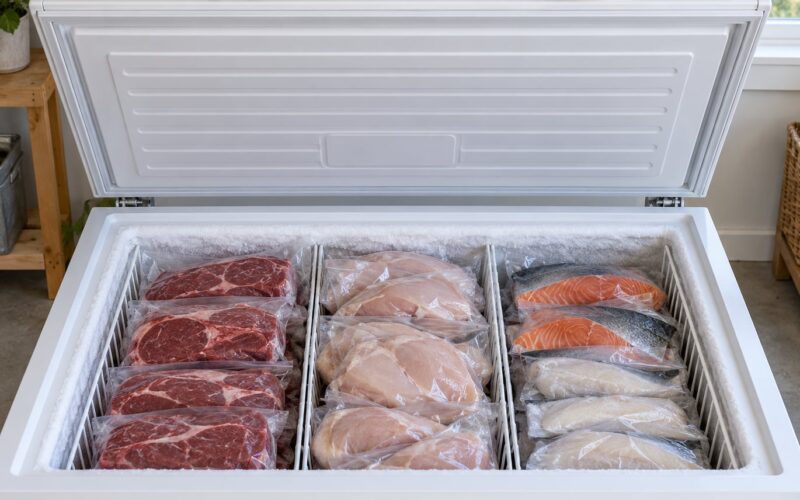
If you cannot cook it in that window, freeze it the same day. Seal it in a freezer bag or airtight container, press out the air, label it with the date, and keep it in the back of the freezer where it will not thaw when you dig around for frozen peas.
Two safety rules to keep straight. Do not rinse raw fish under the tap before refrigerating it. And cook fish to an internal temperature of 145°F, which is 63°C, measured in the thickest part. That is the USDA minimum for fish, and a food thermometer is the only way to know.
Common Mistakes
Almost every mistake at the seafood counter is a habit, and habits are easy to swap out. Here are the ones that cost people the most dinner.
- Choosing on looks alone. A beautiful fillet with a fishy smell is old. Fix: smell first, every time, even when the fish is on ice and you have to ask for a lift of the cover.
- Ignoring the label’s catch or harvest date. The date is the single most useful fact on the card. Fix: read it before you fall in love with the cut.
- Buying too much. A rough guide is a quarter pound of boneless fish per adult for a modest dinner, a third to half pound for a generous one, and less for a child. Fix: write the number down before you go to the case, and scale it for the guests you actually have.
- Forgetting to ask about bones. Even fillets carry pin bones. Fix: ask, or plan to check with a fingertip before cooking, running the flesh along the bone.
- Letting the bag warm up on the drive. Fix: ice in a cooler, straight home, and check your fridge thermometer while you are at it.
- Washing fish before storing it. Fix: skip the rinse, pat dry instead, and start cooking from cold.
- Buying shellfish already shucked. Pre-shucked scallops and oysters cannot be smelled or inspected. Fix: buy live clams, mussels, and oysters in the shell where you can, and choose closed or tightly closed shells that do not open when tapped.
Two smaller habits pay off too. Go early in the day when the case has just been cut, and pick from the display rather than the end of the case where things sit longest. And buy the same day you cook. Timing does as much for quality as inspection does.
Frequently Asked Questions
Is fresh fish better than frozen fish?
Not always. Fish flash-frozen within hours of the catch at sea is often fresher than counter fish that has sat on display for several days, and freezing locks in texture. Look for a ‘previously frozen’ or flash-frozen label rather than treating it as a downgrade. If you want to cook the same day and the counter fish smells clean, buy it fresh.
How can I tell if fish is fresh at a seafood counter?
Use smell first: fresh fish smells like clean air or cold seawater, with no sharp, sour, or soapy note. Then check for clear bright eyes, gills that are vivid red or deep pink, firm flesh that springs back after a thumb press, and shiny skin with scales attached. Muted color, dented flesh, or pooled meltwater in the tray are reasons to walk away.
Should I choose skin-on or skinless fish fillets?
Skin-on is usually the better buy. The skin holds moisture in the flesh during cooking, so fillets dry out less, and it often costs less than the skinless version. Skinless is worth choosing for dishes where you want the clean flavor of the fish with no texture from the skin, and for very thin, delicate species. Either way, ask the clerk to debone or deburr it first.
What is the best way to transport fish home?
Ask the counter for crushed ice, seal the fish in a bag on top of the ice, and put it in an insulated cooler. Keep it at or below 40°F and get it into the refrigerator within about 30 minutes. On a longer drive, add a second bag of ice rather than letting the cooler warm up.
How long can fresh fish stay in the refrigerator?
One to two days is the safe window, with the first day being the best one. Keep the fish covered on a shallow dish set on a bed of ice, on the coldest shelf of a refrigerator holding 40°F or below. Do not rinse it first. If you will not cook it within that window, freeze it the day you bought it and cook from frozen.
How do I know whether a fish is responsibly sourced?
Look for a third-party certification on the label or the case. MSC covers wild-caught fish, ASC covers farmed, and BAP covers both in some categories, all of them independently audited against environmental standards. Monterey Bay Aquarium Seafood Watch is a consumer rating system rather than a certification, but its best choice and good alternative marks are a useful shortcut when no certification is present.
Conclusion
Standing at the counter, five things decide whether dinner is good. Smell the fish and walk away if it is sharp or sour. Check the eyes, gills, and flesh for clear, red, and springy. Ask where it came from, when it landed, and whether it was ever frozen. Compare the price against edible yield rather than the sticker alone. Then pick the cut that matches how much kitchen skill you want to spend that evening.
And ask for ice. A fish that spends its first hour at 40°F or below is worth more than one that rides home warm in a plastic bag, no matter how good it looked in the case.