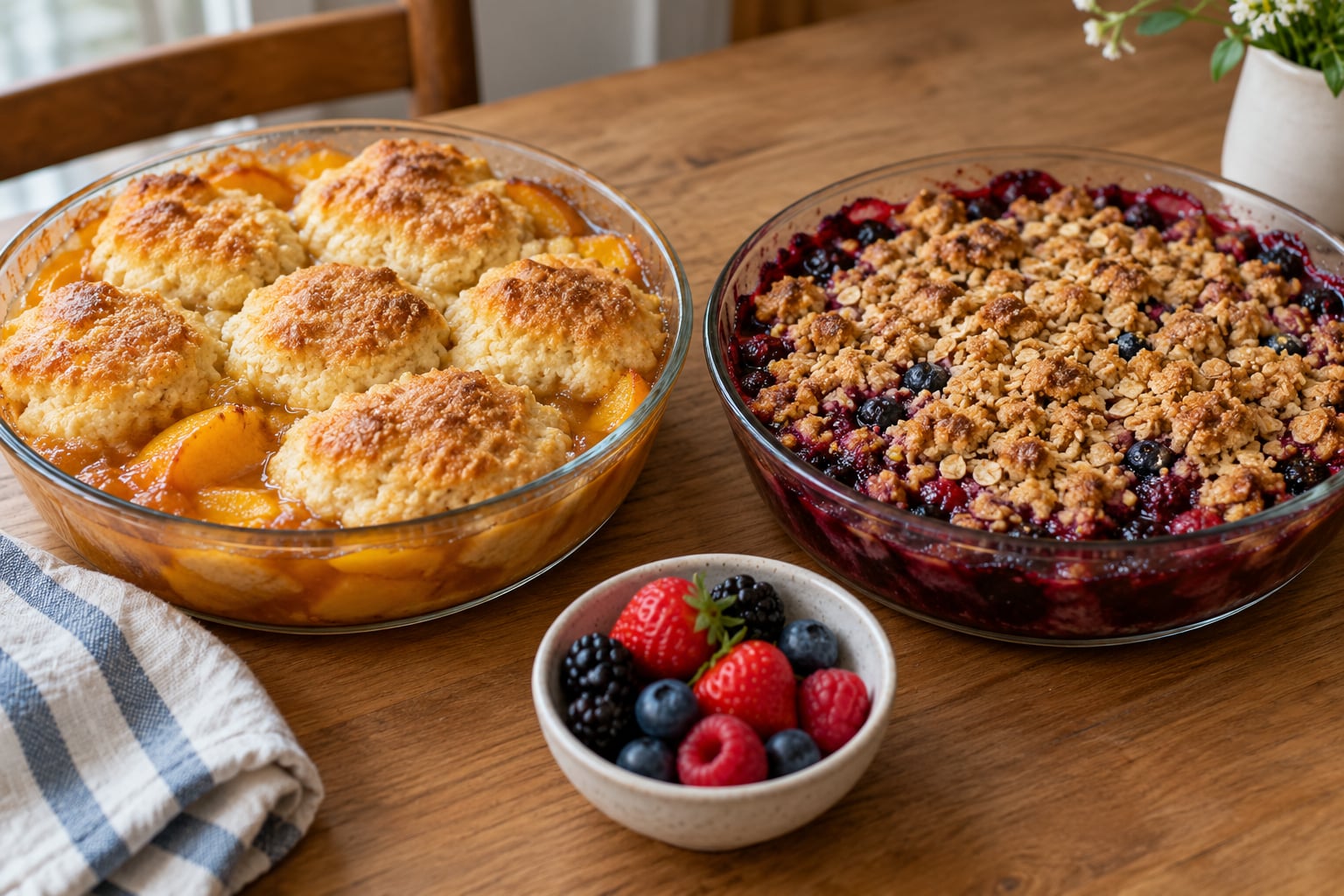
Both are deep-dish baked fruit desserts, and the whole difference is the topping. A crisp gets a crumbly streusel of cold butter, sugar, flour and rolled oats that toasts into something crunchy. A cobbler gets rounds or a sheet of biscuit or pie dough dropped over the fruit, which rise into tender mounds shaped like cobblestones.
Everything else is nearly identical: the same sliced fruit, the same sugar and cinnamon, the same deep baking dish, the same bubbling syrup in the bottom. Once you know that, telling the two apart at a glance is easy.
Table of Contents
- What Is the Difference Between a Cobbler and a Crisp at a Glance?
- What Is a Fruit Cobbler?
- What Is a Fruit Crisp?
- Cobbler vs. Crisp: How the Toppings Differ
- Cobbler vs. Crisp: How the Fruit and Texture Compare
- Cobbler vs. Crisp: Which One Is Easier to Make?
- Cobbler vs. Crisp: Which One Should You Choose?
- Can You Make a Cobbler Without a Topping or a Crisp Without Oats?
- Frequently Asked Questions
- Is a crisp the same as a cobbler?
- What is the main difference between cobbler and crisp toppings?
- Can I use a cobbler recipe for a fruit crisp?
- Which fruit works best for a cobbler or a crisp?
- Can I make either dessert ahead of time?
- Why does my crisp topping not get crunchy?
- Conclusion
What Is the Difference Between a Cobbler and a Crisp at a Glance?
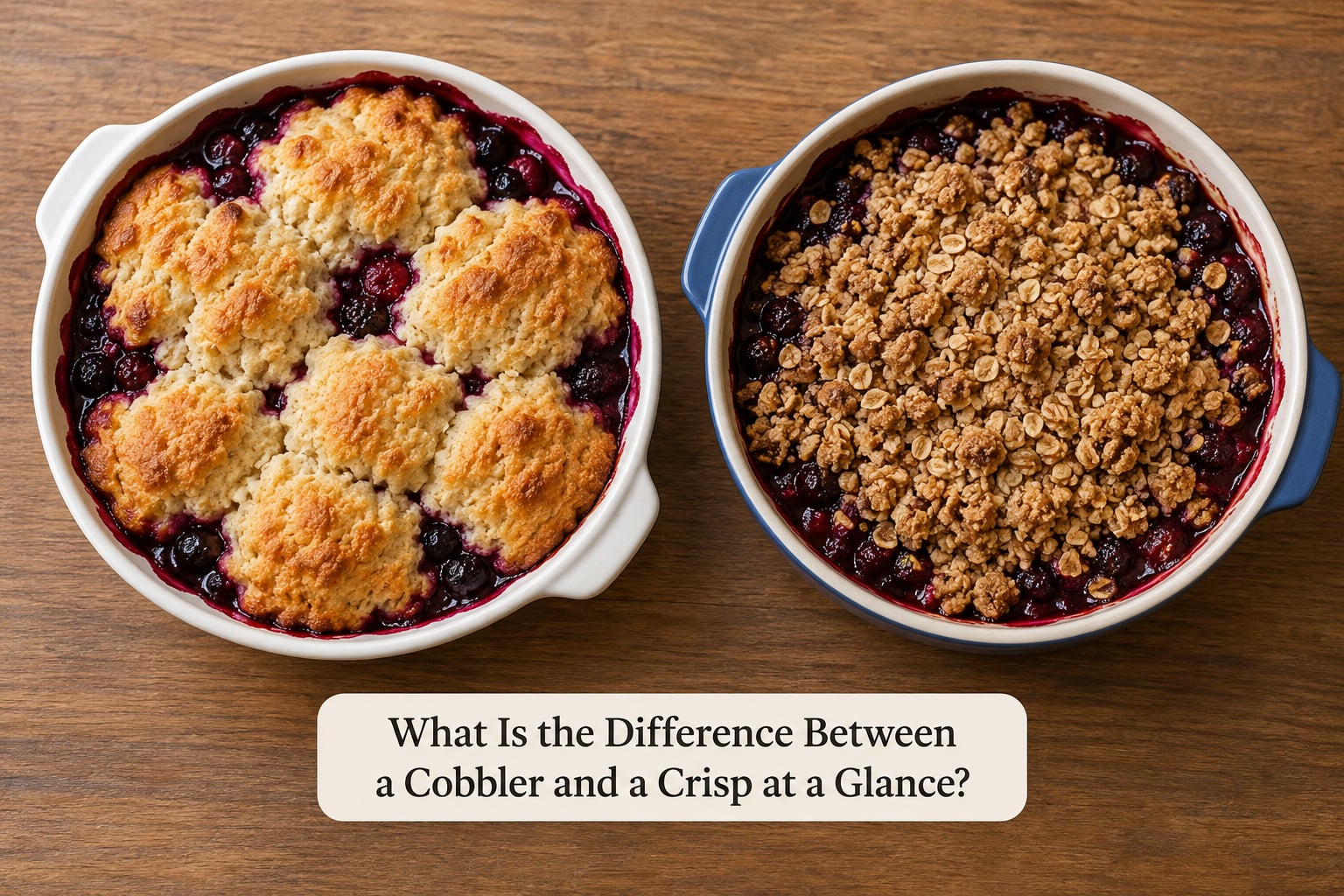
| What to compare | Fruit cobbler | Fruit crisp |
|---|---|---|
| Topping | Dropped biscuit dough, pie dough, or a poured scone-style batter | Streusel crumbs scattered over the fruit |
| Topping ingredients | Flour, baking powder, milk or cream, butter, sugar | Flour or oats, brown sugar, cold butter, salt, sometimes nuts |
| Finished texture | Tender, cakey, slightly dense mounds that soak up juice | Sandy, crumbly, audibly crunchy edges |
| Fruit preparation | Pears, apples, peaches cut firm; bake until just tender | Fruit can be softer, sliced thinner, even slightly overripe |
| Pan depth | Deep 8×8 or 9×9 inch dish, filling comes partway up | Same deep dish, filling usually lower |
| Sweetness | Sweeter overall, sugar often in the dough too | Sweetness concentrated in the crumb layer |
| Best fruits | Apples, pears, peaches, plums, blackberries at peak ripeness | Rhubarb, apples, berries, any fruit needing a crisp lid |
| Best occasion | Sunday supper, holiday table, warm breakfast | Summer cookout, picnic, cook-aheads and transport |
The row that matters most is the first one. Everything else is a preference, and regional bakers disagree on the edges. Cooks in New England tend to reserve the word crisp for an oat-topped dessert and use crumble for the oat-free version, while British and much Southern usage treats the two words as the same dish. If a recipe says crisp and the topping has no oats, nothing went wrong.
What Is a Fruit Cobbler?
A fruit cobbler is sweetened fruit baked in a deep dish under a topping of raw dough. The dough is dropped in evenly spaced lumps rather than rolled out, which is where the name comes from: once baked, the risen mounds cover the filling the way rounded stones cover an old road.
Three toppings fall under that umbrella:
- Dropped biscuit dough, the most common, made like a drop biscuit or scone and dolloped over the fruit.
- A sheet of pie dough, laid across the top and crimped or vented, for a more pie-like result.
- Poured batter, which spreads into a cakery layer as it bakes, common in the South.
Most cobblers have no bottom crust at all. The fruit sits directly in the dish, seasoned with sugar, cinnamon, lemon juice and sometimes cornstarch or flour to thicken the juices, then bakes until the edges bubble and the dough tops turn golden brown. Serve it warm, spooned straight from the dish, ideally with ice cream or cream poured over.
What Is a Fruit Crisp?
A fruit crisp is sweetened fruit baked under a streusel, a loose crumble of butter, sugar, flour and usually rolled oats. Nothing is kneaded and nothing is shaped. You cut cold butter into the dry ingredients until the mixture looks like coarse sand with a few pea-sized clumps, then scatter it over the fruit in an even layer.
Oats are traditional but not required. A classic crumble uses the same formula with no oats at all, and plenty of published crisp recipes skip them, which is a large part of why home bakers feel they did something wrong when a crisp turns out oat-free.
The word describes the result rather than the ingredients. During baking the butter melts into the flour and oats, the sugars caramelize, and the top turns deeply brown with a texture that snaps under a spoon. The fruit underneath stays moist, so a crisp is the more forgiving option when your fruit is not quite perfect.
Cobbler vs. Crisp: How the Toppings Differ
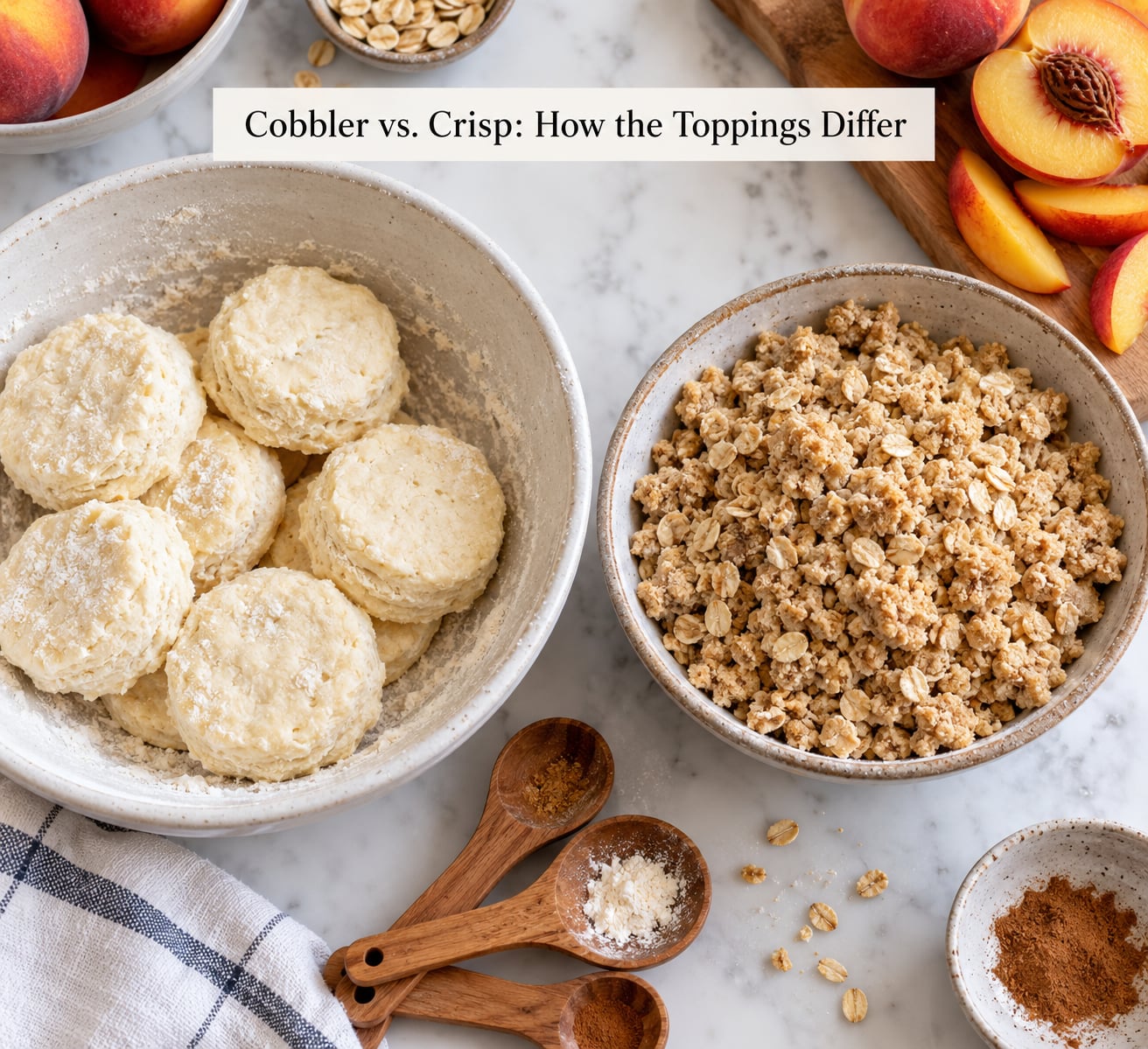
Structurally the two toppings could not be further apart. A cobbler topping is a leavened dough, so it needs liquid and time in the oven to rise. A crisp topping is not a dough at all; it is a dry fat-and-flour mixture that browns in place and never softens the fruit underneath.
That difference changes how you handle each one:
- Cobbler dough needs restraint. Drop the lumps close together but not touching, or they merge into one flat sheet instead of staying distinct.
- Streusel needs cold butter and a light hand. Warm butter melts before it reaches the oven and the topping sinks into the filling as a sad, flat layer.
- Both want the fruit liquid managed. Too much juice and the center stays thin; too little and the fruit scorches before the topping browns.
- Sugar placement differs. Cobbler dough is usually sweetened; crisp sugar belongs in the crumb layer, where it caramelizes.
Converting one to the other takes about two minutes of work. To turn a cobbler into a crisp, keep the fruit exactly as written and replace the biscuit dough with a streusel made from the topping amounts of flour, sugar, brown sugar, rolled oats and cold butter. To go the other way, scatter biscuit dough over a crisp filling and add 10 minutes to the bake.
Cobbler vs. Crisp: How the Fruit and Texture Compare
Both desserts start the same way: fruit sliced roughly even, tossed with sugar and spice, spread in a buttered deep dish. The fruit sits in the dish during baking and releases juice, which mixes with sugar to make a syrup thick enough to spoon over ice cream.
A cobbler gives you two textures in one spoonful, a tender piece of cake-like dough on top and hot fruit underneath. The dough drinks up juice as it bakes, so it stays soft all the way to the edge of the dish. That density is why a cobbler feels more substantial and why it holds up to firm, peak-season fruit like pears or early peaches.
A crisp separates the textures. The fruit layer stays distinctly fruit, cool and juicy, while the topping stays dry and crunchy because it never touches liquid until you break the surface with a spoon. That separation makes a crisp easier to travel, easier to eat outdoors, and easier to serve a day after baking.
Home bakers who have tried both often describe a crisp as crunchier and lighter and a cobbler as heavier and cakier. Forum threads on the question reach the same conclusion, with one useful wrinkle: crisps handle less ripe fruit better, while a cobbler shows off fruit at its absolute best.
Cobbler vs. Crisp: Which One Is Easier to Make?
A crisp is the easier of the two for a beginner. There is no kneading, no shaping, and nothing to judge except whether the crumbs look even. Mixing streusel with your fingers until it clumps is hard to get wrong, and the topping spreads across the whole dish in one motion.
A cobbler asks for a little more precision but not much more time. You still only mix, drop, and bake. The step that trips people up is spacing the mounds, because dough that touches during baking spreads into one continuous layer and you lose the cobblestone look entirely.
In practice the difficulty gap is smaller than the name gap suggests. Both use one dish, one oven and about the same active time. The real time difference comes from what happens after the oven: a cobbler is at its best within the first 30 minutes, while a crisp keeps for two days at room temperature covered, or about four days refrigerated, and travels well if you are bringing it somewhere.
If you want to work ahead, bake both up to two days early and rewarm gently. A crisp tolerates this well. A cobbler does too, but its topping softens in the fridge, so a few minutes under a hot broiler brings it back.
Cobbler vs. Crisp: Which One Should You Choose?
Choose a cobbler when you want a warm, spoonable dessert with a cakey bite, when the fruit is firm and at its peak, or when dinner needs a centerpiece. Apple cobbler and peach cobbler are the versions people ask for by name, and both belong at a holiday table next to the main dish.
Choose a crisp when you want crunch, when the fruit is soft or slightly past its best, or when the dessert has to survive a car ride. Rhubarb crisp and apple crisp are the standards, and a crisp is the safer choice for a cookout where it will sit on a picnic table.
A few specific calls:
- Apples go either way. Cobbler if you want cake, crisp if you want a clean snap against the fruit.
- Peaches are juicier than people expect, so a crisp holds its texture better and a cobbler needs firm fruit.
- Rhubarb releases a lot of water. Both work, but a crisp topping hides the thin filling better than biscuit dough does.
- Berries bake down fast. Lower the heat by 25°F if using a glass dish, since the fruit at the edge can catch.
Can You Make a Cobbler Without a Topping or a Crisp Without Oats?
A cobbler without a substantial topping stops being a cobbler and becomes baked fruit. Biscuit dough, pie dough or poured batter is what makes it a cobbler, so there is no practical version without one.
A crisp without oats is entirely normal. Drop the oats and you have what most people call a crumble, which in New England cooking is a separate name and in British and Southern cooking is simply another word for crisp. The butter, sugar and flour stay exactly the same, and the texture barely changes.
Frequently Asked Questions
Is a crisp the same as a cobbler?
No. They share the same base of sweetened baked fruit, and the topping is what separates them. A crisp has a loose streusel of butter, sugar, flour and usually rolled oats that bakes crunchy. A cobbler is covered with biscuit, pie dough or poured batter that rises into soft, cakey mounds. If the topping is crumbly, it is a crisp. If it rises and browns in pieces, it is a cobbler.
What is the main difference between cobbler and crisp toppings?
The main difference between a cobbler and a crisp topping is that one is dough and the other is a dry crumble. A cobbler topping is a leavened biscuit dough dropped in lumps so it can rise. A crisp topping is cold butter cut into flour, sugar and oats, scattered loose so the butter melts and the crumbs toast. That is why a cobbler bakes soft and a crisp bakes crunchy.
Can I use a cobbler recipe for a fruit crisp?
Yes, and it takes almost no work. Keep the fruit filling exactly as written and swap the biscuit dough for a streusel. For a 9-inch dish, use about 1 cup flour, 3/4 cup brown sugar, 3/4 cup rolled oats, 6 tablespoons cold butter and a pinch of salt. Bake at the same temperature, usually 375°F, and start checking for a browned topping about 5 minutes earlier.
Which fruit works best for a cobbler or a crisp?
Firm fruit suits a cobbler best because the dough needs structure to sit on: pears, apples, peaches and plums that are ripe but not soft. A crisp is more forgiving and handles berries, rhubarb and fruit that is a little past its best. Thicker fruit like apples can go in either; thin, watery fruit like blackberries or plums are usually better under a crumb topping.
Can I make either dessert ahead of time?
Yes. Both can be assembled up to a day ahead and kept refrigerated unbaked, which is the best option because the topping stays separate from the fruit. Baked, a crisp holds well covered at room temperature for two days, or about four days refrigerated, and a cobbler lasts the same length of time but softens, so a few minutes under the broiler brings the topping back.
Why does my crisp topping not get crunchy?
Three things cause this. Butter that started warm melted into the fruit before it could set the crumb layer, so chill it and cut it in quickly. Fruit released too much liquid and steamed the topping instead of browning it, so add a little extra sugar or cornstarch to the filling. And too little topping spreads thin, so use a generous even layer and do not press it down.
Conclusion
Start by looking at the topping. If it is dough that rises, you are looking at a cobbler. If it is crumbs that brown, you are looking at a crisp.
Then pick based on the fruit in front of you: firm and ripe for a cobbler, softer or past its best for a crisp. Chill the butter, leave the topping loose, and let the dish rest a few minutes before serving so the syrup thickens.