Roast a whole pumpkin at 400 F (200 C) for 45 to 90 minutes, depending on size, and it is done when a fork or skewer slides into the thickest part with no resistance. You do not peel it, you do not add water, and you do not need a blender with any real power. This is how to roast a whole pumpkin for puree, and it takes about an hour of oven time plus 20 minutes of cooling.
The reason roasting wins over boiling is the cut surface. Dry oven heat browning the natural sugars is what turns a mild squash into something sweet and deep, and it does it without you stirring a pot. Slice it, cut-side down on a lined sheet pan, and let the oven do the work.
One thing to settle before you start: the pumpkin you pick matters more than the method. A dense pie or sugar pumpkin between 2 and 4 lb gives you smooth, thick puree. A 10 lb jack-o’-lantern gives you something closer to flavored water, no matter how well you roast it.
Table of Contents
- What You Need
- Step-by-Step: How to Roast a Whole Pumpkin for Puree
- How to Roast a Whole Pumpkin for Puree: Choose and Cut the Pumpkin
- How to Roast a Whole Pumpkin for Puree: Roast Until Tender
- How to Roast a Whole Pumpkin for Puree: Peel, Blend, and Adjust
- How Many Cups of Puree Does One Pumpkin Make
- How to Store Homemade Pumpkin Puree
- Common Mistakes
- Frequently Asked Questions
- Do I have to peel a pumpkin before roasting it for puree?
- How long does it take to roast a whole pumpkin for puree?
- What is the best temperature for roasting pumpkin before blending?
- Can I roast a pumpkin without cutting it in half?
- How do I get the smoothest pumpkin puree after roasting?
- How long can homemade roasted pumpkin puree stay in the refrigerator?
- Conclusion
What You Need
- A pie or sugar pumpkin, 2 to 4 lb. Also sold as a baking pumpkin. Small sugar, winter luxury, and heirloom pie varieties all work well.
- A rimmed baking sheet lined with parchment paper or a silicone mat. Do not crowd the pan.
- A large chef’s knife and a sturdy spoon or metal slotted spoon for scraping the cooked flesh.
- A food processor or blender for the purée. A processor with an S-blade gives you the smoothest result with the least effort.
- Do not use large carving pumpkins, which are watery and stringy. They are grown for size and thin walls, not for dense flesh.
Size matters for timing. A 2 lb pie pumpkin roasts in roughly 40 to 50 minutes at 400 F, a 4 lb pumpkin needs 60 to 75, and anything 6 lb or heavier runs 90 minutes or more. Very small sugar pumpkins under 2 lb can be done in half that.
You can leave the skin on. That is the whole point of roasting instead of peeling, and it holds moisture in while the flesh softens. A medium pumpkin also gives you a generous quantity of seeds to roast alongside, if you have the oven space.
No oil is required. Pumpkin flesh is roughly 90 percent water, so it will not dry out the way root vegetables do, and the caramelization comes from its own sugars. A light brush of oil is fine if you want deeper browning, but it is not needed.
Step-by-Step: How to Roast a Whole Pumpkin for Puree
How to Roast a Whole Pumpkin for Puree: Choose and Cut the Pumpkin
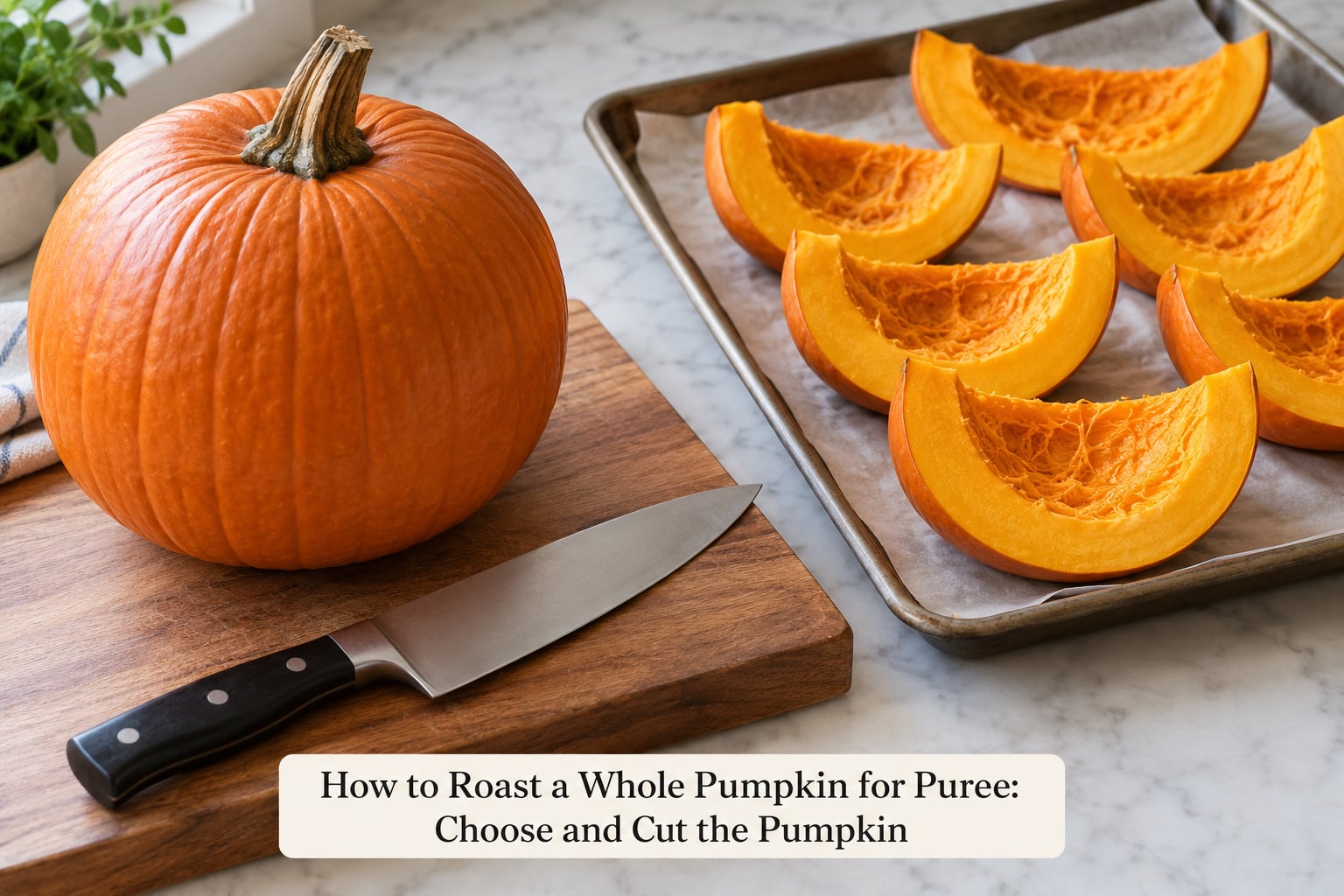
Pick a pumpkin that feels heavy for its size and has a hard, matte rind with no soft spots or mold around the stem. The stem should be dry and corky, not green or squishy. Heavy and dull means the flesh is dense and full of sugar. Bright orange, shiny skins are often picked green and cut short on flavor.
Scrub the outside with a stiff brush under running water, then dry it. Dirt from the field bakes onto the skin, and that skin sits right against the purée. Wipe it down with a damp cloth if it is only lightly dusty.
Cut off the stem, then cut the pumpkin in half. Scoop out the seeds and stringy pulp with a spoon and set it aside in a small bowl. Save the pulp if you want to roast pepitas: spread it on a small sheet pan, toss with a little oil and salt, and bake alongside the pumpkin for the last 15 minutes of roasting.
Turn each half cut-side down and cut it into 2 or 3 wedges, so you get 4 to 6 pieces per pumpkin. Even wedges are the single biggest factor in even cooking, and they are the difference between a pan that is done in 45 minutes and a pan where the thin tips are dry before the thick ends soften.
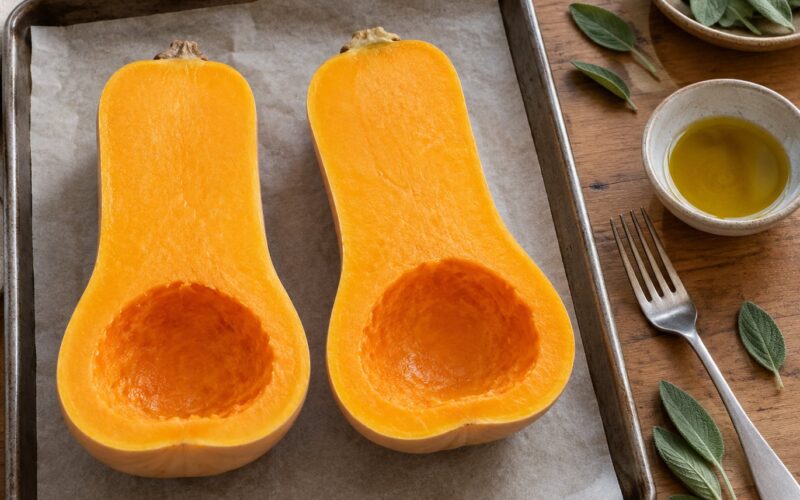
Place the pieces cut-side down on the lined sheet pan, skin side up. Cut-side down traps steam so the center cooks through, while the exposed skin side dries and roasts. Leave a finger’s width of space between pieces.
How to Roast a Whole Pumpkin for Puree: Roast Until Tender
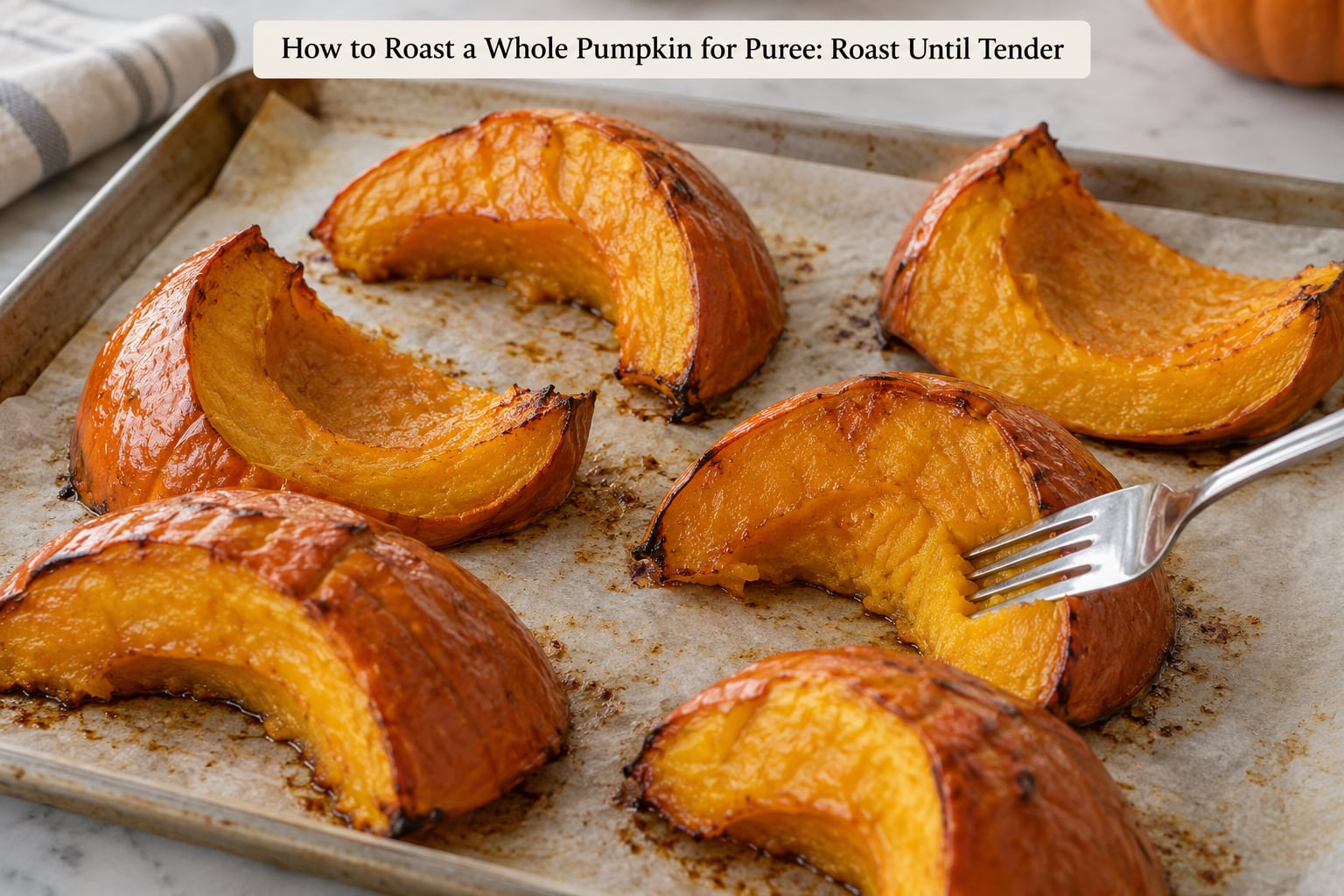
Heat the oven to 400 F (200 C) and put the pan in as soon as the oven is hot. Starting with a cold oven adds 10 to 15 minutes and dries the edges slightly. Many home bakers drop to 350 F (175 C) instead, which roasts more gently and gives a softer, less caramelized result. Both work, and 350 F is the better choice for very large or watery pumpkins. If you go lower again, 325 F (165 C) is the point where you risk drying out the outside before the center gives.
Here is the timing I use, checked with a fork rather than a timer:
| Pumpkin weight | At 400 F (200 C) | At 350 F (175 C) | Cups of purée (about 3 per lb) |
|---|---|---|---|
| 2 lb | 40 to 50 minutes | 55 to 65 minutes | 1.5 to 2 cups |
| 3 lb | 50 to 60 minutes | 65 to 80 minutes | 2 to 2.5 cups |
| 4 lb | 60 to 75 minutes | 80 to 95 minutes | 2.5 to 3 cups |
| 6 lb and up | 90 to 120 minutes | 105 to 135 minutes | 4 cups or more |
Test for doneness the whole time after the halfway mark. Push a fork, skewer, or thin knife into the thickest part of a wedge, right against the skin. It should go in with no resistance and the tip should come out warm and soft. If the flesh springs back or the skewer meets firm orange flesh, give it another 10 minutes. A knife test is the most reliable of the three, because a thin blade feels texture that a fork can slide past.
For parchment versus foil: parchment gives cleaner, drier edges and nothing sticks, which is what you want for purée. Foil traps steam and softens the skin, which makes peeling easier but leaves the surface a little wetter. Silicone mats sit in between. Use parchment for the best flavour.
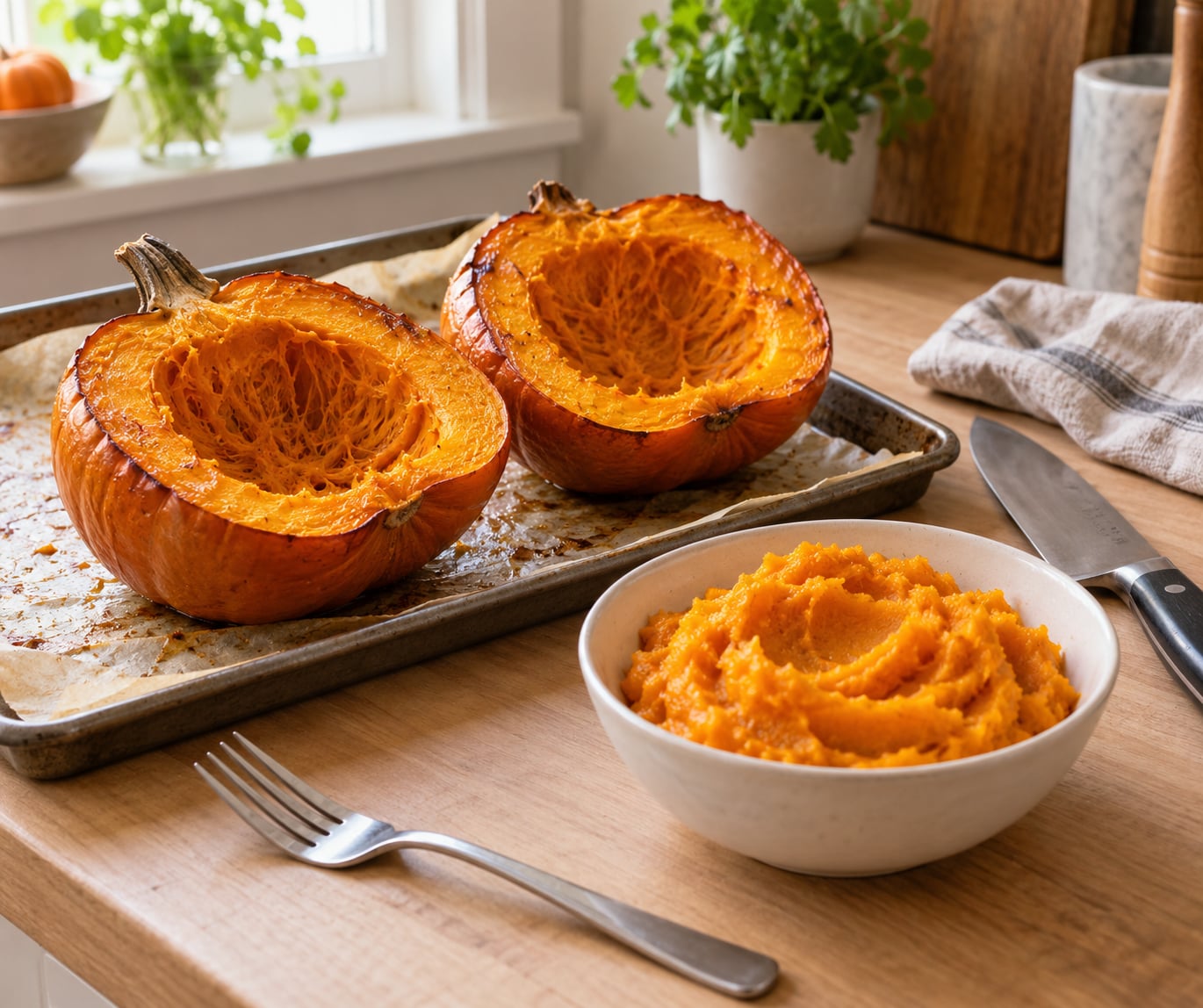
The edges should look matte and slightly shrunken, and the cut face should have lost its wet sheen. You want color, not deep brown. The point where the edges turn dark brown is the point where the sugars have gone from sweet to bitter, and pumpkin has a lot of sugar.
You can roast a whole pumpkin uncut, with no halving at all. Knock the stem off on the counter, then vent each pumpkin with a paring knife: push the tip in at an angle and twist to cut a small hole or a few slits in the top. That hole lets steam escape, which is the whole failure mode of a sealed pumpkin, since a sealed one can build enough pressure to split. Set the pumpkins directly on the oven rack or a heavy sheet pan and roast at 400 F for 20 to 60 minutes depending on size, checking each one individually because they vary so much. A 2 lb sugar pumpkin finishes in about 25 minutes; a 5 lb field pumpkin can take a full hour. The skin wrinkles and darkens, and the stem area gives easily when it is done. This method wastes less prep time and the skin comes off more easily, but the flesh roasts more evenly when you cut the pumpkin up.
Take the pan out and let the pumpkin cool on the sheet for 15 to 20 minutes. It is extremely hot, and the flesh is soft enough at this point that you can handle it with your fingers. Trying to scoop it straight out of the oven burns you and tears the skin.
How to Roast a Whole Pumpkin for Puree: Peel, Blend, and Adjust
Once it is cool enough to touch, press a thumbnail into the skin. If it slides under easily, the skin is loose and will come right off. Peel it with your fingers or a paring knife, and the flesh underneath is soft enough to crumble. If the flesh is firm enough to slice cleanly, it is not done yet, and the next 10 minutes in the oven is better than fighting it in the processor.
Cut the roasted flesh away from the skin and drop it into the bowl of a food processor. The seeds are roasted along with it, and the pepitas are pleasant to bite into, so leave them in if you do not mind the texture. Scoop out any remaining stringy pulp from the cavity; it is the main reason purée goes fibrous.
Blend, starting with short pulses. Let the machine run for 30 seconds, scrape down the sides, and run again. You are looking for a thick, glossy, spoon-coating purée with no visible fibers.
Add water only half a tablespoon at a time, and only if you need it. Roasted pumpkin releases its own liquid as it blends, so most of the time you need nothing at all. A splash of water helps a blender that struggles, and a bit of cream or stock helps a soup. Adding liquid out of habit is what makes homemade purée thinner than canned, and thin purée makes a runny pie and flat cookies.
If the purée still has grit or fibers, push it through a fine-mesh strainer or a piece of cheesecloth set over a bowl. It takes a few minutes and it is the step that separates smooth homemade purée from a slightly grainy one. Strain before you measure, because straining removes enough water to change the volume.
Taste it. Good roasted pumpkin purée is sweet and fairly mild on its own, with a little earthy bitterness underneath. Adjust with salt, a touch of brown sugar if you want it sweeter for baking, or a splash of lemon juice if it is going into a pie.
How Many Cups of Puree Does One Pumpkin Make
Expect roughly 3 cups of finished purée per pound of whole pumpkin before straining, and closer to 2 cups after. A 3 lb pie pumpkin gives about 2 to 2.5 cups, which is just over one 15 oz can. The practical convention that makes baking easier: freeze or store the purée in 2 cup portions, and each one substitutes for one can of canned pumpkin in a recipe.
Roasted purée is more concentrated than canned, which contains water and often diluted purée. If a recipe calls for two 15 oz cans, one home-roasted cup measures closer to 1.5 cups of canned volume. Measure by weight if you can, or reduce the liquid in the recipe by about a quarter cup when you swap in homemade.
How to Store Homemade Pumpkin Puree
- Refrigerator: 4 to 5 days in an airtight container, leaving headspace because the purée expands as it chills.
- Freezer: up to 6 months, pressed flat in a zip-top bag or a freezer-safe container in 2 cup portions, with a permanent marker on the date and the cup count.
- Thaw in the refrigerator overnight. Straight-from-frozen purée will loosen, and a splash of water or stock brings it back to spreadable.
- Freezing is not approved canning. Do not water-bath can homemade pumpkin purée, and do not store it on a pantry shelf. If you want shelf-stable puree, a tested canning recipe from a source you trust is the only route.
Flattening the bag before it freezes is the detail that matters. Air pockets cause freezer burn, and a flat bag takes up a quarter of the space of a round container and stacks neatly. Thawed purée keeps the roasted flavor well for baking, and it is the reason most people make a double batch in the fall.
Common Mistakes
Using a carving pumpkin. This is the number one cause of bad purée. Field and jack-o’-lantern pumpkins have thin, fibrous walls and a high water content, so they roast to a watery, stringy result. The workaround if that is all you have: roast it, then push the purée through a fine-mesh strainer and simmer it down, and expect a flatter flavour. It will not be the same, and a 2 to 4 lb pie pumpkin is worth the difference.
Cutting uneven wedges. The thin tips hit deep brown while the thick ends are still firm, which is the fastest route to bitter edges and undercooked centers. Cut every wedge the same width, and give the thick end a second cut if it is more than about 1.5 inches.
Crowding the pan. Pieces touching each other steam each other, and the flat faces stop browning. Use a second sheet pan. If you have to bake a lot, two pans on two racks works better than one pan stuffed full.
Under-roasting. Firm flesh that springs back against a fork needs more time, not more blending. Give it another 10 minutes and test again. Processing undercooked flesh is how you end up with grit that no strainer fixes.
Letting the edges go dark brown. Pumpkin carries a lot of natural sugar, so it crosses from caramelized to bitter faster than most vegetables. Pull the pan when the edges are matte and shrunken and the cut face has lost its wet look, not when it is properly browned.
Blending hot purée in a full jar blender. Steam builds pressure and the lid can blow off. Cool it fully, or blend in small batches with the vent lid cracked and a towel over the top. A food processor does not have this problem and is the safer tool for the job.
Adding too much liquid. Half a tablespoon of water at a time, and only when the purée will not move. Over-blended or loosened purée is the single most common complaint about homemade versions, and it makes pies weep and cookies spread.
Skipping the strainer with a coarse blender or a carving pumpkin. Fibers that survive blending will not break down later, and they show up in the texture of a pie filling. One pass through a fine-mesh strainer fixes it.
Frequently Asked Questions
Do I have to peel a pumpkin before roasting it for puree?
No. Roasting skin-on is the easier method because the skin holds moisture in while the flesh softens, then the skin loosens and slides off after 15 to 20 minutes of cooling. Peeling a hot roasted pumpkin raw is unpleasant and tears the skin. If a skin does not want to come off, use a paring knife rather than forcing it with your fingers.
How long does it take to roast a whole pumpkin for puree?
At 400 F, a 2 lb pie pumpkin takes 40 to 50 minutes, a 3 lb pumpkin 50 to 60, a 4 lb pumpkin 60 to 75, and 6 lb or more needs 90 minutes or longer. At 350 F add roughly 15 minutes. Timing matters far less than the doneness test: a fork or thin knife should slide into the thickest part with no resistance.
What is the best temperature for roasting pumpkin before blending?
400 F (200 C) is the best all-round temperature. It roasts a 3 lb pumpkin in under an hour and browns the cut face, which is what makes the puree taste sweet instead of merely cooked. Use 350 F (175 C) for very large or watery pumpkins and 325 F (165 C) only if you are worried about the outside drying before the center softens.
Can I roast a pumpkin without cutting it in half?
Yes. Knock off the stem and vent the top with a paring knife, pushing the tip in at an angle and twisting to cut a small hole or a few slits so steam can escape. Roast at 400 F for 20 to 60 minutes depending on size, and check each pumpkin on its own because sizes vary so much. The skin wrinkles and the flesh gives easily when it is done.
How do I get the smoothest pumpkin puree after roasting?
Blend in a food processor in short pulses, scraping down the sides, and add water only half a tablespoon at a time if the machine struggles. Then push the puree through a fine-mesh strainer or cheesecloth. That last pass is what removes fibers a coarse blender leaves behind, and it is worth the five minutes. Measure only after straining, since straining changes the volume.
How long can homemade roasted pumpkin puree stay in the refrigerator?
Four to five days in an airtight container, leaving headspace because puree expands as it cools. For longer storage, freeze it flat in 2 cup portions for up to 6 months and thaw overnight in the refrigerator. Freezing is not canning, so do not water-bath can puree or keep it on a pantry shelf.
Conclusion
Start by heating the oven to 400 F and cutting the pumpkin into even wedges, cut-side down on a lined pan. Choose a pie or sugar pumpkin between 2 and 4 lb and skip the carving pumpkins, however good they look. Start checking at the halfway mark and pull the pan when a fork or thin knife goes into the thickest part with no resistance, not when the color looks right.
Cool it, loosen the skin, blend, and strain if there is any grit. The three checkpoints that decide whether you get smooth homemade pumpkin puree are even cuts, a fork doneness test rather than a timer, and restraint with added liquid. Get those right and the batch is worth freezing in 2 cup portions, one for every can of canned pumpkin your recipe calls for. The times here were checked again for 2026 and will hold as long as the oven does.