Learning how to make barbecue sauce from scratch takes about 40 minutes and only a saucepan. You whisk a tomato base, vinegar, a sweetener, something savory, and warm spices together, simmer the mixture uncovered until it darkens and coats a spoon, then taste it after it cools. The whole thing makes roughly 3 cups, and every part of the balance is yours to adjust.
I make a batch nearly every summer, and the reason is simple: store-bought sauce tastes like sweetener with a vinegar aftertaste. A homemade batch tastes flatter in a good way, more like the sauce you’d get at a counter with dirty plates and a line out the door. It also lets you leave out the high fructose corn syrup that makes bottled sauce cloying.
This recipe is the tomato-and-vinegar style that works on almost anything. I’ll show you how to bend it toward Carolina vinegar or Alabama white sauce later if you want something different.
Table of Contents
- What You Need
- Core ingredients
- Equipment
- Optional add-ins
- Useful substitutions
- The three-ingredient version
- How to Make Barbecue Sauce From Scratch: Step-by-Step
- Make Barbecue Sauce From Scratch by Building the Flavor Base
- Blend the Sauce Until Completely Smooth
- Simmer Until Glossy and Thick Enough to Coat a Spoon
- Cool, Taste, and Store the Sauce
- Common Mistakes
- The Sauce Tastes Like Ketchup With Nothing Added
- The Sauce Is Too Sweet
- The Sauce Is Too Thin
- The Flavor Tastes Harsh or Overly Acidic
- The Sauce Is Bitter or Scorched
- The Sauce Looks Separated or Grainy After Storage
- Common Mistakes and Helpful Tips
- Frequently Asked Questions
- What is the best way to make barbecue sauce from scratch without a blender?
- How long should I simmer homemade barbecue sauce?
- How can I thicken barbecue sauce that is too thin?
- Can I use this recipe for chicken, ribs, or grilled vegetables?
- How long does homemade barbecue sauce last in the refrigerator?
- Can I make barbecue sauce without brown sugar?
- Conclusion
What You Need
Five things do the actual work in this recipe: a tomato base for body, an acid for lift, a sweetener for balance, an umami ingredient for depth, and warm spice for aroma. Everything else is a tweak.
Core ingredients
- Unsweetened tomato puree, 2 cups (480 ml) — the body of the sauce. Tomato puree gives a cleaner flavor than ketchup. Plain ketchup works fine; just expect it to taste more like the bottle.
- Unsweetened tomato paste, 2 tablespoons (30 g) — thickens the sauce and adds a cooked, slightly earthy tomato note.
- Apple cider vinegar, 1/2 cup (120 ml) — the acid. Cider vinegar gives a rounder, fruitier sharpness than distilled white vinegar.
- Light brown sugar, 1/3 cup (67 g) — the sweetener. Dark brown sugar pushes it toward molasses territory.
- Molasses, 1 tablespoon (20 ml) — deepens the savory side so the sauce does not read as candy.
- Worcestershire sauce, 2 tablespoons (30 ml) — salt plus fermented umami. Soy sauce works as a swap.
- Yellow mustard, 1 tablespoon (15 ml) — mild sharpness that survives the simmer.
- Smoked paprika, 2 teaspoons — smoke and a sweet edge. Use regular paprika if you have no smoker.
- Garlic powder, 2 teaspoons
- Onion powder, 1 teaspoon
- Kosher salt, 1 teaspoon — start here and adjust at the end.
- Black pepper, 1/2 teaspoon
- Ground cayenne, 1/4 teaspoon — optional, and easy to leave out.
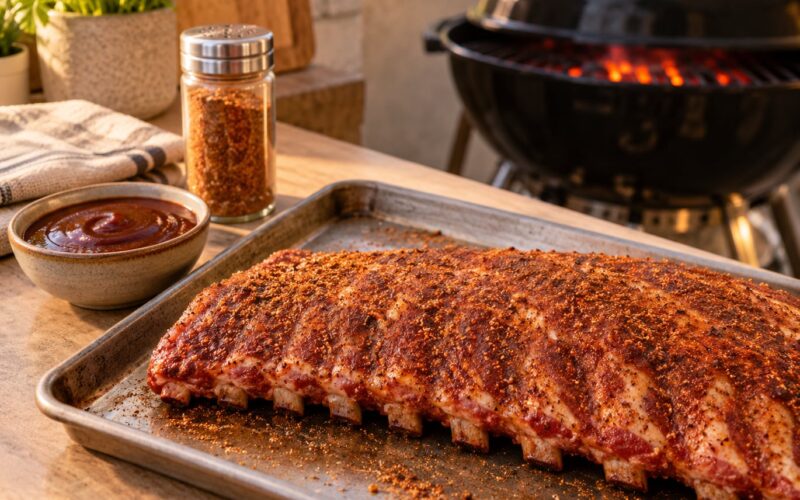
Those amounts give you about 3 cups of sauce. That is enough to baste a whole rack of ribs, dress a couple of pounds of pulled pork, or cover a cookout’s worth of burgers with a little left over.
Equipment
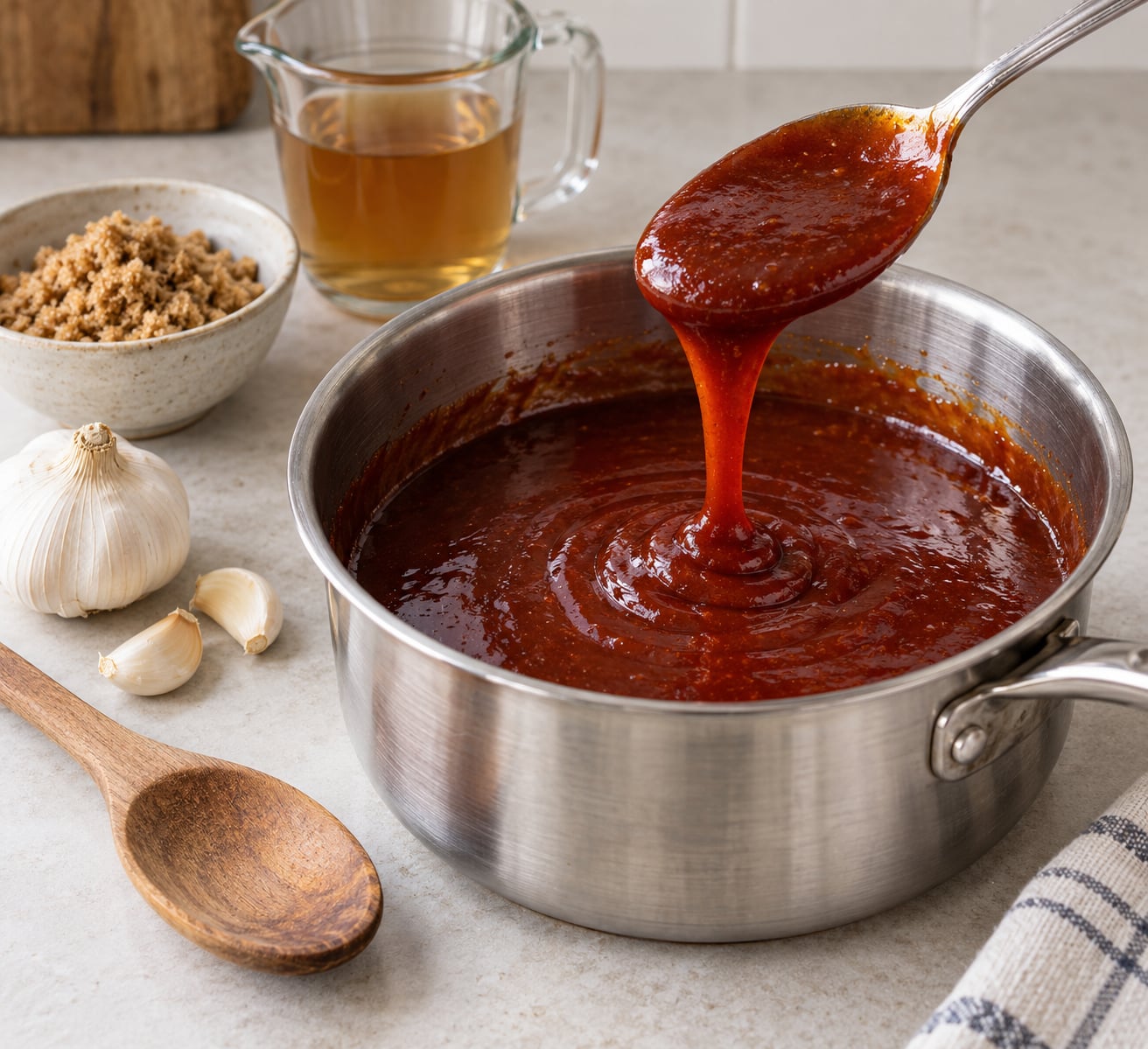
A medium saucepan with a heavy bottom, a wooden spoon or silicone spatula, a whisk or fork, and a blender. That is the whole list. A wide pan reduces faster than a narrow one, which matters if you are doubling the recipe.
Optional add-ins
These change the sauce rather than build it. A tablespoon of bourbon or coffee for depth, a teaspoon of liquid smoke for a stronger smoke profile, hot sauce for heat, honey in place of some brown sugar for a floral sweetness, or a clove or two of garlic minced fresh instead of garlic powder for a brighter, sharper garlic bite that softens in the simmer.
Useful substitutions
Coconut aminos replace Worcestershire sauce for a gluten-free, soy-free sauce. Honey or maple syrup replace brown sugar one for one, though the sauce will be slightly thinner and less caramelized. Tomato passata works in place of puree. If you want no tomato at all, skip the puree and paste, double the vinegar, and add two tablespoons of mayonnaise for body — that is the Alabama white route, covered further down.
The three-ingredient version
Ketchup, brown sugar, and apple cider vinegar, roughly 2 cups to 1/3 cup to 1/3 cup, whisked and simmered 15 minutes. It is genuinely good on chicken and burgers, and it is the fastest way to find out whether you even like homemade sauce.
How to Make Barbecue Sauce From Scratch: Step-by-Step
Four stages: build the flavor base, blend it smooth, reduce it until glossy, then cool it and taste it properly. Most problems people hit happen in stage one or stage three, so give those two your attention.
Make Barbecue Sauce From Scratch by Building the Flavor Base
Warm 1 tablespoon of oil in your saucepan over medium heat. Add a small diced onion if you are using one, and cook it 4 to 5 minutes until the edges look translucent and the raw edge is gone. No color yet — browning here makes the whole batch taste roasted instead of fresh.
Add the tomato paste and cook it for a full minute, stirring, until it darkens from bright red to brick and leaves a slightly darkened film on the bottom of the pan. That fond is flavor you cannot get back later, and the color change is the cue that it happened.
Pour in the tomato puree and stir until the paste disappears into it. Then add the brown sugar, molasses, Worcestershire sauce, mustard, paprika, garlic powder, onion powder, salt, pepper, and cayenne. Stir for about a minute while the pan comes back up to temperature.
Add the vinegar last and stir. Your nose is the best tool here. If the pot smells sharp and makes your mouth water on inhale, the acid is out front and needs more sugar and molasses to sit behind it. If it smells sweet and heavy with no edge at all, you are short on vinegar. A balanced batch smells rounded, like a braise rather than a jar of pickles.
Blend the Sauce Until Completely Smooth
Take the pot off the heat and let it stop bubbling hard. Then blend it.
An immersion blender goes straight into the saucepan and is the fastest route. Keep the blade submerged and pulse in short bursts, sweeping the bottom corners, or you will splatter sauce across your stove. A countertop blender gives a silkier result, but you need to work in batches: fill it no more than halfway, remove the center cap from the lid to vent steam, hold a folded towel over the opening, and start on low speed. Never seal a hot blend and walk away from it.
Whichever tool you use, scrape the sides down and blend again. Onion bits and tomato skins are the two things people miss, and both show up as flecks in the finished sauce.
Simmer Until Glossy and Thick Enough to Coat a Spoon
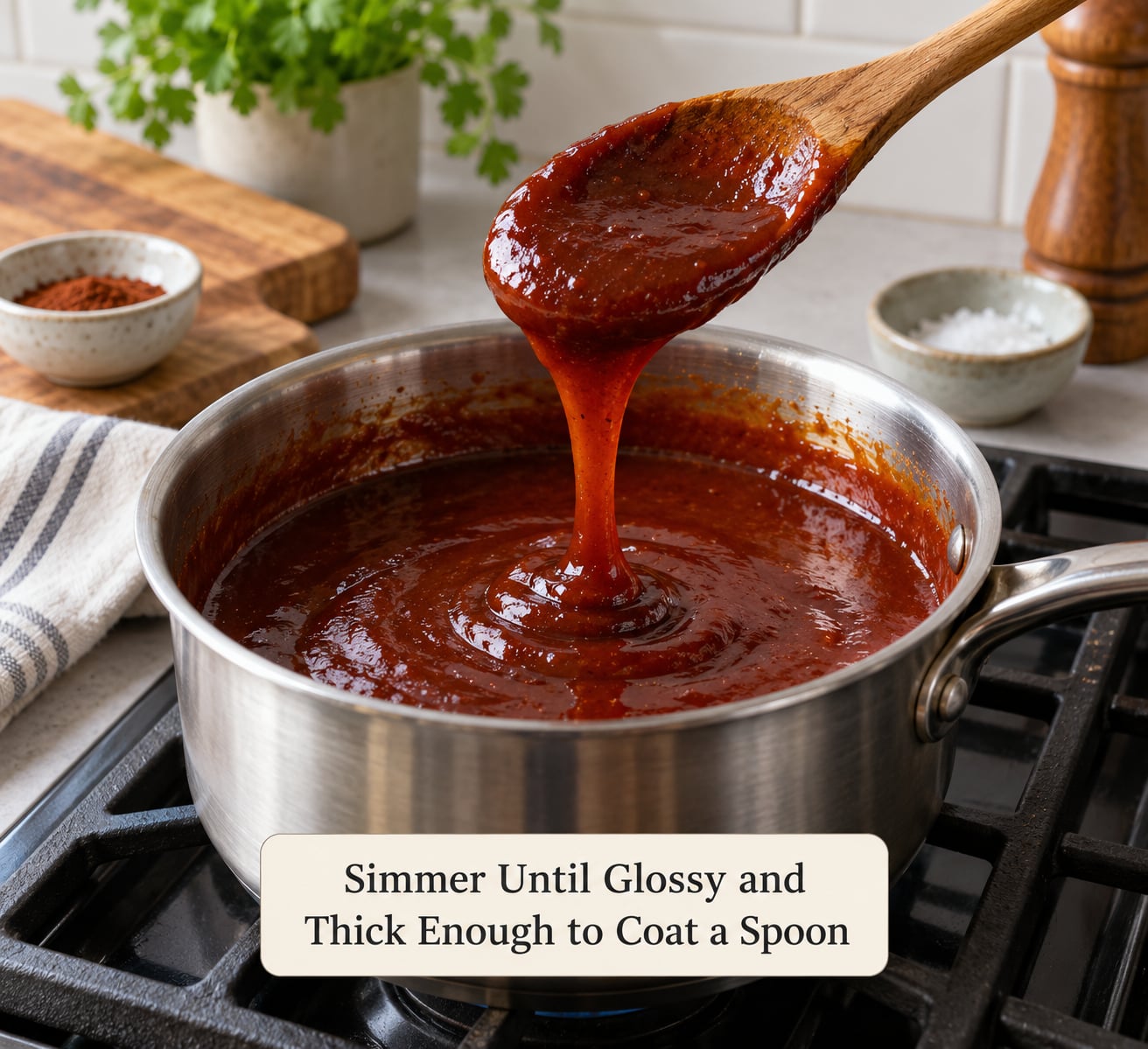
Return the sauce to the pan, bring it to a boil over medium-high heat, then drop the heat to low so you get a steady simmer with maybe one bubble per second.
Stir every 3 to 4 minutes, and scrape the bottom, for 25 to 40 minutes. Sugar scorches fast once it concentrates, and a dark ring on the base of the pan means you went too long or too hot. If you catch it early, move the pot to a burner or lower the heat, and stir vigorously for a minute.
You know it is done when three things happen at once. The color has moved from bright red to a deep brick red. The surface looks glossy rather than wet. And a spoon dragged across the bottom leaves a clean line that stays visible for a second or two before the sauce slowly closes over it.
Here is the part that catches everyone: taste it hot and it will taste sharper and more acidic than it is. If you judge it at the stove you will overcorrect by dumping in sugar, then find it too sweet once it cools. Wait for the taste test below.
Cool, Taste, and Store the Sauce
Pour the sauce into a bowl or a wide jar and let it come to room temperature. The cooling test takes 10 to 15 minutes and it is the step that separates a good batch from a flat one.
Drop a small spoonful on a plate and taste it as it cools through warm to cool. Now adjust. If it tastes too sharp, stir in a tablespoon of brown sugar. If it tastes cloying, add a tablespoon of cider vinegar or a splash of water. If it tastes flat, a pinch more salt fixes it more often than more spice does. Taste again after each addition, because one tablespoon moves the balance a long way.
Texture firms noticeably as the sauce chills. A sauce that looks right for glazing hot is usually exactly right for the jar, so do not chase thickness while it is still warm.
Once seasoned, transfer it to an airtight container or a mason jar and refrigerate it. A homemade refrigerated sauce is good for about four days at or below 40°F. If you need it longer, freeze it in a freezer-safe container with a little headroom for expansion, and thaw it overnight in the refrigerator rather than on the counter.
Reheat by warming gently in a saucepan over low heat, stirring, until it reaches 165°F, or microwave in short bursts with a stir between each one. Let it simmer a minute after it comes up to temperature so the flavor comes back together.
For food safety, remember the standard temperatures: 165°F for poultry, 160°F for ground meat, and 145°F for whole cuts and fish. If you are basting sauce onto meat during a cook, add it in the final 30 to 45 minutes so it caramelizes instead of burning.
Common Mistakes
Almost every disappointing batch traces back to one of six things. Each has a specific fix, and none of them are fixed by throwing in more ingredients to cover the problem.
The Sauce Tastes Like Ketchup With Nothing Added
This is an umami and smoke problem, not a sweetness problem. Extra sugar will not help; it will make it worse. Add a tablespoon of molasses, a tablespoon of Worcestershire sauce, or a teaspoon of liquid smoke, then simmer 10 more minutes to fold it in.
Another cause is using sweetened ketchup, which piles sweetness on top of sweetness. Unsweetened tomato puree is the fix, and it is the single biggest upgrade in this recipe.
The Sauce Is Too Sweet
Sugar concentrates as water evaporates, so a sauce that balanced at the start of the simmer can tip sweet by the end. Add a tablespoon of cider vinegar and a tablespoon of water at a time, stirring and tasting between each addition.
For a less sweet result next time, cut the brown sugar by a third and lean on molasses for the depth instead. Molasses reads savory rather than sugary even when it is quite dark.
The Sauce Is Too Thin
Two different situations get called “too thin,” and they need opposite responses.
If the sauce is still hot and loose, it simply needs more reduction. Keep it at a bare simmer and stir every 3 minutes for another 10 to 15 minutes. Watch it closely at this stage — a thin sauce can cross from perfect to scorched in a couple of minutes once the sugar gets concentrated enough.
If the sauce is cold and loose, do not reduce it yet. Chilled sauce thickens as the pectin in the tomato sets, so the consistency you see in the jar is not the one you saw on the stove. Pour a little water back in and heat it gently for serving.
A second option for a hot thin sauce is a tablespoon of tomato paste whisked in with a few tablespoons of cold water. It thickens without the scorching risk of pure reduction.
The Flavor Tastes Harsh or Overly Acidic
Vinegar sharpness changes with temperature. Warm sauce tastes sharper than cold sauce, so most of the fix is patience: cool a sample fully before you decide anything.
Then correct in this order. A tablespoon of brown sugar first, then tomato paste for body, then a tablespoon of water. Add each, stir, and taste. Tomato paste is the most useful of the three because it adds substance rather than just masking acidity.
If you are still stuck, a tablespoon of molasses will pull the whole thing together. Just avoid reaching for more sugar twice in a row — it is how sauces end up sweet and thin at the same time.
The Sauce Is Bitter or Scorched
Bitter means burned sugar and it cannot be fixed. No amount of honey covers it. If the sauce tastes bitter at all, the practical move is to start a fresh batch and keep the heat lower next time.
Prevention is the whole game: heavy-bottomed pan, low simmer, stirring the bottom every few minutes, and taking the sauce off the heat the moment it hits the spoon-coat test.
The Sauce Looks Separated or Grainy After Storage
A watery layer on top and a thicker layer below is normal — oils and solids separate in the jar. Whisk or shake it back together and it comes right.
Graininess after freezing usually comes from the sugar crystallizing. Warm it gently with a splash of water and stir until it dissolves. Both are texture issues, not spoilage. Smell it first: anything sour, fizzy, or off means it should go in the bin regardless of how it looks.
Common Mistakes and Helpful Tips
Balance beats everything else. Sweet, sour, salty, smoky, and heat are five dials, and you nudge one at a time rather than reaching for all of them at once.
Keep the simmer gentle and the spoon moving. Long unattended reductions are where sauces catch and bitter, and a light splash of water in the pan rescues a thick batch better than any amount of sugar.
Scale in batches. Doubling works in a standard pot, but expect closer to 45 minutes of reduction rather than 30, since the liquid level rises. Quadrupling needs a real stockpot, a bigger spoon, and more stirring than most people expect. If your pot is more than half full, split the batch.
Variations from the same base:
- Carolina vinegar style — drop the tomato puree and paste entirely, keep the cider vinegar, and add a teaspoon of red pepper flakes plus a tablespoon of ketchup for body. Simmer 10 minutes only.
- Kansas City thick and sweet — double the brown sugar, add an extra tablespoon of molasses and dark brown sugar, and reduce until it barely pours.
- Mustard-forward, St. Louis style — raise the yellow mustard to a quarter cup and add a teaspoon of prepared horseradish.
- Smoky — two teaspoons of liquid smoke added in the last five minutes, off the heat, so it stays aromatic instead of acrid.
- Molasses-rich — swap light brown sugar for dark brown sugar and double the molasses. Sugar reduction goes up with it.
- Mild and kid-friendly — leave out the cayenne and halve the hot paprika. Vinegar still provides plenty of interest.
Frequently Asked Questions
What is the best way to make barbecue sauce from scratch without a blender?
Skip the blender entirely and use a fine-mesh strainer. Push the sauce through after simmering with the aromatics, pressing on the solids with the back of a spoon, then discard them. The texture is slightly rustic but the flavor is exactly the same. A food mill or a potato masher works too. If you want truly smooth sauce and own an immersion blender, that is the better tool, since it avoids straining altogether.
How long should I simmer homemade barbecue sauce?
Plan on 25 to 40 minutes at a low simmer after the mixture comes to a boil, stirring every 3 to 4 minutes. A wide pot reduces faster than a narrow one, and doubling the batch pushes it toward 45 minutes. You are done when the sauce darkens to brick red, looks glossy, and holds a clean line across the pan when a spoon drags through it. Judge by that test rather than the clock.
How can I thicken barbecue sauce that is too thin?
Simmer it uncovered over low heat, stirring frequently, for another 10 to 15 minutes and test with a spoon. If the sauce is already cold, do not bother reducing it, since it firms up as it chills. A tablespoon of tomato paste whisked in with a few tablespoons of cold water thickens it fast without scorching. Cornstarch slurry works too, though it dulls the flavor slightly and leaves a faint gloss.
Can I use this recipe for chicken, ribs, or grilled vegetables?
Yes, and it is a genuinely versatile sauce. Baste chicken thighs during the last 20 to 30 minutes of grilling, brush ribs in the final 30 to 45 minutes of a cook so the sugar caramelizes instead of burning, and use it on pulled pork sandwiches, smash burgers, wings, pizza, and fries. For grilled vegetables, thin it with a splash of water or vinegar first, since the glaze is heavy on delicate produce.
How long does homemade barbecue sauce last in the refrigerator?
Store it in an airtight container or a clean mason jar in the refrigerator at or below 40°F, and use it within about four days. Always use clean utensils, since a spoon dipped into the sauce and back into the jar introduces bacteria that shorten the life. For longer storage, freeze it in a freezer-safe container with headroom and thaw it overnight in the refrigerator. Never leave it on the counter for more than two hours.
Can I make barbecue sauce without brown sugar?
Yes. Honey, maple syrup, or agave syrup all work one for one, though the sauce will be less caramelized because they do not darken the same way. White sugar works too but gives a thinner, less complex sauce, so add a tablespoon of tomato paste to compensate. If you are cutting sugar for health reasons rather than flavor, reduce it by a third and add an extra tablespoon of cider vinegar, then simmer 10 extra minutes.
Still deciding which flavor profile you want? Tell me what you are cooking and whether you like sweet or tangy sauces, and I can point you to the right variation.
Conclusion
Start by combining the aromatics, tomato base, cider vinegar, brown sugar, molasses, and spices in one saucepan, and let that mixture come to a boil before you drop the heat. From there the whole recipe is a test of attention: stir through the simmer, watch the color move from bright red to brick, and take it off the heat when it coats the back of a spoon and holds a clean line.
Then taste it cool, not hot. Most of the flavor balance people chase with more sugar or more vinegar was never wrong — it just had not settled yet. Once you have a cooled sample in your mouth, you will know in a tablespoon or two what the batch actually needs, and how to make barbecue sauce from scratch gets easier with every pot you reduce.
Once you have the balance down, keep a written note of the ratios you used. That is how a single pot of sauce turns into a recipe you make for every cookout.