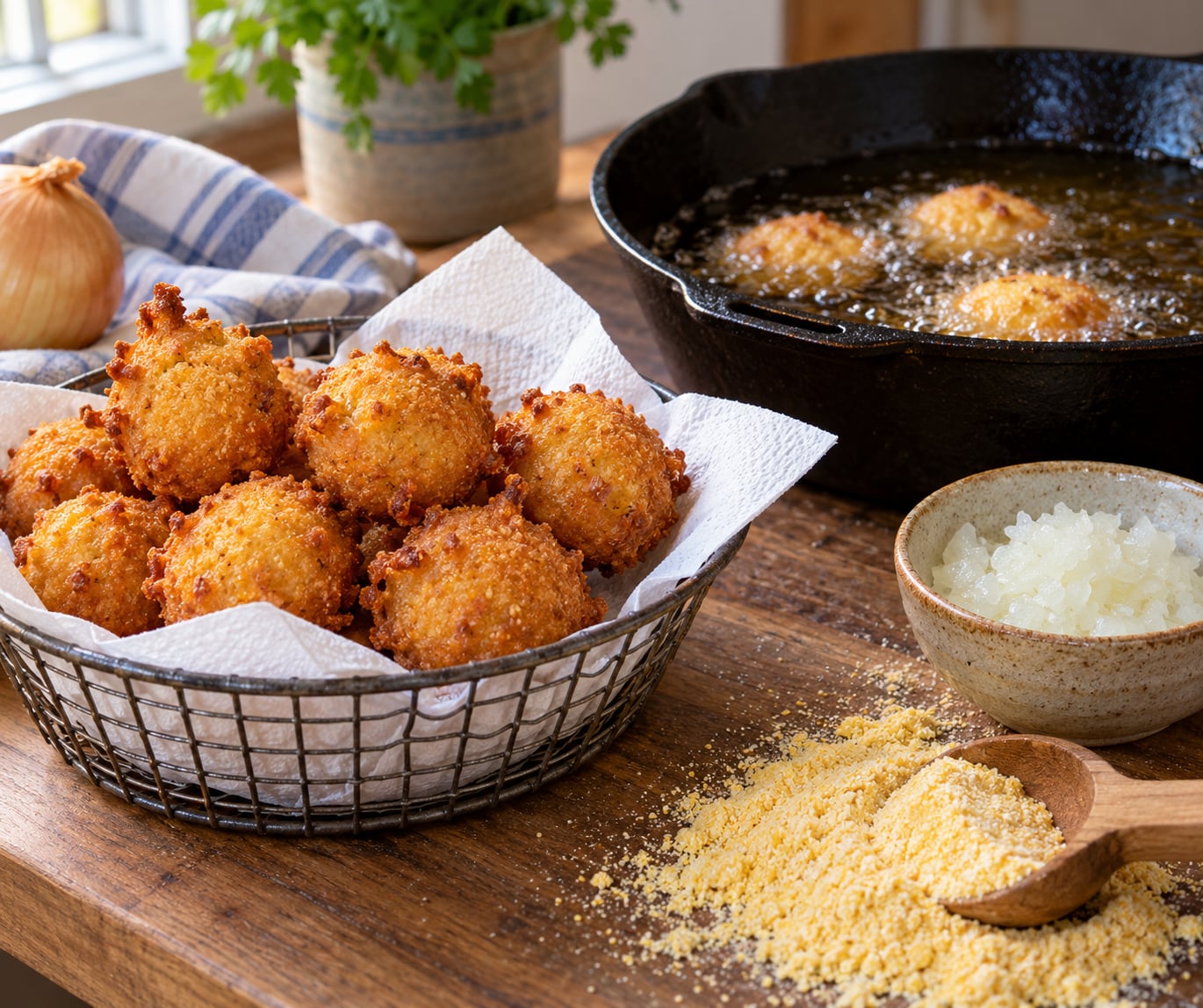
Hush puppies are small balls of sweet-and-savory cornmeal batter, grated onion, egg and buttermilk or milk, dropped into oil heated to 350-375°F (175-190°C) and deep fried until golden brown and crisp outside with a fluffy, tender center. Here is how to make hush puppies from scratch with no boxed mix, plus the temperature and timing details that decide whether they turn out crisp or greasy.
This is the version I make for a fish fry at the market: plain yellow cornmeal, all-purpose flour, measured baking powder, and about half an hour of hands-on work. The batter rests while the oil heats, then scoops go in two or three at a time and come out three minutes later.
Table of Contents
- What You Need
- Step-by-Step: Making Hush Puppies from Scratch
- How to Get the Crispy Texture
- Common Mistakes
- Frequently Asked Questions
- What is the best cornmeal for hush puppies?
- Can I make hush puppies without baking powder?
- How hot should the oil be when frying hush puppies?
- Why are my hush puppies soggy?
- Can I bake hush puppies instead of frying them?
- How do I keep cooked hush puppies crisp?
- Conclusion
What You Need
Everything comes from a regular pantry. Nothing here needs to be hunted down, which matters more for a from-scratch recipe than it sounds like it should.
- 1 cup yellow cornmeal, stone-ground or fine, not self-rising
- 1 cup all-purpose flour
- 1 tablespoon baking powder, plus 1/2 teaspoon baking soda if you use buttermilk
- 2 tablespoons granulated sugar — this is not optional sweetness, it balances the cornmeal
- 1 teaspoon salt, plus 1/4 teaspoon black pepper
- 1 large egg
- 1 cup buttermilk or whole milk
- 1/4 cup coarsely grated onion, about half a small onion
- 2 to 3 inches of frying oil for a 10-inch skillet, or a Dutch oven filled two-thirds
The onion is the ingredient people skip and then miss. Grate it on the large holes of a box grater, not the side of a knife, so you get shreds rather than a wet paste. Half a small onion is the right amount for a full cup of batter, and it seasons the whole batch from the inside out.
Equipment matters more than the shopping list. A heavy skillet with a long handle, a wire rack set over a sheet pan, a slotted spoon, a 1-tablespoon cookie scoop, and an instant-read thermometer are the whole setup. If you do not own a thermometer, see the sizzle test below.
Cornmeal choice changes the texture more than any other single ingredient. Yellow cornmeal gives the coarse, toothsome grit people mean when they talk about a real hush puppy. White cornmeal is milder and softer. Stone-ground holds more of the corn flavor and gives a grainier crumb, while fine-ground dehydrates into a smoother, more tender ball. Yellow is the safe pick, stone-ground is the flavor pick.
Oil choice changes the flavor. Peanut oil has the highest smoke point and a neutral taste, canola and vegetable oil sit close behind and cost less, and lard or bacon drippings give you a distinctly porkier note that some Southern kitchens consider the point. Whatever you use, it should be able to hold 375°F without smoking.
One thing worth clearing up, because several recipes on this topic blur it: a boxed hush puppy mix and a box of cornbread mix are not the same product, and neither is truly from scratch.
| Method | What you add | Result |
|---|---|---|
| From scratch | Plain cornmeal, flour, measured baking powder, egg, milk | You control sugar, salt and leavening. Crisper shell, more onion flavor, no filler. |
| Self-rising cornmeal | Cornmeal with baking powder and salt already in the bag | Convenient, slightly denser crumb. You cannot adjust the salt or sugar. |
| Boxed cornbread or corn muffin mix | Dry mix plus milk, egg and oil | Sweeter and more cake-like. Bakes well, fries with a heavier crust. |
Self-rising cornmeal and self-rising cornmeal mix are the same category of shortcut: a dry blend that already contains leavening and salt. If you want the from-scratch result, buy plain cornmeal and measure your own baking powder.
Step-by-Step: Making Hush Puppies from Scratch
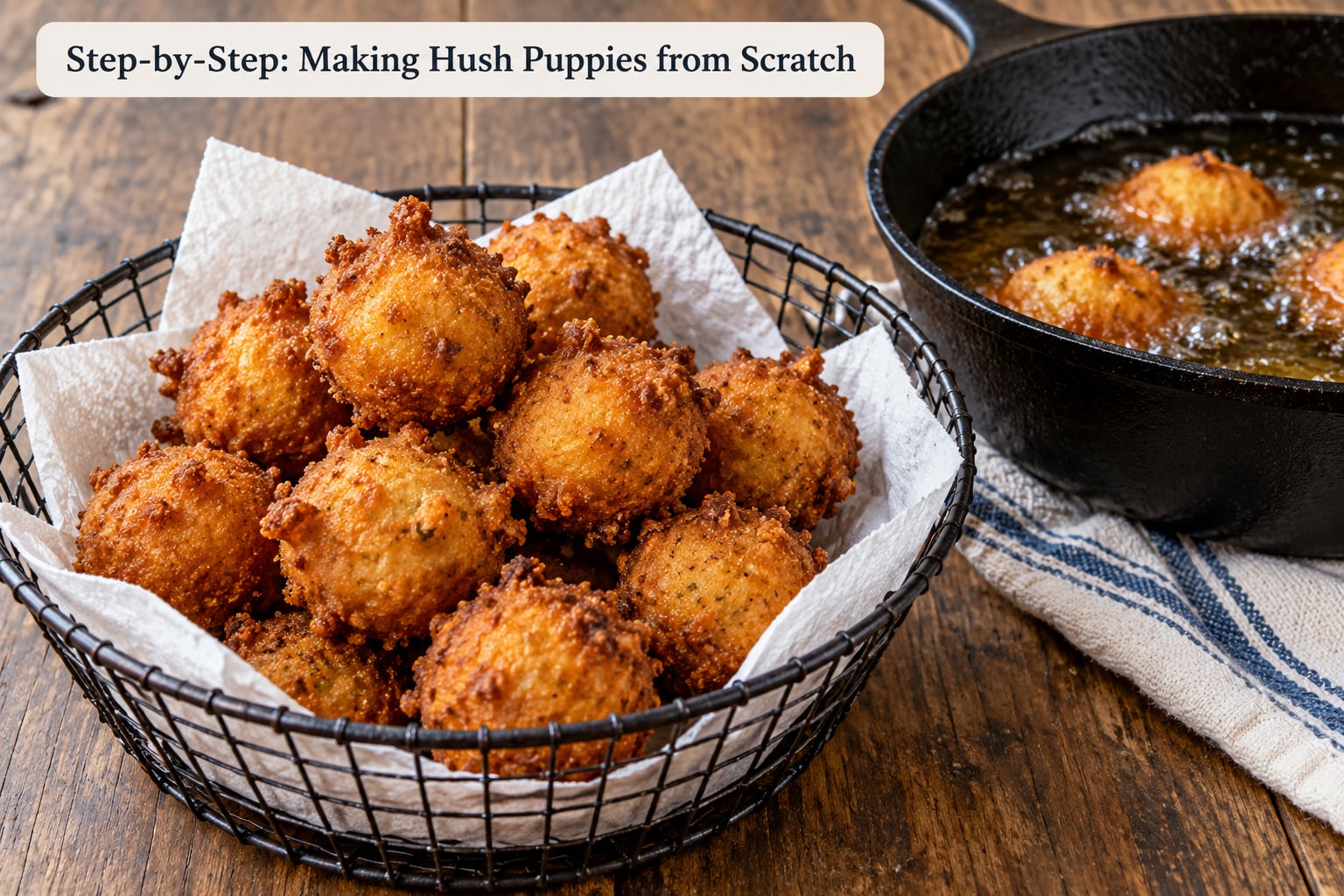
The whole process runs about 40 minutes: 10 minutes to mix, 10 to 20 minutes of rest, and 15 to 20 minutes of frying. Start the oil first if your burner heats slowly, because that is the step that stalls most first-time fryers.
1. Grate the onion. Coarsely grate half a small onion on the large holes of a box grater. You want about 1/4 cup of shreds. Pat it dry with a paper towel if it looks wet; extra water thins the batter and is the usual reason hush puppies spread flat in the pan.
2. Whisk the dry ingredients. In a medium bowl, whisk together 1 cup yellow cornmeal, 1 cup all-purpose flour, 1 tablespoon baking powder, 2 tablespoons sugar, 1 teaspoon salt, 1/4 teaspoon black pepper and 1/2 teaspoon baking soda. Whisk it for a full 30 seconds so the baking powder is evenly dispersed rather than sitting in pockets.
3. Add the wet ingredients. Make a well in the center. Add 1 large egg and 1 cup buttermilk or whole milk. Stir just until the dry ingredients disappear and you can no longer see flour streaks.
4. Fold in the onion. Scrape in the grated onion and fold it through with a spoon. Do not beat the batter. Ten or twelve slow strokes is plenty. Overmixing develops gluten in the flour and gives you a tough, bready hush puppy instead of a crumbly one.
5. Rest the batter. Cover and leave it at room temperature for 10 to 20 minutes, or in the refrigerator for 30 minutes. Cornmeal needs time to hydrate, and that hydration is what makes the finished center tender instead of gritty. Chilling also thickens the batter just enough to hold its shape on the scoop.
6. Heat the oil to 350-375°F (175-190°C). Fill a heavy skillet with 2 to 3 inches of oil. Use enough oil that the hush puppies float rather than sit on the bottom, which is what causes dark spots and uneven cooking. Attach the thermometer to the side of the pan if you have a clip, or hold it in the oil without letting the tip touch metal.
No thermometer? Drop a small pinch of batter into the oil. If it sizzles hard immediately and rises to the surface within two or three seconds, the oil is ready. If it slides in quietly and sinks, wait. If it browns in under a second, pull the heat down.
7. Portion before you fry. With a 1-tablespoon cookie scoop or two spoons, drop the batter into clusters of two or three. Consistent size is the single easiest way to get even cooking. Bigger than a tablespoon and the center will still be raw when the outside is done.
8. Fry for 2 to 3 minutes per side. Slide each one into the oil away from you, then leave it alone for the first 30 seconds so the crust sets. When the edges look dry and the color turns deep gold, turn it. Total time is 3 to 4 minutes per hush puppy. The oil temperature will drop when the batter goes in, so wait for it to climb back to 350°F before adding the next batch. That is why the batter goes in cold and the oil starts higher, around 365 to 375°F.
9. Drain and season. Lift them out with a slotted spoon onto a wire rack set over a sheet pan. A wire rack matters more than it sounds: the bottom stays crisp instead of steaming soft against a plate. Season with a pinch of salt while they are still hot, then serve right away.
How to Get the Crispy Texture
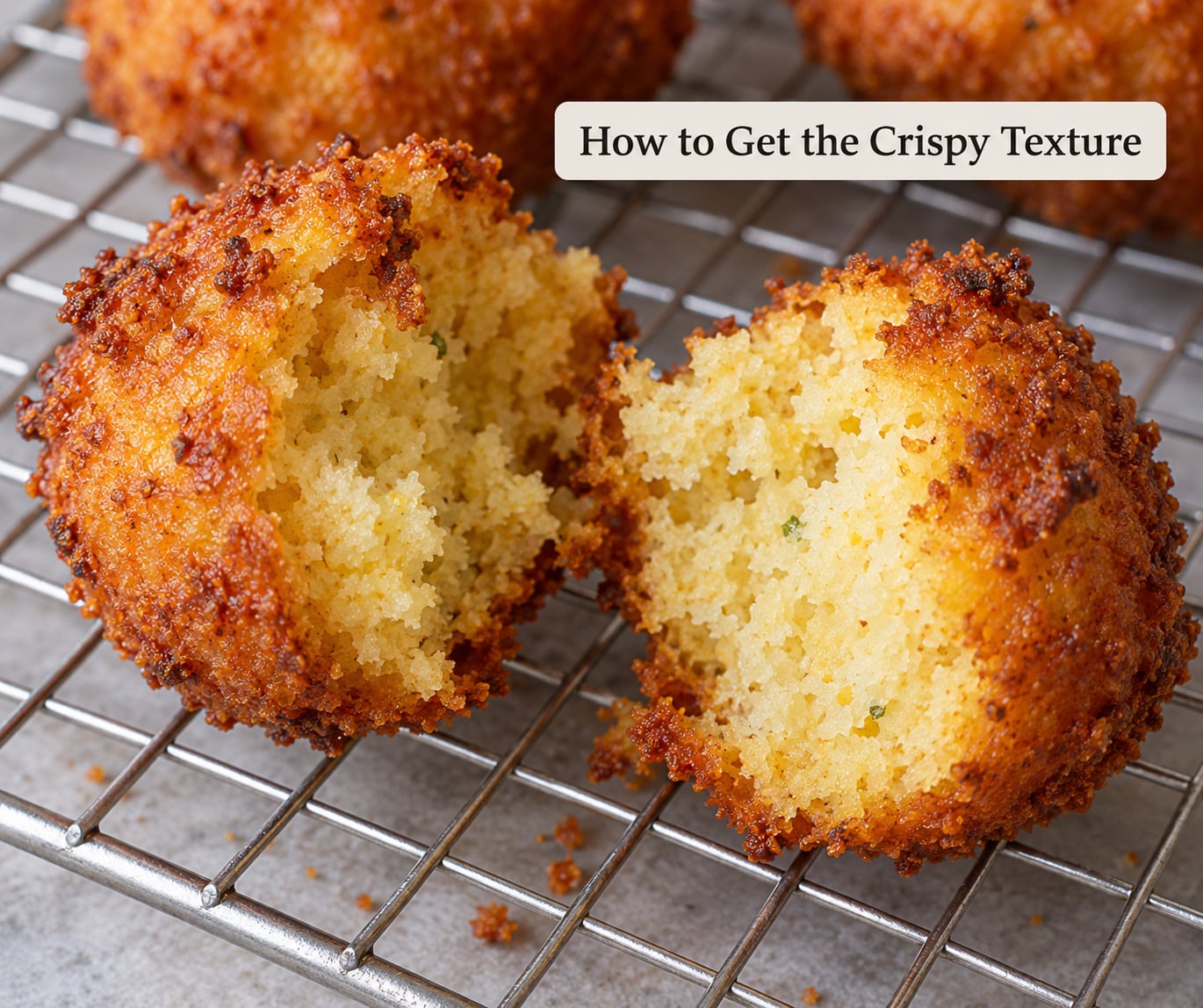
Crisp outside and tender inside is a temperature problem first and a recipe problem second. Five habits do most of the work.
- Fry in small batches. Six hush puppies in a 10-inch skillet is the practical limit. Crowding drops the oil temperature fast, and cool oil is exactly what makes a hush puppy greasy.
- Let the oil recover between batches. Check the thermometer before adding more. If it is still climbing, wait.
- Keep the portion size the same every time. A cookie scoop removes the guesswork that leads to one raw center in the basket.
- Drain on a wire rack, not a paper towel-lined plate. Paper traps steam under the bottom and softens it.
- Hold the finished batch in a 200°F oven. A low oven keeps them crisp for 15 or 20 minutes without drying them out.
Those five are enough. Everything else is a variation on the same idea.
If you want to bake instead, you can, but expect a different food. A 400°F oven with a light spray of oil gives you 15 to 20 minutes and a roll rather than a crisp shell. An air fryer at 375°F for 10 to 12 minutes, flipped halfway, lands closer to the real thing while using a tablespoon of oil instead of a skillet full. Deep frying is still the answer for the classic result.
Common Mistakes
Almost every disappointing batch traces back to oil temperature, batter thickness or a crowded pan. Here is what goes wrong and what to change.
| What happened | Why | Fix |
|---|---|---|
| Greasy or oily | Oil was below 350°F, so the batter soaked up oil before the crust set | Heat to 350-375°F and confirm with the sizzle test before the first one goes in |
| Pale and soft | Batter went in too cool, or batches were too large for the pan | Fry two or three at a time and let the oil recover fully |
| Raw doughy center | Pieces too large, or the outside browned before heat reached the middle | Portion to one tablespoon and extend frying to 3 to 4 minutes total |
| Falls apart in the oil | Batter too thin, or oil not hot enough on contact | Chill the batter 30 minutes and add a spoon of flour if it slumps off the scoop |
| Spreads flat | Batter too loose, often from wet onion or extra liquid | Drain grated onion well and rest the batter longer |
| Tough and bready | Batter was overmixed and the flour developed gluten | Stir until the streaks disappear, then stop. Fold the onion in gently |
| Uneven browning | Oil temperature was allowed to swing batch to batch | Reheat to 350°F between batches and turn each piece at the same point |
One note on handling. A pot of oil at 375°F is the most dangerous thing in most home kitchens. Fill a Dutch oven or heavy skillet no more than halfway with oil, keep a lid nearby, keep kids and dogs out of the room, and never drop water into hot oil. Turn the heat off and let the oil cool completely before you move or strain it.
Leftovers keep three to four days in the fridge in a single layer, and they freeze up to two months. Reheat at 400°F in the oven for 5 to 7 minutes, or 350°F in an air fryer for 2 to 3 minutes. Skip the microwave; it steams the crust soft and never recovers.
Frequently Asked Questions
What is the best cornmeal for hush puppies?
Yellow cornmeal is the best choice, because it gives the coarse, toothsome texture people expect from a real hush puppy. Stone-ground yellow adds more corn flavor and a grainier crumb. White cornmeal is milder and produces a softer, cake-like ball. Whichever you pick, buy plain cornmeal, not self-rising cornmeal, and measure your own baking powder.
Can I make hush puppies without baking powder?
You can, but expect dense, heavy hush puppies. Baking powder is what creates the airy crumb inside the crisp shell. If you only have baking soda, use 1/4 teaspoon soda for every 1 teaspoon of baking powder you are replacing, and make sure your batter includes an acid such as buttermilk so the soda has something to react with.
How hot should the oil be when frying hush puppies?
Heat the oil to 350-375°F (175-190°C). Since cold batter drops the temperature on contact, start closer to 365-375°F and let it settle as you fry. Below 350°F the hush puppies soak up oil and turn greasy. Above 385°F the outside burns before the center cooks. Use an instant-read thermometer or drop a pinch of batter and watch for a hard sizzle within a few seconds.
Why are my hush puppies soggy?
Soggy hush puppies almost always mean the oil was too cool, the pan was overcrowded, or they sat on a plate instead of a rack. Cool oil lets the batter drink oil before the crust forms. Crowding drops the temperature the same way. And draining on paper towels traps steam under the bottom. Set a wire rack over a sheet pan and fry in batches of two or three.
Can I bake hush puppies instead of frying them?
You can bake them, but they will not be hush puppies in the classic sense. At 400°F with a light spray of oil, expect 15 to 20 minutes and a soft, roll-like crust. An air fryer at 375°F for 10 to 12 minutes, flipped halfway, gets much closer to the fried result using far less oil. For the real thing, deep fry.
How do I keep cooked hush puppies crisp?
Drain them on a wire rack set over a sheet pan so air circulates underneath, and hold the finished batch in a 200°F oven while the rest fry. Serve within about 20 minutes. If they must wait longer, hold them spread out on the rack rather than in a pile, and avoid covering them, which traps steam and softens the crust.
Conclusion
Start the oil first. Get it to 350-375°F (175-190°C) and confirm it with a pinch of batter before you grate a single onion, because the oil is the only step that cannot be rushed or corrected halfway through.
Mix the batter from scratch with plain cornmeal, flour and your own measured baking powder, rest it while the oil heats, then fry two or three at a time at a steady tablespoon each. Drain them on a wire rack and get them to the table warm, next to fried catfish, shrimp, collard greens or grits.