Pralines fail to set for one reason more than any other: the syrup never got hot enough. Cook it to the soft ball stage, 234 to 240F on a candy thermometer, then cool the mixture to 110 to 135F before you beat in the pecans and drop it straight onto lined wax paper.
A batch that misses that window lands in one of two bad places. Undercooked, it stays gummy and tacky no matter how long you wait. Overcooked, it turns into brittle rock candy that cracks when you bite it. The window between those two outcomes is about six degrees of Fahrenheit.
This is the method our test kitchen uses, and it comes with the visual and texture cues so you can work without a thermometer on a calm day. Plan on 30 to 40 minutes of cooking plus 15 to 30 minutes of cooling, and read the whole method once before you start. Once the syrup is on the heat it does not wait for anyone.
Table of Contents
- What You Need
- Step-by-Step: How to Make Pralines That Set Properly
- Prepare the pecans and line the work surface
- Cook the butter, cream, and sugar mixture
- Add the pecans at the right moment
- Test the texture before turning off the heat
- Portion and cool the pralines
- Common Mistakes
- Frequently Asked Questions
- Why are my pralines staying soft?
- Can I make pralines without a candy thermometer?
- How long should pralines cool before touching them?
- What temperature should the praline mixture reach?
- Why did my pralines turn grainy?
- How should pralines be stored so they stay crisp?
- Conclusion
What You Need
The ingredient list is short, and almost every home failure traces back to cooking rather than to what goes in the pot. Use this as your baseline for about two dozen pieces.
- 2 cups raw pecan halves or pieces, toasted and cooled
- 1 cup granulated sugar
- 1 cup packed light brown sugar
- 1 stick salted butter, cut into cubes
- 1 cup evaporated milk or heavy cream
- 2 tablespoons light corn syrup, optional but it slows graininess
- 1 teaspoon vanilla extract
- Pinch of fine salt
On equipment, a heavy-bottomed saucepan with high sides is the piece that matters most. Thin pans create hot spots, scorch the butter along the wall, and give you a false reading from any thermometer you clip to them. A wooden spoon or silicone spatula works better than metal, which can encourage crystal formation once you start beating.
Line two rimmed baking sheets with wax paper or a silicone mat, and leave a little space between them so you can slide the first sheet out to a rack without tearing. You will need the second sheet because the mixture firms faster than beginners expect. Keep a small bowl of cold water and an ungreased teaspoon nearby for portioning.
A candy thermometer is not optional in my book, but it is testable. Boil a pot of water, stand the thermometer in it so the tip hangs in the water without touching the bottom or sides, and confirm it reads 212F. Cheap digital probes often run 10 to 20F low, which means your syrup silently never got hot enough. If yours is off by more than 2 to 3F, write the offset on the handle or replace it.
Step-by-Step: How to Make Pralines That Set Properly
The order below matters in three places: when the pecans go in, when the heat comes off, and how long you wait before you touch anything. Get those three right and the rest takes care of itself.
Prepare the pecans and line the work surface
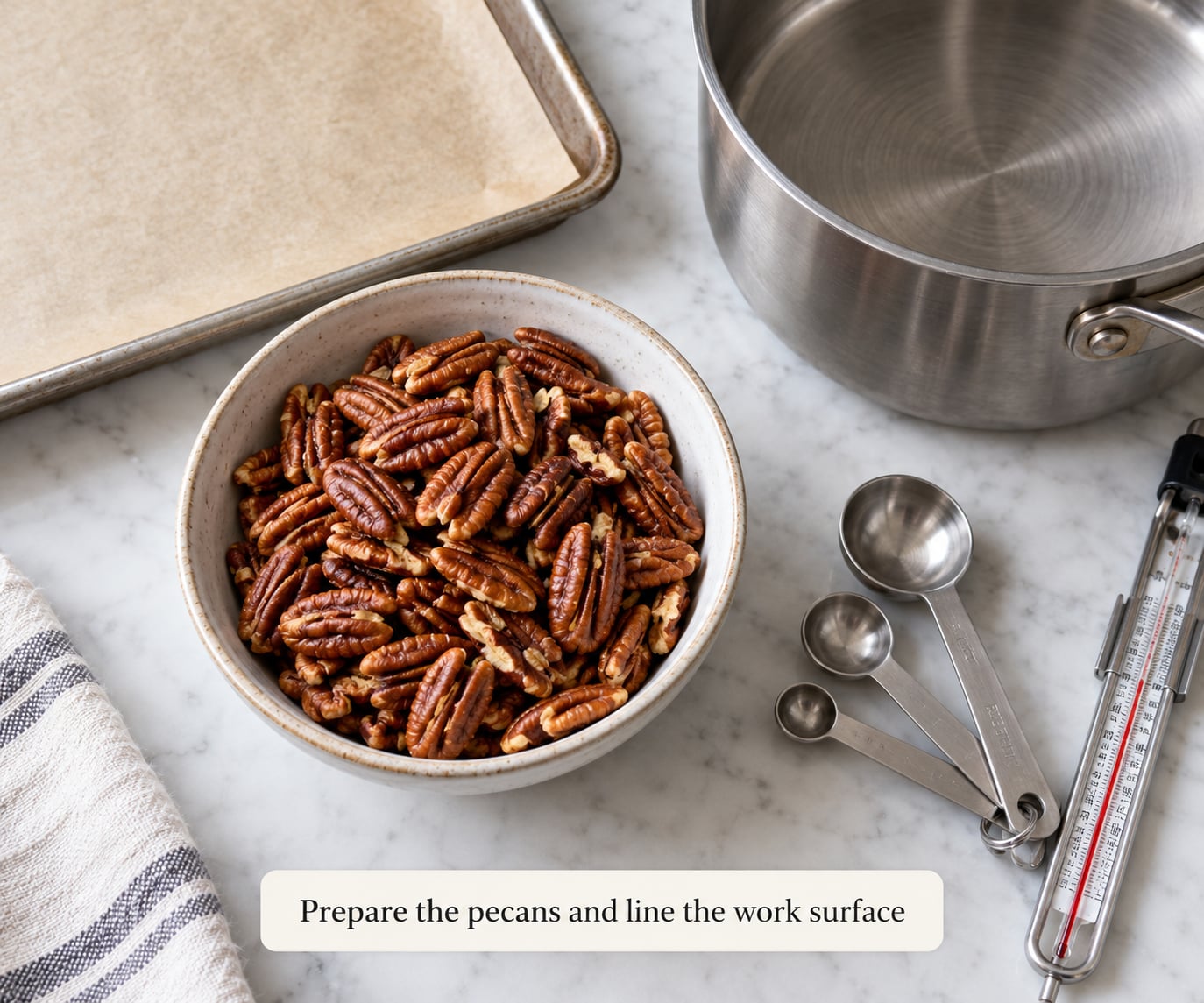
Toast the pecans in a dry skillet over medium heat for 5 to 7 minutes, shaking often, until they smell like baking. Let them cool on a plate. Nuts straight from the oven go into the syrup hot and make the whole batch run thinner than you want.
Line both sheets while the nuts cool. Set out the thermometer, spoon, vanilla, and a clean teaspoon so you are not opening cupboards with a hot pan in one hand.
Cook the butter, cream, and sugar mixture
Combine the butter, both sugars, evaporated milk, corn syrup, and salt in the saucepan over medium heat. Stir continuously, scraping the bottom and the lower wall, until the butter is fully melted and the mixture comes to a full boil with no sugar crystals left on the sides.
Keep the heat at medium and keep the spoon moving once it boils. Scattered stirring at this stage is what produces a smooth, creamy body instead of a grainy one, and it is the cheapest insurance in the whole recipe.
Add the pecans at the right moment
Stir the cooled pecans and the vanilla into the boiling mixture, then cook 2 to 4 more minutes. From the boil to soft ball stage takes roughly 12 to 18 minutes total depending on your pan and your elevation, so start watching the thermometer now rather than at the start.
If the mixture starts smelling scorched or the foam turns dark and thin, drop the heat one notch. Scorched butter tastes through the whole batch and no rescue will fix it.
Test the texture before turning off the heat
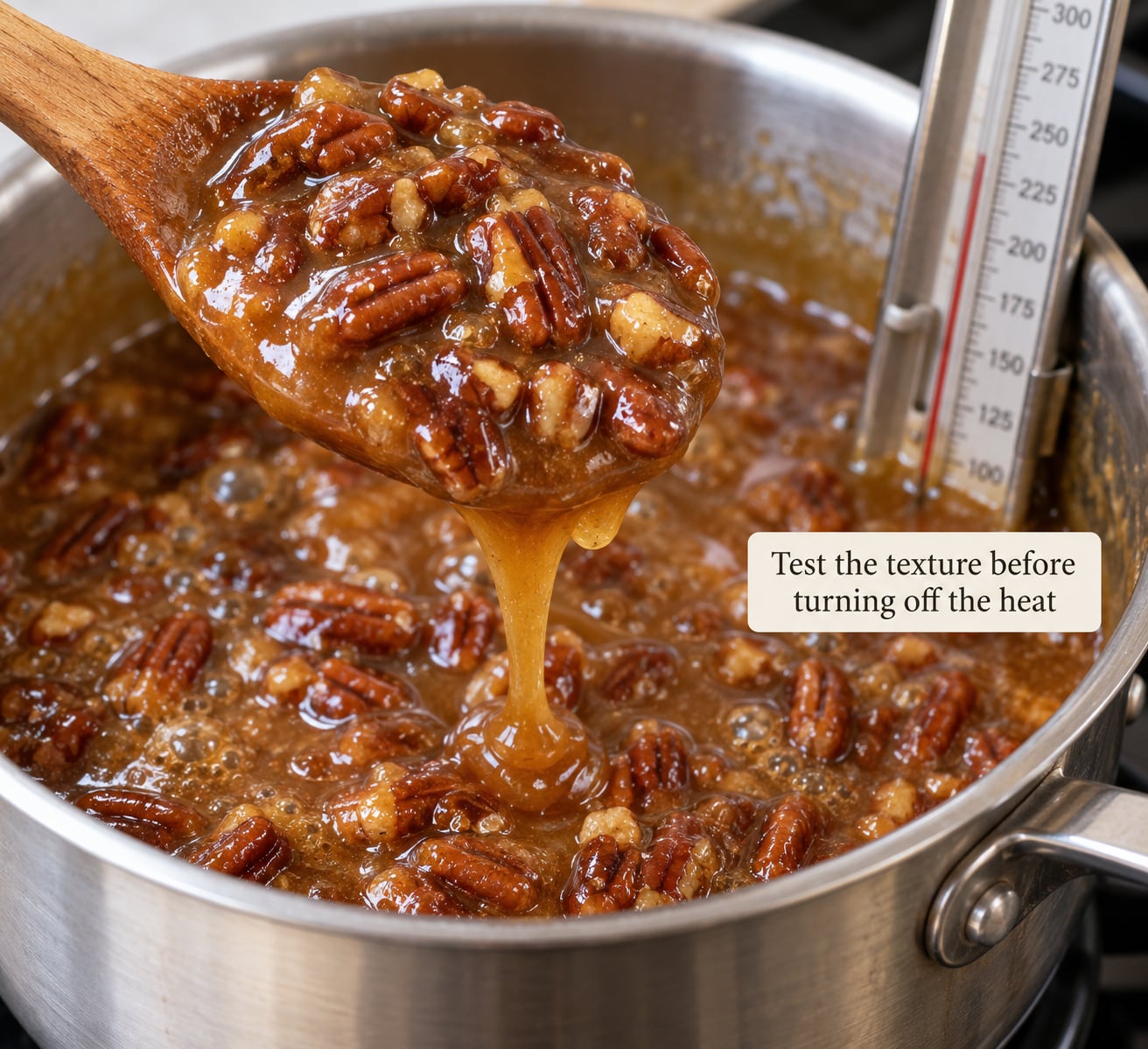
The thermometer reads 234 to 240F at soft ball stage. Cross-check it by dripping a small spoonful into cold water: the candy should hold a soft lump that flattens when you lift it out with your fingers.
Watch the surface too. The mixture loses its wet shine and turns a deep amber, and when you drag the spoon across the bottom you should see a clean channel that stays open for a second or two before closing. If the syrup looks thin and glossy like maple syrup, keep cooking. If it smells burnt, lower the heat now.
Portion and cool the pralines
Pull the pan off the heat at 234 to 240F and set it on a heatproof surface. Do not stir it. Wait until the thermometer reads 110 to 135F before you beat, and if it slips below about 110F put it back over low heat for a minute.
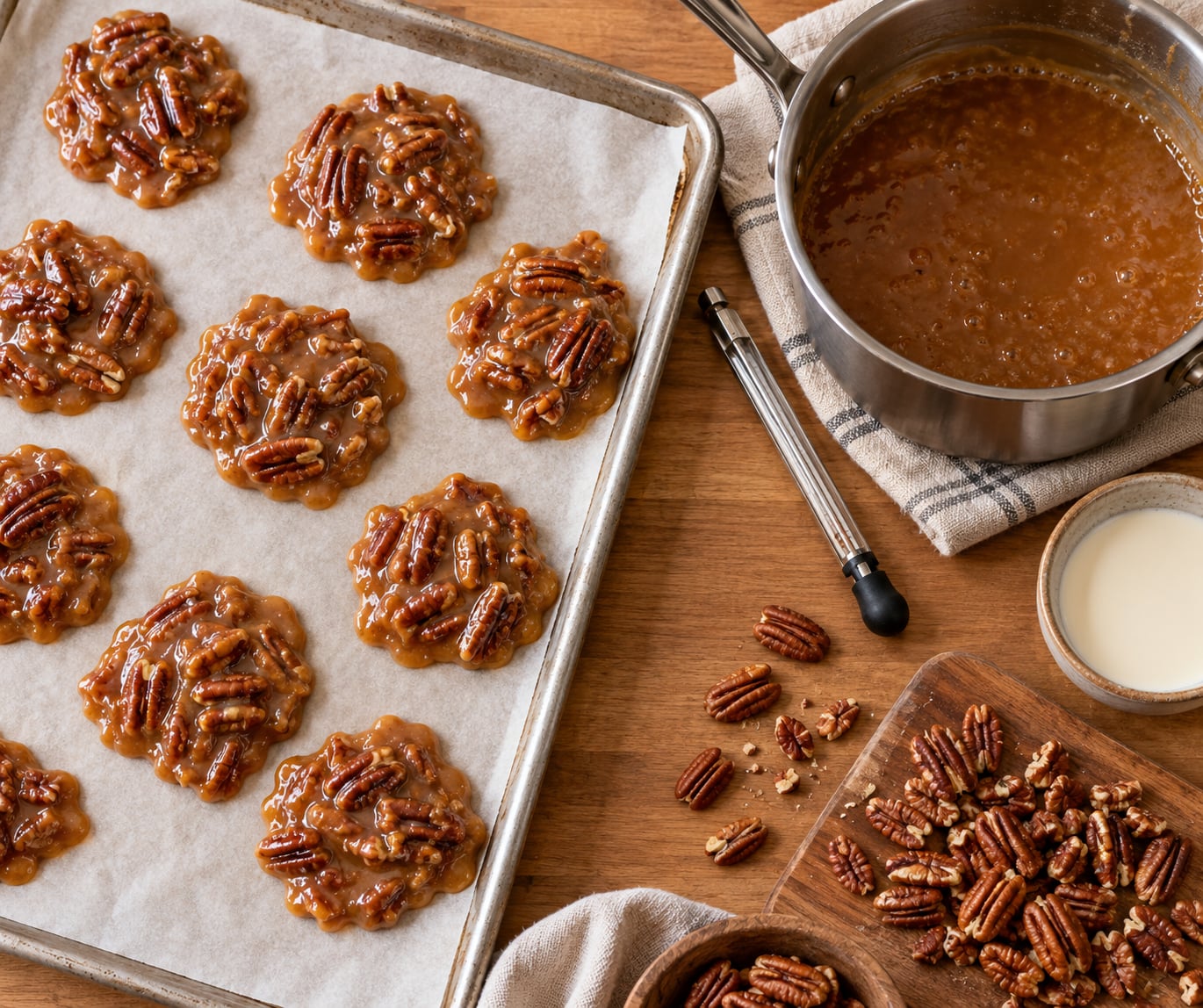
Beat with a wooden spoon for 2 minutes, just until the mixture thickens and loses its gloss, then drop fast with a well-greased teaspoon. Work down the sheet so each piece has room, and count out two dozen before you notice the spoon hardening.
Leave the pralines alone. Full firmness takes 15 to 30 minutes on a cool, dry day, and moving them at minute ten leaves you with fingerprints in the shell. Cool them undisturbed, then touch one to check.
Common Mistakes
Almost every soft, sticky, or grainy batch comes down to one of these six. Work down the list before you change the recipe.
- The syrup stopped short of soft ball. This is the big one and the easiest to confirm. If your pralines are still tacky and glossy after a couple of hours, they are not slow, they are undercooked. Return the batch to the heat, bring it back to a simmer, and cook to 234 to 240F.
- The thermometer was never verified. A digital probe reading low adds ten or twenty degrees of error to everything you do. Boiling-water test first, note the offset, and keep the tip suspended in the syrup rather than resting on the pan bottom, which gives you a false high reading and rock-hard candy.
- You dropped too slowly. Pralines seize up faster than a home cook can scoop. Portion one per second, grease the spoon between drops, and use a second sheet rather than waiting for space.
- The batch set up unevenly, so some pieces are soft and others are hard. That is a temperature spread, usually from too much heat under a thin pan. Use a heavy-bottomed saucepan and medium heat so the whole batch climbs together.
- The candy is grainy rather than creamy. Graininess means crystals formed during cooking. Boil before every grain of sugar dissolves, or scrape crystallized sugar off the pan wall and stir it back in. A spoonful of cream stirred into a cool grainy batch softens it.
- You made candy in a hot, humid kitchen. Sugar pulls moisture from the air, which slows the set and keeps the surface tacky. Air condition the room, work early in the day, or wait for a dry spell. Keep finished pralines out of the refrigerator, since condensation turns them sticky again.
A batch that turned out too stiff but not yet ruined is also recoverable. Warm the pan in hot water for a few minutes, or stir in 4 to 5 drops of boiling water at a time until the mixture drops off the spoon. A reheat-and-cool cycle also rescues loose pralines: set them back in the pan, bring the syrup to 234 to 240F again, and redrop.
Frequently Asked Questions
Why are my pralines staying soft?
Pralines stay soft when the syrup never reached soft ball stage, which is 234 to 240F. Under that temperature there is not enough dissolved sugar to crystallize into a firm candy, so the pieces stay gummy and tacky. Check with a candy thermometer, keep the tip off the pan bottom, and return the batch to the heat to finish cooking. Still glossy after a few hours means undercooked, not slow.
Can I make pralines without a candy thermometer?
You can, but only on a calm day and with real practice. Watch the color turn deep amber, the mixture pull away from the pan sides, and a clean channel open behind the spoon for a second or two. Use a cold water test to confirm: a drip should form a soft ball that flattens when lifted. Expect a little more margin for error than a thermometer gives you.
How long should pralines cool before touching them?
Give them 15 to 30 minutes untouched on a cool, dry day, and up to 1 to 3 hours when the kitchen is warm or humid. Cooled pralines stop moving long before they are fully hard, so moving them early dents the shell and leaves fingerprints in it. Wait until a piece lifted from the center of the sheet feels room temperature and firm before you stack or store anything.
What temperature should the praline mixture reach?
Soft ball stage, 234 to 240F, measured on a candy thermometer with the tip suspended in the syrup and not touching the pan. That target gives a creamy, melt-in-the-mouth praline. Firm ball at 246F sets harder and more brittle, which some classic recipes use, and hard ball at 260F makes candy that cracks like toffee. Conflicting recipe targets come from those three schools of technique.
Why did my pralines turn grainy?
Graininess is sugar crystallizing during the cook instead of during the cool. It happens when the mixture reaches a full boil before every grain of sugar dissolves, when you stir crystal-studded syrup from the pan wall back into the batch, or when you beat the mixture while it is still too hot. Stir constantly at medium heat, wipe the walls, and cool to 110 to 135F before beating. A spoonful of cream softens a grainy batch.
How should pralines be stored so they stay crisp?
Store them in an airtight container lined with wax paper, between layers of parchment, in a cool dry cupboard away from the stove and any direct sun. They hold at room temperature for one to three weeks, and freezing them flat on a sheet for up to three months works well. Skip the refrigerator, since the temperature swing creates condensation that turns the surface sticky within a day.
Conclusion
Pralines set properly when three things happen in order: the syrup reaches 234 to 240F, the mixture cools to 110 to 135F before you beat, and every piece gets a full 15 to 30 minutes undisturbed. Watch the color and the clean channel behind the spoon as much as you watch the thermometer, because texture is the cue that survives a bad thermometer.
If a batch comes out soft, reheat it to temperature and redrop rather than binning it. If the kitchen was hot and humid, air condition the room and try again on a cooler day, and next time run a smaller batch so the mixture stays ahead of your spoon.