How to ferment sauerkraut in a mason jar is mostly waiting: about fifteen minutes of hands-on work, then two to four weeks while the cabbage does its thing. All you do is salt shredded cabbage at roughly 2 percent of its weight, pack it hard into a clean jar, hold it under the brine with a weight, and let the cabbage’s own lactobacillus bacteria turn the sugars into lactic acid. Everything after that is patience and a daily thirty-second check.
The one rule that matters more than any other: use a two-piece canning lid and ring, finger-tight, never a one-piece flat lid screwed down hard. Fermentation makes carbon dioxide, and a sealed jar with no escape route can crack or blow its top off. I have seen a jar go from sealed to foaming across the counter in one afternoon, so get the venting habit down before you start.
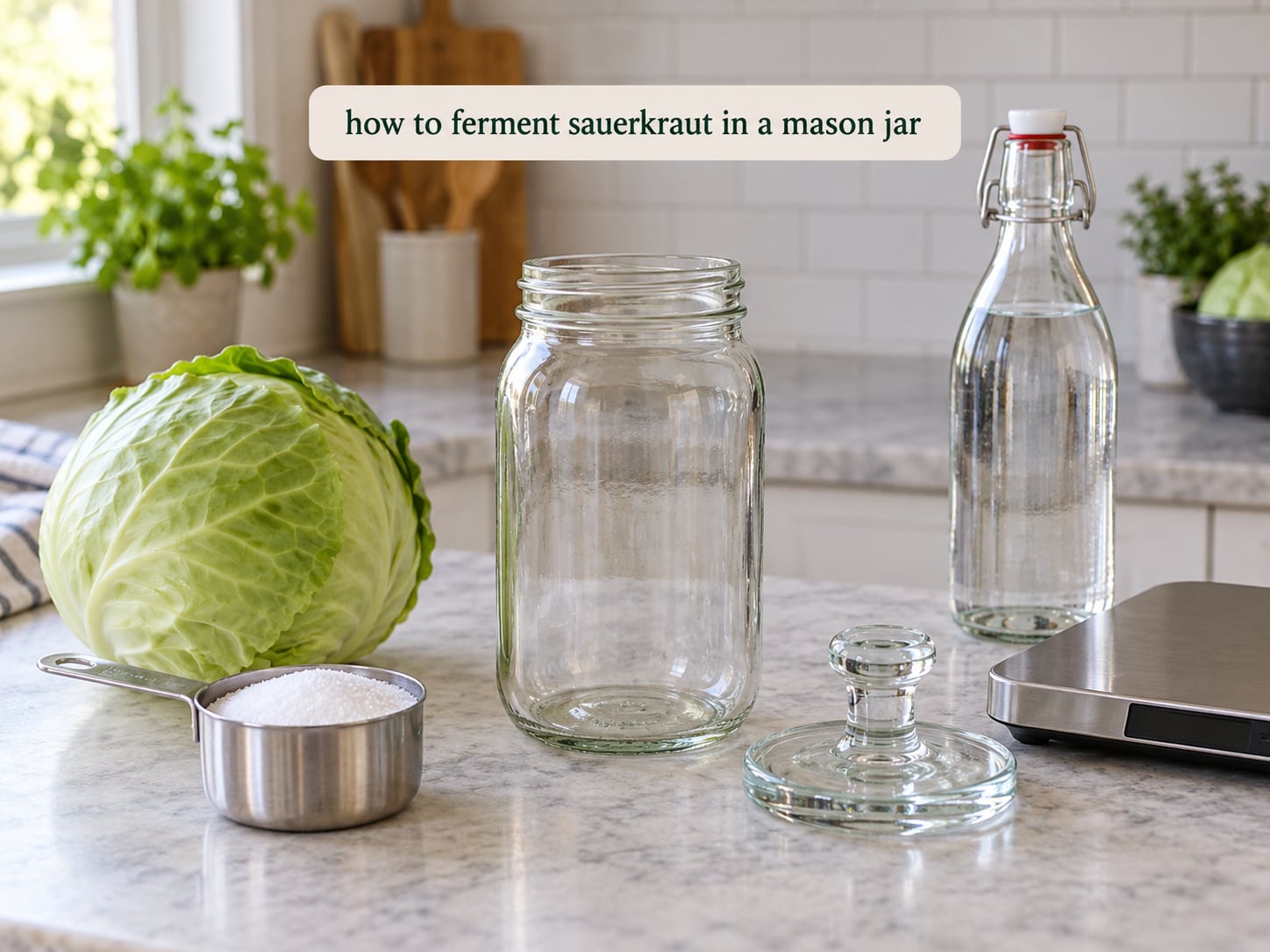
Table of Contents
- What You Need
- Step-by-Step
- 1. Prepare the cabbage and salt
- 2. Massage the cabbage until brine appears
- 3. Pack the mason jar tightly
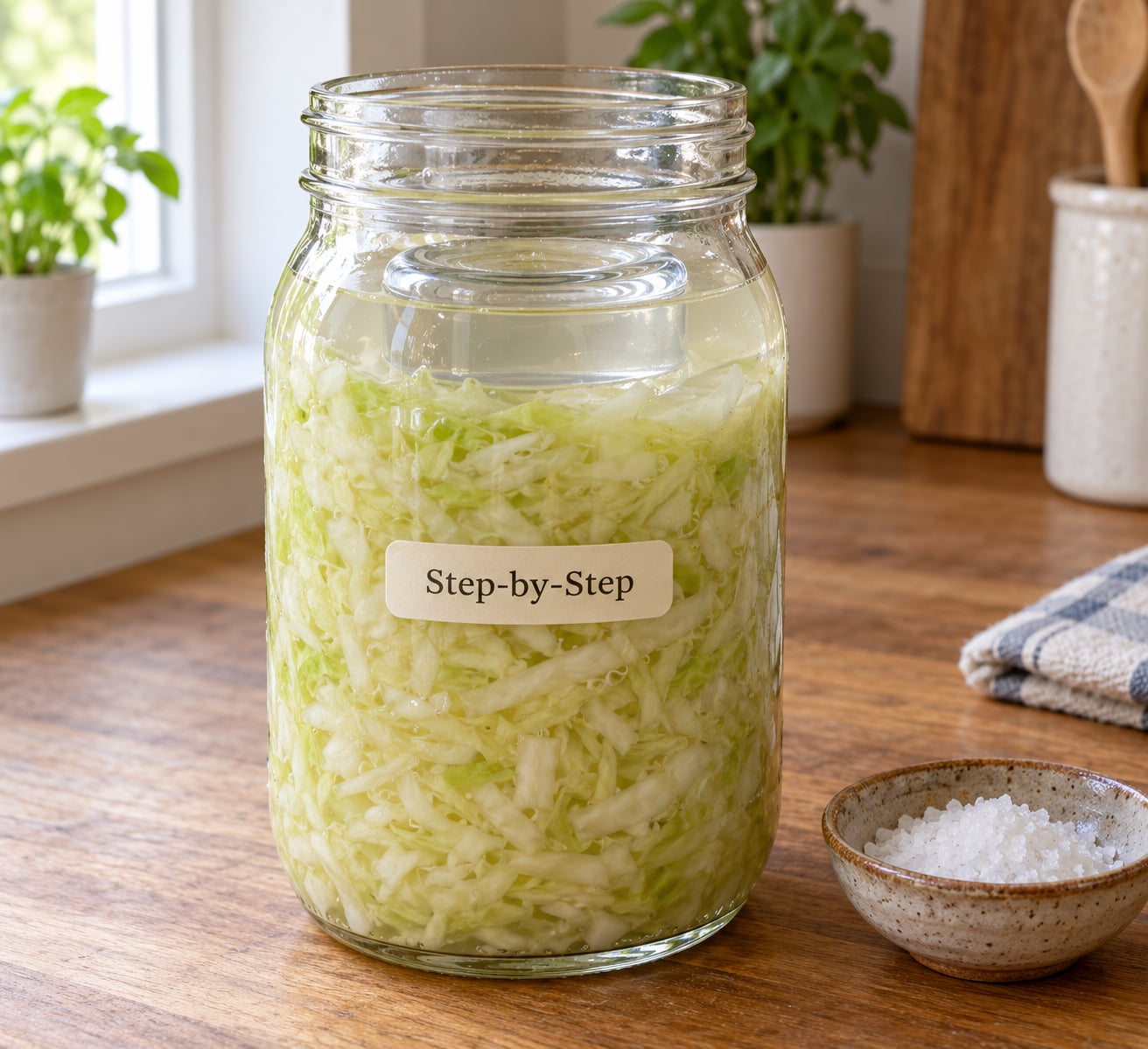
- 4. Cover the cabbage with brine and weigh it down
- 5. Ferment at room temperature
- 6. Chill and store the sauerkraut
- Common Mistakes
- Tips for Better Results
- Is Mason Jar Sauerkraut Safe?
- Frequently Asked Questions
- How long does sauerkraut need to ferment in a mason jar?
- Do I need to rinse the cabbage before making sauerkraut?
- Why is my cabbage floating above the brine?
- What is the best salt-to-cabbage ratio for mason jar sauerkraut?
- How can I tell if sauerkraut has gone bad?
- Can I ferment sauerkraut in a regular mason jar lid?
What You Need
- 1 medium head of cabbage, about 2 pounds, with the outer leaves still on
- Non-iodized salt — pickling salt, canning salt or plain kosher salt. Weigh 18 grams for a 2 pound cabbage, which is two to three tablespoons depending on the brand
- 2 clean quart mason jars with two-piece lids and rings. One head of shredded cabbage usually fills both
- Something to hold the cabbage down — a fermentation weight, a tamper, or a small jar filled with water
- A large bowl for salting and massaging, plus a kitchen scale if you have one
- Optional: caraway seeds, a bay leaf, or a few peppercorns for the classic flavor
You do not need a crock, an airlock, or a thermometer that costs more than your cabbage. A shallow baking dish to set the jars in is worth having, though, because seepage under the lid is normal in week one and it will save your counter.
Skip the shaker on the table. Iodized salt carries iodine and anti-caking agents that can interfere with the bacteria doing the work, and table salt is fine-grained enough that a tablespoon of it weighs more than a tablespoon of kosher flake. Weight by volume is guesswork; weight by weight is a number you can repeat.
Step-by-Step
1. Prepare the cabbage and salt
Pull off the outer leaves and set them aside — you will want one later as a lid for the jar. Quarter the head, cut out the hard core, and shred the rest as fine as you can, about a quarter-inch shred. A mandoline makes this fast and even, and even shreds pack more tightly and release brine more reliably.
Put the cabbage in your bowl, weigh it, then add salt at 2 percent of that weight. For a 2 pound cabbage that is about 18 grams, roughly two to three tablespoons of fine pickling salt depending on the brand. Sprinkle it on in three or four passes rather than dumping it all in one spot, then toss.
2. Massage the cabbage until brine appears
Now squeeze and knead the cabbage with your hands for two to three minutes. You are trying to bruise the shreds and drive the salt into them so water pulls out of the plant cells. It feels wrong for the first minute and then it turns wet and heavy in your hands.
Stop when a pool of brine sits at the bottom of the bowl and the cabbage has gone from fluffy and pale to glossy and slightly translucent. A dry-looking pile that barely moistens is the number one reason a mason jar ferment stalls. Give it another full minute of kneading if you are unsure.
3. Pack the mason jar tightly
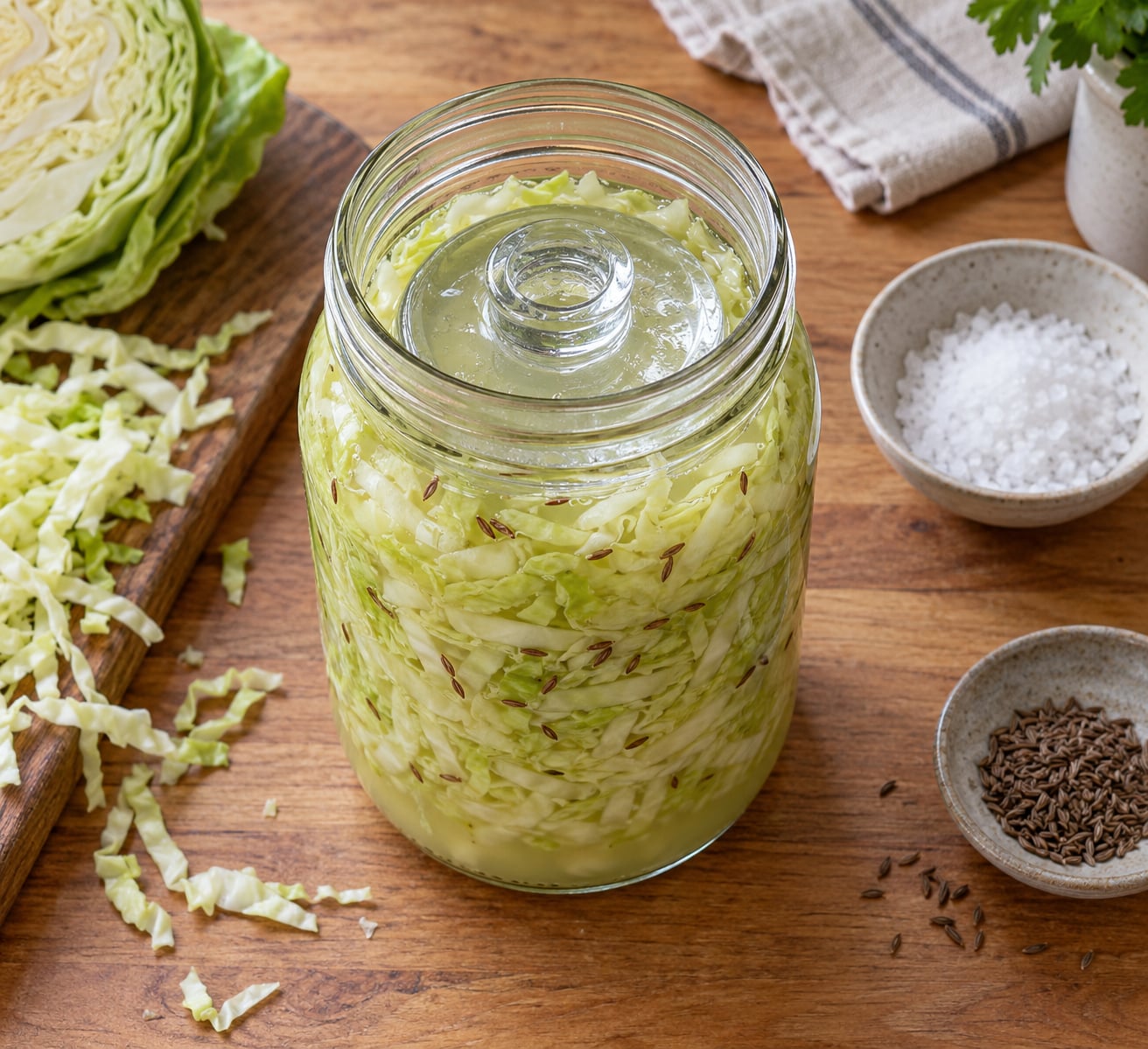
Pack the cabbage into the jar in handfuls, pressing down hard with the back of a spoon or a tamper after each one. Tight packing removes air pockets, and air pockets are where mold and oxidation start. Fill until the brine reaches within an inch of the rim, leaving that headspace for the carbon dioxide that comes next.
Clean the rim with a damp paper towel before you go any further. Any cabbage shred sitting on the glass will dry out, brown, and eventually grow something you do not want to eat.
4. Cover the cabbage with brine and weigh it down
The brine should come up and over the cabbage on its own. If it does not, top it up with a few tablespoons of water and a small pinch of salt — roughly a teaspoon per cup — to keep the salinity from dropping. Every shred needs to be submerged; cabbage breaking the surface oxidizes and molds.
Sit your weight on top so it fits inside the jar walls and holds the cabbage under. A purpose-made fermentation weight works best. Failing that, a small jar filled with water and closed with a lid, a tamper, or a folded clean cabbage leaf tied onto a weight all work. Then screw the ring on until it is just snug.
Finger-tight is the phrase, and it is deliberate. You want the seal to hold cabbage in and let gas seep out around the lid. Cranking it down tight gives you a pressure problem instead of a ferment.
5. Ferment at room temperature
Set the jar somewhere dark, reasonably warm, and out of direct sunlight — a pantry shelf or a corner of the counter is fine. Somewhere between 65 and 70 degrees Fahrenheit is the sweet spot. Put a towel or the baking dish under it in case brine creeps out as the jar burps.
For the first week, check daily. Squeeze the lid gently once or twice a day so trapped gas escapes with a soft hiss, and watch for brine creeping up the glass. Small bubbles climbing through the liquid and cloudy brine are the signs it is working, usually within a day or two.
| Room temperature | Expected time to ferment | What you will notice |
|---|---|---|
| Below 60°F | May not ferment at all | Bubbles appear then everything stalls; bring the jar somewhere warmer |
| 60–65°F | 5 to 6 weeks | Slow and steady; flavor stays mild and clean |
| 65–70°F | 3 to 5 weeks | The everyday result for a normal kitchen |
| 70–75°F | 2 to 4 weeks | Fast, tangy, assertive flavor |
| Above 80°F | Under 2 weeks | Soft, mushy texture and a sharp edge; move the jar cooler |
Do not follow the calendar blindly. Taste with a clean fork around the two-week mark, pressing a shred and eating it straight from the jar.
6. Chill and store the sauerkraut
It is done when the shreds go translucent and limp, the brine smells sharp and sour rather than merely salty, and the aggressive bubbling has settled down. Taste it plain, then taste it again a few days later — the flavor keeps developing in the fridge, which is why many people let a batch go past the point that seems finished.
Tighten the ring fully now that fermentation has slowed, press any stray cabbage back under the brine, and move the jar to the refrigerator. Expect it to stay good for several weeks and often several months; keep it submerged and use a clean fork every time so you do not introduce spoilage organisms. If the brine drops, top it up with plain water.
Common Mistakes
Nearly every failed mason jar ferment comes down to one of five things: cabbage above the line, trapped air in the jar, not enough salt, a warm room, or a lid that was sealed too hard. Here is what each one looks like.
| What you see or taste | Likely cause | The fix | Still good to eat? |
|---|---|---|---|
| Shreds dry and browning at the top | Cabbage broke the surface and oxidized | Push it back under the brine and add a real weight | Usually, if no fuzzy growth and the smell is clean |
| Fuzzy, colored growth — white, green or black | Mold from exposed cabbage or air pockets | Discard the batch; tighten packing next time | No. Do not scrape mold off kraut |
| Thin white film or pink streaks in the brine | Kahm yeast, which grows in weak brine | Pour off the film and use the kraut promptly | Often yes, if there is no fuzz and no off smell |
| Almost no change after three weeks | Room too cold, usually under 60°F | Move the jar to a warmer spot and wait longer | Yes, it just needs heat and time |
| Cabbage is limp and gray-brown after a fast ferment | Ferment ran above 80°F | Ferment the next batch somewhere cooler | Yes, but the texture is not coming back |
| Everything tastes like salt, not sour | Over-salted cabbage | Cut with shredded carrot, apple or a splash of brine from another batch | Yes, salt is the one thing you cannot ferment out |
| Lid popped off, foam down the side of the jar | Ring tightened harder than finger-tight | Burp once or twice a day in week one | Yes, as long as the brine level is still above the cabbage |
And a note on salt ratios, since this is where beginners mostly go wrong:
| Shredded cabbage by weight | Salt at 2% by weight |
|---|---|
| 1 pound (about 4 cups, one quart jar) | 9 g |
| 2 pounds (about 8 to 10 cups, two quart jars) | 18 g |
| 3 pounds | 27 g |
| 4 pounds | 36 g |
Tips for Better Results
- Pick heavy, tight heads. A cabbage that feels light for its size is watery and will give you thin, weak kraut. Heavy heads with crisp leaves shred and pack better.
- Weigh the salt. Grain size varies wildly between brands, so two tablespoons of one salt and two tablespoons of another can be a full percentage point apart. A ten dollar scale removes the guesswork for good.
- Use nonchlorinated water if you need to top up the brine. Chlorine can knock back the ferment in a small batch. Let tap water sit uncovered overnight and the chlorine dissipates on its own.
- Taste on a schedule. Day three, day seven, day fourteen, then weekly. A clean fork, a shred lifted out, a quick taste, fork washed. That is the whole routine.
- Warm kitchens finish faster. If your kitchen runs hot, put the jar on a closet shelf or the coolest corner of the house and give it an extra week rather than cranking up the speed.
- Keep everything but the cabbage clean. Wash your bowl, jars, and utensils, and use hot water on the glass. Salt suppresses most spoilage organisms, but it is not a sterilizer.
- Scale up in jar batches, not one giant jar. A quart jar is the easiest size to manage: enough for a few meals, small enough that you finish it before quality drops. One medium head usually fills two quart jars, which is still an easy weekend batch.
- Flavor comes from the cabbage. Add caraway seeds or a bay leaf at packing time, not at the table, and keep additions modest so you can still taste what fermentation did.
Is Mason Jar Sauerkraut Safe?
Botulism is the reason this question gets asked, and the honest answer is that fermentation handles it — but only when you follow the salt level and the venting rules. Salt at 2 percent by weight suppresses the bacteria that can grow in low-acid, low-salt vegetables, while lactobacillus acidifies the cabbage quickly and drops the pH well into territory where botulism toxin cannot form. Anaerobic jar fermentation is not the same process as home canning: canning relies on a validated heat treatment to destroy spores, while fermentation relies on salt, acidity and time. Reach for a water-bath canner to treat kraut as a safety measure and you destroy the live cultures you fermented for in the first place.
Two habits keep this safe. Keep the cabbage submerged, because mold grows on any shred that sees air. And use a two-piece canning lid and ring that you can loosen, so gas never builds enough pressure to shatter the jar. If the brine is cloudy but smells clean and sour, and there is no fuzz anywhere, you have a ferment. If anything is fuzzy or the smell is rotten, throw it out — salt has never made mold safe, and no amount of skimming changes that.
Frequently Asked Questions
How long does sauerkraut need to ferment in a mason jar?
Plan on two to four weeks in a room kept between 70 and 75F. A cooler kitchen around 65F stretches that to three to five weeks, and 60 to 65F can take five to six. Below 60F the ferment often stalls entirely, while above 80F the cabbage turns soft and sour too fast. Start tasting with a clean fork at the two-week mark rather than trusting the calendar.
Do I need to rinse the cabbage before making sauerkraut?
No, and rinsing works against you. The surface bacteria on a fresh cabbage are part of the culture you want, and rinsing strips some of them while adding water you would then need to salt back up. Give the head a quick rinse if it is grubby, pat it dry, and shred from there. Your fermentation salt is doing the sanitizing, not the tap.
Why is my cabbage floating above the brine?
Floating means two things: not enough liquid, or not enough weight. Top the jar up with lightly salted water so the shreds are fully submerged, then add a real fermentation weight that fits inside the jar walls. Cabbage sitting above the liquid dries out, browns, and grows mold, and those shreds cannot be rescued by pressing them back down. Top it up every time you check during week one.
What is the best salt-to-cabbage ratio for mason jar sauerkraut?
Two percent of the cabbage weight, measured with a scale rather than a spoon. That is about 18g for a 2 pound head, roughly 9g per pound. Use pickling salt, canning salt, or plain kosher salt, and never iodized table salt. Volume measures fail badly because flake salts and fine salts of the same spoonful weigh very different amounts, and over-salting is the most common taste complaint people bring back.
How can I tell if sauerkraut has gone bad?
Discard the batch if you find fuzzy, textured growth in white, green, black, or any color other than a smooth film, or if the brine smells rotten or ammonia-like. Cloudy brine, a thin flat film, and pink streaks usually mean kahm yeast, which many people eat after skimming the film off. When in doubt, throw it out, and never taste a batch you have already identified as moldy.
Can I ferment sauerkraut in a regular mason jar lid?
You need a two-piece canning lid and ring, tightened just until snug so gas can seep out. A one-piece flat lid screwed down hard traps the carbon dioxide the ferment produces, and the pressure can crack the jar or send the top across the room. If your lid has no separate ring, buy canning lids before you start. Burp the jar once or twice a day for the first week.
If you only change one thing about your first batch, make it the salt. Weigh it at 2 percent of the cabbage weight, pack the jar hard enough to squeeze the air out, and give it a weight that actually holds the shreds under the brine. Then set it somewhere warm and dark, taste it at two weeks, and stop guessing about the rest.