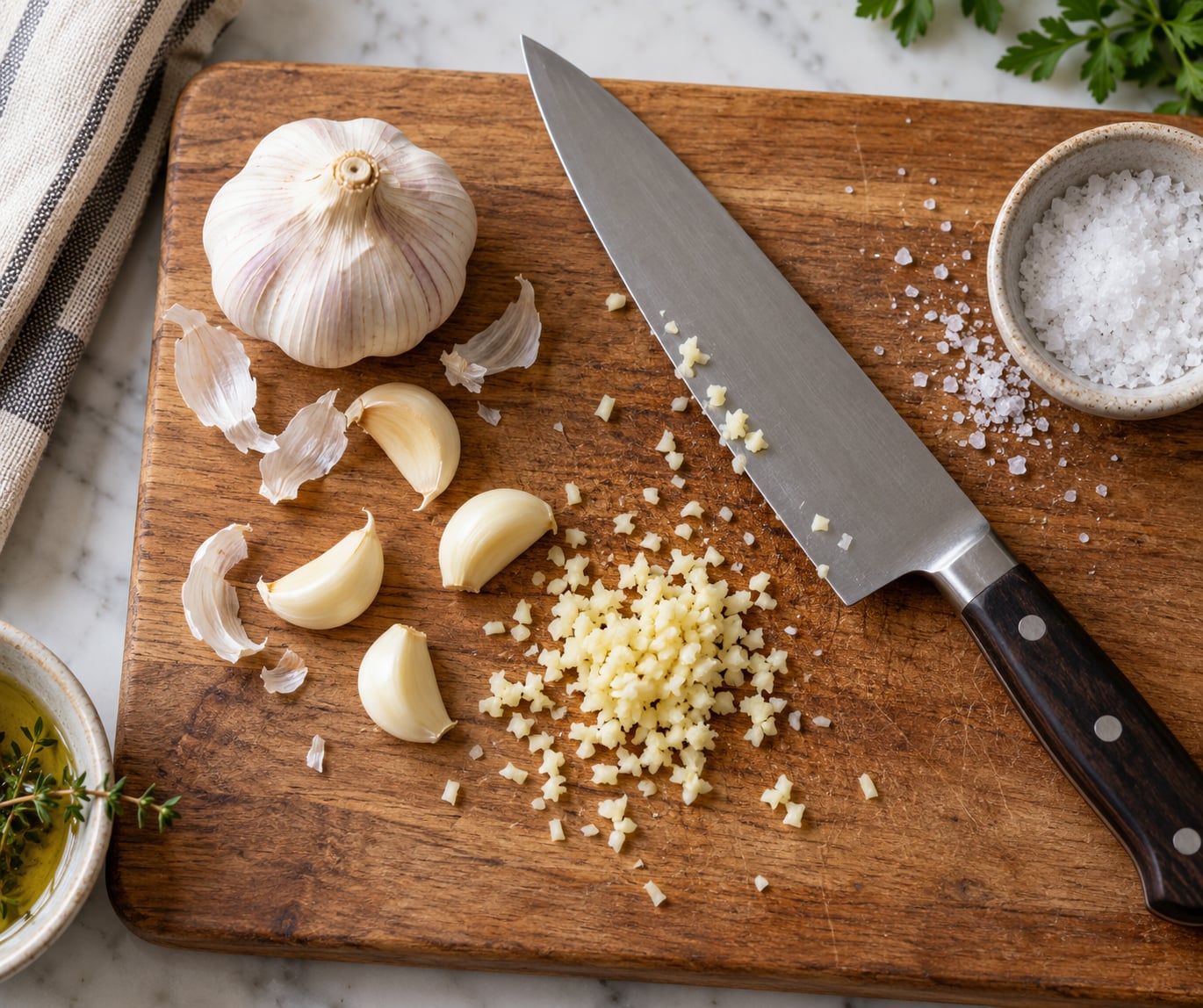
To mince garlic without a press, flatten a peeled clove under the flat of your knife, slice it thin, pile the slices up, and rock the blade back and forth over a pinch of coarse salt until the pieces are small and even. The whole job takes about two minutes per handful of cloves, and the texture stays drier and more distinct than pressed garlic.
A press is quick for a single clove, and it is the wrong tool for a head of garlic or a market-scale prep session. It also crushes the clove into a wet paste, which releases allicin faster and changes how the finished dish tastes. Hand mincing gives you control over that.
Table of Contents
- What You Need
- How to Mince Garlic Without a Press: Step-by-Step
- How to Mince Garlic Without a Press: Peel and Prep the Cloves
- Make Thin Slices First
- Rock the Blade and Mince
- Check the Texture and Use the Garlic
- Other Ways to Mince Garlic Without a Press
- Common Mistakes
- Why Garlic Sticks to the Cutting Board
- How to Get the Smell Off Your Fingers
- Frequently Asked Questions
- What tool can I use to mince garlic if I don’t have a press?
- Can I put garlic in a blender or food processor to mince it?
- Can you mince garlic with a cheese grater?
- How much fresh garlic equals one tablespoon of minced garlic?
- Why does my minced garlic turn into paste?
- How should I store minced garlic, and is garlic stored in oil safe?
- What to Do First
What You Need
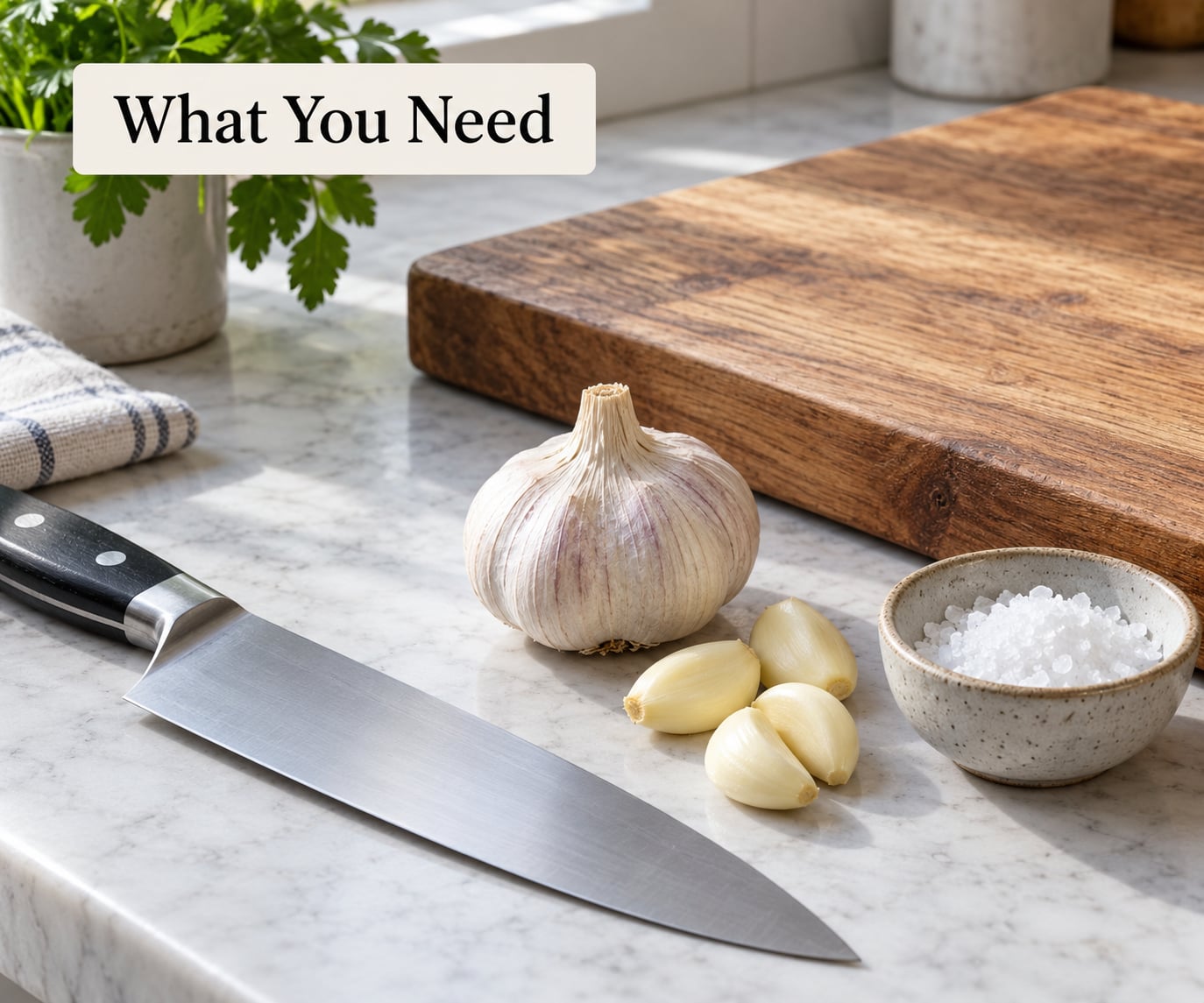
You need very little. A sharp 8 to 10 inch chef’s knife does the real work, and the single most useful trick costs nothing: coarse salt.
- Chef’s knife with a straight edge and a comfortable handle. Rocking needs clearance at the tip, so a short paring knife is awkward for more than two cloves.
- Large cutting board with a groove or a damp surface underneath so the board cannot skid while you press down.
- Coarse salt or kosher salt. The crystals act as an abrasive, draw moisture out of the cut garlic, and keep the pieces in a loose pile instead of a smear.
- Garlic you actually want to use. Softneck bulbs have large, easy-to-peel cloves with smooth skin; hardneck bulbs have smaller cloves with thicker skin, so plan on more peeling time.
- Optional: the side of a spoon, the flat of a second knife, or a bench scraper to scoop the finished mince into the pan.
How to Mince Garlic Without a Press: Step-by-Step
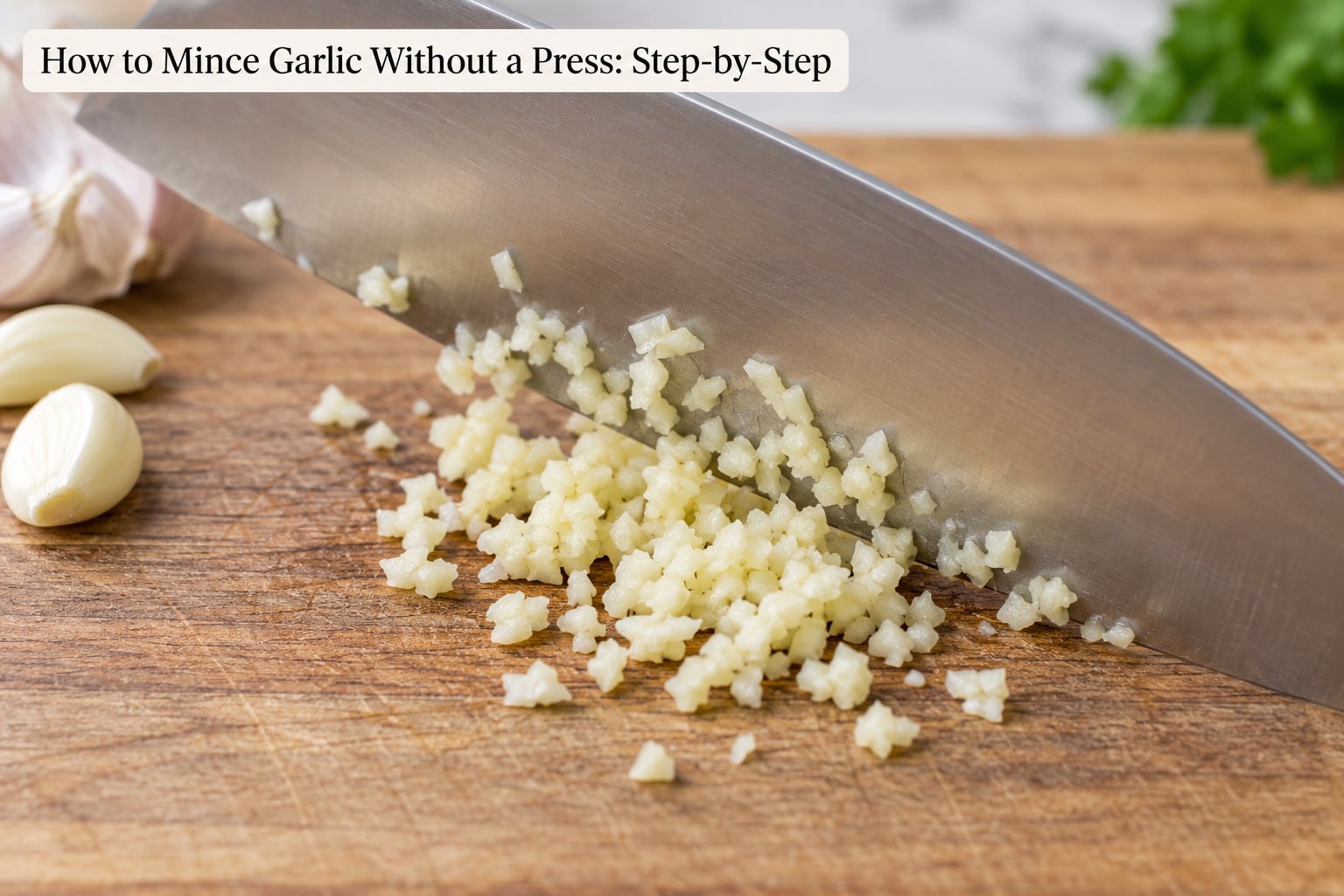
How to Mince Garlic Without a Press: Peel and Prep the Cloves
Break the bulb apart at the base and separate the cloves. Trim the root end and any stray green shoot from each one.
Set a clove flat on the board, lay the broad side of the knife across the top, and press straight down until the clove cracks and flattens. The papery skin splits and lifts off in one piece. Cooks call this the crush-and-peel trick, and it cuts peeling time on a whole bulb to a couple of minutes.
Turn the clove so the flat side rests on the board. That gives the blade a wide, stable surface instead of a round one that rolls under pressure.
Make Thin Slices First
Hold the knife in your dominant hand and rest the flat of the other hand on top of the blade, knuckles facing forward. Curl the fingertips of that guiding hand back so the knuckles ride the spine of the knife and the pads never reach the edge.
Cut the clove into slices about 1/8 inch thick, moving the blade up and down rather than pushing it away from you. Even slices are the whole trick. Uneven ones mean some pieces turn to paste while others stay chunky.
Rock the Blade and Mince
Scoop the slices into a tight pile with the side of the blade and sprinkle a teaspoon of coarse salt over it. Then pivot the tip on the board and rock the heel through the pile in a steady rhythm.
Rocking beats chopping for a reason: the pivot point stays put, so the edge meets the garlic at the same angle every stroke. Speed matters more than downward force, and your guiding hand rides on top of the spine doing almost nothing.
Do two or three passes, then scrape the pile back together with the side of the blade and repeat. Four or five quick passes give you a coarse mince. Keep going and you cross into paste territory.
Check the Texture and Use the Garlic
A proper mince looks like small, distinct bits, roughly the size of coarse sea salt, with a few pieces a size or two apart. If everything is uniform and glossy, you have gone too far.
That line matters because crushing ruptures the cells and forms allicin. Minced garlic keeps its shape, so it tastes sharper and cleaner; garlic that has been crushed into paste tastes rounder, sweeter, and more aggressive, and it browns and burns faster in a hot pan.
Use a coarse mince for pasta sauce, sautés, soups, and stews where you want the clove to soften and melt. Use a paste for garlic butter, aioli, marinades, and vinaigrettes, where you want it dispersed and smooth. The practical rule most cooks fall back on: press it for raw applications, mince it for cooked ones.
Other Ways to Mince Garlic Without a Press
When you are working through a whole head, or your hands are already tired, these are the no-press options. They are not equal, and the differences matter.
- Microplane or fine zester. Gives the finest, most even texture of any hand method. It suits dressings and raw applications, and it is the fastest option for two or three cloves. It does not go coarse, so it cannot produce a rustic mince for a stew.
- Cheese grater. Works, but the holes are usually too large and the garlic gums up in them. Fine on a box grater, frustrating on anything bigger. The microplane is the same idea done properly.
- Mortar and pestle. The classic route to a paste, and it pulls more flavor out of the garlic than any other method. It is slow, and a sticky pestle at twelve cloves is a real chore.
- Meat tenderizer. Put the cloves in a sheet of parchment paper, rest the spiky face on top, and hit it four or five times with the flat of a mallet. Parchment keeps the mess contained and lets you tip the crushed garlic straight into a bowl, and a plastic bag works the same way. Note that this crushes rather than minces, so expect paste-like texture and sharper flavor.
- Manual chopper. A sealed cup and a curved blade handle a whole head in a few strokes and keep your fingers away from the garlic. They rinse clean in seconds, which solves the odor problem that a press makes worse by trapping skin in the chamber.
- Food processor or blender. A processor is faster than anything else here. Pulse in short bursts and stop while the garlic still has texture. A blender running continuously hits paste almost immediately, and the puree-like result has none of the structure you want in a sauce.
Common Mistakes
Almost every disappointing bowl of minced garlic traces back to one of five things.
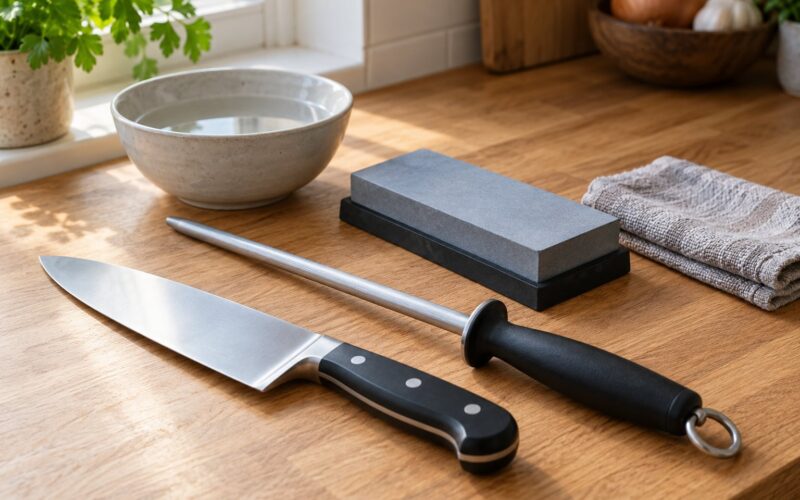
A dull knife. If the knife drags and the pieces are uneven, stop blaming your technique. A dull edge crushes instead of cutting, so the garlic smears on the board and turns gummy. Sharpen it or borrow a better knife.
Skipping the flat-side step. A round clove rolls, shifts, and throws off your spacing. Flattening it first gives the blade a stable surface and keeps the slices the same thickness.
Forcing the knife downward. Pressing hard is how people hurt themselves and how the garlic ends up uneven. Keep the claw grip light, let the weight of the blade do the work, and move fast.
Chopping straight up and down. Up-and-down cuts leave ragged, uneven bits. The rocking pivot keeps the edge at one consistent angle, which is what produces an even mince.
Skipping the salt, or adding it too late. Salt works on contact. Sprinkling it after the garlic has already smeared does nothing for the texture you were trying to prevent.
Why Garlic Sticks to the Cutting Board
Garlic releases moisture the moment you cut it, and moisture plus a smooth board surface equals glue. Three fixes cover almost every case.
Salt the garlic before you mince, not after. Use a board with a groove or a handle hole and dampen the underside so the board stays put. And scrape frequently with the side of the blade rather than pushing the pile around, which is what smears it further.
How to Get the Smell Off Your Fingers
Sticky, pungent fingers that smell for days after washing are the complaint cooks raise most often, and the oil on your skin traps the odor rather than letting soap reach it.
Rub your hands on bare stainless steel for about thirty seconds. The sulfur compounds bind to the metal, and most people notice a difference after one pass. Wipe your hands on a lemon half or a lemon wedge, then wash with warm water and dish soap, which cuts grease better than hand soap. A coarse salt scrub followed by a rinse works on stubborn hands, and keep a bowl of warm water and soap by the board so you can rinse mid-cook instead of at the end.
Frequently Asked Questions
What tool can I use to mince garlic if I don’t have a press?
A chef’s knife is the answer for almost every home kitchen. Smash the clove under the flat of the blade to peel it, add coarse salt, and rock the knife over a tight pile until the pieces are even. For a large batch, a microplane gives the finest texture, a manual chopper handles a whole head in seconds, and a mortar and pestle makes a paste.
Can I put garlic in a blender or food processor to mince it?
Both work, and a processor is the fastest option for a whole head. Pulse in short one-second bursts and check between each pulse, stopping while the garlic still has visible texture. A blender left running continuously goes straight to puree, and a smooth puree has none of the structure a sauce needs. Neither gives you the even, distinct pieces a rock-chopped mince produces.
Can you mince garlic with a cheese grater?
Technically yes, but it is not the tool you want. Grater holes are usually too large and the gummy residue clogs them, so you get uneven shards and a messy sink afterward. A microplane or fine zester does the same job far better, producing a uniform, almost powdered mince in a fraction of the time.
How much fresh garlic equals one tablespoon of minced garlic?
One medium clove yields roughly one teaspoon of minced garlic, so a tablespoon works out to about three cloves. Three cloves roughly replace one tablespoon of garlic powder in most savory recipes, though the fresh version tastes sharper and brighter. Start with two cloves if the dish also has other strong flavors like pepper or chili.
Why does my minced garlic turn into paste?
Two things cause it: a dull knife, which crushes instead of cutting, and too many passes with a sharp one. Once the cells rupture, the garlic turns glossy and gummy and keeps going. Stop after four or five rocking passes for a coarse mince. If you want a paste deliberately, add a pinch of salt and keep going, or use a mortar and pestle for a more even result.
How should I store minced garlic, and is garlic stored in oil safe?
Keep minced garlic in an airtight container in the fridge and use it within four days, or freeze it in a portioned ice cube tray. Garlic stored in oil at room temperature is a real botulism risk because the sealed, oxygen-free environment suits the bacteria. Refrigerated garlic in oil is fine, but eat it within four days and never leave a jar on the counter.
What to Do First
Put one clove under the flat of your knife, press down, and peel it. That single move is the difference between a two-minute job and a ten-minute one, and it is the step most people skip. Once the clove is flattened and salted, four or five rocking passes and you are done.