You cut vegetables faster when you remove the things slowing you down: a dull blade, a board that slides, a round onion that rolls, and a guide hand that hovers instead of holding. Fix those four and the same onion takes half the strokes. How to cut vegetables faster with better knife skills comes down to setup, grip, and repetition, not hurrying.
That matters because vegetable prep eats 15 to 20 minutes of a typical weeknight before the pan even heats up. Most home cooks assume slow chopping is a talent problem. It usually is not. It is a board slipping on a wet counter and a knife that has been dull for two months.
Here is what I have found works, in the order I would fix it. One caution up front: if you are nervous about knives, cut-resistant gloves exist and some nervous beginners find them reassuring, though plenty of cooks say they dull your finger feedback. Start slow and skip them.
Table of Contents
- What You Need
- Step-by-Step
- Set Up a Stable Cutting Station
- Hold the Knife and Vegetable Safely
- Master the Core Cuts
- How to Cut Vegetables Faster With Better Knife Skills
- Use a Sensible Prep Order
- Practice for Speed Without Sacrificing Control
- Common Mistakes
- Frequently Asked Questions
- What is the best knife for cutting vegetables faster?
- How do I stop my cutting board from sliding?
- What is the easiest way to cut vegetables evenly?
- Should I use a chef’s knife or a paring knife for vegetables?
- How can I practice knife skills without wasting food?
- Is it faster to use a food processor than a knife?
- Start With a Sharp Knife and a Secure Grip
What You Need
You do not need a knife collection. You need one good knife, one good board, and ten seconds of setup.
- An 8 inch chef’s knife or santoku. This is the tool for ninety percent of vegetable work. A santoku has a shorter, broader blade that some people find easier to control on an upright surface.
- A small paring knife. Better for peeling, trimming cores, and cutting shallots or ginger than the big knife is.
- A serrated knife. Only for bread and soft-skinned fruit such as tomatoes. Serrated edges tear vegetables, so keep them away from the board.
- A board with a working edge. End grain wood or good plastic, large enough that a halved onion sits near the middle. A board that flexes will slow you down more than you think.
- A damp towel or a non-slip mat. Something to go under the board.
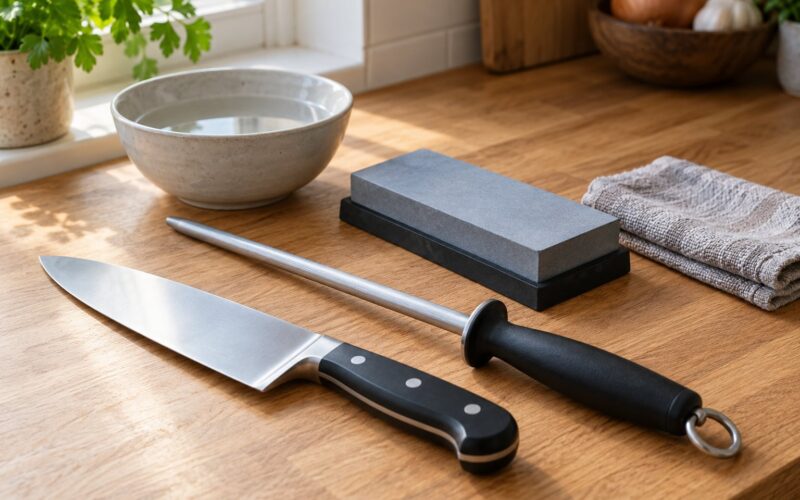
- A honing steel. A steel straightens an edge between sharpenings. A whetstone removes metal, and you need one only every several months.
- A scrap bowl and containers. Prepping fast means you never walk away from the board mid-task.
Lighting matters more than any gadget. If your counter is dim at night, the shadows hide where your fingertips are, and shadows cause accidents.
Step-by-Step
Set Up a Stable Cutting Station
A sliding board forces you to correct mid-cut, and correcting mid-cut is where most near-misses happen. Fold a damp towel and lay it flat under the board, or use a non-slip mat. Widen your stance so your hips are roughly under the counter, and let your forearms rest lightly on the surface for support.
Sit the board a few inches in front of you rather than right against the edge. You work best when your elbow sits slightly above the blade, which means less wrist bend.
You know the setup worked when you can press hard on a round vegetable with your palm and it does not move at all. If it rolls, the towel is too dry or too thin. Wet it again.
Hold the Knife and Vegetable Safely
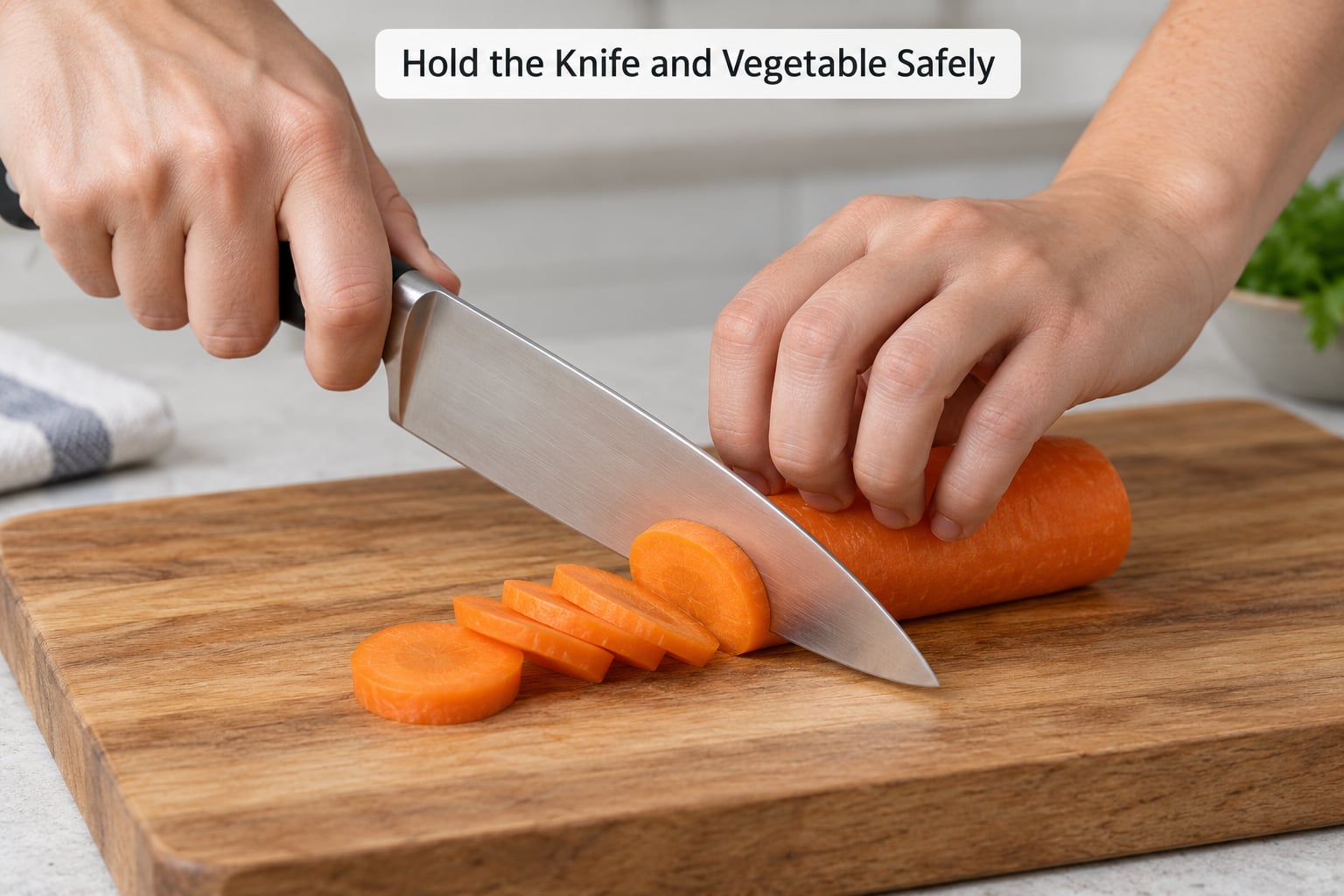
There are two grips worth learning. On the knife hand, use the pinch grip: pinch the blade between the pad of your thumb and the side of your index finger just in front of the handle, then wrap the rest of your fingers around the handle. You get more leverage and more control than a full fist grip on the handle.
On the guide hand, use the claw grip. Curl your fingertips under, rest the flat of your fingers on top of the vegetable, and point your knuckles toward the blade. The blade rides against the side of your index finger, not your fingertip. Keep the knife in contact with that finger and never raise the blade above your first knuckle. That single rule, repeated constantly on cooking forums, prevents most home kitchen cuts.
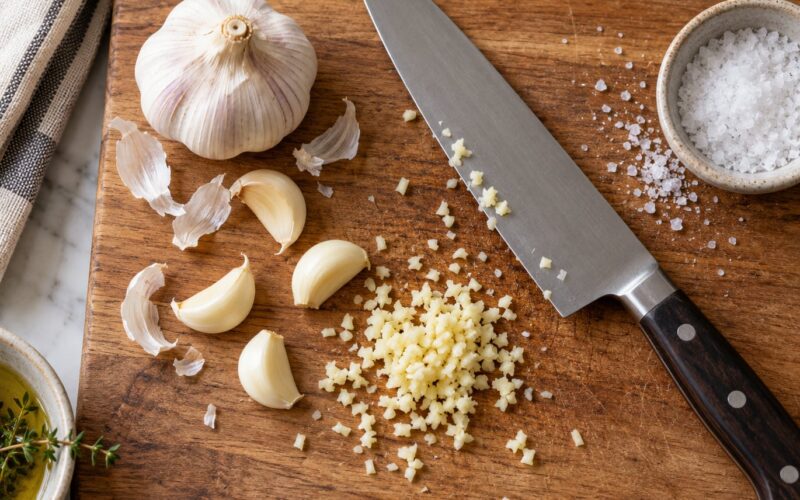
For round or flat items like onions, cut a flat base first so the round can sit on the board without rolling. For very small items like shallots or garlic cloves, the bridge method helps: rest the fingers of your guide hand flat across the top of the food, palm facing down, and pinch the item with your fingertips underneath. Your knuckles shield the blade and nothing is left exposed.
The cut is right when you finish a slice and the vegetable has not moved, your guide-hand fingertips are nowhere near the edge, and your shoulder is not lifting toward your ear. Raise the blade and the tension comes right back.
Master the Core Cuts
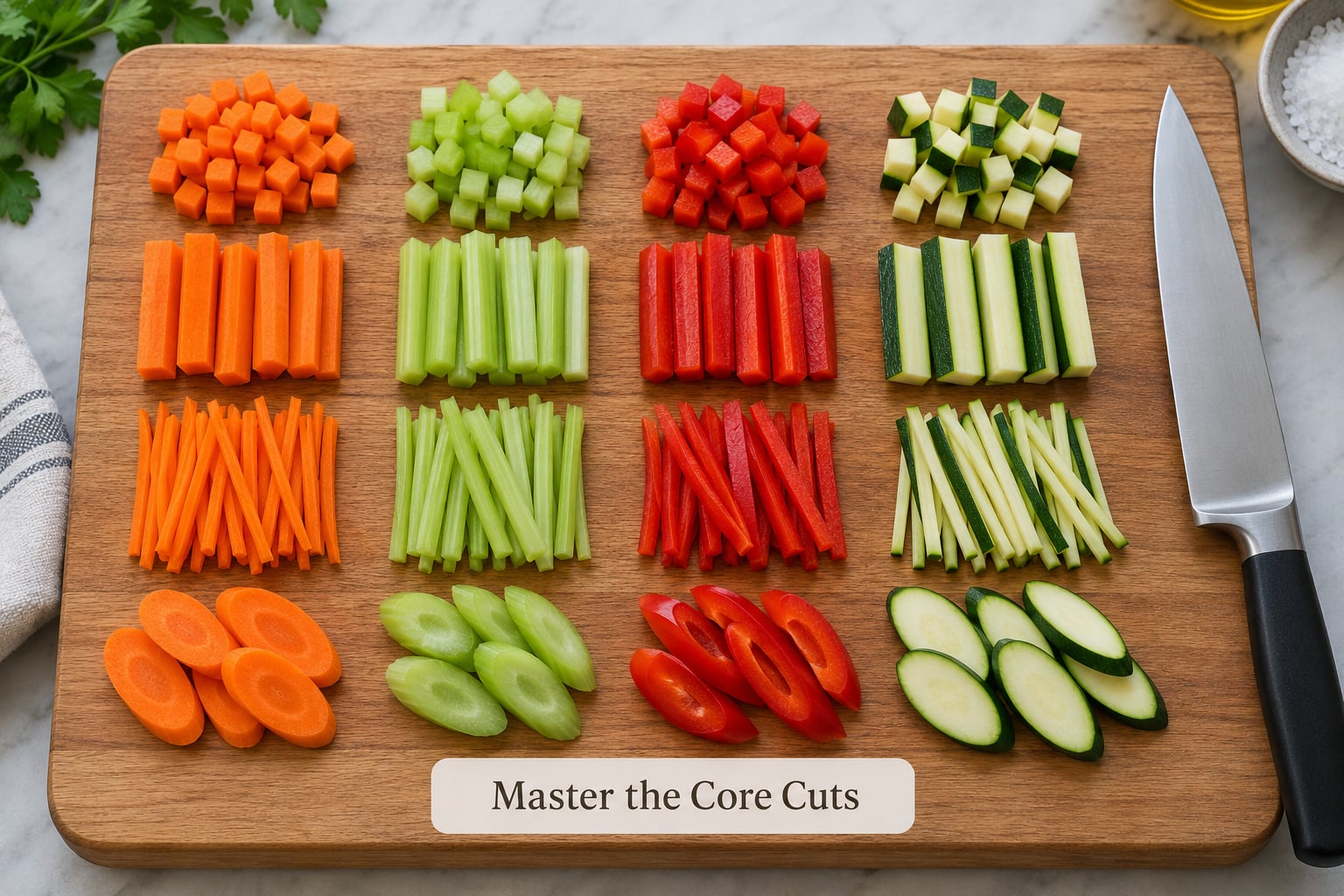
Five cuts cover nearly everything. Learning them well is faster than learning a dozen badly.
- Slice. Hold the food with the claw grip and let the blade rock tip to heel. Use it for onions, peppers, cucumbers, and anything going into a pan.
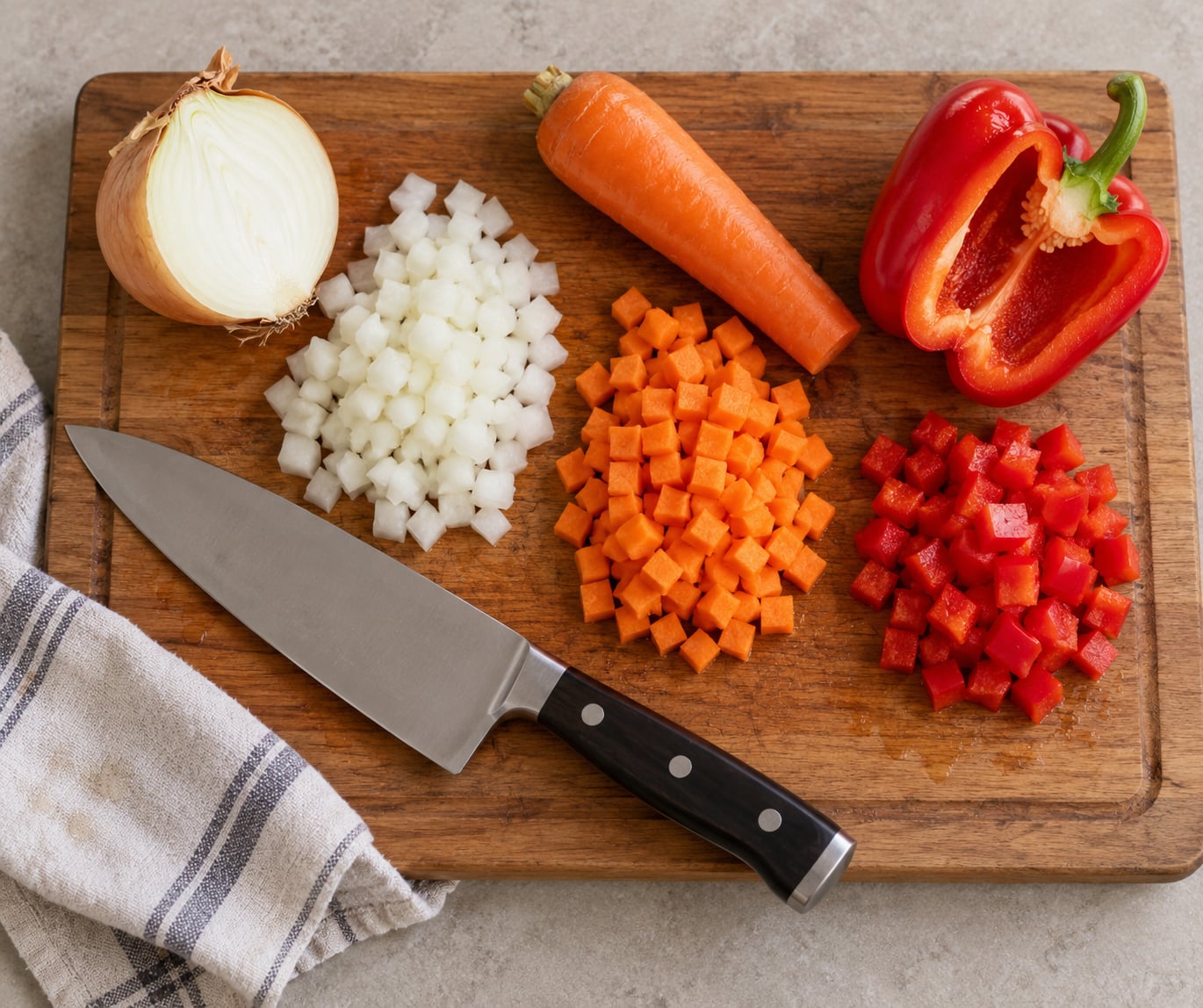
- Dice. Cut planks first, then batons, then turn the batons and cut cubes. Consistency at every stage is what makes the last step fast, because every piece is the same width.
- Julienne. Cut batons about a quarter inch wide, then stack them and slice into thin matchsticks. Good for stir-fries and slaws.
- Bias slice. Tilt the vegetable as you cut. On round items like mushrooms or bell peppers, a slight angle gives you more usable surface per stroke than a straight cut.
- Peel. Use the paring knife, not the chef’s knife. A Y-peeler is faster for straight vegetables like carrots, a knife is faster around the curves of a bell pepper or an onion.
Mincing comes from dicing, then rocking the blade over a pile, gathering with the spine, and repeating a few times. Rock rather than stab, and keep the tip on the board.
Judge your work by looking at a finished piece against your fingers. Even pieces cook at the same rate; a mix of thick and thin slivers is the reason sheet-pan vegetables brown unevenly.
How to Cut Vegetables Faster With Better Knife Skills
Here is the actual mechanics of chopping vegetables faster. Speed comes from four habits: a sharp blade that needs no force, a food surface that stays put, a stroke that rocks instead of lifting, and a guide hand that moves the food toward the blade rather than away from it.
The biggest single time sink is lifting the knife. Every up-and-down stroke you remove gives you back time on every cut you make afterward. Keep the tip or heel of the blade touching the board, pivot instead of lifting, and the work drops off noticeably.
Second is repositioning. Each time you have to spin a vegetable around to start a new side, you have added two wasted seconds. Cutting a flat base first on round items means you can rotate them on a stable face instead of fighting them.
Third is force. If you have to push hard, something is wrong: the knife is dull, you are cutting the wrong side, or you are sawing instead of pressing. On hard vegetables like carrots or dense squash, cooks on cooking forums describe pulling the knife back and forward like unzipping a zipper, tip down and handle up, which starts the cut without a hard downward shove.
Fourth is cutting small pieces first when the piece is hard to hold. Large, flat slabs are safer and faster to cut than small, awkward ones. Many beginners reverse this and spend most of their time on the fiddly stage.
One more that pays off across everything: pick a cut size, decide it before you start, and hold to it. Consistent pieces give you rhythm, and rhythm is where speed comes from.
Use a Sensible Prep Order
Workflow saves more time than technique. Wash and dry everything first, because a wet board is a slippery board and wet vegetables bleed juice across your cuts. Then trim, then peel, then cut, in that order.
Do not interleave. Cutting a pepper, going back for the knife you dropped, hunting for the peeler, then remembering the onions sitting there getting sticky, all of that is avoidable motion. Prep one vegetable completely, tip it into a bowl or container, and move to the next.
Put containers where you can reach them without turning. Keep a scrap bowl beside the board, not across the room.
The order works when you never have to re-wash the board mid-task, and when the knife gets lifted rarely. If you set the knife down, you have lost your rhythm.
For weeknights, batch prep beats technique every time. Chop a week’s worth of onions, carrots, and peppers at once, store them airtight in the fridge, and use them within three to four days. Most cooks on cooking forums call this the biggest single saver, and it holds up. Wash and dry peppers and other high-moisture vegetables before storing, and keep cut produce in the fridge, not on the counter.
Practice for Speed Without Sacrificing Control
Fifteen minutes on a few forgiving vegetables a week will do more than an hour of watching technique videos. Onion, carrot, and bell pepper are ideal: cheap, widely available, and different enough to train different cuts.
- Five minutes, onion only. Peel, halve, cut root to stem, then make vertical cuts without cutting through the root. Peel the layers and you have a clean dice. Do it three times and time yourself.
- Five minutes, carrots. Cut planks, then batons, then dice. Aim for pieces within an eighth inch of each other. Speed comes after evenness, never before.
- Five minutes, pepper. Side slices, then strips, then a dice. Watch that the claw grip stays put on the slippery skin.
Three checkpoints tell you whether you are improving. Consistency first: are your pieces the same size without staring at them. Safety second: is your guide hand in position before the blade moves, every time. Speed third, and only then.
The rule from kitchen lore holds up well here: slow is smooth, and smooth is fast. Hurrying the first two weeks tends to produce both the nicks and the uneven pieces that make week three feel harder.
Common Mistakes
Nearly every slow chop traces back to one of these.
Using a dull knife. A dull blade needs force, force causes slipping, and a slipping blade causes injuries. This is counter to intuition but consistent across every credible source. If cutting a carrot makes you push rather than press, hone it or sharpen it.
A dry board on a wet counter. Damp towel underneath. Non-negotiable.
A flat guide hand. If your fingertips are extended, you are one bad roll away from a cut. Curl them.
Raising the knife above the first knuckle. It works fine until the vegetable shifts, then the blade has further to fall.
Forcing through a core or a hard stem. Turn the vegetable, cut from the other side, or cut around the tough bit. Do not push through it.
Inconsistent sizing. You will cook a plate of vegetables at ten different rates. Pick a target size and stick to it.
Cutting in the wrong sequence. If you trim, peel, and cut each vegetable before moving on, you are resetting your station over and over. Batch by task instead.
Chasing speed too early. Fast, uneven, and nicked is slower next week than slow and clean was this week.
Pieces sticking together or a watery board. This one comes up constantly and gets almost no attention. Thin slices of watery vegetables like cucumber and tomato fuse at the base because the blade is pushing the layers forward rather than cutting them apart. A sharper blade fixes most of it. Dry the vegetable surface first, keep the board scored rather than glassy smooth, and finish each slice with the blade angled slightly down through the cut instead of lifting straight up.
Misusing the serrated knife. Serrated edges tear vegetables into ragged pieces. Use it for bread and soft-skinned fruit only.
Frequently Asked Questions
What is the best knife for cutting vegetables faster?
An eight inch chef’s knife is the best all-round tool for cutting vegetables faster, because the blade length lets one rocking stroke travel from tip to heel through a whole onion half. A santoku works nearly as well if you prefer a shorter, broader blade or work with an upright cutting board. Add a small paring knife for peeling and trimming, and keep a serrated knife for bread and tomatoes only. What matters more than the model is that the edge is sharp.
How do I stop my cutting board from sliding?
Put a damp cloth folded flat underneath the board, or use a non-slip mat made for counters. The cloth needs to be genuinely damp, not just misted, because the friction comes from surface tension rather than moisture. You can also put a damp paper towel under a plastic board. A heavier end grain board resists sliding on its own, and working with your weight over the board rather than reaching across it helps too.
What is the easiest way to cut vegetables evenly?
Measure one piece first and use it as your ruler for the rest. Plank the vegetable into even slabs, turn it ninety degrees, plank it again into batons, then cut across the batons into cubes. Working in stages keeps every piece the same width, which is what makes the final step fast. A sharp blade helps because it cuts cleanly without compressing the vegetable and shrinking your measured pieces.
Should I use a chef’s knife or a paring knife for vegetables?
Use the chef’s knife for anything that benefits from a long stroke: onions, carrots, peppers, celery, cabbage. Use the paring knife for small, delicate jobs such as peeling garlic, trimming a core, or cutting shallots, where a large blade is awkward and hard to control. Trying to peel a carrot with a chef’s knife is the usual reason beginners nick themselves, so switch tools instead of forcing it.
How can I practice knife skills without wasting food?
Practice with onion, carrot, bell pepper, celery, and cabbage. They are inexpensive, forgiving, and available year round, and they train different skills: onion for dice, carrot for planks and batons, pepper for the claw grip on a slippery surface. Do not practice with steak, expensive fish, or soft fruit that bruises. If food waste bothers you, chop what you practised on straight into a soup or stir-fry the same evening.
Is it faster to use a food processor than a knife?
A processor is faster for large batches of uniform pieces, such as a week’s worth of onions or a mountain of carrots. It is slower and less flexible for anything shaped or sized by hand, and it turns mushy produce to puree faster than a knife does. Many cooks use a processor for bulk prep and a knife for the parts that need control. A mandoline sits between the two and does uniform slices quickly.
Start With a Sharp Knife and a Secure Grip
Here is the whole thing in three moves. Put a damp towel under your board and hone your knife. Then cut one onion with the claw grip and let the blade rock tip to heel, never rising above your first knuckle.
Everything after that is repetition. Fifteen minutes a week on onions, carrots, and peppers, with evenness as the only goal for the first month, will make you faster than any technique video, and you will be safer the whole way there.