Mushy jambalaya comes down to two things: the wrong rice and too much liquid. Most of how to make jambalaya without it getting mushy happens before the pot even heats up: use long-grain white rice, rinse and toast it in the pot, add roughly 1.5 to 2 cups of broth per cup of rice, stir exactly once, and pull it off the heat while the grains still have a bite.
From prep to serving takes about 45 minutes, and most of that is hands-off. The hard part is not any single step, it is the ten minutes after the liquid goes in, when the urge to stir and peek is at its strongest.
Table of Contents
- What You Need
- Step-by-Step: How to Make Jambalaya Without It Getting Mushy
- Brown the Meat and Build the Flavor Base
- Toast and Season the Rice
- Add Liquid Without Overcrowding the Pot
- Layer, Simmer, and Keep the Rice Separate
- Rest the Jambalaya Before Serving
- Common Mistakes
- Symptom, Cause, and Fix at a Glance
- How to Fix Jambalaya That Is Already Too Soupy
- Reheating and Make-Ahead Notes
- Frequently Asked Questions
- Can I use instant rice to prevent jambalaya from getting mushy?
- Should I rinse rice before making jambalaya?
- Why does my jambalaya turn mushy even though I used less liquid?
- What is the ideal ratio of liquid to rice in jambalaya?
- Is jambalaya supposed to be soggy?
- Can I make jambalaya in advance and reheat it without it becoming mushy?
- Conclusion
What You Need
The ingredient list for jambalaya is short and forgiving, but three choices decide the texture before you start: the rice, the pot, and how much liquid you trust the vegetables to contribute.
- Rice: 2 cups long-grain white rice. Extra long grain, basmati, and jasmine all work. Parboiled or converted rice is the most forgiving option if you have never had luck.
- Liquid: 3 to 4 cups chicken broth or water. Stock concentrates and bouillon paste add salt and color, so cut back on the salt.
- Protein: 1 to 1.5 pounds smoked sausage, andouille, chicken thighs, or a mix. Cook any poultry to 165°F / 74°C before it goes back in the pot.
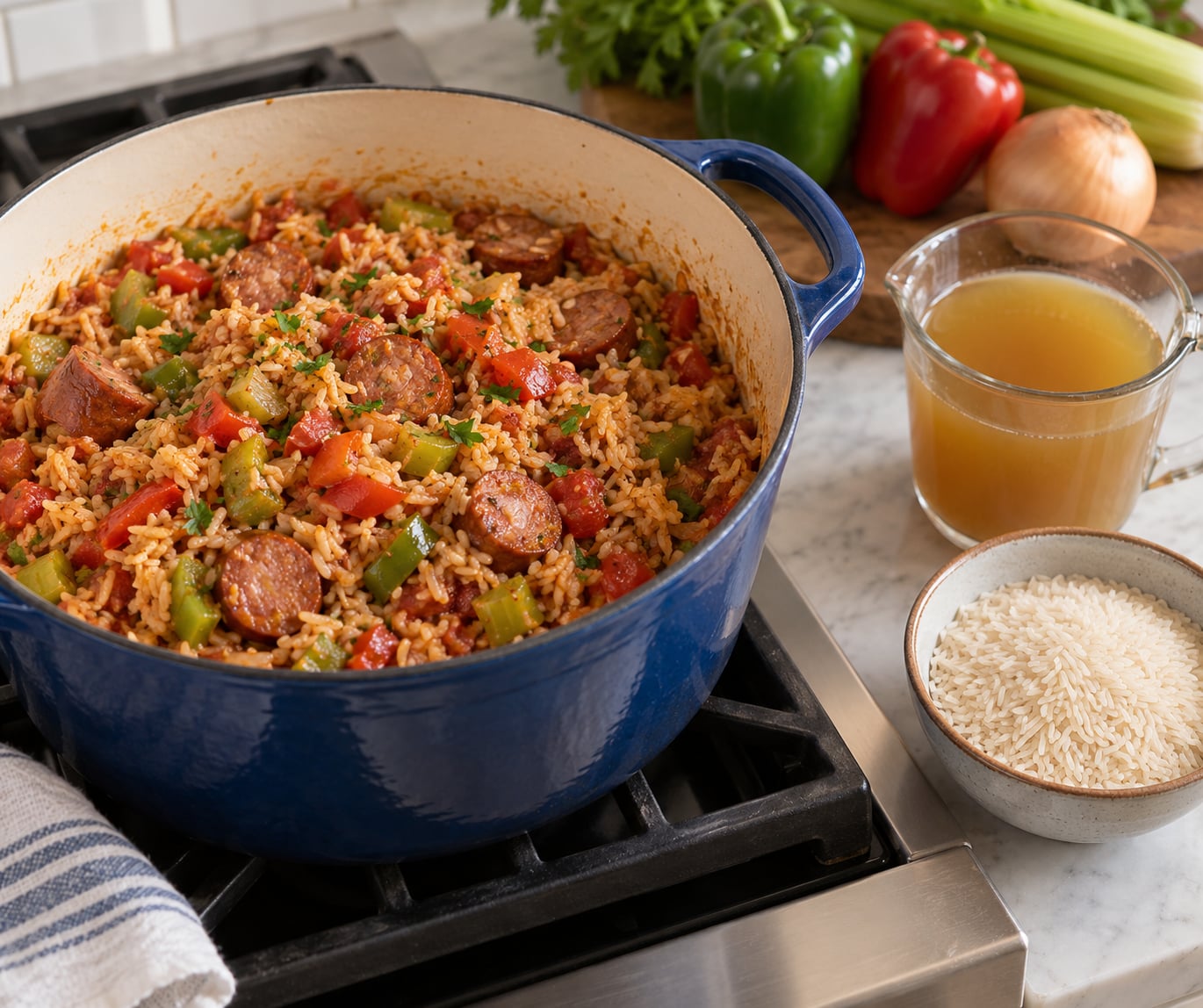
- The holy trinity: onion, bell pepper, and celery, about 1 cup total. These release water as they cook, which matters more than most recipes admit.
- Seasoning: salt, black pepper, garlic powder, hot sauce, and one bay leaf.
- Optional for Creole style: one 14-ounce can of diced tomatoes. Tomato adds roughly a quarter cup of liquid, so drop the broth a notch.
You also want a heavy pot with a tight lid, 4 to 6 quarts for the amounts above. A heavy Dutch oven or stockpot is the difference between rice that steams and rice that scorches on the bottom while the top stays wet. Thin steel pans conduct heat straight to the base and are the single biggest reason restaurant-style jambalaya does not happen at home.
One more tool matters: a fine-mesh strainer for rinsing rice. A slotted spoon is wrong for rinsing because the water pushes starch straight through the holes.
Step-by-Step: How to Make Jambalaya Without It Getting Mushy
The method below runs about 45 minutes for a four-serving pot, and about 20 of those minutes are hands-off while the lid stays on.
Brown the Meat and Build the Flavor Base
Cut the meat into bite-size pieces, about half-inch cubes, and brown it in the dry pot over medium-high heat. Work in two batches if the pot is smaller than 6 quarts. Crowding drops the temperature, the meat sweats instead of browns, and the liquid that renders into the pot becomes part of your mush problem later.
You want browned edges, not grey cooked surfaces. When the meat is done, scoop out most of the fat with a slotted spoon and set it aside. Cooking the vegetables in a thin film of fat instead of a pool of grease keeps the finished dish from feeling heavy.
Add the onion, celery, and bell pepper to the same pot and cook 5 to 7 minutes until soft and translucent. Scrape up the browned bits from the bottom. Then stir in the seasonings and cook one more minute until they smell toasted rather than raw.
Toast and Season the Rice
Rinse the rice under cool running water for about a minute, swishing it with your fingers, until the water runs mostly clear. That cloudy water is surface starch, and starch is what turns into glue. Then drain the rice in the strainer for 10 minutes and pat it dry.
Add the dry rice to the pot with a tablespoon or two of the reserved fat and toast it over medium heat for 60 to 90 seconds, stirring, until some grains look opaque and the kitchen smells nutty. Toasting dries the surface and slows the release of starch once liquid arrives, which makes it the single biggest lever in how to make jambalaya without it getting mushy.
Season the rice now with a good pinch of salt. If you skipped the toast because you are in a hurry, rinsing and draining still do most of the work. Skipping both is not worth it.
Add Liquid Without Overcrowding the Pot
Now the number that decides everything. Most home recipes say add enough broth to cover the rice, and that instruction is exactly what produces soup. Broth should sit about a quarter inch above the rice line, no more.
Written ratios also assume nothing else is adding water. Your browned meat, softened onion, celery, and peppers all release liquid while they cook, so the pot is already wetter than the recipe says. If you are using fresh vegetables rather than frozen, subtract another quarter cup from the broth.
| Rice | Broth per 1 cup rice | Cook time after the boil | Expected texture |
|---|---|---|---|
| Long-grain white | 1.6 to 1.75 cups | 18 to 20 minutes | Loose, separate grains |
| Extra long grain | 1.6 cups | 18 to 22 minutes | Loosest grains, most forgiving |
| Basmati | 1.5 cups | 15 to 18 minutes | Firm, slightly nutty |
| Jasmine | 1.6 cups | 15 to 18 minutes | Fragrant, a touch stickier |
| Parboiled or converted | 2 to 2.25 cups | 20 to 25 minutes | Very separate, hard to overcook |
| Short grain, arborio, sushi | 2.25 cups or more | 25 to 30 minutes | Intentionally creamy, not the goal here |
Parboiled rice absorbs more water than plain rice, which is why it gets more liquid, not less. If you scale up for a crowd, add 1.5 extra cups of broth per extra cup of rice rather than doubling it.
Layer, Simmer, and Keep the Rice Separate
Spread the rice in an even layer over the vegetables instead of stirring it into them. An even layer cooks at an even rate, and a mound of rice in one spot turns to paste while the rest stays dry.
Pour the broth in along the side of the pot so it does not blast the grains with cold liquid. Bring to a boil over medium-high, stirring once from the bottom to the top so nothing is welded to the pot. That is your one stir.
Cover tightly, drop the heat to the lowest simmer your burner can hold, and walk away. Repeated lid-lifting lets steam escape, the pot goes dry, and you find yourself adding broth back in, which is the most common reason a pot turns into soup mid-cook. A boil that you then leave alone is fine. A simmer you keep checking is the problem.
At the end of the cook time, lift the lid once and press a few grains against the side of the pot with the back of a spoon. If they bend easily and the liquid is gone, they are done. If there is still a puddle of broth, give it another 3 to 4 minutes rather than stirring. You want the rice slightly underdone when you stop.
Rest the Jambalaya Before Serving
Turn off the heat and leave the pot covered, undisturbed, for 10 to 15 minutes. Big batches can take closer to 30. During that time carryover heat finishes cooking the center of each grain and the surface moisture escapes as steam, which is what firms the rice up instead of letting it collapse.
Then open the lid and fluff from the bottom to the top in one or two gentle passes, scooping rather than smashing. Serve right away, loose enough to fall off the spoon but with every grain still distinct. If it sits on the stove for another 20 minutes it will start to drink the remaining liquid and go gluey again.
Common Mistakes
Almost every bowl of bad jambalaya traces back to one of these. The first three cause most of the damage.
- Using short grain, arborio, sushi, instant, or minute rice. Short grain releases more starch and needs far more liquid, which is how you end up with rice pudding. Minute rice is pre-cooked and disintegrates in a long cook.
- Adding broth until it covers the rice. That is an unlimited-liquid instruction. Use a measured ratio and remember the vegetables are already releasing water.
- Stirring constantly to prevent sticking. Every stir releases surface starch into the broth and thickens it. Stir once, then trust the covered simmer.
- Peeking under the lid repeatedly. Each lift costs steam, and a dry pot gets more broth added by nervous cooks.
- Cooking until every grain is tender. The rice finishes on its own during the rest. Cook to a slight bite, not to softness.
- Skipping the rinse. Grains rub together in the bag and pick up surface starch. Two minutes of rinsing removes it.
- Crowding a small pot. A crowded pot steams instead of simmering, cools unevenly, and scorches at the base.
- Adding extra broth midway. If it looks dry at minute 15, put the lid on and give it three more minutes. The liquid is usually still hiding between the grains.
Symptom, Cause, and Fix at a Glance
| What you see | What caused it | What to do next time |
|---|---|---|
| Soupy, brothy, loose | Too much liquid, or liquid added mid-cook | Cut broth by a quarter cup per cup of rice, lift the lid for the last 5 minutes |
| Gummy or gluey | Excess surface starch plus overcooking | Rinse thoroughly, toast the rice, stir only once |
| Stiff, crunchy, hard-centered grains | Cooked too little, or heat was too high | Add a quarter cup of hot broth, cover, and cook 3 minutes more |
| One solid clump | Over-stirring early in the cook | Stop stirring; let the rice rest undisturbed instead |
| Scorched bottom, wet top | Thin pot, burner too hot, pot too full | Use a heavier pot, fill it no more than two-thirds, lower the heat further |
| Bland but texture is fine | Rice and broth were under-salted, or rice was added late | Season the liquid and the rice separately before combining |
How to Fix Jambalaya That Is Already Too Soupy
If you are standing in front of a pot of runny jambalaya, you have three options, fastest first.
- Take the lid off and turn the heat to medium. Uncovered for the last 5 to 10 minutes, the broth cooks down and the rice tightens. Stir once, gently, at the halfway point.
- Spread it onto a sheet pan. A thin layer cools fast, the liquid spreads out, and you end up with something much closer to separated grains. Scrape it back into the pot once it looks dry.
- Make a fresh batch in layers. Drain off what you can, and build the dish in a new pot with cooked, drained rice folded in with a small splash of hot broth. This is the approach cooks use when feeding a crowd.
Once it is thick enough to hold a spoon standing for a second, let it rest 10 minutes before serving. Reheating the rice in a hot, thin layer on the stove dries it faster than the oven or a microwave.
Reheating and Make-Ahead Notes
Reheated jambalaya goes soft for a normal reason. Cooked rice takes on moisture again as it sits, and starch that was set during resting turns soft in the fridge. You can slow that, but not undo it.
Cool it fast. Spread it in a shallow container, get it into the fridge within an hour, and keep it covered. Store it no more than three to four days, and freeze only rice that is still separate-grained. Mushy rice that gets frozen stays mushy.
Reheat only what you need. Put the portion in a saucepan with a splash of broth, cover loosely, and warm over low heat for five to seven minutes, stirring once. Loose cover means steam can leave instead of soaking back in. Microwave on half power, with a damp paper towel, for the same reason.
If you want jambalaya that still has bite tomorrow, cook the rice separately and fold it in at the last minute. It is the way experienced cooks handle big batches, and it costs about ten extra minutes.
Frequently Asked Questions
Can I use instant rice to prevent jambalaya from getting mushy?
No. Instant rice can absorb liquid unpredictably and may turn soft or pasty during a long cook. Use long-grain white rice, ideally converted or parboiled, because it holds its shape better. If you only have instant rice on hand, cook it separately according to its own package directions and fold it into the finished jambalaya just before serving.
Should I rinse rice before making jambalaya?
Yes, for most home cooks. Rinse until the water runs mostly clear, drain ten minutes, and pat dry. Some Louisiana cooks never rinse because surface starch carries seasoning into the grain. Both camps are right in their own context, so the compromise that works for most people is a light rinse plus toasting the drained rice in fat, which keeps the flavor benefit without the glue.
Why does my jambalaya turn mushy even though I used less liquid?
Liquid is rarely the only cause. Mushy rice also comes from an unrinsed grain, over-stirring, cooking past the point of a slight bite, or a pot that is too full and steams instead of simmering. Check your pot size, count your stirs, and pull the pot off the heat while the rice is still slightly underdone. The rest does the rest.
What is the ideal ratio of liquid to rice in jambalaya?
About 1.6 to 1.75 cups of broth per cup of long-grain white rice. Parboiled rice needs more, around 2 to 2.25 cups, because it absorbs extra water. Reduce the written amount by a quarter cup when your onion, pepper, and celery are fresh, since they release water as they cook. Broth should sit no more than a quarter inch above the rice.
Is jambalaya supposed to be soggy?
No. Properly made jambalaya is loose and spoonable, with every grain separate and a light bite in the middle. The brothy, rice-soup texture is a different dish, and much of what circulates online as Cajun jambalaya is closer to soup with meat in it. If the grains hold their shape when you tilt the plate, you are in the right zone.
Can I make jambalaya in advance and reheat it without it becoming mushy?
Yes, with realistic expectations. Cool it fast in a shallow container, refrigerate covered, and eat it within three to four days. Reheat only the portion you need, with a splash of broth, loosely covered over low heat. For a texture that survives reheating best, cook the rice separately and fold it in just before serving or just before reheating.
Conclusion
Control the liquid first. Measure 1.6 to 1.75 cups of broth per cup of long-grain white rice, remember the vegetables are already adding water, and resist the urge to stir or peek. Rinse, toast, stop the cook while the rice still has a bite, and let it sit covered for 10 to 15 minutes. Get those four things right and how to make jambalaya without it getting mushy stops being a problem you have to manage.