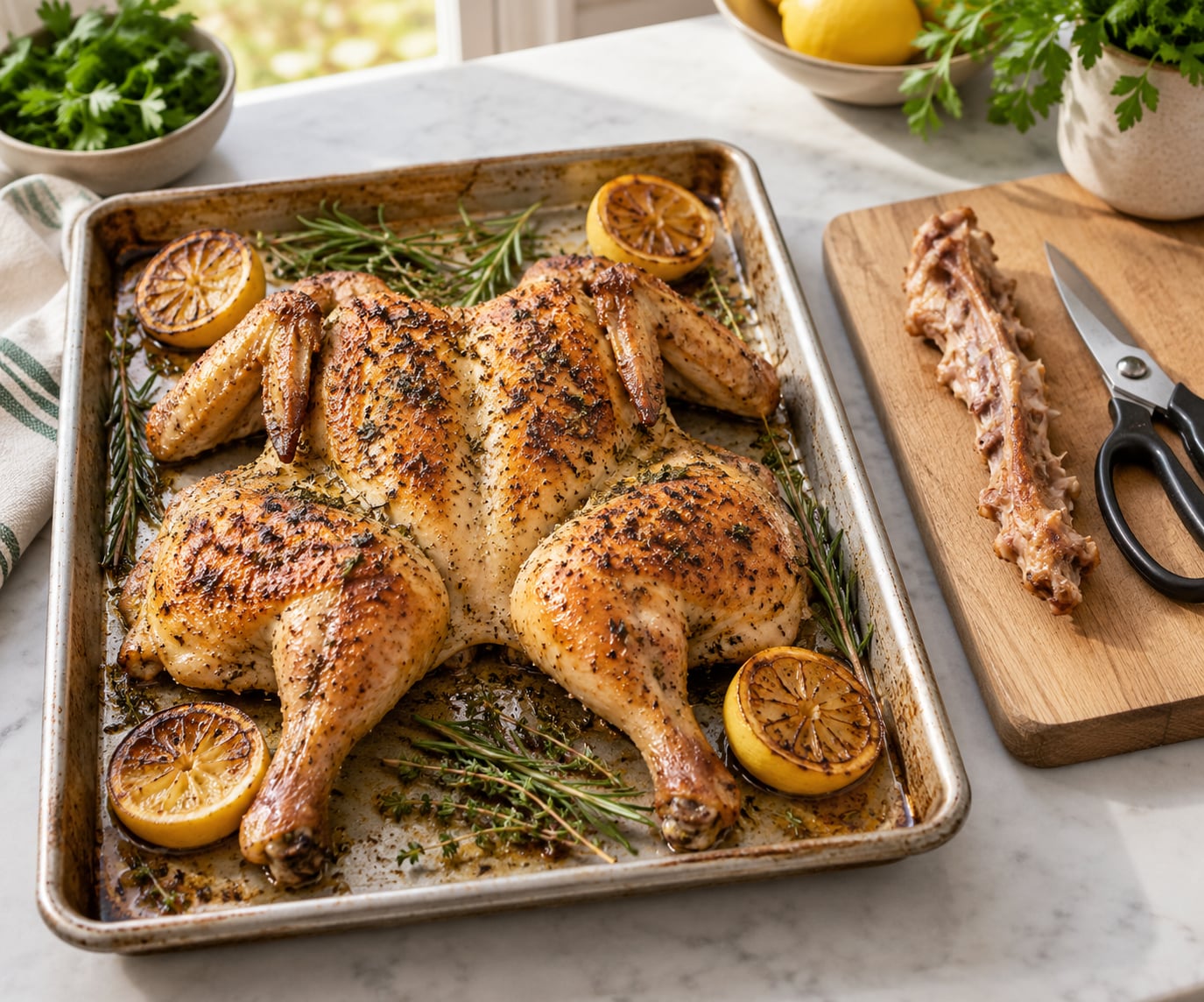
Spatchcocking means cutting out a chicken’s backbone and pressing the bird flat so it cooks faster and more evenly. You remove the spine with kitchen shears, crack the breastbone, and the breast and dark meat finish at roughly the same time instead of the legs running an hour behind.
Ten minutes of knife work buys you a whole bird that roasts in about 40 minutes, and it is the easiest way I know to get crisp skin without a blowtorch. Here is the exact method, plus the cook times and the mistakes that trip people up.
Table of Contents
- What You Need
- Step-by-Step: How to Spatchcock a Chicken
- 1. Prepare the Chicken
- 2. How You Spatchcock a Chicken
- 3. Season the Flattened Chicken
- 4. Roast Until It Reaches 165°F
- 5. Rest, Carve, and Store
- Common Mistakes When Spatchcocking
- Frequently Asked Questions
- Does spatchcocking a chicken change how long it takes to cook?
- Do I remove the skin before spatchcocking a chicken?
- Can I spatchcock a frozen chicken?
- Should I cover a spatchcocked chicken while roasting?
- Why is my spatchcocked chicken browning unevenly?
- Conclusion
What You Need
The bird itself is the only ingredient. A 4 to 5 pound whole chicken is the sweet spot, and you can spatchcock anything from two Cornish hens up to a 14 pound turkey with the same motion.
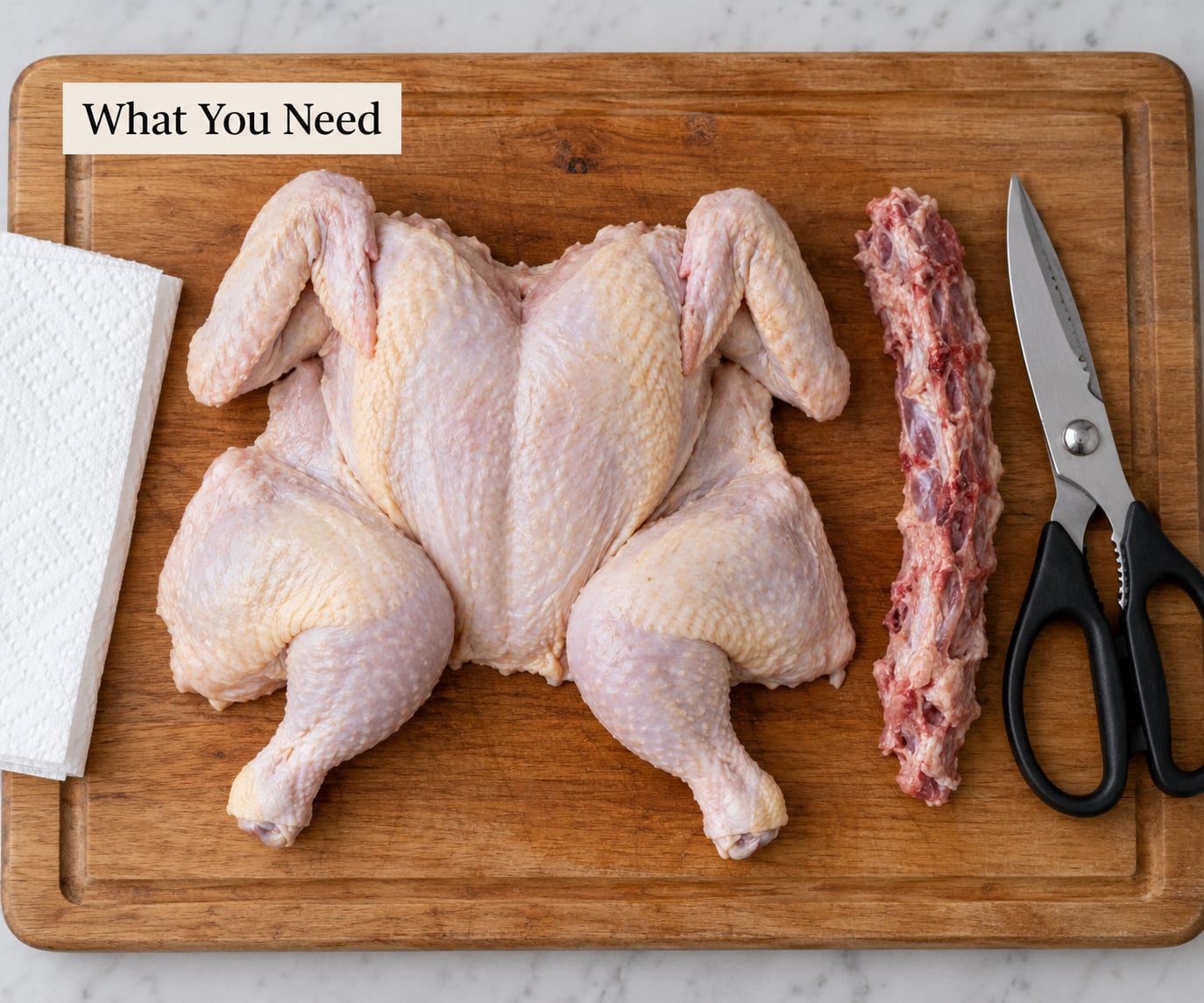
For tools, you want a sturdy cutting board with a groove or damp towel underneath so it does not slide, a pair of poultry shears or heavy kitchen shears, an instant-read thermometer, paper towels, and a rimmed sheet pan or roasting pan. A paring knife handles the joint incisions later.
Set up before you touch the bird. Clear the counter, wet a towel and lay it under the board, and pull the giblet packet out of the cavity if you still see one.
Safe thawing matters more than most people expect. Move a frozen bird to the refrigerator and give it a full day or two, or put it in a sealed bag submerged in cold water and change the water every 30 minutes. Never thaw on the counter, and never rinse the bird under the tap, since water spreads bacteria across the skin and the sink.
For prep ahead and leftovers, spatchcock the bird up to a day early and refrigerate it on a rack or in a covered container, then get it into the refrigerator within two hours of cooking and use it within three to four days.
Step-by-Step: How to Spatchcock a Chicken
1. Prepare the Chicken
Which side should be down when spatchcocking a chicken? Breast-side down, with the legs and tail pointing toward you, and that answer matters more than it sounds. Backside up exposes the backbone where you need it, and it gives you a flat, stable surface to cut against.
Pat the bird dry all over with paper towels, inside and out. Dry skin browns, wet skin steams, and a wet bird also slides around on the board, which is the most common way people nick themselves during this cut.
Then look inside the cavity and pull out any giblets or neck that are still packed in there. Do not reach deep, and do not cut through the rib cage at this stage.
2. How You Spatchcock a Chicken
This is the whole technique, and it comes down to one straight cut on each side of the spine, one firm press, and a flip.
First cut: with the chicken breast-side down, place the tips of your shears just outside one side of the backbone, near the tail, and cut straight down toward the board. Stay shallow, cutting through the bone and cartilage but not into the meat of the breast.
Second cut: rotate the bird and repeat on the other side of the backbone, working from the tail toward the neck. When both cuts meet near the neck, the backbone lifts free in one piece.
Save that backbone. It is the best part of the bird for homemade broth, and freezing a few in a bag means you always have one when you need it.
No shears? A heavy chef’s knife works. Rest the tip against the spine and chop straight down several times on each side, using the same shallow path, and the backbone will separate once the cartilage gives.
Flip the bird breast-side up. Put both palms on the breastbone, near the neck end, and press down hard and evenly until you hear and feel the bone crack and the ribs splay open. Rock your weight forward rather than stabbing straight down, because stabbing is how you punch a hole through the breast instead of cracking it.
Your checkpoint is even flatness. The breast and both legs should sit in a single layer, and both breast halves should be the same thickness from shoulder to tip of the breast. If one side is higher, press that side again.
Two optional finishing touches help. Fold the wing tips back behind the breast so they sit over the meat instead of jutting out over the pan edge, where they scorch before the rest of the bird is done. And make a small incision, no more than half an inch, with a paring knife over each wing joint and each thigh joint.
Those tiny cuts matter more than they look like they should. Bone and overlapping meat conduct heat poorly, which is why a flattened bird can still show pink at a joint even when the breast is well past done. Slitting the joint exposes the flesh to oven heat and evens out the last few minutes.
3. Season the Flattened Chicken
Dry brine first if you have time: salt the skin generously, about 1 tablespoon of kosher salt per 4 pound bird, and refrigerate uncovered for 2 hours to 24 hours. The salt draws a little moisture out and lets it reabsorb into the meat, which seasons the bird deeper and dries the surface for better browning. Experienced grillers treat the overnight version as close to mandatory.
Then season and roast, grill, air fry or pan sear it. For oil, drizzle a little neutral oil over the skin and the flattened underside, or loosen the breast skin and slide garlic herb butter underneath. Rub seasoning over the whole surface, working it into the crevices where the legs meet the body, since that is where a dry rub collects and where the bird is easiest to under-season.
Keep some bare skin exposed. Oil and rub help, but a thick blanket of paste on the skin steams it and you lose the crackle.
4. Roast Until It Reaches 165°F
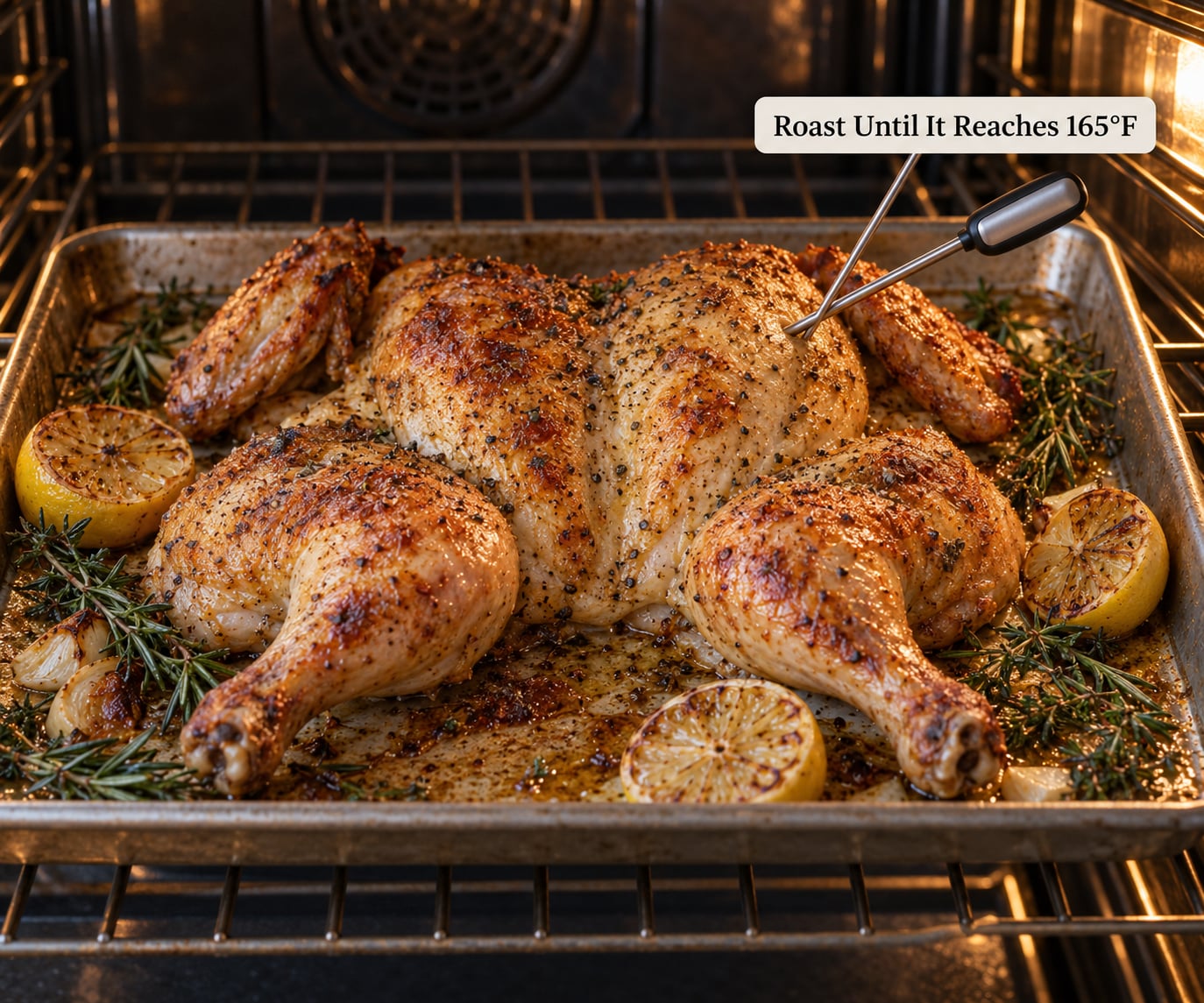
How long to cook a spatchcock chicken depends on the oven temperature and the weight of the bird. A 4 to 5 pound flattened bird hits temperature in about 40 minutes at 425°F, while a 6 pound bird usually needs another 10 minutes.
| Method | Temperature | Time for a 4 to 5 lb bird |
|---|---|---|
| Roast, low and slow | 225°F / 107°C | 55 to 70 minutes |
| Roast, moderate | 375°F / 190°C | 45 to 55 minutes |
| Roast, hot | 425°F / 220°C | 35 to 45 minutes |
| Roast, very hot | 450°F / 232°C | 30 to 40 minutes |
| Grill, indirect | Medium-high heat | 35 to 45 minutes |
| Air fryer | 400°F / 205°C | 30 to 40 minutes |
| Cast iron skillet, lid on | Medium-high | 30 to 35 minutes |
Heat the oven fully before the bird goes in, then set the pan on a rack in the lower third if you are roasting vegetables alongside. Roast breast-side up, skin-side up, and add your vegetables for the last 25 to 30 minutes so they roast in chicken fat without burning.
On a grill, grill skin-side down over direct heat for 5 to 10 minutes to buy real crispness, then move the bird to indirect heat with the lid closed until it reaches temperature. Yes, you flip a spatchcocked chicken once on a grill, but you do not flip it in the oven, because every flip costs you skin and browning.
On a stovetop, a large cast iron skillet with a tight lid works well. Skin-side down for the first 10 minutes, then flip and finish with the lid on. For an air fryer, lay the bird skin-side up in a single layer, and if the basket is tight, use the smaller birds or cut the bird in half.
Use a thermometer, not color. Check three places: the thickest part of the breast, the innermost thigh where it meets the hip, and the wing joint. All three need to hit 165°F or 74°C, measured without touching bone. A probe pushed into bone reads high and gives you a false pass.
You can also pull the bird at 160°F and let carryover cooking finish the job during the rest, which is my preference for the breast. Big pieces keep climbing several degrees after they leave the oven, so a 160°F pull arrives at the table closer to 165°F, still juicy, instead of sitting there until the thermometer agrees.
5. Rest, Carve, and Store
Rest the bird 10 to 15 minutes on the pan, breast-side up. Skipping the rest dumps the juice on the cutting board instead of in the meat, and that is the difference between a dry breast and a good one.
Carve by cutting each leg off at the hip joint, then slicing down between the breast and the rib cage to lift each breast half off the bone. Because the bird is flat and boneless in the middle, you are cutting in straight lines rather than working around a carcass.
Refrigerate leftovers within two hours, in shallow containers so they cool fast, and eat them within three to four days. Reheat to 165°F, and only reheat the portion you plan to eat.
Common Mistakes When Spatchcocking
Cutting while the bird is breast-side up. You are working blind against the breast meat and will take off more flesh than you meant to. Turn the bird over.
Leaving a piece of backbone in. The bird will not lie flat and one side sits higher. Press down and check the whole spine is out, including the little wishbone near the neck.
Stabbing instead of pressing. Straight down through the breastbone tears the skin and puts a hole in the breast. Use the heels of your hands and push forward until the bone gives with a crack.
Pressing unevenly. One breast half ends up thicker than the other and cooks at a different rate. Compare the two sides by eye and press the high side until they match.
Ignoring the joints. Flattening fixes uneven cooking from shape, not from bone. A paring knife incision over each wing and thigh joint is what actually solves raw spots.
Crowding the pan. A spatchcocked bird needs its own rimmed sheet pan. Touching skin in a small roasting pan steams instead of browns, and the wings press against the sides.
Stopping before the thickest part is done. Pulling on time or color is how you serve a bird that is pink at the thigh. Probe the breast, thigh and wing until all three read 165°F.
A couple more things worth knowing. Trimming the wing tips and drumstick tips stops the ends from burning on a grill or in a smoker, and those bits belong in the broth bag too. And spatchcocking a day ahead gives the salt time to work, so the bird tastes noticeably better than one you cut and roasted the same afternoon.
Frequently Asked Questions
Does spatchcocking a chicken change how long it takes to cook?
Yes, significantly. Removing the backbone and flattening the bird lets heat reach both sides at once, cutting roughly 25 percent off the cooking time compared with a whole bird. A flattened 4 to 5 pound chicken roasts in about 35 to 45 minutes at 425F, while the same bird whole can take an hour and a half.
Do I remove the skin before spatchcocking a chicken?
No, leave the skin on. It protects the breast during cooking and is what gets crisp in the oven or on the grill. If you want garlic herb butter underneath, do the flattening first, then gently separate the skin from the breast meat with your fingers and slide the butter in. Taking the skin off beforehand just dries the surface.
Can I spatchcock a frozen chicken?
Not safely, and not well. A frozen bird is too rigid to cut cleanly and you will end up chopping rather than slicing. Thaw it in the refrigerator for one to two days, depending on size, or seal it in a bag, submerge it in cold water, and change the water every 30 minutes. Never thaw on the counter.
Should I cover a spatchcocked chicken while roasting?
Leave it uncovered if you want crisp skin. A loose tent of foil helps in the first stretch if your oven runs hot or your bird is on the larger side, but take it off for the last 15 minutes so the skin can dry out and brown. Covering the whole bird the entire time traps steam and gives you soft skin.
Why is my spatchcocked chicken browning unevenly?
Uneven browning usually means uneven thickness, an oven running hot on one side, or a pan crowded enough that the bird sits in its own steam. Compare the two breast halves and press the thicker one down before cooking. Also rotate the pan once halfway through, and give the bird its own rimmed sheet pan so nothing is touching.
Conclusion
Spatchcocking is ten minutes of work for a bird that cooks in roughly 40. Flatten it evenly so both breast halves match, roast it breast-side up on a rimmed pan, and probe the breast, thigh and wing until all three read 165°F before you carve. Get those three right and you get even doneness, crisp skin and a weeknight dinner that tastes like you planned it harder than you did.