You can absolutely smoke meat without a smoker. Any lidded grill set up for indirect heat at 225°F to 250°F with wood chips or chunks added will produce genuine smoke flavour, and a stovetop pot or a kitchen oven works too when you have nowhere to set up a fire.
Here is the short version of how to smoke meat without a smoker. You push all the heat to one side of the grill, put the meat on the cool side with the lid shut, and feed a small amount of wood into the hot zone. The smoke wraps around the meat while the ambient heat does the cooking.
A dedicated smoker is a convenience, not a requirement. Most people who smoke today learned on a kettle or a gas grill, and the flavour difference on a small cook is much smaller than the argument suggests. Budget two to four hours for chicken, ribs or a couple of pounds of brisket, and set aside an evening of light supervision rather than constant tending.
Table of Contents
- What You Need
- Step-by-Step: How to Smoke Meat Without a Smoker
- Choose a Smoking Method: Grill, Stovetop, or Oven
- Prepare the Meat and Set Up Safe Indirect Heat
- Add Wood and Control the Smoke
- Monitor Temperature and Finish the Meat
- Common Mistakes and How to Fix Them
- Tips for Better Results with Every Method
- Frequently Asked Questions
- Can you smoke meat in a normal oven?
- Can I smoke with a regular grill?
- How long do you smoke meat on a grill?
- What temperature should a grill be for smoking?
- Should I soak wood chips before smoking meat?
- Conclusion
What You Need
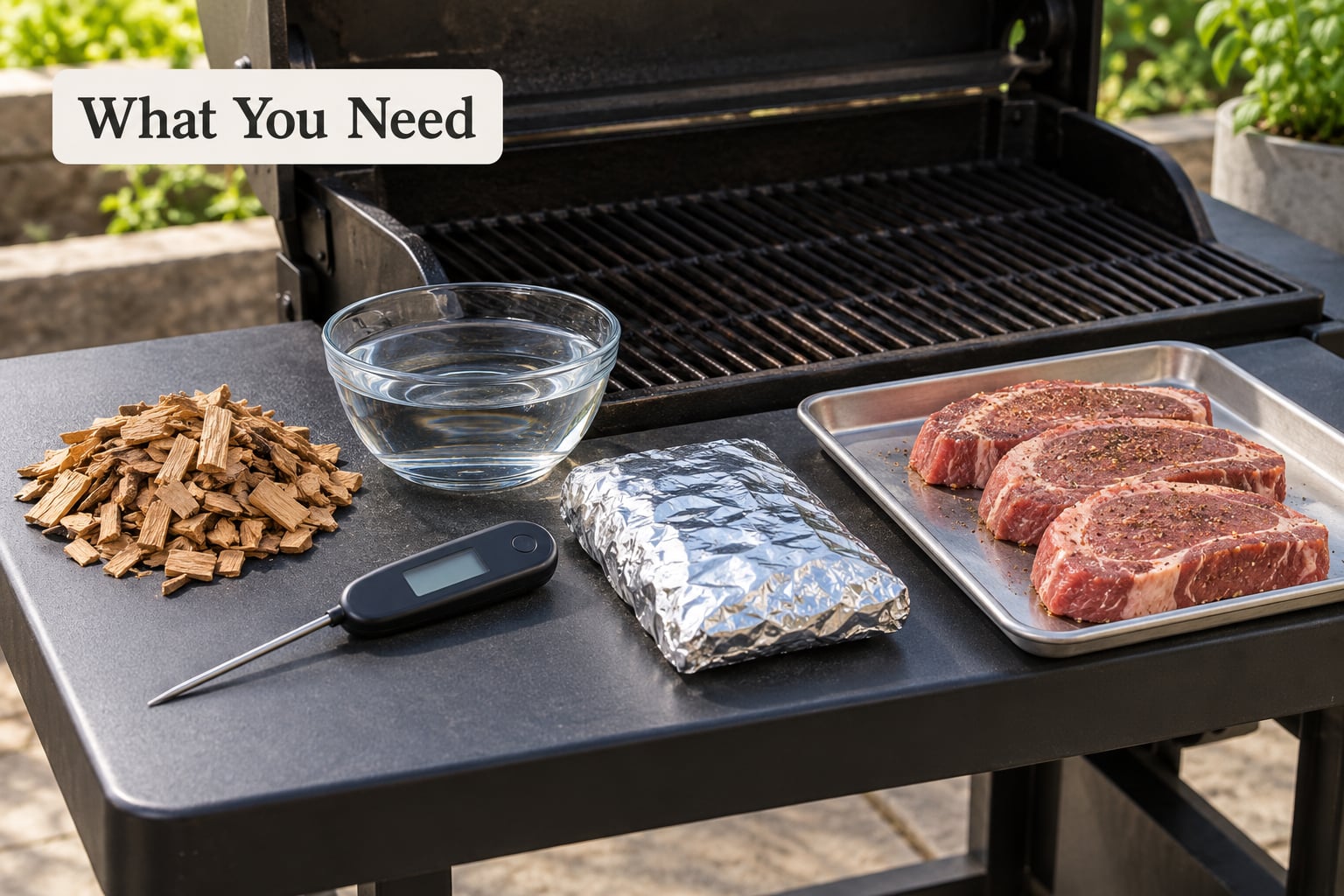
The gear list for how to smoke meat without a smoker is short, and most of it you may already own. A dedicated smoker box is the only piece you might want to buy, and even that has a free substitute.
- A lidded grill with a working lid thermometer. A kettle grill, a basic charcoal grill or a three-burner gas grill all work. A lid thermometer is the difference between guessing and knowing.
- Fuel. Charcoal briquettes burn steadier and cooler, which makes them easier for a first cook. Lump charcoal burns hotter and faster but gives a cleaner flavour.
- Wood. Chips for gas grills and short cooks, chunks for charcoal grills and longer cooks. Use only untreated hardwood from a grocery or hardware store.
- A foil packet or a DIY smoker box. A shallow tray of heavy-duty foil with a handful of chips and holes poked in the top does the same job as a store-bought smoker box.
- An instant-read thermometer and a leave-in probe thermometer. One tells you what is happening under the lid, the other stays in the meat so you do not have to open the lid at all.
- A wire rack. It lifts the meat above the drip pan so the underside cooks and the bark sets instead of steaming.
- A drip or water pan. A pan of water in a charcoal grill moderates swings and keeps drippings off the coals.
- Long tongs and heat-resistant gloves. Regular grill tools bend at this temperature.
Never use pine, cedar, or any lumber that has been painted, stained or pressure treated. The resins in softwoods and the chemicals in treated wood produce bitter smoke and are unsafe to cook with, which is why hardwood grocery-store chips and chunks are the rule.
Step-by-Step: How to Smoke Meat Without a Smoker
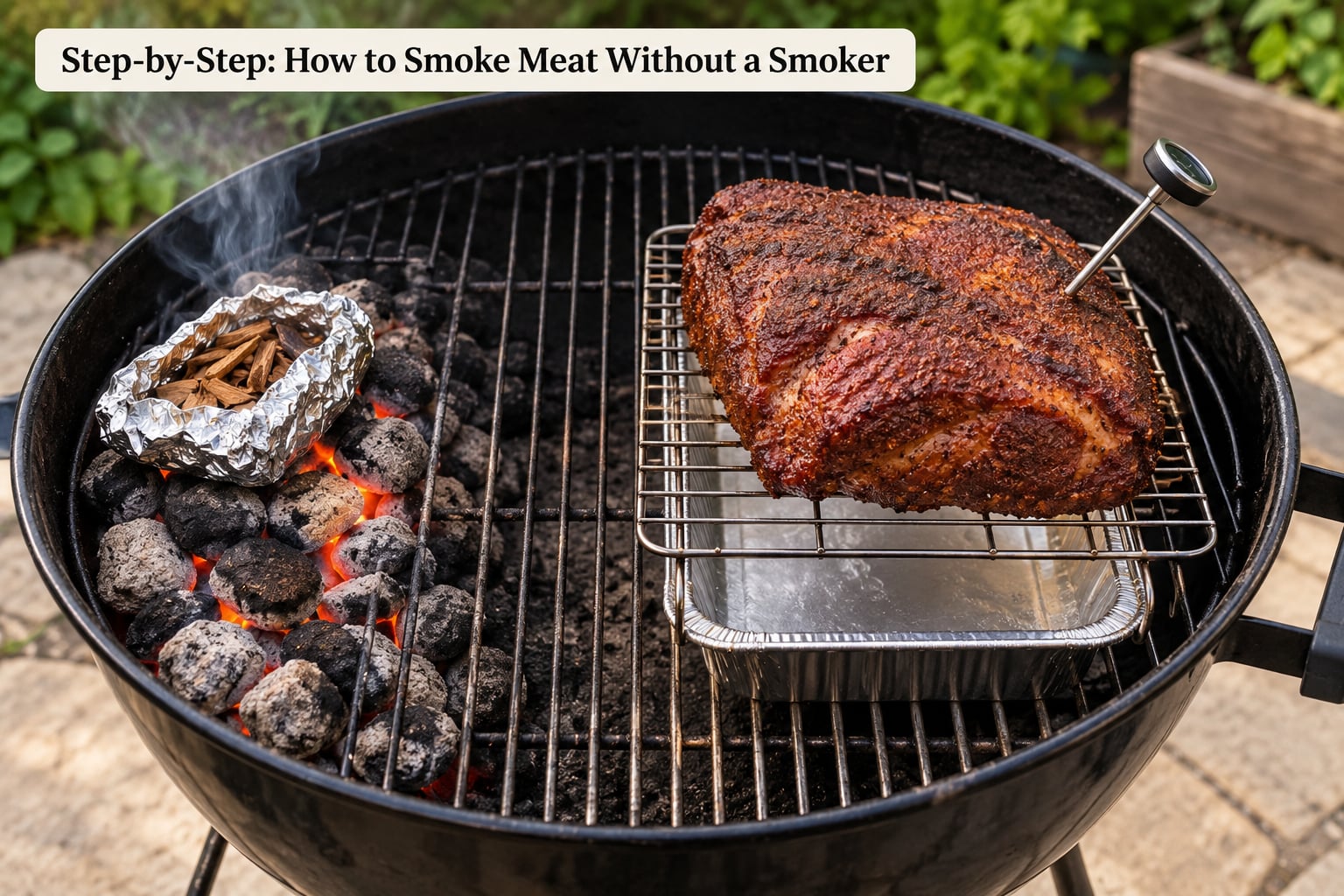
There are four practical routes to smoke flavour, and they all share the same three ingredients: indirect heat, a closed lid, and wood. Pick the one that matches the equipment you already have and follow the steps under each method heading.
Choose a Smoking Method: Grill, Stovetop, or Oven
A charcoal grill is the closest thing to a real smoker, because you control the fire itself. A gas grill is the easiest and least forgiving of temperature swings. A stovetop pot is the fallback for anyone without outdoor space. A conventional oven gives you bark and steady heat but little true smoke.
| Equipment | Smoke source | Ideal temperature | Best for |
|---|---|---|---|
| Charcoal grill | Wood chunks or chips in a foil tray | 225°F to 250°F | Brisket, pulled pork, ribs, anything long |
| Gas grill | Foil packet of chips over one lit burner | 225°F to 250°F | Chicken, turkey, salmon, short cooks |
| Kettle grill | Chimney or basket banked to one side | 225°F to 250°F | Everything, including small quick cooks |
| Stovetop pot | Dry chips in a foil-lined pot | Very low simmer | Small cuts when there is no outdoor space |
| Conventional oven | Chip tray or a splash of liquid smoke | 225°F to 250°F | Bark and steady heat, subtle smoke |
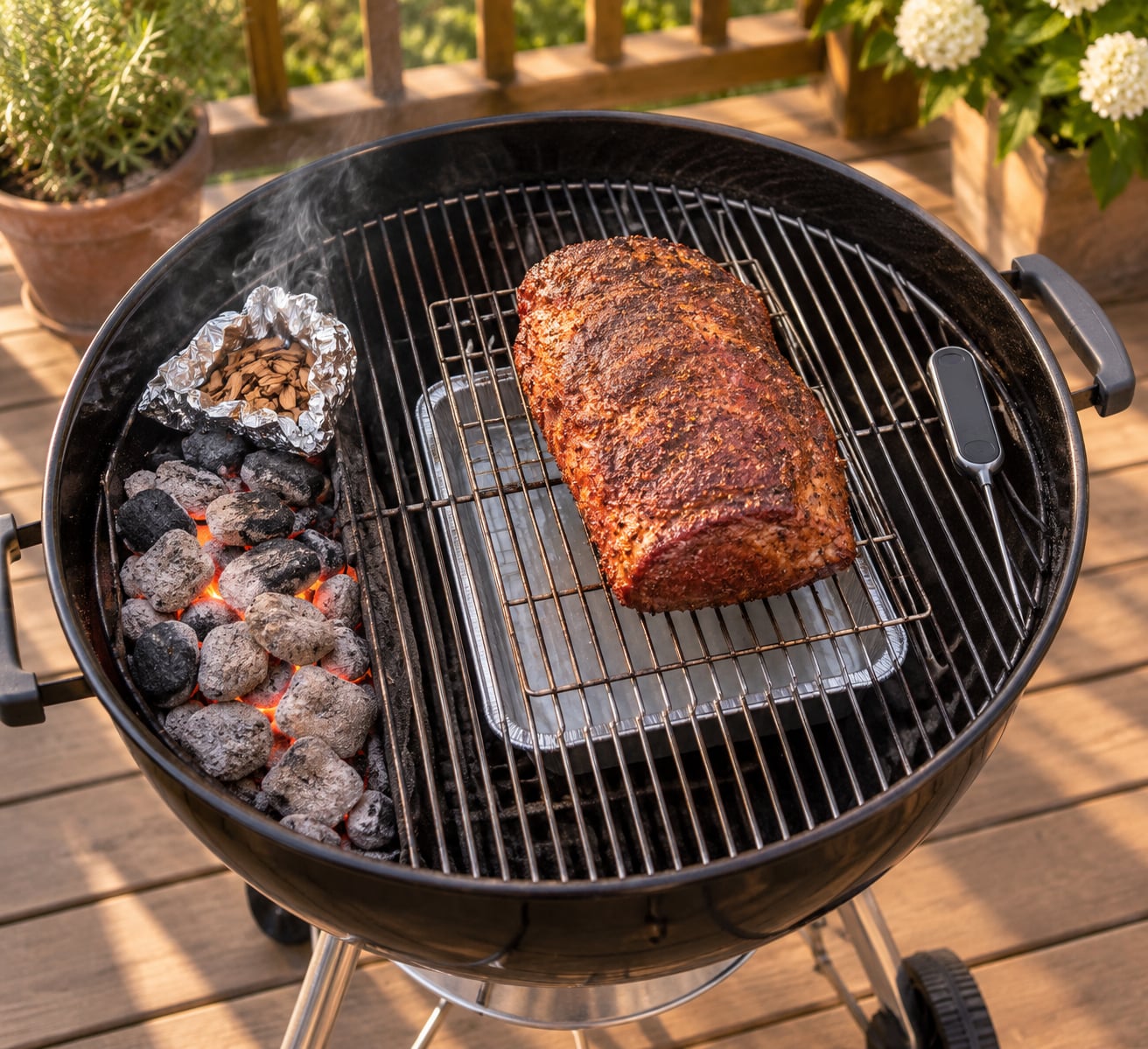
On a charcoal grill, build a two-zone fire. Light a chimney starter, empty it into the lower grate on one half of the grill, then push the coals to the edge of that half with the lid so air can flow. If you use a snake, lay it around the outer edge of the grate. Leave the other half empty for the meat.
On a gas grill, light only one side burner and set it to medium-low, leaving the far burners off. Wrap two handfuls of chips in a double layer of foil, poke six or seven holes in the top, and set the packet on the grate over the lit burner. The chips smoulder and drip; the smoke travels across to the food.
On the stovetop, line a heavy pot or Dutch oven with foil, add a handful of dry chips to the bottom, set a wire rack above them, and sit the meat on the rack with a splash of water or juice in the base. Cover tightly, lower the heat to its lowest setting, and infuse for 30 to 45 minutes before finishing in a standard oven to the internal temperature you need.
In a conventional oven, set a shallow tray of wood chips on the lower rack or on the floor, wrapped in foil, and put your meat on a rack above it. Heat the oven to 250°F for an hour to get the chips smoking, then add the meat. Expect bark and good colour, and only a light smoke note.
Prepare the Meat and Set Up Safe Indirect Heat
Trim the meat and let it come closer to room temperature than feels comfortable, maybe 20 to 30 minutes, because cold meat cooks unevenly on a long grill cook. Season it the way you always do and let the surface dry slightly in the fridge, uncovered, overnight if you have time. A dry surface makes bark; a wet surface makes crust.
Let the grill preheat with the lid closed for 15 to 20 minutes after the coals are grey and the lid thermometer stabilises. This is the step people skip, and it is why so many first cooks get no smoke at all. You are not starting the cook until the grill has held its target temperature for a while with the lid down.
Set the empty grate over the hot zone as a heat deflector, then put your water pan in the firebox and the wire rack above it. Place the meat on the far side, away from the direct fire, with a couple of inches of clearance around it for airflow. Close the lid and let the temperature recover.
Add the wood at the same moment the meat goes on. That first hour is when the smoke actually penetrates the food, which is worth repeating because most beginners add wood for the whole cook and end up with something bitter.
Add Wood and Control the Smoke
Add a small, controlled amount of wood and resist adding more than the recipe calls for. Two handfuls of chips on a gas grill, two or three fist-sized chunks on a charcoal grill, and one small handful in a pot. You want thin, lazy smoke that you can see drifting under the lid, not a fire and not a cloud.
Soaking chips before they go on is widely believed and barely matters on a grill. Soaking adds water that has to boil off, which mostly produces steam, and the chips in a grill or foil packet do not sit long enough to burn dry anyway. Soak if you like the ritual; it will not change the result.
Keep both vents open. Restricted airflow smoulders the wood instead of burning it cleanly, and that thick tarry grey smoke is creosote. It sticks to the meat, it tastes bitter, and it is the single most common complaint from people new to this.
Here is the part that surprises most cooks: smoke flavour saturates. Food absorbs smoke for roughly the first one to two hours, then stops taking on more no matter how much wood you feed it. The four-hour rule people ask about is not a cooking rule, it is a misunderstanding. After two hours, extra wood only adds risk of bitterness and creosote, not flavour.
For long cooks, add one or two more chunks around the two-hour mark and then stop. Rest the lid closed between checks so the temperature holds and the bark stays dry on the surface.
Monitor Temperature and Finish the Meat
Run your grill on temperature, not on time. Put the lid thermometer probe in the meat without touching bone and close the lid on the cable side, then check the grill temperature only when you check the food.
| Protein | Safe internal temperature | Approximate time on a grill at 225°F to 250°F |
|---|---|---|
| Chicken and turkey | 165°F (74°C) | 3 to 4 hours for a whole bird |
| Ground meat | 160°F (71°C) | 1 to 2 hours depending on the cut |
| Whole cuts of beef, pork, lamb, and fish | 145°F (63°C) with rest | Varies widely by size |
| Pork shoulder or brisket | 195°F to 205°F for shreddable texture | 8 to 14 hours |
| Ribs | 195°F to 205°F for tenderness | 5 to 7 hours |
These are USDA minimums for safety, not finishing targets. Smoked meat looks pinker than grilled meat because of the smoke, so colour is not a doneness signal. Judge pork and beef by probe tenderness: the probe slides into the thickest part with almost no resistance. Ribs are done when the membrane between the bones gives easily.
Do not flip meat during a long cook. Turning dries the surface and costs you bark, and there is no upside unless a piece is badly positioned over the hot zone. Repositioning once early on is fine if the fire is uneven.
Pull everything one degree or so under your target, because the carryover heat finishes it while it rests. Rest brisket at least an hour, ribs 20 minutes, chicken 15 minutes. Resting lets the juice redistribute, and a rested cut slices like something from a pit rather than a grill.
Common Mistakes and How to Fix Them
Nearly every disappointing first cook comes down to smoke quantity, airflow, or heat placement. These are the fixes that actually change the outcome.
| Symptom | Cause | Fix |
|---|---|---|
| Food tastes bitter or harsh | Too much wood, or dirty smouldering smoke | Cut wood by half, open both vents, keep the fire clean and white-ashed |
| No smoke at all | Grill was not preheated, or chips sat too far from the fire | Preheat 15 to 20 minutes with the lid down; move the packet closer to the coals |
| Temperature spikes over 300°F | Lid propped open or vents fully open with a small fuel load | Close the lid, trim one vent to a crack, add charcoal only to one side |
| Temperature drops in the second hour | Charcoal burning fast without a stable bed | Use briquettes, or bank more coals on the hot side and keep the water pan full |
| Flare-ups under the meat | Drippings hitting coals, no water pan | Add water to the pan and move the meat to the cool side |
| Meat dries out | Cooking too hot, or resting too long uncovered | Hold 225°F to 250°F and wrap large cuts in foil after two hours |
| Bark peels off when sliced | Meat was wet when it went on | Dry the surface uncovered in the fridge before cooking |
| Cook never finishes on schedule | Lifting the lid repeatedly | Leave it shut and trust the probe; each check can add 10 to 15 minutes |
If your smoke tastes wrong in a way you cannot place, the smoke itself is the problem, not the food. Back off the wood, open the vents until the fire burns cleanly, and dump the fuel that has gone grey and tarry rather than trying to cook through it.
Cold weather changes the arithmetic. A grill in winter burns hotter and more efficiently because the air is denser and the coals lose less heat to the surroundings, so you need less wood and fewer adjustments than you would in July.
Tips for Better Results with Every Method
Start with a small cut. A rack of ribs, a batch of drumsticks or two chicken breasts will teach you your grill’s temperament in an afternoon, and the lesson is cheaper than a dry brisket.
Pair the wood to the food rather than to your preference. Apple and cherry are mild and sweet enough for poultry, fish and vegetables. Hickory and mesquite are strong and suit pork and beef. Pecan and oak sit between them and are a safe all-rounder. Use one wood per cook so the flavour stays readable.
Charcoal comes before wood. Briquettes give a long, steady, cooler burn that lets a small amount of wood do the work. If you use lump, expect to add fuel more often and use less wood, because the hotter fire makes smoke less pleasant.
Keep a second probe in the meat and stop opening the lid. Most temperature problems are self-inflicted by checking curiosity, and each opening costs you more time than it gives you information.
Wrap big cuts in foil once the bark is set, usually after two or three hours. Foil traps steam and fat, which protects a long cook from drying out without hiding the bark you just built.
If you live in an apartment, a townhouse or anywhere with neighbours close by, smoke before the evening wind, keep the wood load modest, and check your local fire rules. Grills are for outdoor use only, and running one indoors or in a garage sets off smoke alarms and creates a real fire hazard.
Test your setup cheap before you test it expensive. Smoke a piece of cabbage or a slice of bacon over cold coals for twenty minutes. You will learn your grill’s hot spot and how fast it recovers, and it costs almost nothing.
Frequently Asked Questions
Can you smoke meat in a normal oven?
Partly. A conventional kitchen oven at 225°F to 250°F gives you excellent bark and very consistent heat, but no ventilation, so true smoke flavour is limited. Put a foil tray of wood chips on the lowest rack to get some smoke, or add a small splash of liquid smoke to the meat in the last hour. It is a genuine option for ribs, brisket and chicken, just expect seasoning and colour more than deep smoke.
Can I smoke with a regular grill?
Yes, and a charcoal grill is the best equipment most people already own. Bank the coals to one side, leave the other half empty, and put the meat on the cool side away from the direct fire. Hold 225°F to 250°F with the lid closed, feed a small amount of wood, and check the food with a probe thermometer. That is the whole method.
How long do you smoke meat on a grill?
It depends entirely on the cut. Chicken takes 3 to 4 hours, ribs 5 to 7 hours, and a full brisket or pork shoulder runs 8 to 14 hours. Cooks on a grill with a smaller fuel bed than a smoker sometimes run a little faster. Plan on the low end of any range you read, then cook to temperature rather than to the clock.
What temperature should a grill be for smoking?
Hold 225°F to 250°F with the lid closed. Below 225 the fire struggles to burn cleanly and the smoke gets dirty. Above 275 the meat cooks before the bark sets and fat renders off. That narrow band is the whole reason a grill smoker works, so adjust one vent rather than adding more fuel every time the needle moves.
Should I soak wood chips before smoking meat?
It makes very little difference on a grill. Soaking gives the chips a head start and delays ignition slightly, but the water mostly turns to steam and can slightly inhibit smoke. Chips in a foil packet burn through in well under an hour anyway. Use dry chips, keep both vents open, and spend your restraint on quantity instead of soaking.
Conclusion
The easiest way to smoke meat without a smoker is to set up a two-zone charcoal grill at 225°F to 250°F, put a small amount of wood on the hot side, and cook on the cool side with the lid shut. If you have no outdoor space at all, a stovetop pot followed by a finish in the oven gets you smoke flavour on a weeknight.
Start with a small cut. Confirm your grill is actually holding temperature before you put anything on it, keep the wood restrained and the vents open, and check the food with a probe instead of the clock. Rest it before you slice. That routine alone puts you ahead of most people who own a smoker.