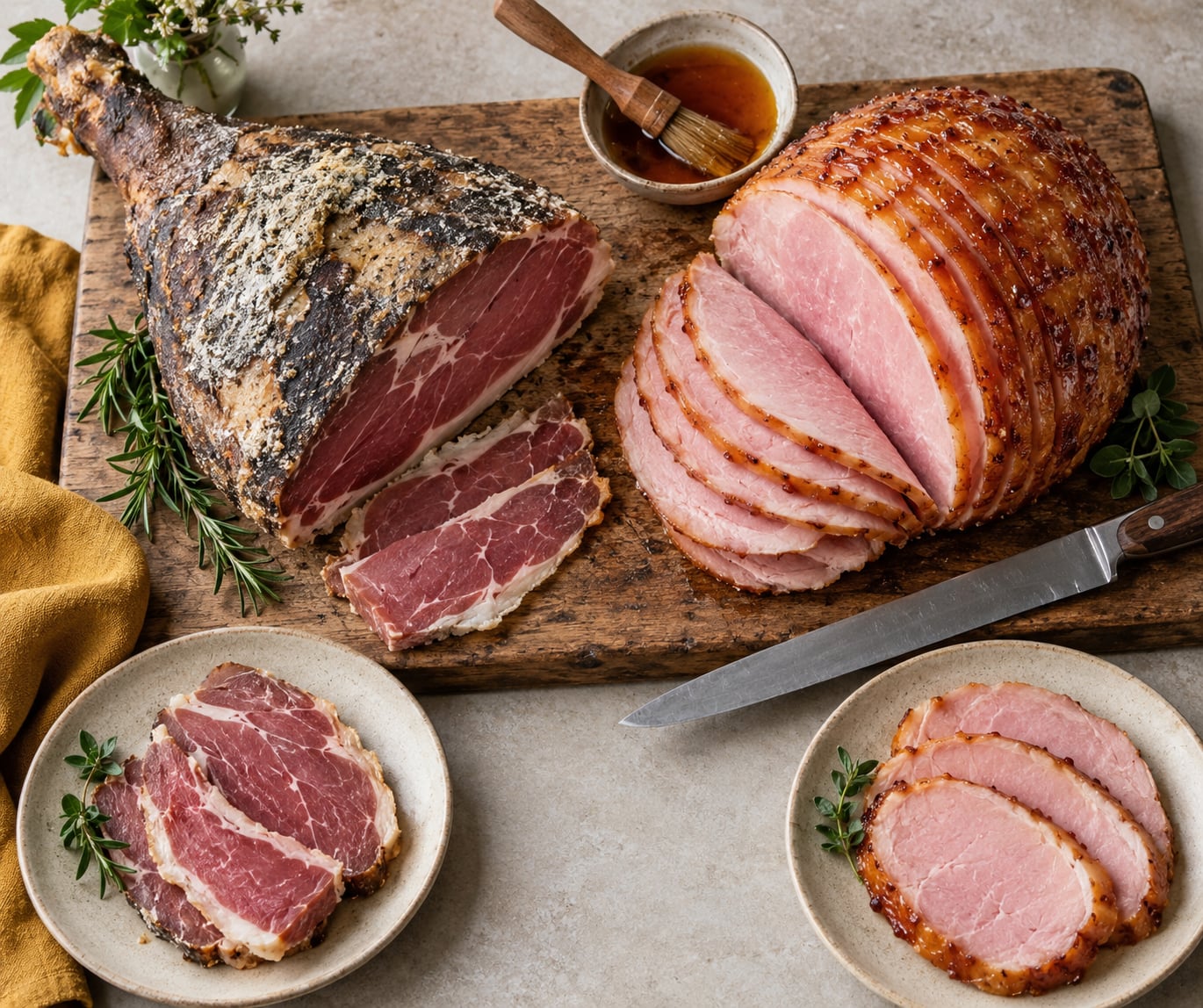
How you cook a country ham and how you cook a city ham are two different jobs. City ham arrives fully cooked and only needs reheating to 140 F, while a raw country ham is dry cured, heavy with salt, and has to be soaked, then simmered or roasted for hours until it reaches 145 F with a three minute rest. Treat them the same way and one of them comes out ruined.
On this site we cook a lot of cured pork, and the mistake I see most often is a shopper handing a spiral city ham to the oven for three hours. It dries out by the second hour. The bone-in aged leg gets the opposite error: no soak, straight into a hot oven, and it is tough and salty. Get those two switched and both hams turn out well.
Below is the comparison we actually use at the counter, followed by step-by-step methods for each, safe temperatures, storage times and a short list of questions worth asking the person who cuts your ham.
Table of Contents
- How to Cook Country Ham Versus City Ham at a Glance
- What Is the Difference Between Country Ham and City Ham?
- How Flavor, Texture, and Saltiness Change the Cooking Method
- How to Cook Country Ham Versus City Ham
- How to cook a country ham, step by step
- Soak time by ham size and salt level
- How to cook a city ham, step by step
- What about temperature targets, honestly?
- Which Cooking Method Works Best for Each Type?
- How to Store Country Ham and City Ham Safely
- Which Should You Choose?
- Frequently Asked Questions
- Are city ham and country ham the same thing?
- Are you supposed to cook country ham?
- How do I soak the salt out of country ham?
- How long should I cook each type of ham?
- Does a ham get more tender the longer you cook it?
- Conclusion
How to Cook Country Ham Versus City Ham at a Glance

Here is how to cook country ham versus city ham in the shortest form possible: soak the country ham, cook it long and slow until tender, and warm the city ham just enough to serve. The table breaks down how the two differ on cure, flavor, texture and handling.
| Criterion | Country Ham | City Ham |
|---|---|---|
| Curing method | Dry cured with rock salt and often sodium nitrite, then air dried and hung | Wet cured by soaking or injecting a salt, sugar and water brine |
| Typical cure duration | Weeks for a basic cure, then 6 to 24 months of aging | One to two weeks in the brine, then a cook and a short smoke |
| Smoke | Often cold smoked before aging, sometimes hickory or applewood | Usually a light smoke after the cook, sometimes none at all |
| How it is sold | Bone in, whole or half leg, usually unglazed, sometimes ready to eat raw cured | Bone in, semi boneless or boneless, frequently spiral sliced and glazed |
| Flavor | Deep, cured, concentrated, noticeably salty | Mild, sweet, familiar, close to what most people mean by ham |
| Texture raw | Firm and dense, almost firm as raw steak | Tender already, since it was cooked in the vat |
| Does it need cooking | Yes, unless the label says ready to eat | No, only reheating |
| Preparation first | Scrub, soak 12 to 48 hours in cold water, change the water | Skip the soak, slice or leave whole depending on the plan |
| Oven temperature | 275 to 300 F, loosely tented with foil | 325 F, uncovered so the glaze can set |
| Time per pound | About 25 to 30 minutes per pound for a soaked leg | About 15 to 20 minutes per pound to reheat |
| Target internal temperature | 145 F with a three minute rest | 140 F |
| Best uses | Soup and beans, ham and apples, split thin cold, a long holiday centerpiece | Buffet, sandwiches, a glazed centerpiece for a crowd |
| Main risk | Tough if undercooked, inedibly salty if under soaked, dry if roasted too long | Dry and stringy if reheated too long or too hot |
| Refrigeration | Uncured surface salt makes an aged leg stable unrefrigerated for a short period | Keep refrigerated until you need it, and once cut, always |
What Is the Difference Between Country Ham and City Ham?
Country ham is dry cured and city ham is wet cured, and every other difference follows from that one fact.
A country ham starts as a hind leg that gets packed in dry salt, sometimes with sodium nitrite, and then hung in a curing barn so the salt draws moisture out of the muscle and concentrates the flavor. Old legs age six months to two years, which is where the deep, almost fermented edge comes from. Many are smoked before aging, so the surface carries a layer of smoke and a dark rind.
City ham is the commercial opposite: the leg is soaked in a brine or pumped through the artery with salt, sugar and water, then cooked in a vat and given a short smoke. Because the water is locked back inside, the meat stays juicy and mild. This is the same product sold at a supermarket, and it is also what people mean when they say wet cured ham or baked ham.
Worth saying plainly: city ham is an industry term, not one standardized style. A spiral honey cured ham, a sugar cured ham and a sweet pickle cured ham are all city hams with different sweeteners and spice packets, and none of them behaves like an aged country ham.
How Flavor, Texture, and Saltiness Change the Cooking Method
Because country ham is dense and heavily salted, it needs a long soak followed by long, moist heat. Because city ham is already tender, it needs only a gentle warm-up.
The salt is the part people underestimate. Dry curing pushes salt into the outer inch or so of the meat, so the very outside can be far saltier than the center. Soaking in cold water does two jobs at once: it rehydrates the dehydrated surface and it floats salt off in layers, which is why the water gets changed once or twice.
Texture runs the other direction. A soaked country ham still needs heat and time to get past its density, and reaching tenderness usually means hours at a low temperature rather than a short blast of high heat. City ham already went through that once in the factory. Every extra minute in your oven takes water out of it, and the connective tissue that was tender turns stringy as it dries.
Seasoning follows from both. City ham takes a sweet glaze well because it is mild enough to absorb one. A country ham barely needs glaze at all; most of the flavor people want to add should come from simmering it with beans, apples, mustard seed or a splash of the cooking liquid.
How to Cook Country Ham Versus City Ham

A soaked country ham gets simmered or slowly roasted to 145 F with a three minute rest, and a city ham gets reheated to 140 F for about 15 to 20 minutes per pound at 325 F. Here is the full method for each.
How to cook a country ham, step by step
1. Check the label first. Fully cooked country hams exist and are designed to be sliced cold. If the package says fully cooked or ready to eat, skip the whole soak and cook section and move to storage and carving.
2. Scrub the face side. That is the cut side, opposite the skin. Use a non abrasive brush with cold water to remove the black pepper and curing spice, plus any surface mold. Rinse the leg under cold running water.
3. Soak. Submerge the ham in cold water so it is fully covered, and refrigerate it. Change the water every 8 to 12 hours. Length depends on the leg.
4. Pick the method. Simmering in water gives the gentlest texture and the best flavor. Low and slow roasting gives you a browned surface for a glaze.
5. Cook slowly. For the oven, tent loosely with foil at 275 to 300 F and plan on 25 to 30 minutes per pound. For simmering, hold the water just below a boil at around 190 F and let it go until a probe slides into the thickest part of the leg with little resistance.
6. Glaze only if roasting. If the ham is browned and you want a sweet finish, brush a brown sugar and mustard glaze on during the last 30 to 45 minutes. Simmered ham does not need it.
7. Rest and check temperature. Rest 20 to 30 minutes before carving, and confirm 145 F in the thickest part, closest to the bone, with a three minute rest before slicing.
Soak time by ham size and salt level
Soaking longer is not automatically better. Push past 48 hours and you wash away the character you paid for, which is exactly the failure people describe on cooking forums when a soaked ham tastes flat.
| Ham | Soak time | Water changes | Why |
|---|---|---|---|
| Shank half, lightly cured, under 6 lb | 12 to 18 hours | 1 | Small legs take on water and salt faster |
| Whole bone in leg, standard cure, 10 to 14 lb | 24 to 36 hours | 2 | The most common case, and the safest default |
| Long-aged leg, 18 to 24 months | 36 to 48 hours | 2 to 3 | Older cures are noticeably saltier |
| Salt heavy ham with a visible white crust | 48 hours | 3, plus a 30 minute rinse soak | The crust is the salt you need to remove |
| Ready to eat country ham | None | None | It is cured to be eaten as is |
| City ham, any cut | None | None | Soaking a brined ham only dulls it |
How to cook a city ham, step by step
1. Skip the soak. City ham is already seasoned through the muscle, and water does not improve it.
2. Choose the cut. Leave a bone in leg whole for a centerpiece and glaze it. Spiral sliced hams reheat fast and come apart into serving slices, which is why most households buy them.
3. Heat gently. Set it in a pan at 325 F, uncovered. Use about 15 to 20 minutes per pound for a bone in ham, or 20 to 30 minutes for a small boneless or quarter cut.
4. Glaze in the last 30 minutes. Brown sugar and mustard, a fruit reduction, or a spice rub all work. Put it on late so it caramelizes rather than burns.
5. Rest and check. Let it stand 15 to 20 minutes, and confirm 140 F in the thickest part before carving.
What about temperature targets, honestly?
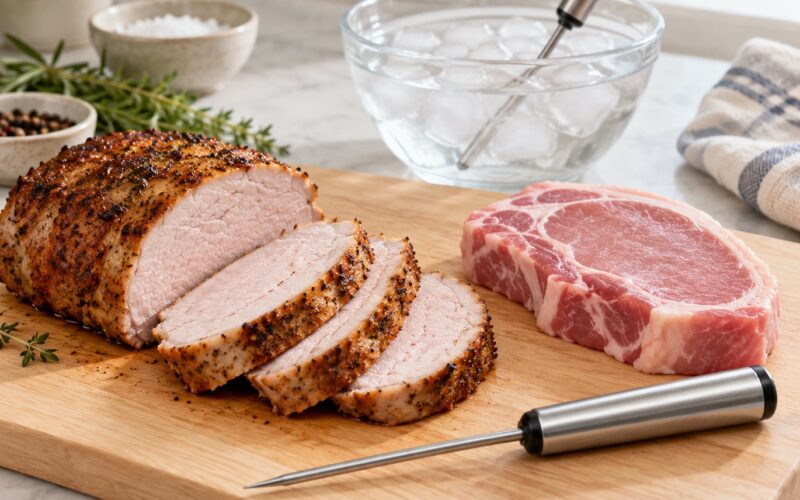
For reheating a fully cooked ham, the target is 140 F. For cooking a raw or partially cooked country ham, follow the whole cut pork guidance: 145 F with a three minute rest.
You will see 135 F quoted online for reheating ham, and it is below current USDA reheating guidance, so do not use it. A thermometer probe in the thickest part, away from the bone and the glaze, is the only reliable check. Glaze and bone both mislead you, bone reads high and sweet glaze reads high too.
Which Cooking Method Works Best for Each Type?
Wet, low, slow heat wins for country ham, and short gentle reheating wins for city ham. Baking, simmering, a slow cooker, a pressure cooker, sous vide and the skillet each suit one better than the other.
| Method | Country ham | City ham | Notes |
|---|---|---|---|
| Oven | 275 to 300 F, foil tented, 25 to 30 min per lb | 325 F, uncovered, 15 to 20 min per lb | Most reliable option for both, and the easiest to control |
| Simmer in water | Best texture, just under a boil until a probe slides in | Works, but leaches flavor | Classic country ham method, keeps the meat moist |
| Slow cooker | Slice it and cover with water, low for 6 to 8 hours | Low for 3 to 4 hours | The usual fix for a leg that is still tough after roasting |
| Pressure cooker | High for about 25 minutes per pound, then a natural release | Not worth it, reheats too fast and dries out | Fast and tender, but the texture is softer than oven or pot |
| Sous vide | 145 F for about 2 to 3 hours in a sealed bag | 135 to 140 F for 30 to 45 minutes | Very even results, no bark, so finish a roasted ham under a hot grill |
| Skillet | Poor choice for a whole leg | Good for slices, 3 to 4 min per side | The best way to brown leftover city ham slices |
| Serve cold | Only for ready to eat or cured hams | Only for ready to eat cured hams | Let it sit at room temperature 10 to 15 minutes first |
One honest note on the community oven numbers. Hobbyists cooking cured hams land somewhere between 275 and 325 F, and both ends work, just differently. 275 to 300 F with a tent protects a big aged leg over a long cook, and 325 F is fine for a smaller or partially cooked ham where you want the surface to color before the center gives up. The oven is not the variable that ruins a ham. Cutting into it early is.
How to Store Country Ham and City Ham Safely
An unopened city ham keeps refrigerated until the use by date on the package, and once you cut into it you have three to five days in the fridge. A soaked, cooked country ham gets about the same window, and unopened cured country ham is the one case where cold storage is optional.
That last point confuses people. Salt curing lowers the water activity of the meat, which is what stops spoilage organisms from growing, and that is why a properly cured country ham can hang in a cool barn or a cold porch unrefrigerated for weeks. A cut surface has no such protection, so refrigerate anything you have sliced or trimmed.
- Unopened city ham. Refrigerated, at or below 40 F, until the package date. Freeze it for longer storage.
- Cut city ham. Airtight in the fridge for 3 to 5 days, or freeze in single slices.
- Unopened country ham. Fine in a cool place if the vendor says it is properly cured, and refrigerate it anyway if your kitchen runs warm or you have young kids around.
- Cooked country ham. Refrigerate within 2 hours, use within 3 to 4 days, and keep it covered.
- Freezing. Slice first, wrap in portions, and freeze. Thaw in the fridge overnight and reheat with a splash of its own juice or water.
- Uneven dates. Use the earliest date among the items you packed together, and label the container with the date you froze it.
Which Should You Choose?
Choose city ham if your weeknight cook needs to be predictable, if you are feeding a crowd, or if you want a ham that takes a glaze and disappears into sandwiches. Choose country ham if you want a real cured flavor, if you have the afternoon to soak and simmer it, or if you are making something like ham and beans or ham and apples where that concentrated flavor is the point.
Match the ham to the plan rather than the other way round. A smoked spiral city ham at 325 F for 15 minutes per pound is a buffet centerpiece that lets you spend the morning on the sides. An aged bone in country leg needs a day of soaking and a long, low cook, so buy it the day before you plan to serve it.
If you are buying at a market or butcher counter, ask four questions and you will know exactly what you are holding.
- Is this ham fully cooked, ready to eat, or raw and needing a cook?
- How long has it been cured and aged, and how salty do they consider it? That answer sets your soak.
- Was it smoked, and over what wood?
- Is it bone in or semi boneless, and will they slice it or score it for you?
On age and flavor, longer aged hams are more intense and cost more, so buy the longest aged leg only if you already like strong cured pork. A three month ham with beans will please more people at a table.
Frequently Asked Questions
Are city ham and country ham the same thing?
No. Country ham is dry cured in rock salt, often smoked, then aged in a hanging barn for months or years. City ham is wet cured by soaking or injecting a salt, sugar and water brine, then cooked and lightly smoked. That difference is why a city ham is sold ready to reheat and a country ham usually needs a soak and a long cook.
Are you supposed to cook country ham?
It depends entirely on the label. A country ham marked ready to eat or fully cooked is cured to be sliced cold, so skip the heat. A raw or partially cooked ham needs soaking and then cooking to 145 F with a three minute rest. Check the package and ask the vendor rather than guessing, because both versions come from the same hind leg.
How do I soak the salt out of country ham?
Submerge the ham in cold water in the refrigerator and change the water every 8 to 12 hours. Plan on 12 to 18 hours for a small shank, 24 to 36 hours for a whole bone in leg, and 36 to 48 hours for a long aged or salt heavy ham. Beyond two days you strip away the flavor people bought it for.
How long should I cook each type of ham?
A soaked country ham needs about 25 to 30 minutes per pound at 275 to 300 F, or a gentle simmer until a probe slides into the thickest part with little resistance. A city ham only needs reheating, roughly 15 to 20 minutes per pound at 325 F. Cooking a city ham for hours is what turns it dry and stringy.
Does a ham get more tender the longer you cook it?
Up to a point, yes. Collagen in a soaked country ham breaks down into gelatin with slow, moist heat, so it keeps improving for several hours. City ham has already gone through that once, so extra time only dries it. If a country ham is still firm after roasting, slice it and simmer it in water in a slow cooker rather than roasting it longer.
Conclusion
The whole comparison comes down to one question: is this ham wet cured and already cooked, or dry cured and aging? Wet cured and already cooked means reheat it gently to 140 F and save your afternoon. Dry cured and aging means soak it in cold water for a day, then cook it low and slow to 145 F with a three minute rest.
So check the package label first, and feel the leg if you can get your hands on it, because a firm, dark, salt crusted leg needs hours while a soft, glazed spiral needs minutes. Get that right and how to cook country ham versus city ham stops being a puzzle.