Knowing how to make divinity candy in humid weather comes down to one variable most recipes leave out: the moisture already sitting in your kitchen. Divinity is a soft nougat made from cooked sugar syrup whipped into egg whites, and the finished candy firms up by drying out, so humid air stretches that job out and leaves you with a sticky pan. The recipe does not need to change — your room does. Plan on 90 minutes of hands-on work plus 12 to 24 hours of drying before the candy is wrapped.
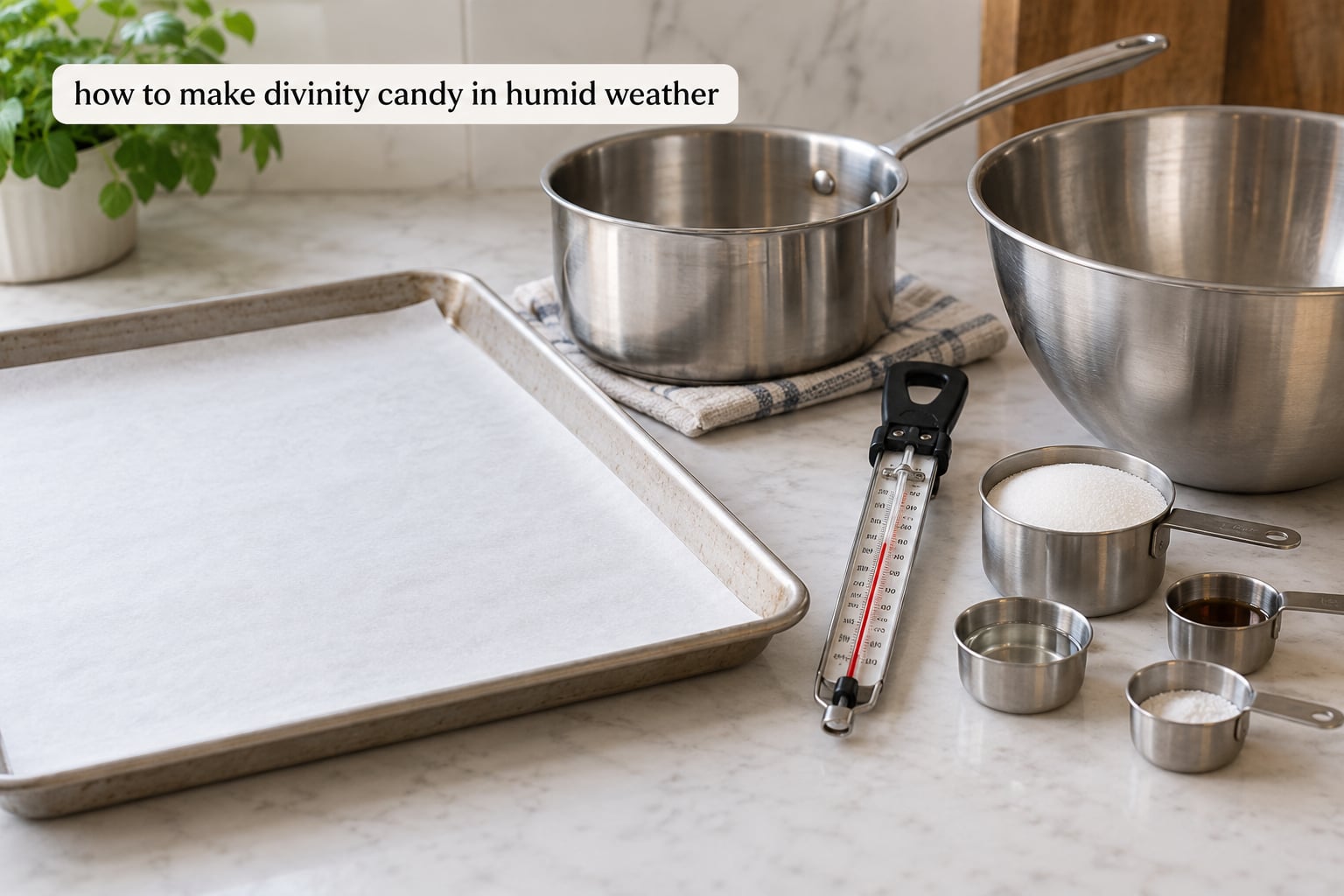
Table of Contents
- What You Need
- Step-by-Step: How to Make Divinity Candy in Humid Weather
- Step 1: Dry the Workspace and Control the Room
- Step 2: Cook the Sugar Syrup to a Reliable Hard-Candy Stage
- Step 3: Beat the Egg Whites to a Stable Foam
- Step 4: Fold the Syrup Into the Egg Whites
- Step 5: Add Vanilla, Butter, and Optional Nuts
- Step 6: Spread, Cut, and Cool
- Step 7: Dry and Store the Finished Candy
- Common Mistakes
- Frequently Asked Questions
- Why is my divinity candy sticky?
- Can I make divinity candy on a rainy day?
- What temperature should divinity candy reach?
- Should I refrigerate divinity candy if it is humid?
- How long does divinity candy take to set?
- Can I add nuts or coconut to divinity candy?
- The One Thing to Do First in Humid Weather
What You Need
Divinity is a short ingredient list, but humidity is not a recipe problem — it is an equipment problem. Here is what goes on the counter for a standard batch:
- Sugar and syrup: 2 and 2/3 cups granulated sugar, 2/3 cup light corn syrup, and 1/2 cup water.
- Egg whites: 2 large eggs, separated. Pasteurized eggs are the safer choice for anything eaten raw.
- Stabilizer: 1 teaspoon fresh cream of tartar. This is your humidity insurance, not a flavor ingredient.
- Flavor and fat: 1 teaspoon vanilla extract and 2 tablespoons butter.
- Optional nuts: about 1 cup of chopped pecans, plus whole pecan halves for the tops.
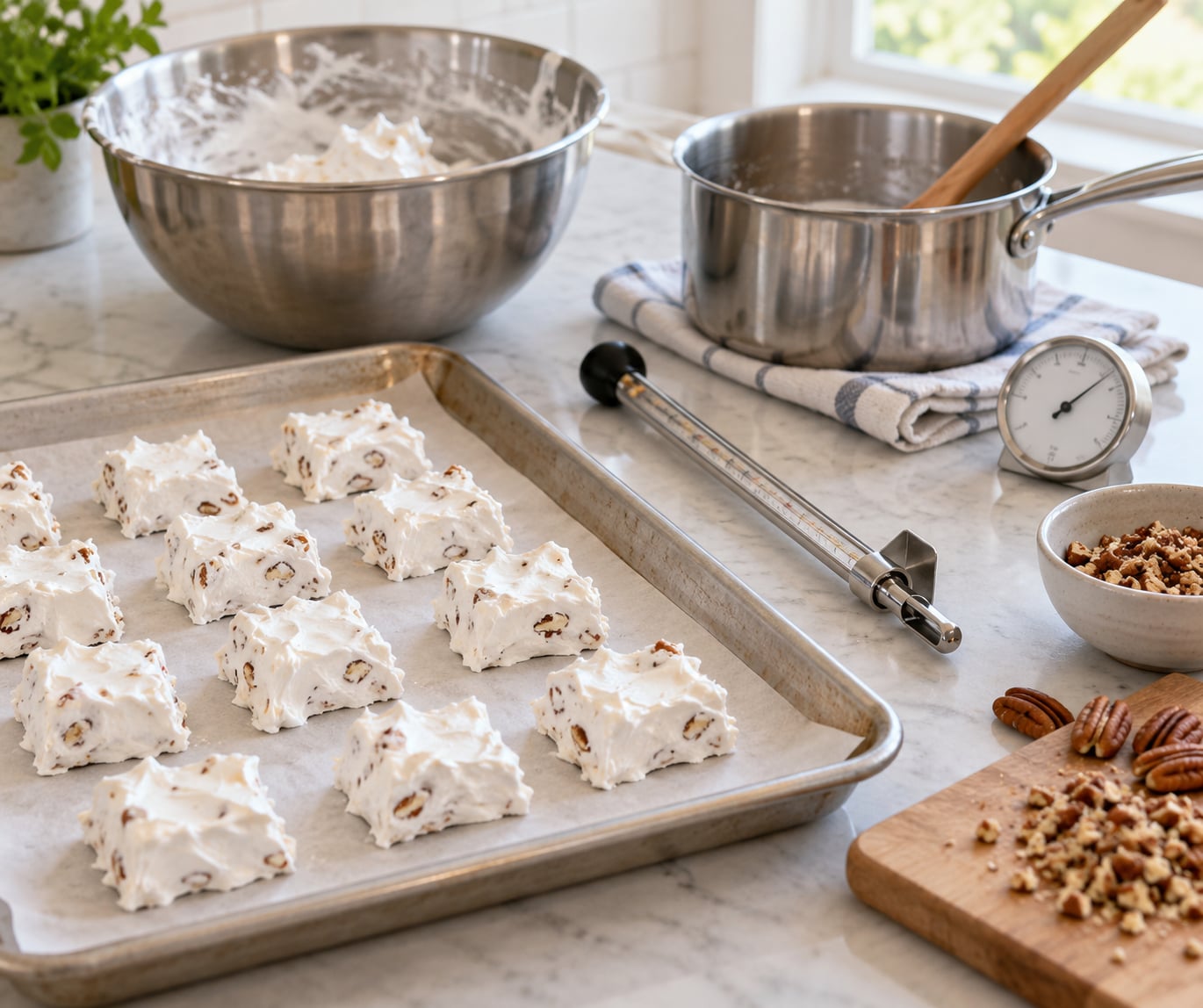
- Tools: a candy thermometer, a heavy-duty stand mixer or hand mixer with a whisk attachment, a clean heavy saucepan, a heatproof rubber spatula, and a dry metal bowl with a heatproof handle.
- Setting surface: parchment paper or waxed paper and a rimmed metal baking sheet.
- Moisture control: a hygrometer, a dehumidifier, or a kitchen you can close up and air condition.
Why does humidity hit hardest after cooking instead of during? Because the egg white foam has already been built by the time the candy hits the pan. Sugar is hygroscopic, which simply means it pulls water out of the air around it. In dry air that moisture leaves the candy and it firms into the cloud-like nougat texture you want.
In humid air the candy finishes setting in a cloud of water vapor, so the surface stays tacky and the inside stays soft. That is why the fix belongs in your preparation and drying routine rather than in the ingredient list.
Step-by-Step: How to Make Divinity Candy in Humid Weather
Step 1: Dry the Workspace and Control the Room
The whole job starts before the stove is on. Set the air conditioner or run the dehumidifier in the kitchen with the doors and windows closed, then give it 30 to 60 minutes to pull the room down before you crack an egg.
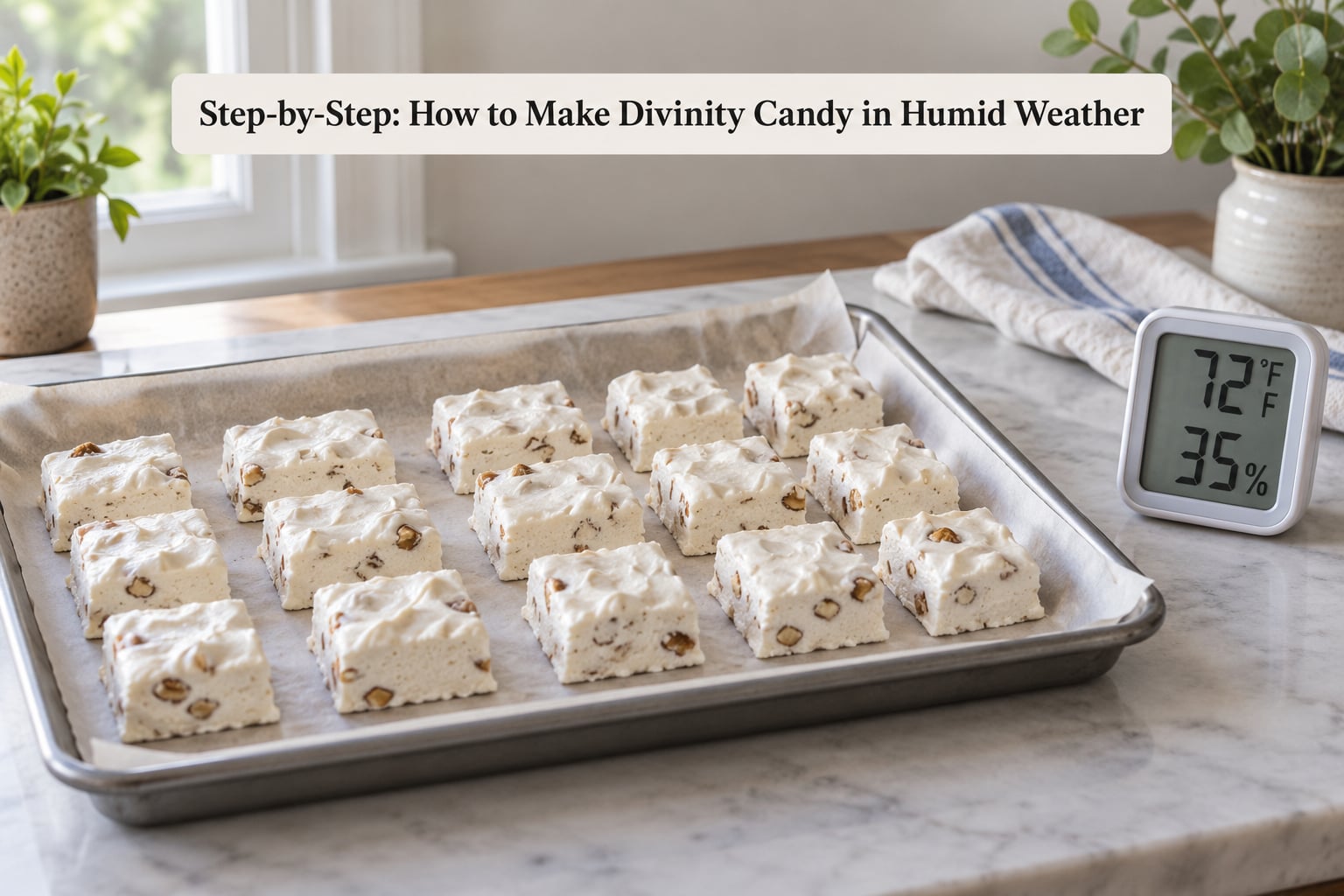
Put a hygrometer on the counter near your work area, not on a windowsill. Aim for a reading under 40% relative humidity, where you can make divinity without any adjustment. A reading between 40 and 55% is workable with a dried-out room and a longer drying window. Above roughly 65%, switch the day.
Dry the pan, the spatula, and the mixer bowl in a warm oven or wipe them dry and park them on the counter. Every bead of water on a tool goes straight into the batch.
Keep wet ingredients away from the candy. Do not steam vegetables while the syrup cooks, do not wash a sink in the next room with the door open, and do not run the dishwasher during the set period. A single rainy afternoon is not automatically a lost batch, but a kitchen doing its own laundry is working against you.
Step 2: Cook the Sugar Syrup to a Reliable Hard-Candy Stage
Cook the sugar, corn syrup, and water to 260°F, which sits in the hard ball range of 250 to 265°F. That number is the whole reason this candy is repeatable, and it is why a thermometer beats color, feel, or the weather outside.
Stir with a heatproof spatula so nothing scorches on the bottom, keep the heat moderate, and stop stirring once the thermometer holds steady for 30 seconds. If you have no thermometer, you are guessing, and guessing is exactly how humid-weather batches end up soft later.
Pull the pan off the heat the moment you hit the number. Syrup keeps cooking and climbing for a few seconds after it leaves the burner, and those extra degrees matter once egg whites join the pan.
Step 3: Beat the Egg Whites to a Stable Foam
Whip the two egg whites with the cream of tartar on medium-to-high speed until they hold stiff, glossy peaks and the bowl can be turned upside down without a drop escaping. That usually takes 2 to 3 minutes. Fresh cream of tartar is worth the extra effort here, because it stabilizes the foam against exactly the kind of slack, weepy structure that humid kitchens produce.
Keep yolks out of the bowl. A single yolk adds fat to the foam and the whole mixture will refuse to hold. If the whites look dull, loose, and grainy at the peaks, you over-beaten them. Start over with fresh eggs and a clean bowl rather than trying to beat the damage out.
Do not taste the foam. Raw egg white is safe to avoid tasting whether or not you used pasteurized eggs, and divinity candy is not the place to make an exception.
Step 4: Fold the Syrup Into the Egg Whites
Set your mixing bowl on a folded towel or a stand mixer head away from the burner, then pour the hot syrup in a thin, steady stream while you keep the mixer running at medium speed. A slow drizzle gives the foam time to cool; a fast dump cooks the egg whites into a scrambled, lumpy mess.
Beat until the mixture goes from glossy to matte and thickens enough that lifting the whisk leaves a shape that holds itself up on its own. Expect roughly 2 minutes of pouring plus 5 to 8 more minutes of beating, longer in humid air when the mixture firms more slowly.
Put the bowl back over low heat partway through if the candy feels loose and glossy, since the egg white foam needs to reach hard ball temperature to set properly. Do not walk away while that happens — this is the stretch where scorched sugar can go from fine to bitter in under a minute.
Step 5: Add Vanilla, Butter, and Optional Nuts
Take the pan off the heat, then add the butter, the vanilla, and the pecans, and fold them through with a spatula until the nuts are evenly scattered. Adding these off the heat keeps the butter from breaking the emulsion and the vanilla from cooking away.
Be honest about the tradeoffs. Nuts add surface texture that traps moisture, and unsweetened coconut does more of the same, so both raise your odds of a tacky piece. They also make the candy softer, which is the one texture complaint you cannot fix with a dehumidifier. If your kitchen is above 55% humidity, skip the mix-ins this batch and save them for a dry day.
Fold in small strokes from the bottom. Stirring hard deflates the foam you spent step 3 and 4 building, and a thin flat sheet of candy never recovers.
Step 6: Spread, Cut, and Cool
Scrape the candy onto the parchment or waxed paper in the middle of your sheet, not against the rim where humidity pools. Smooth it to about a quarter inch thick, press the whole pecan halves onto the top, and let it sit undisturbed.
Cut the pieces when the edges still feel slightly tacky, roughly 20 to 30 minutes in. Pulling a knife through fully set candy smears the surface, and you end up sanding the pieces down anyway.
Leave the candy uncovered until it is completely cool and firm, typically 2 hours at room temperature. Do not slide the pan into a warm cupboard or stack a towel over it to speed things up. Trapping air around cooling candy is the fastest way to create condensation, and condensation is the exact problem you are trying to avoid.
Step 7: Dry and Store the Finished Candy
Humid-weather candy needs a full drying window before it gets wrapped. Give the pieces 12 to 24 hours spread out on the rack in that same dried-out room, until the bottoms feel dry and firm rather than tacky. Batching is the exception; the whole pan in a single layer dries faster than pieces stacked on a plate.
Once dry, store the candy in an airtight container in a cool, dry cupboard kept around 60 to 70°F. Do not refrigerate it, because condensation forms on the way back out every time you take it out, and each cycle softens the surface again.
If the cupboard is genuinely damp, refrigerate and freeze instead. Let a piece come to room temperature inside its sealed wrapper so condensation forms on the plastic rather than on the candy.
Properly dried and stored candy keeps a few weeks. Freezing in a freezer bag with the air pressed out extends that to a few months, and the texture comes back close enough after thawing.
Common Mistakes
Sticky or tacky candy that never firms. Almost always humidity, and occasionally under-cooked syrup. Extend the drying to a full 24 hours, move the pieces to the driest room you have, and check your thermometer was actually reading 260°F rather than sitting in cool syrup.
Soggy, weeping, or weepy surfaces. The egg whites were not beaten to stiff peaks, or yolk got into the bowl. Next batch, check the bowl by turning it upside down, and separate the eggs cold with a clean, dry shell.
Brittle candy that shatters. Over-cooking. Past 265°F the syrup goes from hard ball into a stage that produces a glassy, brittle result once the egg whites cool. Take the pan off the heat the second the thermometer reads 260°F.
Foamy candy with big airy holes. Over-beating after the pour, or folding too vigorously at the end. Stop as soon as the candy holds a shape when you lift the whisk, then use a light hand to fold in the butter and nuts.
Grainy or dry-looking candy. The egg whites broke during the pour, most often because the syrup was dumped in too fast. Drizzle it thin with the mixer running, and keep the bowl away from the burner.
Lumps of cooked egg. The bowl sat on a hot burner or the syrup was poured in one thick stream. Use a separate bowl set on a towel, and pour in a ribbon you can hear sizzling steadily.
Quick rules for humid days: run the dehumidifier before you start, keep the batch out of the fridge until it is properly dried, add no nuts or coconut above 55% humidity, and never skip the thermometer. A dry kitchen and a correct reading solve more divinity problems than any recipe swap will.
Frequently Asked Questions
Why is my divinity candy sticky?
Sticky divinity almost always means the candy was wrapped before it finished drying, or the room was humid enough to stop the moisture leaving. A batch that feels tacky after two hours usually needs another 12 to 24 hours spread out on a rack before it goes into an airtight container. If it is still tacky after a full day of drying, the syrup probably never reached 260°F. Check your thermometer and cut into one piece to look for a dry, dense interior rather than a wet, foamy one.
Can I make divinity candy on a rainy day?
Rain on its own does not matter, but the humidity in the air behind it does. Run the dehumidifier or close the kitchen and cool it with the air conditioner for an hour, then keep doors closed through cooking and setting. On a day when your hygrometer reads above 65% and the dehumidifier cannot get it below 55%, wait. A dry room beats any recipe adjustment you can make at the stove.
What temperature should divinity candy reach?
The syrup goes to 260°F, which falls inside the hard ball stage of 250 to 265°F. After the syrup is poured into the egg whites, the mixture also returns to the heat so the foam reaches hard ball temperature and sets. Staying under 265°F matters, because anything hotter produces brittle candy instead of the soft nougat texture divinity is known for. Always verify with a candy thermometer rather than judging by color.
Should I refrigerate divinity candy if it is humid?
Not in a humid kitchen, unless the cupboard itself is damp. Bringing cold candy into warm humid air creates condensation on every piece, which softens the surface and makes it sticky again. If the storage area is genuinely humid, freezing is the better tool: wrap the fully dried candy, freeze it, and let it come to room temperature inside the sealed bag so condensation forms on the wrapper instead of the candy.
How long does divinity candy take to set?
The candy firms up enough to cut after about two hours at room temperature, and most pieces feel dry to the touch by then. In humid air, budget much longer: 12 to 24 hours spread out on a rack before wrapping. Cut while the edges are still slightly tacky, roughly 20 to 30 minutes in, because a knife dragged through fully set candy smears the surface.
Can I add nuts or coconut to divinity candy?
Yes, and they are traditional. Chopped pecans inside and whole pecan halves pressed on top both work, added off the heat after the candy finishes beating. The catch in humid weather is that nuts and unsweetened coconut add surface texture that traps moisture and make the finished candy softer, so the batch is less forgiving of a damp kitchen. Above about 55% humidity, make a plain batch and add mix-ins when conditions are dry.
The One Thing to Do First in Humid Weather
Get the room dry before you touch an egg. An hour of dehumidifier or air conditioning, a hygrometer reading under 40%, a thermometer aimed at 260°F, and a full day of drying afterward will save more batches than any change to the recipe itself.
Once you have the method down, the rest is practice. Divinity is a forgiving candy in a controlled kitchen, and a small one you make every holiday season is easier to keep dry than a big one you make once a year on whatever day the calendar lands.