Why are my pralines grainy? Because the sugar in your mixture crystallized instead of staying dissolved, usually because undissolved grains got knocked off the sides of the pot during the boil and seeded the whole batch. It is a texture problem, not a flavor or burning problem, and most batches are fixable with a slow reheat and a little extra cream.
The tricky part is that pralines have a very narrow window. You need the syrup at 235 to 240°F (112 to 115°C), the soft ball stage, and you need it there without disturbing it. Miss that window on either side and the texture goes wrong: too low and it never sets, too high and the sugar structure turns sandy and brittle.
I have made enough batches of these to know the moment that graininess starts, and it is almost never the recipe. It is the ten seconds where you scrape the bottom of the pan out of habit. Here is what is actually happening in the pot, what went wrong, and how to get a smooth batch next time.
Table of Contents
- What Causes Grainy Pralines?
- How Sugar Crystallization Makes Pralines Grainy
- Why Are My Pralines Grainy? Common Mistakes
- How to Fix Grainy Pralines
- How to Prevent Graininess in the Next Batch
- Praline Texture Problems: What the Symptom Means
- How to Store Pralines Without Making Them Grainy
- Frequently Asked Questions
- Are grainy pralines safe to eat?
- Can I blend grainy pralines smooth?
- Why do some pralines turn grainy every single time?
- Should I stir praline mixture while it boils?
- Do pralines really need a candy thermometer?
- How long do pralines take to harden?
- Conclusion
What Causes Grainy Pralines?
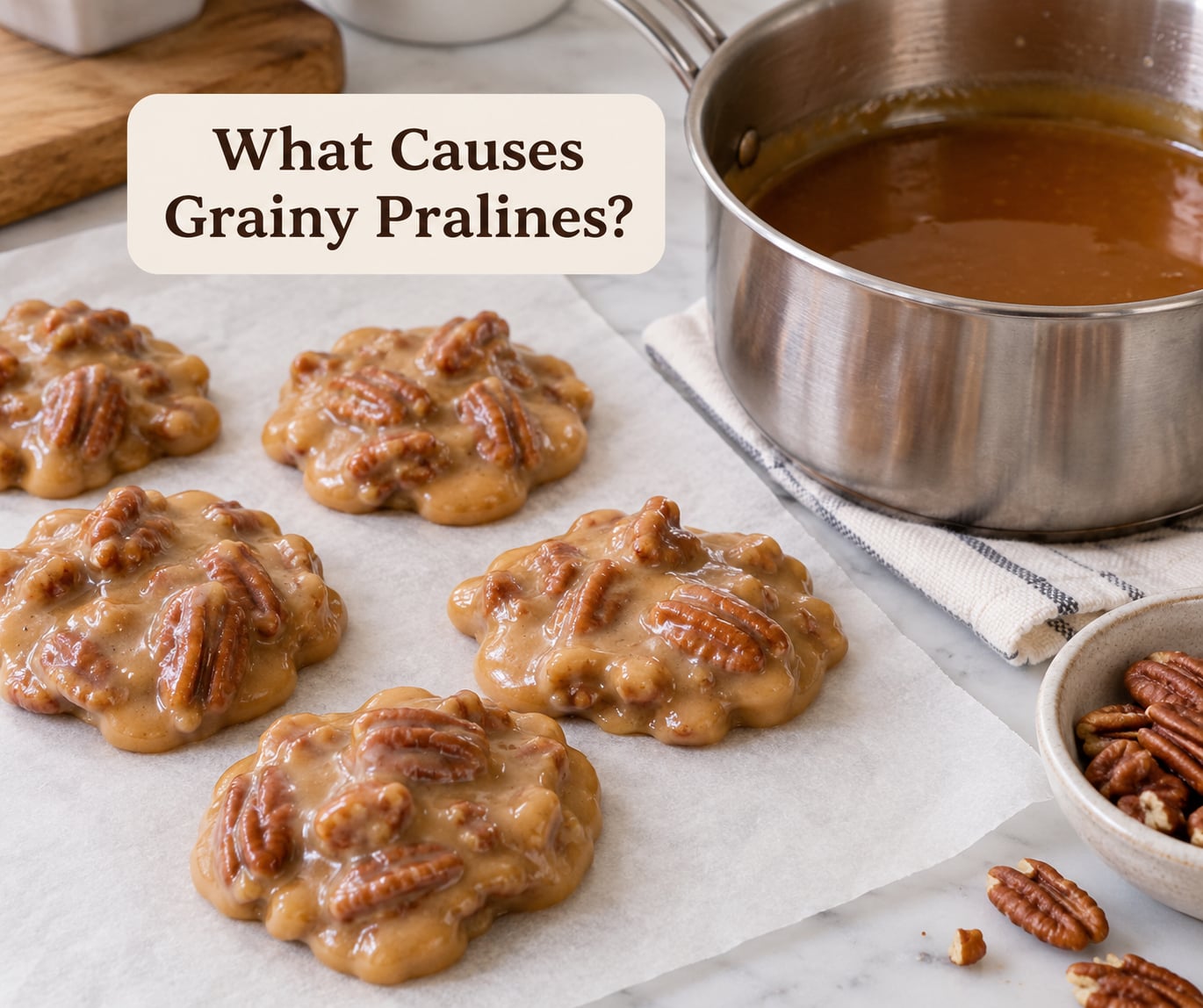
Grainy pralines are candy in which sugar crystals formed visibly instead of staying in solution. Good pralines are supposed to be dense, smooth and almost fudgy, with a clean snap on the outside and a melt on the tongue. What you have instead reads as raw sugar, sand, or broken glass shards depending on how far the crystallization ran.
There are two very different textures hiding under the word grainy, and telling them apart decides whether you bother rescuing the batch. A fine, even sandy grit that still feels slightly tacky is recoverable. Large, hard, translucent chunks that crunch like rock candy are crystallized sugar that has physically separated, and those cannot be stirred back into a cream.
How Sugar Crystallization Makes Pralines Grainy
Sugar dissolves in liquid until it cannot hold any more. Once the water boils away and the concentration climbs, the syrup becomes supersaturated, meaning there is more sugar dissolved than a stable solution could normally hold. At that point the sugar is looking for a reason to come back out as a solid.
Crystals need a seed to grow around, and your pot is full of them. Any sugar that splashed up the sides and dried, any speck of raw sugar from your measuring cup, any dust from the spoon resting on the counter, all of it is a ready-made nucleus. Once one seed drops into supersaturated syrup, it pulls more sugar out of solution and the reaction runs through the whole pot in seconds. That is the chain reaction that turns a smooth cream into sand.
Temperature is the other half of the story. Crystals form fastest on surfaces and wherever the syrup has cooled, which means the walls of the pot and any syrup sitting on the bottom. Big temperature swings during cooling give the crystals time to grow big enough to feel. A gentle, uninterrupted cool-down keeps them fine enough to read as smooth.
Home cooks sometimes hear that stirring causes crystallization and conclude they should never stir a sugar mixture at any stage. That is only half right. Stirring is necessary while the sugar is still dissolving early on. What you avoid is stirring once the syrup is boiling and supersaturated.
Why Are My Pralines Grainy? Common Mistakes
Here are the causes in roughly the order that cooks run into them, from the most frequent to the least.
Stirring during the boil. This is the big one and it is self-inflicted. Once the syrup hits a rolling boil, every pass of your spoon scrapes sugar off the wall and drops it straight into the middle of the batch. Those crystals do not dissolve at that concentration, they multiply. Let the syrup boil undisturbed and only touch the spoon to the pot if something is threatening to scorch.
Sugar crystals left on the sides of the pot. Even a diligent stirrer leaves a ring of dried syrup above the liquid line. As the level drops and rises with the boil, that ring breaks loose and rains seeds into the mixture. Keep the heat moderate enough that the syrup does not climb the walls, and if sugar does splash up, wipe the walls once with a damp cloth rather than knocking the dry ring back in.
Not hitting the soft ball stage. Undercooking leaves the syrup too thin to trap air and structure, and a thin syrup that sits and cools lets crystals grow into visible grains. Cooking to 235 to 240°F is what turns the mixture into candy rather than a sweet sauce.
Overshooting the temperature. Past roughly 250°F the syrup moves toward the hard crack range and the texture becomes brittle and glassy rather than creamy. You can end up in the gap between soft ball and hard crack without ever looking at a thermometer, especially with a thin-bottomed pan that runs hot.
Too much sugar for the liquid. This is the one people argue about most on cooking forums. If the ratio of sugar to evaporated milk, condensed milk or cream is too heavy, the mixture is supersaturated from the start and there is simply not enough liquid to hold every grain in solution. No amount of extra heat fixes it, and no amount of stirring helps. Home cooks who report the same recipe working and failing usually have different pans, different burners and different sugar-to-liquid ratios in front of them.
Brown sugar that never dissolved. Light brown sugar has molasses in it, and molasses is already a concentrated sugar solution. In a dense praline base it can stay lumpy and then break into grains as it cools. Granulated white sugar or raw cane sugar gives you a much more forgiving result.
Humidity and altitude. Sugar grabs moisture out of humid air, which slows drying and makes the surface of the candy tacky and prone to crystallization. In a dry climate the same recipe sets cleaner. Altitude works the other way, since water boils at a lower temperature up there and the syrup gives up its water faster, which pushes it past the soft ball stage before your thermometer says it is there. Cooks above about 3,000 feet generally add a couple of degrees to their target to compensate.
A note on safety while you are in there: molten sugar sticks to skin and causes serious burns. Use a long-handled spoon, keep your face back from the steam, and have a lid nearby so an overboiling pot can be covered in a second.
How to Fix Grainy Pralines
You have a real shot at a batch that is grainy but still soft and slightly tacky to the touch. The move is to melt the crystals back into solution and then re-concentrate without letting new ones form.
Put the mixture back on low heat and stir slowly and continuously until every grain has disappeared. This stage is not the boiling stage, so stirring is your friend here and your only tool. The texture will look thin and slack for a few minutes, which is expected.
As soon as the crystals are gone, add cream, milk or evaporated milk a tablespoon at a time, stirring each addition in completely. You are adding the liquid that dissolves the sugar was missing. Stop as soon as the mixture pulls back together into a glossy, cohesive cream. Too much liquid and you will need to cook it back down to 235 to 240°F before you scoop it.
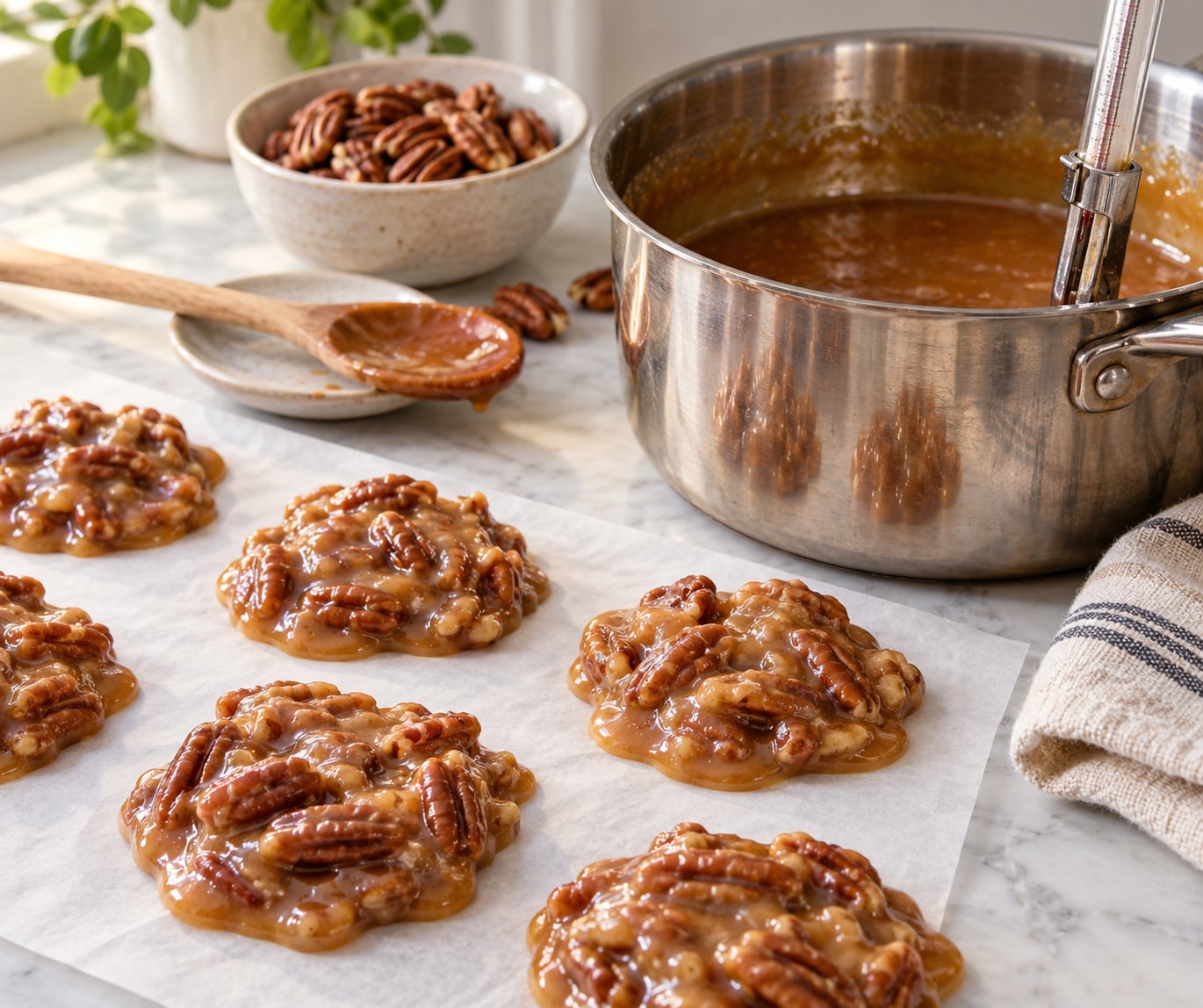
Once it reaches temperature again, pour it onto a lined sheet and work quickly, because you have just made a fresh supersaturated syrup with the same chance to go grainy a second time.
For pralines that have already set and hardened with a fine sandy texture, break them up and return them to the pan with a splash of cream, then warm slowly and stir until the grit dissolves. Expect it to take longer than a fresh batch and expect the texture to be slightly less dense.
What will not work: hard translucent crystal chunks, candy scooped before it was cool enough, or a batch that tastes scorched. Those have separated rather than softened, and no amount of reheating will put them back together. Some candy makers describe a blended shortcut for hard pralines, but in my experience you end up with a spreadable paste, not a praline.
How to Prevent Graininess in the Next Batch
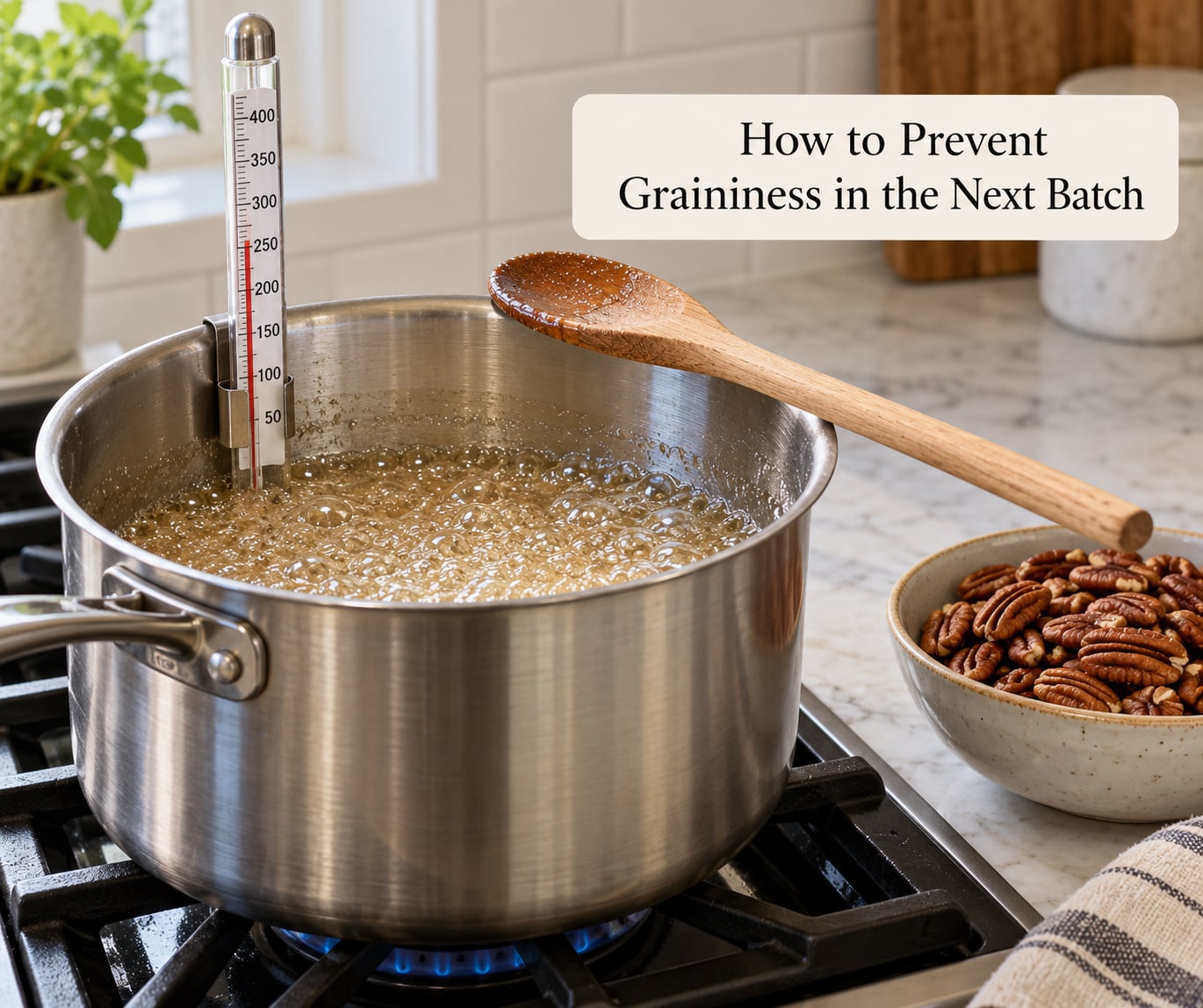
Prevention is mostly about removing seeds, controlling heat and not rushing the cool-down. Here is the method I use.
Calibrate your thermometer in boiling water first. Most cheap thermometers read 10 to 20 degrees off, and that is the entire gap between soft ball and hard crack. Put it in a pot of boiling water, check the reading against 212°F, and know your offset before you ever boil sugar.
Use a heavy-bottomed pot. Thinner pans give you a hot spot that scorches the base and a fast temperature swing that stresses the crystals. A copper pot is lovely and cooks evenly, but it costs real money and nothing about it is required.
Stir only until dissolved. Bring the sugar and liquid together, stir until everything is fully dissolved and the mixture is clear, then stop. From that point to 235 to 240°F, leave it alone. If you need to keep the spoon in the pot, rest it on the rim so it is not dragging crystals through the syrup.
Watch the temperature, not the clock. Aim for 235 to 240°F. Without a thermometer, drop a small spoonful into cold water and see whether it forms a soft ball you can barely hold. At sea level, add about 1 to 2°F to your target on a humid or cool day; above 3,000 feet of altitude, add the same 1 to 2°F because the syrup runs hotter at the same reading. If you see the bottom of the pot as it stirs, you are close.
Prep the nuts ahead. Toast pecans until fragrant, cool them fully and chop them while they are still soft. Nuts added at the end carry water and their own sugar into the mixture, and wet nuts are the most common reason for graininess in a batch that was otherwise cooked correctly.
Cool slowly and undisturbed. Pour onto parchment or a silicone mat and leave it alone at room temperature. Some cooks switch the oven off and put the pan inside to cool in a warm oven, which takes the temperature shock out of the process. Nothing should touch the surface while it sets.
A clean pot matters more than people expect. Wash yours thoroughly and dry it fully, because leftover sugar in the seams of an old pot is a standing invitation for the next batch to crystallize.
Praline Texture Problems: What the Symptom Means
Match what you are holding to the row below and you will know what happened in the pot.
| What you see | Likely cause | What to do |
|---|---|---|
| Fine even sand, still slightly tacky | Crystals formed during a fast or cold cool-down | Reheat with cream a tablespoon at a time and stir until dissolved |
| Hard, crunchy crystals like rock candy | Seeds dropped in during the boil and the reaction ran away | Not salvageable as pralines; do not waste more time on it |
| Gritty but soft, texture not setting | Undershot the soft ball stage | Recook to 235 to 240°F with the nuts still in |
| Sticky, tacky surface that never dries | Humid kitchen or a room that is too cool | Move it to a drier, warmer spot with airflow |
| Bitter or smoky flavor with grainy texture | Overshot past the soft ball range and scorched | Discard; flavor cannot be rescued |
| Smooth but chewy, like soft fudge | Sugar-to-liquid ratio too heavy | Increase the cream or evaporated milk by a few tablespoons next time |
| Thin and never firm, even after hours | Stood well below temperature, or no thermometer used | Recook slowly to temperature and re-test with cold water |
For reference, here is what the sugar stages mean and how to test them without trusting your eyes.
| Stage | Temperature | Cold water test | Result in pralines |
|---|---|---|---|
| Thread | 230 to 234°F (110 to 112°C) | No shape, breaks apart | Too thin, will not set |
| Soft ball | 235 to 240°F (112 to 115°C) | Soft, moist ball that barely holds when lifted | The target, creamy and dense |
| Firm ball | 244 to 248°F (118 to 120°C) | Firm ball with less give | Begins turning hard and grainy |
| Hard crack | 300 to 310°F (149 to 154°C) | Brittle, breaks on contact | Glass-like candy, not pralines |
How to Store Pralines Without Making Them Grainy
Pralines are hygroscopic, which is a plain way of saying they pull moisture out of the air around them. That moisture is what makes them soft, and it is also what lets fresh crystals form on the surface over time.
Let the candy cool completely on the mat before you handle it. Piling warm pralines into a container traps steam, and the condensation that forms is exactly the kind of moisture you do not want near finished candy.
Store them airtight at room temperature, separated by layers of wax or parchment paper so the pieces do not press against each other and turn into one solid block. Airtight is the part that matters most, followed by a dry spot away from the stove and the sink.
Expect roughly a week to two at room temperature in a cool, dry kitchen. In humid weather that shortens, and it is not a safety problem so much as a texture problem, since surface graininess usually shows up first. If you live somewhere damp and want the batch to last, freezing works well: wrap it airtight, and bring it back to room temperature sealed in the bag so condensation forms outside the candy rather than on it.
Refrigeration is the trap most people fall into. The temperature shock from warm candy into a cold fridge shocks the sugar structure, and the pieces that come out can feel gritty or turn hard and dull. If you refrigerate them, do it after they have fully set and accept the texture change.
The more useful question alongside all of that is how long the candy is worth eating. Sugar candy has very low water activity and pralines carry no dairy once cooked down thick, so they keep well past the point where they are pleasant. Check for an off smell, visible moisture or mold on the nuts and discard if you find any.
Frequently Asked Questions
Are grainy pralines safe to eat?
Usually yes. Graininess is a texture fault, not spoilage. It comes from sugar crystallizing rather than dissolving, and it does not make the candy unsafe as long as it was cooked to 235 to 240°F and stored properly. Discard the batch instead if it tastes bitter or smells scorched, or if there is visible mold, which can show up on the nuts in humid storage.
Can I blend grainy pralines smooth?
You can, but the result is not a praline anymore. Blending hard pralines turns them into a spreadable paste that you would spoon onto toast rather than set into pieces. If the batch is only finely sandy and still soft, reheating it with a splash of cream and stirring until the crystals dissolve gives you a much better outcome.
Why do some pralines turn grainy every single time?
A repeatably grainy batch almost always means the ratio is off rather than the technique. Too much sugar relative to your evaporated milk, condensed milk or cream leaves the mixture supersaturated from the start, so crystals form no matter how carefully you cook it. Add more liquid to the recipe and, second, check that your thermometer is calibrated before you blame the stove.
Should I stir praline mixture while it boils?
Stir until the sugar is fully dissolved and the syrup looks clear, then stop. Once the mixture reaches a rolling boil, stirring knocks dried sugar off the sides of the pot and drops seeds straight into supersaturated syrup, which is the main cause of graininess. During the rescue stage, where you are melting crystals back down, stir slowly and continuously because that is where stirring helps.
Do pralines really need a candy thermometer?
They make life much easier. You can cook to the soft ball stage by dropping a spoonful into cold water and checking whether it forms a soft ball you can barely hold, but that method is easy to read wrong and it has no built-in allowance for a thermometer that reads high. If you make pralines more than once a year, a cheap thermometer with a calibration check is worth the money.
How long do pralines take to harden?
Scooped pralines usually firm up within about an hour at room temperature, and they reach full firmness over a few hours. Humidity stretches that out, and a cool kitchen does too. If yours are still tacky after several hours, move them to a drier, warmer spot with airflow rather than putting them in the fridge, which causes its own graininess.
Conclusion
When pralines come out grainy, check two things first: the final temperature of the syrup and how the batch cooled. If you undershot 235 to 240°F, or you stirred, splashed or shocked the candy while it set, you have the reason.
Then the short version of the fix and the plan. Rescue a soft sandy batch by reheating it low with a tablespoon of cream added at a time until the crystals dissolve, then bring it back to temperature. For the next batch, calibrate the thermometer, stir only until the sugar disappears, leave the boiling syrup alone, hit 235 to 240°F, add dry toasted nuts at the end, and cool it untouched in a dry room. That sequence removes the seeds and the temperature swings, which are the only two things that ever turn a smooth praline into sand.