You can absolutely make cornbread without buttermilk: sour a cup of milk with a spoon of vinegar or lemon juice, rest it five minutes, and bake as usual. Learning how to make cornbread without buttermilk takes about ten extra minutes and no specialty shopping, and the crumb comes out just as tender.
Most recipes fail here for one reason, and it is not the missing buttermilk. They swap plain milk in without changing anything else, and the loaf bakes up denser and drier than it should. Buttermilk contributes acid and fat, and you have to replace both, not just the liquid.
Below is a base formula that works with any of the substitutes in the table, plus the exact ratios, pan times, and the fixes for the three ways it usually goes wrong.
Table of Contents
- What You Need to Make Cornbread Without Buttermilk
- The base formula, with and without buttermilk
- What to sour the milk with: ratios per 1 cup (240 ml) of milk
- Vinegar or lemon juice: which one should you use?
- How to Make Cornbread Without Buttermilk: Step by Step
- Why the acid matters, and do you still need baking soda?
- Plain milk plus extra fat, done properly
- Greek yogurt or sour cream instead
- Dairy-free, egg-free and gluten-free swaps
- Bake times by pan and temperature
- Common Mistakes and How to Fix Them
- Frequently Asked Questions
- What can I use instead of buttermilk in cornbread?
- How do I make buttermilk substitute for cornbread?
- Why is my cornbread dry without buttermilk?
- Can I use milk and vinegar instead of buttermilk?
- How long should cornbread bake at 350°F?
- How do I keep cornbread moist after baking?
- Start With the Vinegar Ratio
What You Need to Make Cornbread Without Buttermilk
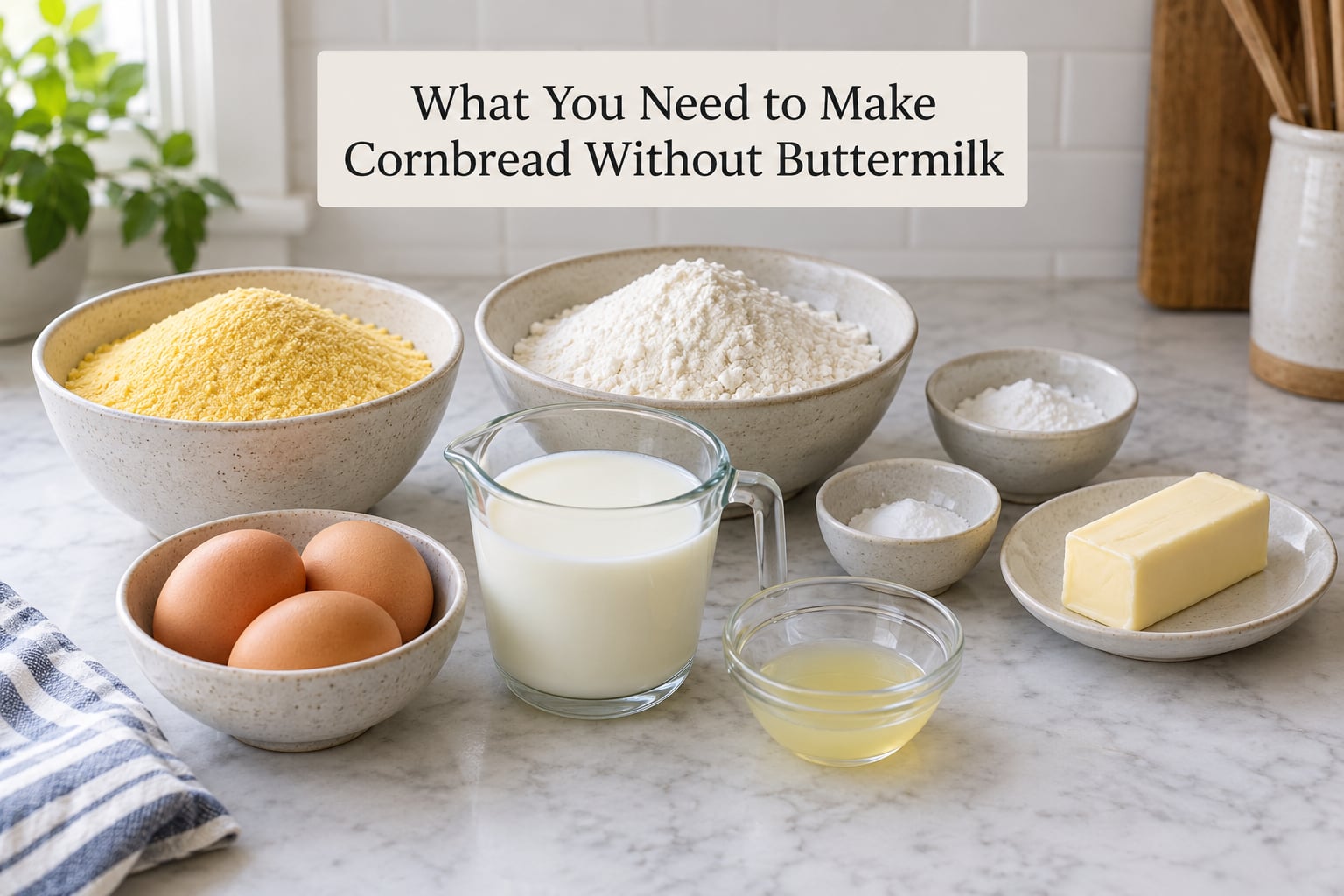
Everything here is a pantry staple except the acid, and for that you have better options than a carton of buttermilk. If you have milk and either vinegar or a lemon, you can make cornbread without buttermilk tonight.
The base formula, with and without buttermilk
- 1 1/2 cups all-purpose flour (180 g)
- 1 1/2 cups fine or medium-grain yellow cornmeal (200 g)
- 1 tablespoon baking powder (4 g)
- 1 teaspoon baking soda (skip if you use plain milk with no acid)
- 1 teaspoon salt
- 2 large eggs
- 1 1/4 cups milk plus acid (300 ml) — see the ratios below
- 6 tablespoons melted butter or neutral oil (85 g)
- 1 tablespoon honey or 2 tablespoons sugar (optional)
That is a 9×9-inch or 8×8-inch pan. Use yellow cornmeal rather than white for the flavor people expect, and go fine or medium grain if the meal matters to you. Stone-ground cornmeal is coarser and more fragrant, and it wants a few extra minutes.
What to sour the milk with: ratios per 1 cup (240 ml) of milk
| Substitute | Amount per 1 cup milk | Rest time | What it does to the crumb | Best for |
|---|---|---|---|---|
| White distilled vinegar | 1 tablespoon (15 ml) | 5 to 10 minutes | Moist, classic tang, best rise | The closest stand-in to real buttermilk |
| Lemon juice | 2 tablespoons (30 ml) | 5 minutes | Moist, slightly floral | When you are out of vinegar |
| Apple cider vinegar | 1 tablespoon (15 ml) | 5 minutes | Moist, faintly fruity | Milder flavor, no vinegar bite |
| Full-fat Greek yogurt | 1/2 cup (120 g) for 3/4 cup of the milk | None | Moist, tender, rich, slightly less lift | No souring step, very forgiving |
| Sour cream | 1/2 cup (115 g) for 3/4 cup of the milk | None | Moist and dense, cakiest edge | Casting both roles when you are short on eggs too |
| Plain milk plus extra fat | No acid at all; add 2 to 3 tablespoons more butter or oil | None | Tender but a little flatter, less tang | Kids who refuse anything sour |
| Buttermilk powder | 1 tablespoon powder plus 1/2 cup water per cup of milk | 5 minutes | Moist, closest match of all | Pantry baking, travel, camping |
The wide range of published vinegar amounts is why people second-guess this. One tablespoon per cup is the standard that works, and lighter doses still turn out fine. Even a single teaspoon of lemon juice in one cup of milk gives a usable result, so the acid does not have to be heavy-handed.
Vinegar or lemon juice: which one should you use?
| Acid | Strength | Flavor note in the finished bake | Which to pick |
|---|---|---|---|
| White distilled vinegar | Sharpest of the three | Neutral after baking, classic buttermilk tang | Pick this for cornbread that should taste like traditional cornbread |
| Apple cider vinegar | Milder than white vinegar, fruity | Faintly sweet and fruity | Pick this if vinegar smells sharp to you |
| Lemon juice | Mildest, about 1.5 to 2 tablespoons per cup of milk | A faint floral note can survive into the crumb | Pick this only when vinegar is out; it is less forgiving |
My rule is simple: white vinegar if you have it, apple cider vinegar second, lemon juice as the last resort. Cornmeal is sweet enough to hide a little tang, but not floral notes, and that is the whole argument for vinegar.
For equipment, a heavy 8×8-inch or 9×9-inch square baking dish, a 10-inch cast iron skillet, or a 12-cup muffin tin all work. A whisk, a medium bowl, and a measuring cup with a spout are enough. Skip parchment paper if you want a crisp bottom crust; grease the pan with butter or oil instead.
How to Make Cornbread Without Buttermilk: Step by Step
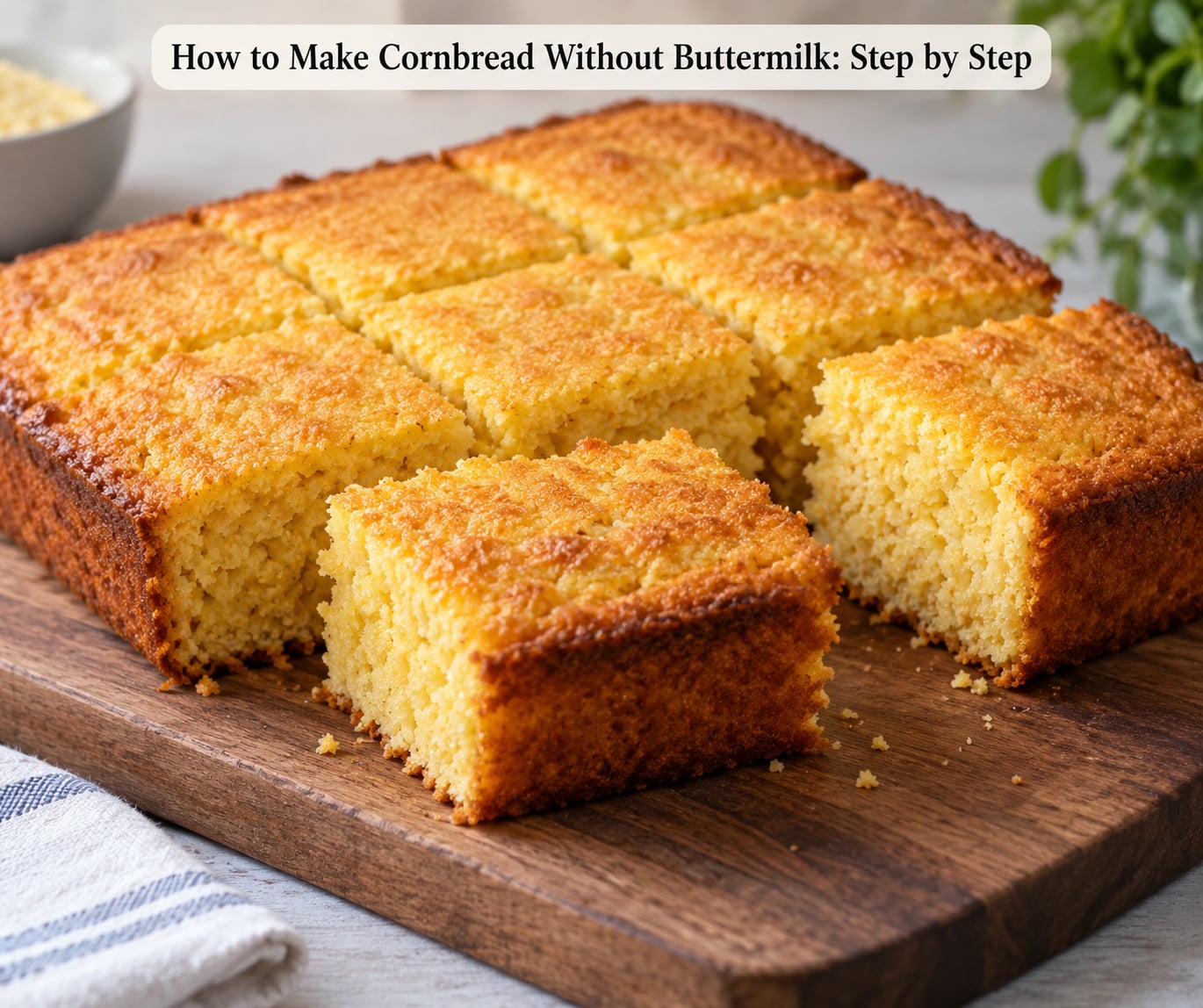
Heat the oven to 400°F (205°C) and put the empty pan inside while it heats. A hot pan is the difference between a crisp edge and a pale one, and it takes nothing extra.
- Sour the milk. Warm 1 1/4 cups (300 ml) of whole or 2% milk to blood-warm, about 105°F (40°C), or just use it straight from the fridge. Stir in 1 tablespoon (15 ml) white vinegar or 2 tablespoons (30 ml) lemon juice and leave it alone for 5 to 10 minutes. You will see it thicken slightly and look faintly curdled. That thicker look is the point, and the milk is still perfectly usable.
- Whisk the dry ingredients. Combine the flour, cornmeal, baking powder, baking soda and salt in a bowl and whisk until the baking powder has no streaks. If you are using a self-rising cornmeal mix, skip the baking powder and the salt.
- Beat in the butter, eggs and honey. Melt the 6 tablespoons of butter and let it cool a minute, because hot butter scrambles the eggs. Whisk it into the soured milk along with the 2 eggs and the honey.
- Combine gently and rest. Pour the wet into the dry and stir only until the flour disappears, about 20 seconds, then stop. Over-mixing develops gluten and gives you a tough, dense crumb, and that is the most common way a good recipe turns out bad. Let the batter sit 5 minutes while the cornmeal hydrates.
- Pour into the hot pan. Scrape the batter in and smooth the top. Put it in the oven and bake 20 to 25 minutes.
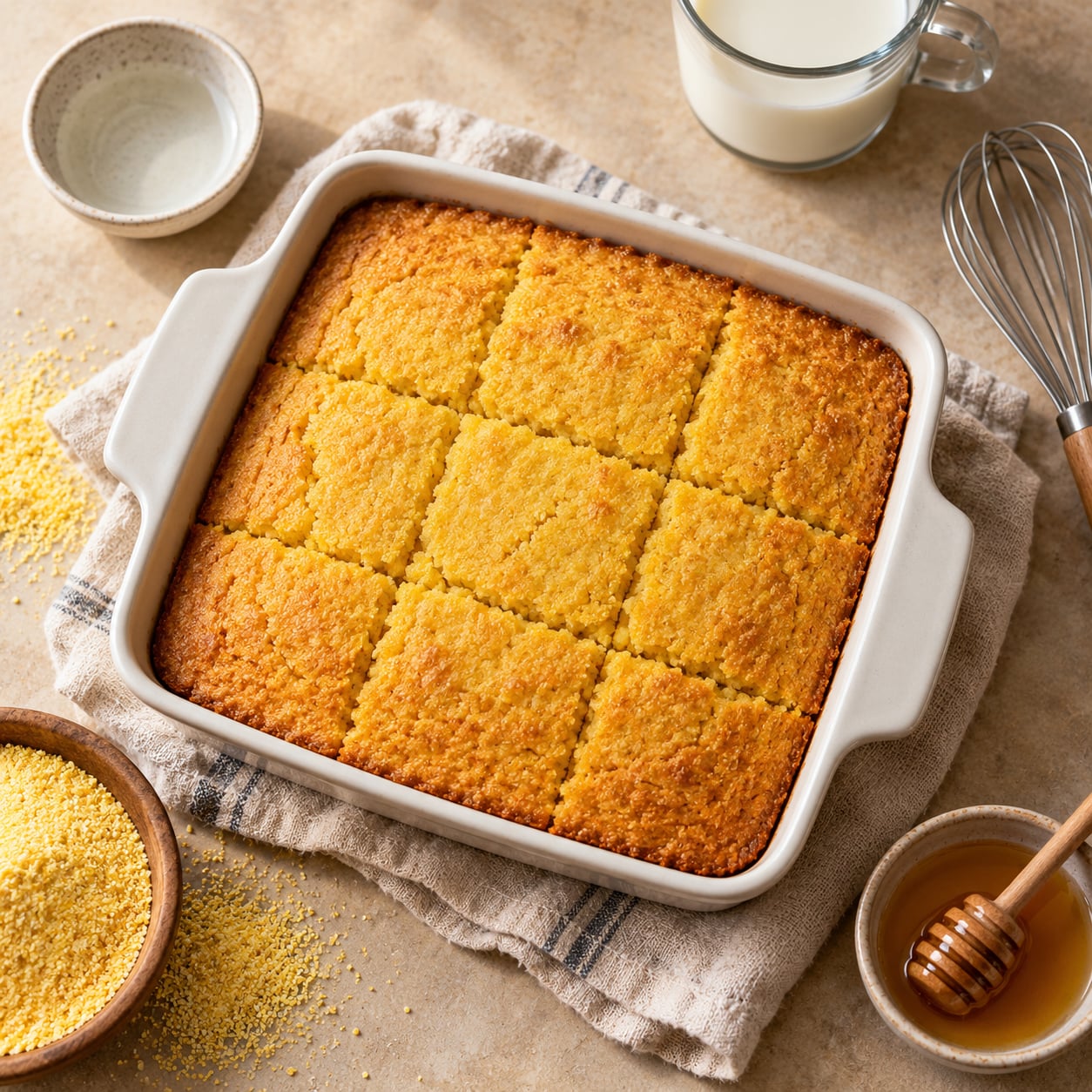
- Check for doneness. Insert a toothpick in the center. It should come out clean or with a few moist crumbs attached; wet batter on the toothpick means give it 3 more minutes. The top should be golden brown and the edges should pull slightly from the pan.
- Rest before cutting. Let the cornbread sit in the pan for 5 to 10 minutes. It firms up as it cools, and cutting it hot leaves you with crumbs all over the board.
Total time is about 45 minutes with 15 of those minutes being prep and resting.
Why the acid matters, and do you still need baking soda?
Yes, you still need it if you are souring the milk. Buttermilk is mildly acidic, and that acidity is what reacts with baking soda to release the carbon dioxide gas that lifts the crumb. Vinegar or lemon juice does the same job, so a cornbread made with soured milk rises exactly the way a buttermilk one does. If you use plain milk with no acid anywhere, drop the baking soda and either keep the baking powder or add an extra half teaspoon, because there is nothing left to react with.
This also means a recipe built on a self-rising cornmeal mix, which already carries its own leavening, needs no extra baking soda and no acid.
Plain milk plus extra fat, done properly
Plain milk works, but only if you replace the fat that buttermilk brings. Use the full 1 1/4 cups of milk, add 2 to 3 tablespoons more melted butter or neutral oil, and leave out the baking soda as described above. The result is tender and mild with a flatter rise, and it is the version to make for a child who will not eat anything sour.
Greek yogurt or sour cream instead
Whisk 1/2 cup of full-fat Greek yogurt into the 1/4 cup of milk to replace the whole 1 1/4 cups, then carry on from step 3. Cultured dairy brings both acid and fat, so keep the baking soda. Sour cream works the same way and also covers the egg role, which is handy when the eggs are what you are out of.
Dairy-free, egg-free and gluten-free swaps
Unsweetened soy milk soured with the same 1 tablespoon of apple cider vinegar behaves very close to the dairy version, and oat milk works if you expect a slightly softer crumb. Boxed vegan buttermilk is usually sweetened soy or almond milk with a little acid already added, so follow the label and skip your own vinegar.
For the egg, 1/4 cup of unsweetened applesauce or a slurry of 1/4 cup cornstarch plus 6 tablespoons water both bind and moisten. Gluten-free cornbread needs a cup-for-cup swap to gluten-free all-purpose flour or a gluten-free cornmeal blend, and those bakes brown faster, so pull them a few minutes early.
Bake times by pan and temperature
| Pan | Temperature | Bake time | Notes |
|---|---|---|---|
| 8×8-inch square dish | 400°F (205°C) | 20 to 25 minutes | Crisp all four edges |
| 9×9-inch square dish | 400°F (205°C) | 22 to 26 minutes | The most reliable everyday pan |
| 9×13-inch rectangular pan | 400°F (205°C) | 30 to 35 minutes | Thinner, ideal for a layer cake base |
| 10-inch cast iron skillet | 450°F (230°C), preheated | 20 to 25 minutes | Deep, crisp edges; let the pan heat 10 minutes |
| 12-cup muffin tin | 400°F (205°C) | 14 to 18 minutes | Fill each cup about two-thirds full |
A slightly cooler 375°F (190°C) bake for 25 to 30 minutes gives a moister, cakier crumb if you prefer tender over crusty. That is a real choice, not a compromise.
Common Mistakes and How to Fix Them
The crumb is dry or crumbly. Usually one of three things: too little liquid, too long in the oven, or a grain too coarse. Fix the next bake by measuring the milk with a proper cup rather than eyeballing, checking the toothpick two minutes earlier than the recipe says, and switching to a fine or medium cornmeal. Adding a couple of tablespoons of extra melted butter to the batter helps with moisture but will not rescue a bake that already ran dry through.
The center is dense or gummy. That is over-mixing, an underbaked middle, or both. Stir the batter only until the flour disappears and no longer. If the middle still pulls apart, extend the bake by 3 minutes next time rather than raising the temperature, since a hotter oven sets the outside before the center finishes.
The top is dark before the middle sets. Your oven is running hot or the pan is thin and light-colored. Drop to 375°F and tent loosely with foil for the last 8 minutes. A cast iron skillet at 450°F does the same thing, so if you are using a light pan, lower the heat.
It tastes sour or lemony. You over-acidified it, which happens with a double dose of lemon juice or a badly curdled batch. Remedy the next time by cutting the acid to one tablespoon and tasting the soured milk before it goes into the bowl. It should smell pleasant, not sharp.
It barely rose. Check three things in order: baking soda present, milk acidified and rested, and batter not over-stirred. Also confirm your baking powder is not old, since stale leavening is the quiet culprit in flat bake after bake.
For serving, let the cornbread cool in the pan, then cut and serve warm with butter and honey for a breakfast cake, or at room temperature alongside chili, barbecue, or soup. Store it airtight at room temperature for up to two days, refrigerate it for a week, or wrap individual squares and freeze for up to three months. Reheat from the oven at 350°F (175°C) for 8 to 10 minutes in a loose foil packet, which brings back the crust instead of drying it out.
Frequently Asked Questions
What can I use instead of buttermilk in cornbread?
For every cup of milk, add one tablespoon of white vinegar, one tablespoon of apple cider vinegar, or two tablespoons of lemon juice, then let it sit 5 to 10 minutes. You can also skip the acid entirely and use 1/2 cup of full-fat Greek yogurt or sour cream, or use plain whole milk with 2 to 3 extra tablespoons of melted butter.
How do I make buttermilk substitute for cornbread?
Pour 1 1/4 cups (300 ml) of milk into a bowl, stir in 1 tablespoon of white vinegar, and wait 5 to 10 minutes until it thickens and looks faintly curdled. Use the whole mixture in the batter, exactly as if it were buttermilk, and keep the baking soda in the recipe because the acid is what makes it lift.
Why is my cornbread dry without buttermilk?
Plain milk is thinner and less acidic than buttermilk, so it delivers less moisture and less lift. Add 2 to 3 tablespoons of melted butter or oil, measure your liquid properly, and check the bake two minutes early with a toothpick. Over-baking and a coarse stone-ground cornmeal are the other two common causes of a crumbly result.
Can I use milk and vinegar instead of buttermilk?
Yes, and it is the most reliable swap available. One tablespoon of white vinegar per cup of milk, rested for 5 to 10 minutes, reproduces both the tang and the lift that buttermilk provides. Keep the baking soda, and use white or apple cider vinegar since lemon juice is milder and needs double the amount.
How long should cornbread bake at 350°F?
A 9×9-inch pan at 350°F needs roughly 28 to 32 minutes, and an 8×8-inch pan about 25 to 30 minutes. The lower temperature gives a moister, cakier crumb. Test with a toothpick in the center and pull it when it comes out clean or with a couple of moist crumbs.
How do I keep cornbread moist after baking?
Cool the cornbread in the pan for 5 to 10 minutes before cutting, then store it airtight at room temperature for up to two days. For longer storage, wrap single squares and freeze them for up to three months. Warm pieces in a loose foil packet at 350°F for 8 to 10 minutes rather than reheating them uncovered, which dries out the crumb.
Start With the Vinegar Ratio
If you take one thing from this guide, take the ratio: one tablespoon of white vinegar per cup of milk, rested five minutes, with the baking soda kept in. That single swap is what makes how to make cornbread without buttermilk a ten-minute adjustment instead of a recipe rewrite. From there, the only thing left to decide is which pan you are baking in.