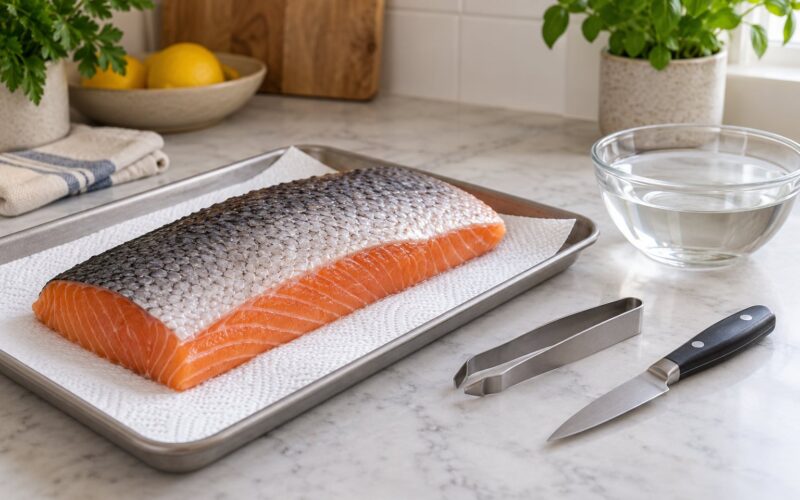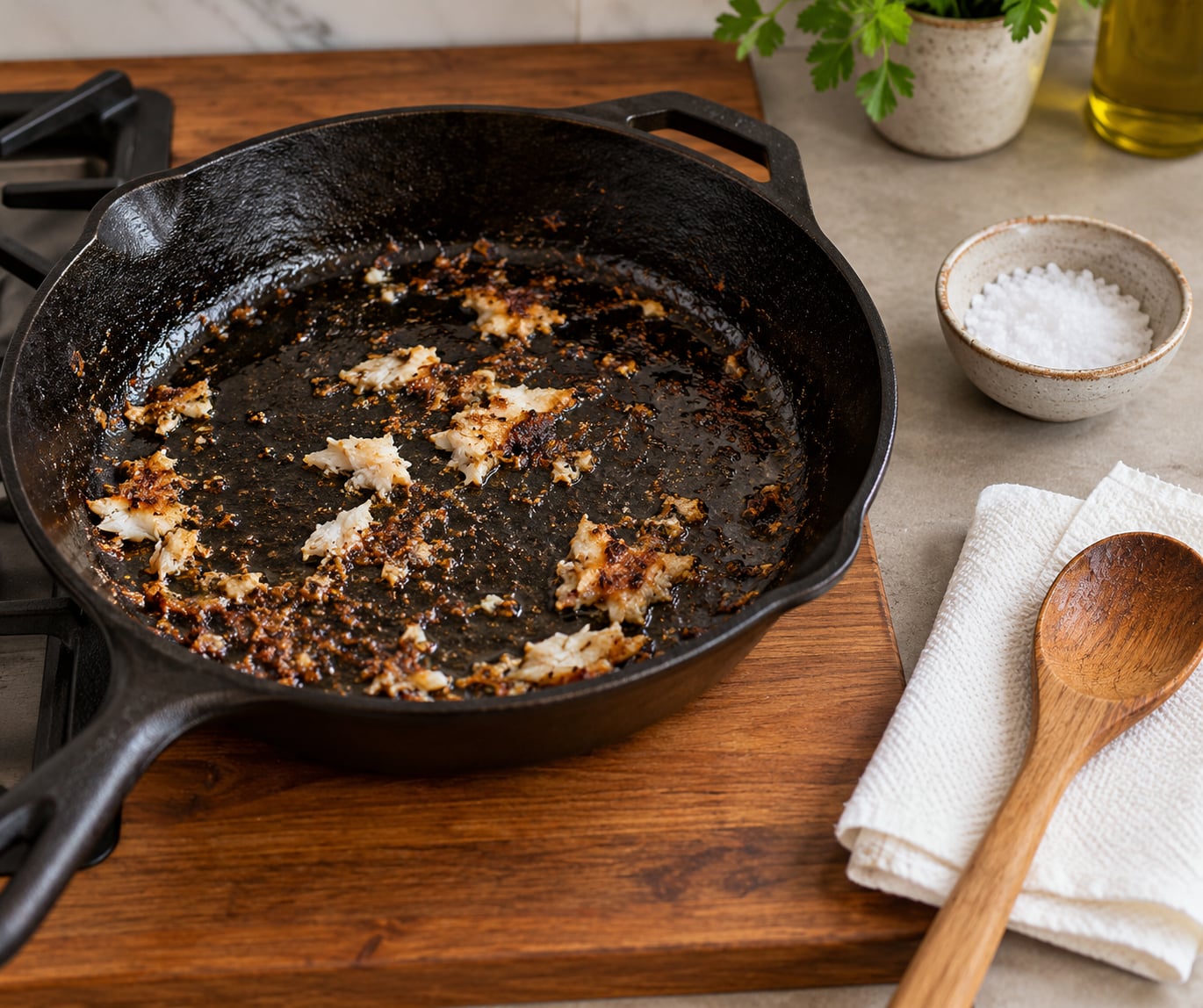
To clean cast iron after cooking fish, wash it while it is still warm with hot water and a small drop of mild dish soap, dry it completely on the stove, then wipe on a very thin coat of oil. Most pans need about ten minutes, and the whole job is easier than most people make it.
The reason fish is a special case is the oil it renders. Fish is high in omega-3 fatty acids, and those oils soak into the microscopic pores of the seasoning layer instead of sitting on top of it. Sit there long enough and they oxidize and turn rancid, and the next time the pan heats up you get a smell that no amount of scrubbing seems to touch. It can even carry into the taste of the next meal, which is where eggs usually get hit first.
So the cleaning after fish is not really a deep clean. It is a two-part job: get the pan clean and dry right away, and treat the smell separately if it is still there afterward. Trying to do both in one soaking, scrubbing session is the most common way people accidentally damage a good pan.
Whatever you do, cook your fish to an internal temperature of 145°F (63°C), and save the cleanup for when the skillet is warm rather than screaming hot. I have a Lodge pan I use for market-fresh salmon about once a week, and the routine below is what keeps it in rotation without any fuss.
Table of Contents
- What You Need
- Step-by-Step: How to Clean Cast Iron After Cooking Fish
- 1. Let the Fish and Pan Cool — But Not Cold
- 2. Remove Loose Fish and Grease
- 3. Loosen Cooked-On Residue
- 4. Remove Fish Odor and Rinse
- 5. Dry and Re-Oil the Cast Iron
- Common Mistakes
- Frequently Asked Questions
- Can I use soap to clean cast iron after cooking fish?
- Why does my cast iron skillet still smell like fish after washing?
- Is it safe to soak cast iron after cooking fish?
- What is the best way to remove burnt fish from cast iron?
- Should I re-season cast iron after every fish meal?
- Can I put a cast iron fish pan in the dishwasher?
What You Need

Gather these before you start, while the pan is still cooking. Scrambling for a brush after the water has gone cold is how stuck fish turns into a problem.
- A wooden spoon or spatula for lifting out fish before it bonds.
- Folded paper towels to wipe out rendered grease without adding water to a hot pan.
- A pan scraper or stiff-bristle brush for the cooking surface and the cookware ridges.
- Coarse kosher salt as an abrasive that costs almost nothing and rinses clean.
- A small drop of mild dish soap. Dawn and other standard dish soaps are fine here.
- Hot water and a sponge or chainmail scrubber for the actual washing.
- A neutral oil such as grapeseed, canola, or vegetable oil for the final wipe.
- An absorbent cloth or a few minutes of unused burner time for the stovetop dry.
You do not need baking soda, vinegar, or anything harsh for the routine clean. Save those for odor, and only when the smell is actually there.
Step-by-Step: How to Clean Cast Iron After Cooking Fish
1. Let the Fish and Pan Cool — But Not Cold
Turn off the heat and let the skillet sit until it is warm enough to handle with a bare hand on the handle, usually two or three minutes. You want the pan warm enough that the grease is still liquid, but not so hot that cold water hits it.
While you wait, lift out any large pieces of fish with the wooden spoon. The single biggest reduction in stuck residue happens right here, before anything cools into a crust. If a fillet is welded to the surface, slide the spoon edge underneath it and work slowly rather than prying.
Pouring cold water into a hot cast iron pan is the fastest way to guarantee a cracked or warped skillet. Cast iron has almost no elasticity, and a sudden temperature swing cracks it. Warm water into a warm pan is fine. Cold water into a cold pan is fine too.
2. Remove Loose Fish and Grease
Fold a paper towel and wipe the pan out while it is still warm. One pass with a dry towel pulls off most of the rendered fish oil, and that oil is the main thing you do not want to leave behind.
Pay attention to the rim and the helper handle, where oil collects and where the seasoning layer tends to be thinner. Pour that grease into the trash rather than the sink if it is a lot of it, since fish oil can clog a drain.
At this point the pan should look bare metal with a dark, even seasoning color. If there are still chunks of fish, keep going with the spoon before you add any water.
3. Loosen Cooked-On Residue
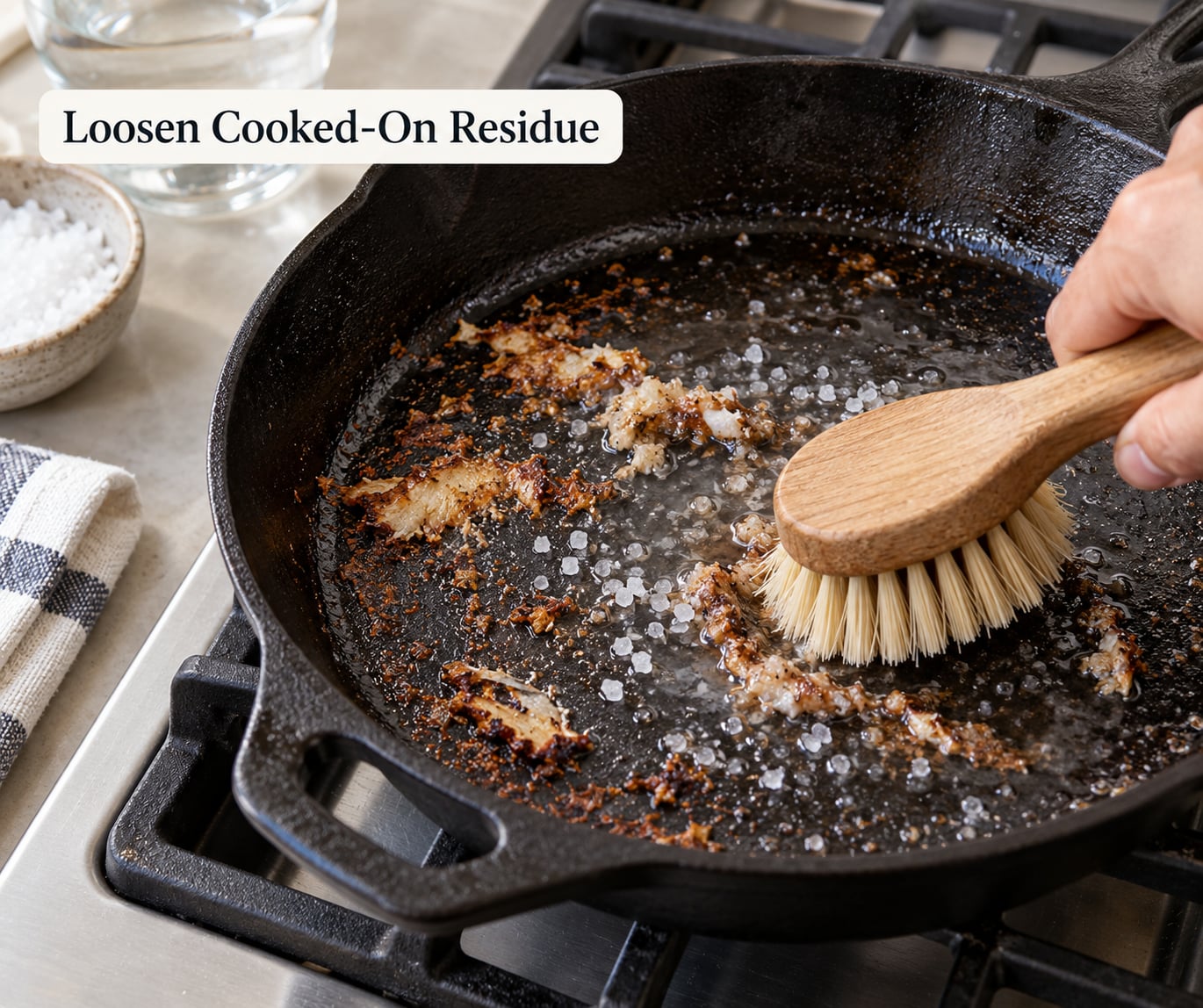
How to clean cast iron after cooking fish is mostly decided in this step, and the simplest fix for stubborn residue is a handful of coarse kosher salt and a splash of water. Rub it around with your fingers, a stiff sponge, or a chainmail scrubber until the brown bits lift.
Scrub in circles across the whole cooking surface, then along the ridges and the pour spouts where carbon collects. The salt does the grinding, the water carries the debris away, and unlike steel wool it will not strip a healthy seasoning layer.
If the fish has burnt onto the pan and salt is not shifting it, add a small squirt of oil instead of more force. Let the oil sit on the warm surface for a minute, then scrub. Boiling a little water in the pan for a few minutes loosens the same residue, and a splash of red wine does the job while leaving the seasoning more intact than vinegar would.
Keep the pressure light. You are removing food, not trying to polish out every mark, and grinding the seasoning down to bare metal means a re-season from scratch later.
4. Remove Fish Odor and Rinse
Rinse the pan with hot water and a small drop of mild dish soap, then scrub with a sponge or stiff brush until the water runs clear. Yes, mild dish soap is safe on cast iron. The idea that soap destroys seasoning comes from old lye-based formulas; modern soap is mild enough that a single drop will not touch a polymerized oil film.
Soap will not fix odor on its own, though. If the pan still smells after the rinse, work in one of these while the pan is still warm, and stop as soon as the smell goes:
- Coarse salt overnight. Fill the dry pan with a layer of coarse salt, leave it in the pan or in a sealed bag overnight, then tip it out and wipe the surface dry. Salt pulls moisture and the lighter odor compounds out of the seasoning.
- Baking soda. Add a couple of tablespoons, a splash of water, and a five-minute simmer on the stove. Baking soda is mildly alkaline and lifts the last traces of grease.
- Vinegar steam. A 50/50 mix of water and white vinegar, brought to a gentle boil for two or three minutes only. Vinegar is acidic, and more than a brief simmer starts to bite at the seasoning.
- Dry heat burn-off. Empty the pan over a medium flame for 15 minutes, or in a 400°F (204°C) oven for 10 to 15 minutes. This is the one method that works on odor trapped deep in the pores.
The oven option is the one to know about. Fish odor comes from amine compounds that boil off around 200 to 250°F, and from oxidized fatty acids that vaporize above 350°F. A 400°F oven clears both, and it beats the stovetop version because it does not stink up your kitchen. Ventilate, and do it when you are not trying to keep a pan finish you like, since a long hot burn can darken the surface.
Do not soak the pan. Ten minutes of hot water is one thing, and leaving a skillet submerged overnight is how you get orange rust spots inside a seasoned pan.
5. Dry and Re-Oil the Cast Iron
Set the pan back on a warm burner for a minute or two until every drop of moisture has gone. You want it dry to the touch, not just dry on the surface, and running a folded towel along the inside catches the last damp patch in the ridges.
While the pan is still barely warm, pour a small pool of neutral oil into it and wipe it around with a paper towel until the surface looks dry. Most people put on too much. A properly seasoned pan feels dry with a faint sheen, not tacky and not slick.
Grapeseed, canola, and avocado oils all work because they are high in unsaturated fats that polymerize into a hard, nonstick film. Skip olive oil for daily use, since its high polyunsaturated content goes rancid in the pan and that is the exact problem you are trying to undo.
Store the pan somewhere cool and dry, upright or stacked with a paper towel between pans if you nest them. A thin film of oil on bare cast iron is what prevents rust, and rust is the only thing on this list that is genuinely hard to undo without stripping the pan.
Common Mistakes
Almost every ruined pan I have seen came from one of these habits rather than from anything complicated.
- Soaking the skillet. Water sitting in the pores for hours lets rust form under the seasoning. Rinse and scrub instead.
- Running thermal shock. Cold water into a hot pan can crack or warp cast iron. This one is genuinely dangerous to the cookware.
- Steel wool by default. A chainmail scrubber or coarse salt handles stuck fish. Bare steel wool belongs to a full strip and re-season, not to a Tuesday night fish dinner.
- Storing the pan damp. Water trapped in the cookware ridges is the number one cause of rust spots. Dry it on the burner, every time.
- Heavy dish soap and leaving it sitting. A rinse-and-scrub with a small drop is fine. A pan sitting in soapy water for an hour is the version to avoid.
- Oiling too thick. A heavy coat goes gummy, then sticky, then flaky, and the next thing you cook sticks worse than before.
- Harsh degreasers or the dishwasher. Neither has any place near cast iron, and the dishwasher cycle strips seasoning and invites rust.
Two smaller habits matter more than most people expect. The first is cooking eggs next: heat the empty pan for a minute and smell it before you crack anything in, and if the pan still smells fishy, go straight to the burn-off step rather than hoping the smell will hide under butter.
The second is prevention, and the best trick I know comes from people who cook over campfires. Line the cooking surface with baking parchment before the fish goes in. It costs nothing, it keeps the omega-3 oil out of the seasoning entirely, and you toss the paper afterward instead of scrubbing protein out of your pan. A liner is also the simplest fix if you are out at a fire with no sink and only a scrap of water.
One more thing worth knowing: not every odor means damage. A sticky, tacky pan with black patches is flaking oil buildup rather than lost seasoning, and a grey, dull, rough pan is more likely genuinely stripped. Odor on its own is almost always fixable with heat, so re-seasoning is rarely the answer. A full strip is worth doing only when the seasoning is already grey and flaky all over, or when rust has set in.
Frequently Asked Questions
Can I use soap to clean cast iron after cooking fish?
Yes. A small drop of mild dish soap with hot water will not damage a healthy seasoning layer. The old rule against soap came from lye-based formulas that are no longer made. Scrub, rinse, and dry the pan right away, and re-oil it thin.
Why does my cast iron skillet still smell like fish after washing?
Because the smell is usually in the seasoning, not on the surface. Fish oil soaks into the microscopic pores of the polymerized layer and oxidizes there. Washing removes the grease you can see. Clearing the odor needs dry heat, such as 15 minutes over a medium flame or 10 to 15 minutes in a 400 degree oven.
Is it safe to soak cast iron after cooking fish?
No, and it is the mistake worth avoiding. Hours of standing water let rust form in the pores and under the seasoning, which is far harder to fix than stuck food. A few minutes of hot water to loosen residue, then scrub, does the same job without the rust risk.
What is the best way to remove burnt fish from cast iron?
Coarse kosher salt with a splash of water, scrubbed in circles with a stiff sponge or chainmail scrubber. If the burnt crust will not budge, put a small amount of oil in the warm pan, wait a minute, then scrub. A short simmer of water loosens the same residue without any abrasion at all.
Should I re-season cast iron after every fish meal?
No. Every clean needs a thin coat of oil, but a full re-season is only needed when the seasoning is grey, rough or flaking, or when rust has appeared. Odor alone is not a reason to strip the pan, because heat clears the smell without touching the seasoning layer.
Can I put a cast iron fish pan in the dishwasher?
Skip the dishwasher. The long soak, the harsh detergent and the slow drying all work against seasoning and leave the pan vulnerable to rust. The cycle is short compared with hand washing: hot water, a little soap, a scrub, a burner for drying and a wipe of oil.
Start with the part that takes five minutes: let the pan cool to warm, lift out the fish, wipe out the grease with a paper towel, scrub with coarse salt and hot water, dry it on the burner, and wipe on a thin coat of oil. That is how to clean cast iron after cooking fish the right way, and the smell rarely survives it.